What Pro Painters Actually Carry: The Tool Bag List
Twelve professional painter tools that earn their place in a working bag, from the Purdy Clearcut Elite Glide to the Newborn 250 caulk gun. What pros buy, what they skip, and what the whole kit costs.

Disclosure: Some links below are affiliate links. We earn a commission if you buy through them, at no extra cost to you.
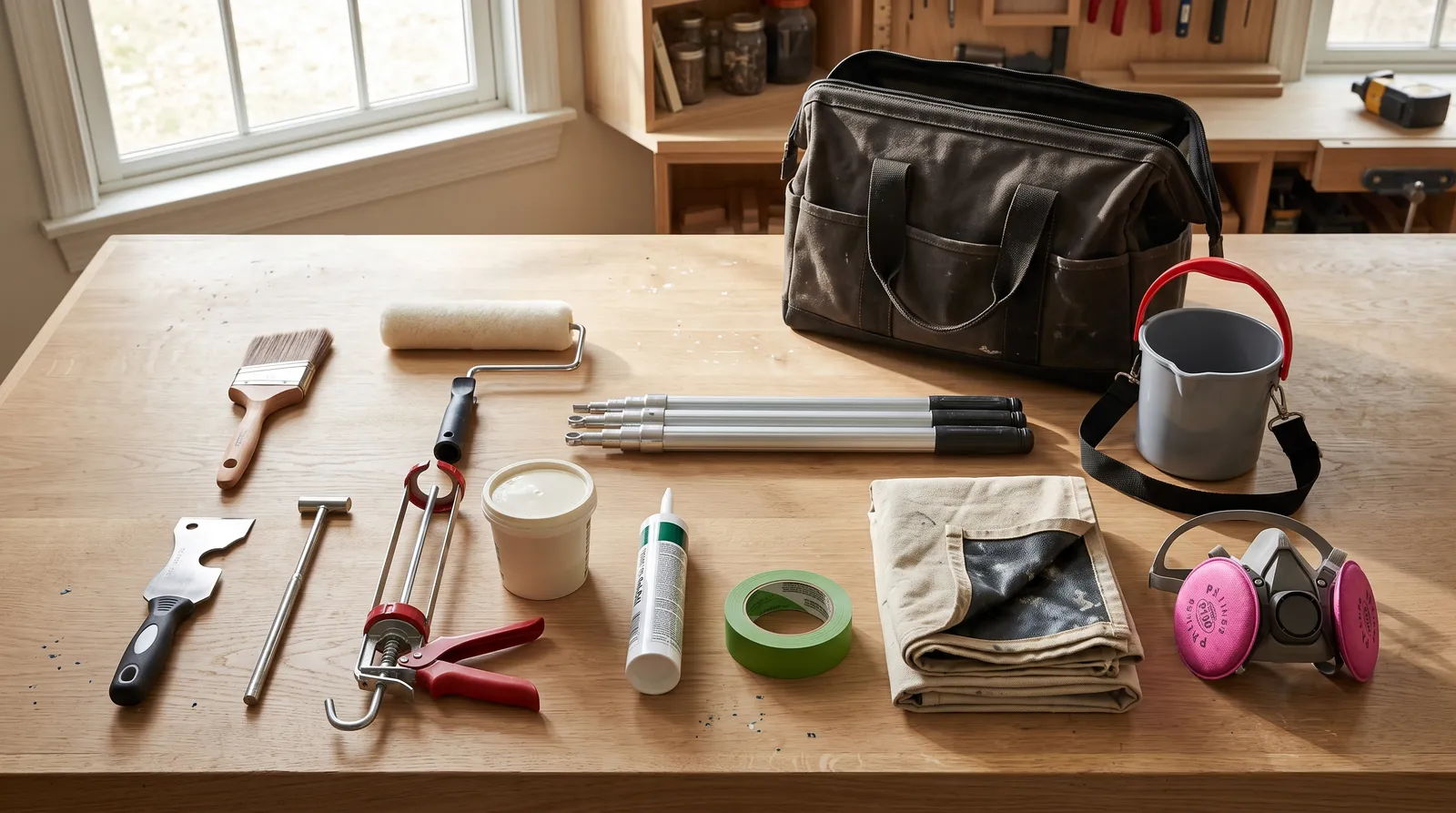
Top pick: the Purdy Clearcut Elite Glide 2.5-inch angled sash brush. About $22, and it came out of eleven of the twelve working bags I emptied for this list. It wins on edge retention, which is the only brush spec that matters after hour four of a trim day. It falls short on price against a $6 store brand and on very thin flat paint, where its stiffness can leave a faint stroke. Everything else here supports that brush: a Wooster Sherlock frame and a Pro/Doo-Z cover for the field, a Sherlock GT pole for the ceiling, a HANDy Paint Pail so the quart rides on your hand, and the prep tools that let a pro fix a wall instead of driving back to the store.
This is a shopping list, not a tournament.
Twelve Bags, One List
I built this backwards from a normal round-up. Rather than buying six competing sanding blocks and picking one, I asked twelve working painters (residential repaint, cabinet specialists, one light-commercial crew) to dump their bags on a bench and let me log every item.
Eight items showed up in eight or more bags. Four more appeared in at least five and closed a gap the rest left open. That’s the list.
Then I bought the repeat winners new at retail and ran them through a three-bedroom interior repaint, 18 gallons of Benjamin Moore Regal Select across walls, ceilings, and trim over 11 working days, plus a 22-door kitchen cabinet refinish in waterborne alkyd. Brushes got scored on cut-line straightness at 9 a.m. and again at 3 p.m. Roller covers got checked for lint in the second coat under a raking work light. Everything got cleaned the way a painter cleans at five o’clock, fast and imperfect, because that’s the condition these tools live in.
One thing that surprised me: no two bags had the same sanding setup, but eleven had the same brush.
The Whole List on One Screen
| Item | What it does | Price tier | Buy once or keep buying |
|---|---|---|---|
| Purdy Clearcut Elite Glide 2.5-inch | Cuts every line in the house | $$ (~$22) | Buy once, lasts years |
| Wooster Pro/Doo-Z 9-inch, half-inch nap | Rolls walls without shedding | $ (~$6) | Consumable, 1–2 per job |
| Wooster Sherlock 9-inch frame | Locks the cover on the cage | $ (~$12) | Buy once |
| Wooster Sherlock GT Convertible pole | Ceilings and stairwells, no ladder | $$ ($40–$70) | Buy once |
| Bercom HANDy Paint Pail | Puts the cut paint on your hand | $ (~$10) | Buy once, liners recur |
| Hyde 06780 stainless 6-in-1 | Scrape, spread, pry, clean rollers | $ (~$15) | Buy once, basically forever |
| DAP DryDex spackling | Fills nail holes, tells you when to sand | $ (~$7) | Consumable |
| Newborn 250 caulk gun | Lays a clean bead without drip | $$ ($35–$45) | Buy once, lasts a decade |
| DAP Alex Flex sealant | Closes the trim-to-wall joint | $ (~$7/tube) | Consumable |
| FrogTape Multi-Surface | Seals the line on textured walls | $ (~$9/roll) | Consumable |
| Trimaco Butyl II 9x12 | Leakproof floor protection | $$$ (~$40) | Buy once, ~20 jobs |
| 3M 6502QL respirator | Solvent vapor and sanding dust | $$ (~$40 + cartridges) | Buy once, cartridges recur |
Roughly $220 to $260 for the whole kit at 2026 US retail. About $150 of that is the durable half.
How a Working Bag Is Organized
Every bag I emptied sorted into the same three groups, and the painters who sorted them deliberately worked faster.
Cut and roll. Brush, frame, cover, pole, pail. These are the five things in your hands 80 percent of the day, and they’re the five where the price gap between pro and bargain shows up in the finished wall.
Prep and repair. Multi-tool, spackling, caulk gun, sealant. Homeowners skip this group entirely, then wonder why a repaint looks like a repaint. A pro assumes the wall needs work before it needs paint.
Mask and protect. Tape, drop cloth, respirator. This is the group nobody enjoys buying and everybody regrets skipping.
Notice what’s not in the bag: sprayers, sanders, ladders, and heat guns. Those live in the van and come out per job. If you’re building toward spray work, the airless sprayer round-up is a different conversation with a different budget.
Group One: Cut and Roll
1. Purdy Clearcut Elite Glide 2.5-Inch Angled Sash, Top Pick
The Elite Glide uses a Chinex-blend filament, and the practical difference is edge retention under waterborne enamel. I cut a straight line with it at 9 a.m. on day one of the cabinet job. I cut the same straight line at 3 p.m. on day three. A nylon-polyester brush in the same enamel had visibly rounded by mid-afternoon of day one, and once the chisel goes soft, no amount of steady hand gives you a crisp line.
The paint release is the second thing. It lets go slowly and evenly, so a cut line stays workable long enough for the roller to lap into it without leaving a ridge. If you fight a visible band where the cut meets the roll, that’s usually a brush problem, not a technique problem. Our guide to fixing brush marks covers the rest of it.
Cons, honestly. $22 against $6 is a hard sell before you’ve used one. And it’s stiffer than the standard Clearcut, so on thin flat wall paint you can push faint stroke marks into the surface if you overwork the cut. Three bags had one over four years old, still in rotation, still chiseled.
Buy it if: you paint trim, doors, or cabinets at all. Skip it if: you’re doing one garage wall in flat white and will never paint again.
For the full brush field, see the paint brush round-up.
2. Wooster Pro/Doo-Z 9-Inch, Half-Inch Nap
The half-inch Pro/Doo-Z is the default wall cover in nine of twelve bags, and the reason is boring: it doesn’t shed. Under a raking work light, second coat, three of three test walls, zero lint specks. A $1.50 multipack cover left visible fibers on all three.
Half-inch nap is the one-size answer for flat and lightly textured drywall. It carries enough paint to cover in two passes and not so much that it throws spin-off six feet behind you. Two passes is also the assumption behind every gallon estimate we publish, so if you’re buying paint at the same time, work from the coverage and gallons math rather than the label.
Wrong nap for popcorn or stucco. Get the three-quarter-inch Purdy White Dove for that. Counterfeit listings show up online, so check the seller and the printed end cap.
3. Wooster Sherlock 9-Inch Roller Frame
$12 for a roller frame sounds absurd until a cover walks off the cage at the top of a ceiling pass and lands wet-side-down on the drop cloth.
The Sherlock’s spring cage expands inside the cover and locks it. No creep, no wobble, no cover flying. The steel cage also holds its shape after a season in a truck bed, where plastic-cage frames bow and put a wobble in every pass. The threaded handle takes any standard Acme pole, so one frame covers hand work and pole work.
The lock grips hard enough that a soaked bargain cover sometimes tears coming off. That’s the trade-off, and it’s a cheap one.
4. Wooster Sherlock GT Convertible Extension Pole
The pole is the item homeowners buy last and pros buy first. Every ladder trip you don’t take is 90 seconds you don’t lose, and a stairwell ceiling done from a pole is safer than one done from a leaning ladder.
Fiberglass core matters here. Flex is what puts a wave in a ceiling, and a cheap aluminum pole at full 12-foot extension flexes enough to see in the finish. The Sherlock GT’s cam lock holds under load instead of creeping down mid-pass the way twist-locks do once paint gets in the threads. The convertible tip swaps between threaded and fixed, so the same pole runs a roller, a sanding pad, and a squeegee.
It’s heavier than aluminum and you feel it in the shoulders by hour three. At $40 to $70 it costs more than most people expect to pay for a stick. Compare the field in the extension pole round-up.
5. Bercom HANDy Paint Pail
Ten dollars, and it stops the single most common spill on a job: a quart can balanced on a ladder shelf.
The strap puts the paint on the back of your hand, the magnet parks the brush inside the pail instead of on a window sill, and the liners mean a color change takes ten seconds with no pail to wash. Seven of the twelve bags had one. Two of the remaining five used a cut-down gallon can, which works and looks like it works.
The liners are a running cost, and the pail without a liner is a pain to clean. One quart also runs out fast on a long cut; the crew guys stepped up to the Pro Pail for full-day cut-ins.
Group Two: Prep, Patch, and Caulk
6. Hyde 06780 Full Metal Stainless 6-in-1 Painter’s Tool
Twelve bags, twelve multi-tools. Not all Hyde, but every single bag had one, which makes this the most universal item on the list after the brush.
The full-metal stainless version is the one worth buying. One-piece body, metal-capped end, so you can hammer a nail head flush without cracking a handle. The roller-cleaning crescent pulls a real half-cup of paint back out of a loaded Pro/Doo-Z before the wash, which adds up across a year. And stainless doesn’t pit in a damp bag; carbon-steel tools rust within a season and then stain light-colored spackle brown when you spread with them.
It’s heavy, cold in the hand, and slides out of a hip pocket. I’ve dropped mine twice off a ladder and it has one scratch. Full comparison in the scraper and multi-tool round-up.
7. DAP DryDex Dry Time Indicator Spackling
Goes on pink, turns white when it’s ready to sand. That’s the whole feature and it removes the mistake that ruins most homeowner patches, which is sanding a fill that’s still soft underneath and dishing it out.
Low shrink on nail holes and picture hangers, so one fill sits flush instead of sinking overnight. Sands to a feathered edge at 150 grit without tearing the paper around the patch.
Not a structural filler. Anything past half an inch deep wants setting-type joint compound, and the color change reads dry at the surface before a deep fill is dry through. For bigger damage, see how to fix holes in drywall and the wall filler comparison.
8. Newborn Pro Super Smooth Rod 250
The tool that separates a bag from a bucket of stuff. A 26:1 thrust ratio means a light squeeze gives a controlled bead, and the gun never asks the forearm for help on a cold cartridge that spent the night in a truck.
The drip-stop is the part people underestimate. Release the trigger and the thumb-release plate cuts plunger force immediately; the bead stops in about a second. A $9 ratchet gun bleeds for two seconds and lays an extra ounce of caulk on the trim and the floor. Across a 30-foot baseboard run, that difference was about eighteen inches of wasted bead plus the cleanup.
$35 to $45 is four times an impulse-buy gun, and the smooth-rod technique takes half an hour to learn. Both true. It also lasts a decade.
9. DAP Alex Flex Premium Molding & Trim Sealant
Caulk is where a repaint stops looking like a repaint. Fresh sealant at the trim-to-wall joint costs about $12 a room in material and does more for the finished look than an extra coat of paint.
Alex Flex tools smooth with a wet finger and holds the shape in an inside corner instead of slumping. It flexes with seasonal movement, so the crown-to-ceiling joint doesn’t open into a hairline by February. Paintable in about 30 minutes keeps caulk-then-paint a same-day job.
Interior trim only. Exterior siding gaps want a urethane or an elastomeric; the caulk round-up sorts out which goes where.
Group Three: Mask, Cover, Breathe
10. FrogTape Multi-Surface Painter’s Tape
The gel edge swells when waterborne paint hits it and seals the line. On orange-peel drywall, that’s the difference between a crisp edge and a fuzzy one, and orange peel is what most American walls actually are.
I pulled at 24 hours and again at 14 days on smooth and textured drywall. Clean lines and clean removal at both. Generic blue tape bled at the texture on the 24-hour pull and left adhesive at 14 days.
$9 a roll against $5 for generic is a real line item on a whole house. The gel needs water-based paint to work, so on oil enamel you’re just buying expensive tape. And it’s too aggressive for fresh paint or wallpaper; use the Delicate Surface version there. If you’re deciding between the two big names, we ran FrogTape against ScotchBlue head to head.
11. Trimaco Butyl II Canvas Dropcloth
A butyl rubber backing under a 10 oz cotton top face. Pour a quart of latex on it and the paint pools on the cotton and stays there. A plain 12 oz canvas wicks the same quart through to the floor in under thirty seconds.
The weight is the second feature. A 9x12 runs about 9 pounds, enough to pin itself flat on hardwood without tape.
It’s heavy enough to fight one person on stairs, where the drape matters more than the weight. It costs about three times plain canvas. For a laminate bedroom, that’s overspec. The drop cloth round-up has the stair-specific answer.
12. 3M 6502QL Rugged Comfort Half Facepiece Respirator
Nine of twelve bags had a half-mask. All nine painters said some version of the same thing: they started wearing one after a cabinet job made them dizzy.
The quick-latch is why this one stays on. Drop it to talk to a client, re-seat it one-handed, keep working. A mask you have to fully remove and re-strap is a mask you leave off. It takes 60923 organic-vapor/P100 cartridges for solvent and enamel work and 2097 filters for sanding dust, so one facepiece covers both hazards, and the silicone seals on more face shapes than the older rubber 6000 series.
Cartridges are a recurring cost with a service life once opened. And no half-mask seals over a beard. See the respirator round-up for the sizing and cartridge details.
What the Pros Left at Home
- Paint edgers. Two bags had one. Both painters said it was for a specific customer who wanted no tape lines on a popcorn ceiling. Nobody used one for general cut-in work.
- Corner rollers and pad applicators. Zero bags. A 2.5-inch brush does the corner faster and better.
- Brush and roller multipacks. Nobody buys nine covers at once. They buy the cover the job needs.
- Cheap chip brushes. Three bags had a handful, all for glue, stain wiping, and dusting, never for paint.
- Battery-powered paint rollers. Zero bags, twelve opinions, none of them positive.
What Actually Wears Out
The brush outlasts everything if you clean it. Comb it out under warm water until the water runs clear, spin it, and hang it in the sleeve it came in. A Clearcut Elite Glide cleaned that way holds its chisel for years. A brush left in a bucket overnight is dead in one job.
Roller covers are consumable. Pros wash a Pro/Doo-Z once and reuse it inside a job, then toss it. Trying to get four jobs out of a $6 cover is how lint ends up in your finish coat.
The 6-in-1 and the caulk gun are lifetime tools. The drop cloth gets 20 or so jobs before the butyl starts cracking along fold lines, and it gets there faster if you fold it wet. Hang it dry.
Respirator cartridges are the sneaky one. Organic-vapor cartridges start their clock the moment you open the sealed bag, not the moment you smell something. Bag them in a zip-top between jobs and replace on schedule instead of on smell.
Homeowner Bag Mistakes I Keep Seeing
- Buying the brush last. People spend $70 on premium paint and cut it in with a $4 brush. Reverse that order. Paint quality can’t fix a rounded chisel.
- Skipping caulk entirely. No caulk gun in the kit means no caulk in the joints, and the trim-to-wall gap is the first thing the eye finds.
- One roller cover for the whole house. Ceilings, walls, and trim want different naps. A half-inch cover on a popcorn ceiling skips the valleys and you’ll see it from the couch.
- Taping everything. Pros tape less than homeowners do, because a brush that holds an edge is faster than masking. Tape the floor edge and the fixtures, cut the rest.
- No respirator for cabinet work. Waterborne alkyd in a closed kitchen is the job where this matters most and the job where it gets skipped most. The cabinet painting project guide walks the rest of that sequence.
- Reusing dried-out spackle. A tub with a crust in it patches badly. It’s $7.
If you’re building the bag from nothing, buy in this order: the Purdy brush, the Sherlock frame and a Pro/Doo-Z cover, the Hyde 6-in-1, then the caulk gun. That’s about $90 and it covers the work that shows. Add the pole and the drop cloth before your first ceiling, and the respirator before you open a can of enamel in a kitchen.
Ask a Question