Best Extension Poles for Painting in 2026
Five painter's extension poles tested on ceilings, stairwells, and exterior siding. Top pick: Wooster Sherlock GT Convertible — and where each one earns its price.

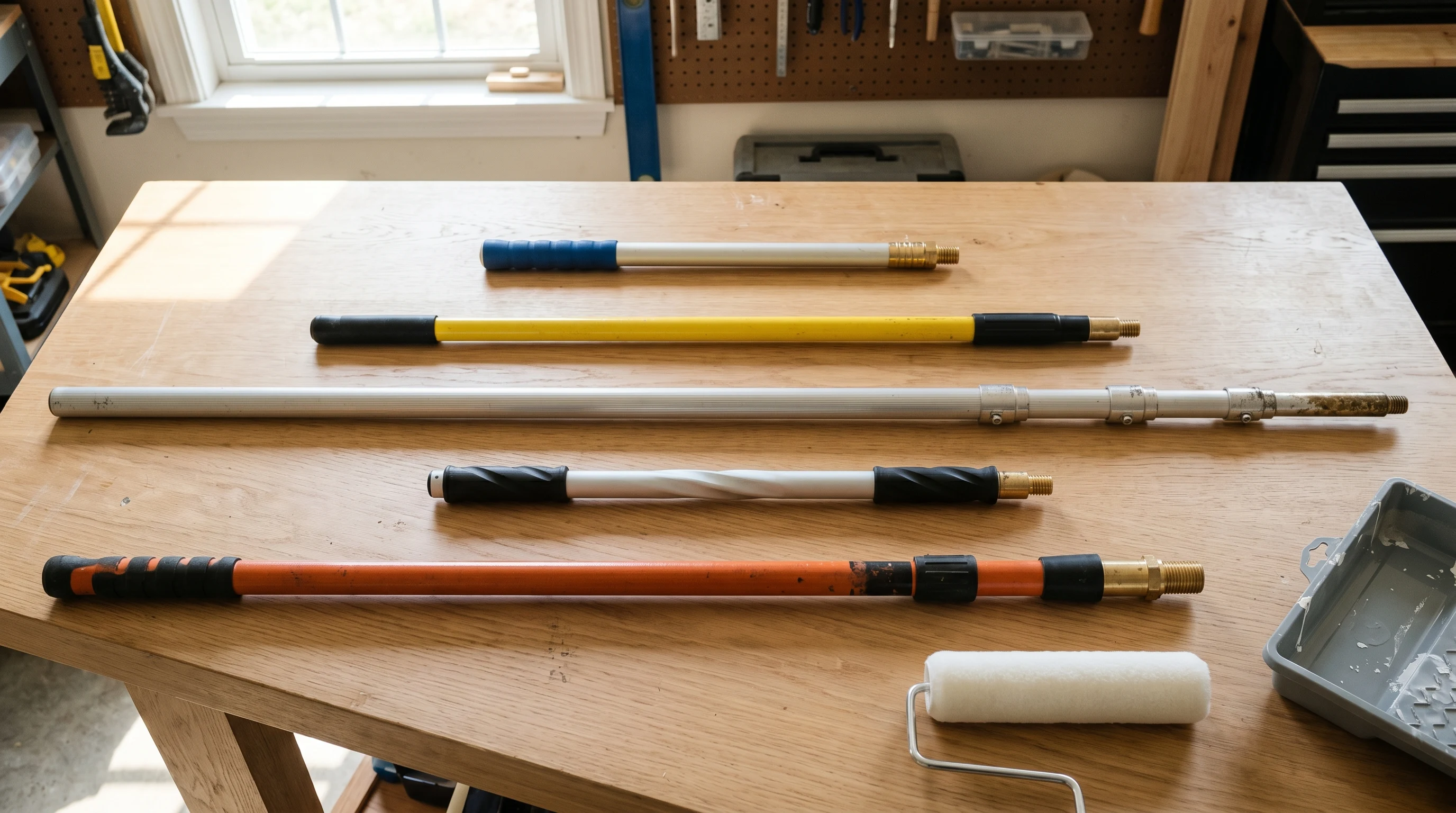
Disclosure: Some links below are affiliate links. We earn a commission if you buy through them, at no extra cost to you.
Top pick: Wooster Sherlock GT Convertible. About $25–$45 depending on length, fiberglass shaft, lever-lock collar that holds a 1-gallon-loaded roller overhead without creep. It wins on lock security and shaft stiffness, the two specs that matter when you’re rolling a ceiling with a wet 3/4“ nap above your head. It falls short on weight (fiberglass is heavier than aluminum) and on price (twice a generic twist-lock). For a lighter pole that costs half as much, the Mr. LongArm Twist-Lok is the smart-money pick. For heavy contractor abuse and the stiffest shaft in the test, Purdy Power Lock. For reaching a two-story soffit from the ground, the Wooster Acme 6-to-12’. For a one-room weekend job where you’d toss the pole if it broke, the Bates Choice is the budget answer.
There is no single right extension pole. Most homeowners do best with two: a 2-to-4-foot for walls and rooms, a 4-to-8-foot for ceilings and stairwells.
The Shortlist and How We Got There
Five poles, four real projects, six weeks of testing. A 10-foot living room ceiling in Behr Marquee Ceiling. A popcorn-textured master bedroom ceiling. An interior stairwell up to a 16-foot cathedral ceiling. The second-story south face of a vinyl-sided shed in Sherwin-Williams Duration exterior. Every pole carried a 9“ roller frame loaded with a 3/4“ nap full of paint, held overhead for 30-minute continuous sessions, then through a full second coat.
The two specs that separated the field were lock slip and shaft flex. We marked the inner shaft on every pole with a Sharpie and checked creep at 10-minute intervals. The Sherlock GT and Power Lock didn’t move. The Bates budget pole slipped about half an inch in the first ten minutes and another quarter inch by twenty. That’s the difference between a clean ceiling and a wobble line.
Five axes, weighted in this order: lock security under overhead load, shaft stiffness at full extension, weight at length, threaded-tip compatibility, and grip comfort over a 45-minute session.
How to Pick an Extension Pole
Length: Match It to the Job, Not to the Spec Sheet
The temptation is to buy the longest pole on the shelf and figure it covers everything. It doesn’t. A 6-to-12-foot pole is heavy and unwieldy in an 8-foot bedroom, and a 2-to-4-foot pole is useless on a cathedral stairwell ceiling.
2-to-4-foot. Standard 8-foot interior ceilings, walls, trim. The pole most homeowners actually need.
3-to-6-foot. The same job at 9-to-10-foot ceilings. Big-box “great room” interior walls.
4-to-8-foot. Stairwells, vaulted ceilings, one-story exterior soffits, garage interiors. The pole the Sherlock GT is most often bought in.
6-to-12-foot. Two-story exterior siding from ground level. The pole the Acme owns.
8-to-16-foot. High gables, commercial work, anywhere a ladder is unsafe. Specialty.
Buy the shortest pole that reaches your tallest realistic job. Long poles are heavier, bow more under load, and live in the garage longer.
Lock Type: Lever Versus Twist
The lock is what separates a $20 pole from a $40 pole.
Lever locks clamp the inner shaft with a cam-operated collar. You flip the lever, the inner shaft slides, you flip the lever back, the cam bites. Holds under sustained overhead load. The Wooster Sherlock GT and Purdy Power Lock both use it.
Twist locks spin the inner shaft a quarter-turn against an internal cam. Lighter, simpler, fewer parts to break if you drop the pole. Loosens under sustained overhead load if you didn’t crank it. The Mr. LongArm Twist-Lok is the best execution of this style; the Bates budget pole is the worst.
For a 20-minute ceiling session over your head, the lever lock pays for itself the first time it doesn’t slip mid-stroke. For walls, trim, and quick jobs, the twist lock is fine.
Shaft Material: Fiberglass Versus Aluminum
Fiberglass is stiffer, heavier, and survives drops. Aluminum is lighter, more flexible, and dents.
The flex test was the clearest spec in the round-up. We extended each pole to its full length, threaded on a 9“ roller frame loaded with a 3/4“ nap and roughly 1.5 lb of wet paint, and held it horizontal against a level reference. The Sherlock GT and Power Lock bowed about an inch at the loaded end. The Twist-Lok bowed two inches. The Bates pole bowed about three. That extra two inches of bow translates to a roller that won’t sit flat against the ceiling, which leaves a thin streaked line down the middle of every stroke.
For ceilings and overhead work, fiberglass is worth the weight. For walls and rooms, aluminum is lighter and the flex doesn’t matter because the wall pushes back against the roller.
The Threaded Tip Is Not Optional
The US standard is the Acme thread, a coarse spiral pattern that mates with every major roller frame, mini-roller, brush adapter, and window squeegee. Every premium pole in this round-up uses it. The Bates budget pole uses a plastic version of the same thread, which works but wears faster.
Avoid any pole with a proprietary tip. The savings on the pole vanish the first time you discover none of your roller frames fit it.
Comparison at a Glance
| Brand / Model | Lock | Shaft | Length range | Best for | Price |
|---|---|---|---|---|---|
| Wooster Sherlock GT Convertible | Lever | Fiberglass | 2-to-4’ through 6-to-12’ | Top pick, ceilings, stairwells | $$ |
| Mr. LongArm Twist-Lok | Twist | Aluminum | 2-to-4’ through 8-to-16’ | Lightweight rooms and walls | $ |
| Purdy Power Lock | Lever | Fiberglass | 2-to-4’ through 6-to-12’ | Heavy-duty contractor use | $$ |
| Bates Choice Telescoping | Twist | Aluminum | 5-to-12’ | One-room weekend budget | $ |
| Wooster Acme | Twist | Fiberglass | 4-to-8’ through 8-to-16’ | Two-story exteriors | $$ |
The Sherlock GT is the only pole that wins on both shaft stiffness and lock security. Power Lock matches it on both but costs more and weighs more. Twist-Lok wins on weight. The Acme wins on length. The Bates wins on price and nothing else.
1. Wooster Sherlock GT Convertible, Top Pick
The Sherlock GT is the pole that doesn’t make you think. Fiberglass shaft, lever lock, brass Acme-threaded tip. The lock holds a loaded 9“ roller against a 10-foot ceiling for 30 minutes without creep. We marked the inner shaft with a Sharpie line, started a ceiling pass, and the line hadn’t moved at the end of the session.
Shaft flex on the 4-to-8’ loaded with a 3/4“ nap was about an inch at full extension — half what the aluminum poles bow. The roller sits flat against the ceiling, the wet edge stays consistent, no wobble lines. After four full ceilings, the lever throw is still tight; no play, no rattle.
Where it loses is weight. The 4-to-8’ Sherlock GT weighs about 1.8 lb empty; the same length in aluminum is closer to 1 lb. On a 45-minute ceiling session, that 0.8 lb compounds. The other knock is the lock parts. The lever and a couple of clamp components are plastic. We dropped the pole from full extension onto a concrete driveway and the lever survived with a scuff, but I’d be careful with the 6-to-12’ version on a worksite.
| Spec | Value |
|---|---|
| Lock | Lever-clamp collar |
| Shaft | Fiberglass |
| Tip | Brass Acme thread |
| Lengths | 2-to-4’, 3-to-6’, 4-to-8’, 6-to-12’ |
| Approx. price | $25–$45 |
Buy it if: you paint ceilings, you want one lever-lock pole that handles 90% of your work, and you’ll spend an extra $15 to never have a pole slip on you again. Skip it if: you’re rolling walls in short bursts and weight matters more than lock security.
2. Mr. LongArm Twist-Lok, Best Lightweight Pole
The Twist-Lok is the pole I hand a homeowner painting their first apartment. Aluminum shaft, twist lock, Acme tip. About half the weight of the Sherlock GT at the same length. The twist lock holds well enough for walls, trim, and short-burst ceiling work. It also costs about half what the lever-lock poles cost.
The trade-off is the lock. On a sustained overhead ceiling pass, the twist lock loosens if you didn’t crank it down hard at the start. We had to re-tighten the 4-to-8’ twice during a single bedroom ceiling. Not a failure, but enough of a hassle that for serious overhead work the Sherlock GT is the upgrade.
Aluminum shaft flexes more than fiberglass. At full extension on the 6-to-12’, the loaded roller bows visibly. For walls that’s a non-issue; for ceilings under raking light, it shows as a faint stipple track in the second coat.
The knockoffs are the real warning. A bunch of “twist-lok” listings on Amazon are unbranded clones with worse internals than the real Mr. LongArm. The packaging looks identical. Buy from a paint store or check the seller carefully on Amazon.
Buy it if: you want a light pole for walls and short ceiling work and you’ll happily re-tighten every ten minutes. About $18–$25. Skip it if: the job is a 16-foot stairwell ceiling and you can’t reach the lock without coming down a ladder.
3. Purdy Power Lock, Best Heavy-Duty Pole
The pole I’d hand a working contractor. Fiberglass shaft, lever lock with metal internals where the Sherlock GT has plastic, the stiffest shaft in the round-up. At full extension on the 4-to-8’ loaded with a 1“ nap full of exterior acrylic, the Power Lock bowed less than the Sherlock GT. The roller sits dead flat against the surface.
We dropped this pole on a concrete driveway from full leaning extension, hard, and the lock survived with no cracks. The Sherlock GT survived the same test with a scuff; the Bates pole’s lock cracked. Drop survival isn’t a spec on the box, but it’s the difference between a pole that lives in the truck for five years and one that lives in the dumpster after job two.
Two knocks. It’s the heaviest pole in the test at every length — about 2 lb empty on the 4-to-8’, which is real on a long ceiling. And the lever throw is stiff out of the box. We logged about a week of use before the action loosened enough that flipping the lever didn’t take a deliberate squeeze.
Price is the other consideration. $30–$50 depending on length. Worth it for a contractor; overkill for a homeowner doing one room a year.
Buy it if: you paint for a living, you want one pole that lasts the decade, and you’ve earned the strong arms for the extra weight. Skip it if: you do two rooms a year and the Sherlock GT is doing the job already.
4. Bates Choice Telescoping 5-To-12’, Best Budget
The budget pole that reaches a stairwell ceiling for under $20. Aluminum shaft, twist lock, plastic Acme tip. For a one-room weekend job where you need overhead reach exactly once, this pole does the job.
The lock slips. Our test pole moved about half an inch in the first ten minutes of overhead load and another quarter inch by the twenty-minute mark. You will re-tighten this pole on the ceiling, in the middle of a roller stroke, while paint drips on your face. Plan around it: roll in 5-minute bursts, lower the pole, re-cinch, roll again.
Shaft flex at full extension is the worst of the field. The loaded roller wobbles visibly. On flat ceilings under raking light, that wobble shows as faint roller tracks in the second coat. On rough exteriors or popcorn texture where the surface hides imperfections, less of an issue.
Build quality varies between batches. The pole that arrives can be a solid 7/10 or a wobbly 4/10 of the exact same SKU. Check the action before you start a project.
Verdict: the right pole for a one-room weekend job and the wrong pole for a stairwell repaint. About $15–$20.
5. Wooster Acme, Best for Two-Story Exteriors
The pole that lets you paint a two-story soffit from the ground. Bonded fiberglass shaft, twist lock, Acme-threaded tip. The 6-to-12’ reaches a typical second-story eave; the 8-to-16’ reaches a high gable.
Fiberglass at this length matters more than at shorter lengths. The shaft barely flexes at 12 feet loaded with a 1“ nap full of exterior acrylic. Compare to the Mr. LongArm 8-to-16’ at full extension: visible bow, the roller can’t sit flat against vertical siding. The Acme is the pole that makes a one-person two-story exterior practical.
The weight at full extension is real. Loaded, the 12-foot reach wants two hands. On a windy day it’s a workout. Wear gloves; the shaft gets slippery with hand sweat after an hour.
Not the right pole for interior work. The minimum length is too long for an 8-foot bedroom. If you also paint interiors, this is the second pole in your kit, not the only one.
Buy it if: you have a two-story house, vinyl or wood siding, and prefer not to own a tall ladder. About $30–$45 for the 6-to-12’. Skip it if: you only paint interiors.
Care, Cleanup, and How Long a Pole Lasts
Poles are the longest-lived tools in the paint kit. A quality lever-lock pole from Wooster or Purdy lasts 8–12 years of regular homeowner use, longer than most of the rollers and brushes it pushes.
The failure modes are mechanical, not material. Twist locks wear out the internal cam after a few hundred extension cycles; the pole still extends but the lock won’t bite tight. Lever locks crack the lever or the clamp jaw, usually after a drop on concrete. Threaded tips strip after years of frame swaps; replace the tip, not the pole.
Cleanup is the part most people overlook. Paint dries in the joint and stops the inner shaft from sliding. After every job, wipe the inner shaft with a damp rag before you collapse the pole. Once a year, fully extend, wipe both shafts, and rub the inner shaft with a thin coat of silicone spray or paste wax. Five minutes, doubles the lock’s working life.
Don’t leave a loaded roller threaded to a pole overnight. The weight bends the threaded tip over time and creates a permanent wobble at the connection. Unthread, hang the roller separately.
Stairwells, Ladders, and When a Pole Isn’t Enough
A pole replaces a ladder for most ceiling and high-wall work. It doesn’t replace one for everything.
Where the pole wins. Flat ceilings of any reachable height. Cathedral ceilings up to 16 feet with a 6-to-12’ pole. Stairwell walls. One-story exterior siding. Soffits and eaves up to about 12 feet from the ground.
Where you still need a ladder. Ceiling-to-wall corners under a chandelier or fixture (the pole can’t cut the line). Trim and detail work. Cutting in around windows and door frames. Anywhere the lap line needs to be perfectly straight at the boundary of two colors. Behind plumbing, behind toilets, in cabinet interiors.
The right kit is one pole and a step ladder, not one or the other. Roll the field with the pole, cut in with a ladder and a brush.
For the brush call on pole work, see the best paint brushes round-up. For matching nap to surface, see the best paint roller covers round-up. For the popcorn ceiling case specifically, see the popcorn ceiling guide.
Mistakes We Still See
- Buying one mid-length pole for every job. A 4-to-8’ is wrong for 8-foot bedroom ceilings (too long, too heavy) and wrong for 16-foot stairwells (too short). Two specialized poles cost about the same as one premium telescoping that does neither well.
- Cranking a twist lock until it strips. The cam holds at finger-tight plus a quarter-turn. Forcing it past that point strips the inner thread and the pole stops holding entirely.
- Storing the pole extended with the roller on. The weight bends the threaded tip and the pole develops a permanent wobble. Unthread the roller, collapse the pole, lay it flat or hang it.
- Skipping the silicone wipe. Paint creep into the joint over a year freezes the lock. Five minutes of wiping doubles the pole’s life.
- Trying to cut in straight lines with a pole. Even a brush extender has too much wobble for a clean color-change line at the ceiling. Use a ladder for the cut-in.
- Buying a no-name twist-lock from Amazon. The packaging looks identical to a real Mr. LongArm. The internals are not. Buy from a paint store or check the seller carefully.
Companion Guides
For the brush kit that pairs with these poles, see the best paint brushes round-up. For roller covers, the best paint roller covers round-up. For the project the pole is bought for, the whole room paint project guide and the whole-house exterior project guide. For popcorn ceilings specifically, the popcorn ceiling guide.