How to Paint a House Exterior the Pro Way
Pro playbook for a whole-house exterior repaint: weather window, scaffold and ladder plan, top-down order, spray-and-back-roll, and the two-coat rule.

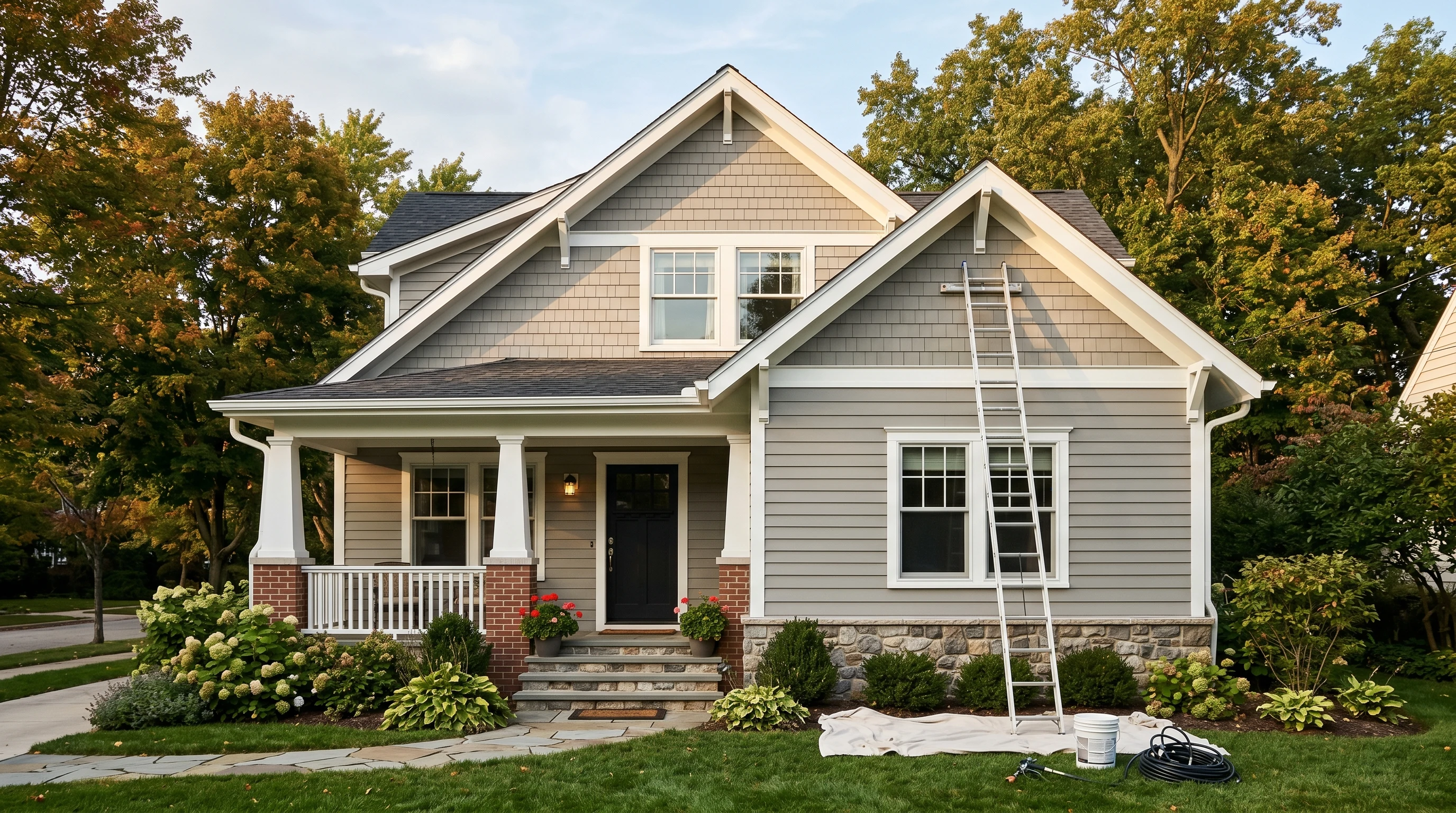
A whole-house exterior is the biggest paint job most homeowners ever take on, and the part nobody warns you about is the weather. Not the paint, not the ladders, not the prep. The weather.
You can do everything else right and have a job that fails in three years because you painted a 95-degree south wall at 2pm in August. The schedule is what’ll bite you. Here’s the order I work a house in.
What You’ll Get
A two-coat acrylic finish on a sound wood-sided or fiber-cement house, properly back-rolled, ready for seven to ten years of weather. Materials run $650–$1,400 for a single-story 1,800–2,400 sq ft of siding. Pro labor on the same house quotes $4,500–$9,000.
Honest Take on Time and Difficulty
Hard project. Not technically. The application is straightforward once you’ve done a wall. Hard because it’s a week and a half of physical work, on ladders, with a weather window that moves on you every morning.
| Day | Work | Hours |
|---|---|---|
| 1 | Pressure-wash whole house | 4–5 |
| 2–3 | Dry-down (no work) | 0 |
| 3 | Scrape, sand, repair siding | 5–7 |
| 4 | Caulk, mask windows, spot-prime | 4–6 |
| 5 | First coat body (sprayer + back-roll) | 6–8 |
| 6 | Second coat body | 5–7 |
| 7 | Trim cut-in and door | 4–6 |
| 8 | Touch-ups, pull masking, walk-around | 2–3 |
Two-story doubles most of those. A second-story gable is the slowest part of any house. The right tool is a 5-foot rolling scaffold, not a 28-foot extension ladder you keep wrestling around the eave. Sixty bucks a day at the rental yard buys back two days of ladder time and one fall you didn’t have.
The Weather Window
This is the rule. Surface temperature (not air) between 50 and 85°F. Humidity under 80%. No rain in 24 hours, no direct sun for the four hours before you spray.
Read the wall with an infrared thermometer. A $20 IR gun pays for itself the first morning. Siding in direct sun on a 75-degree day sits at 100–105°F. Paint hitting that surface flashes off the solvent before the film can level, and you get a chalky thin coat that won’t take a second coat.
Watch the dewpoint, not just humidity. If the dewpoint is within 5°F of the surface temp, water is condensing on your siding even when the wall looks dry. Morning work in spring is the trap: air is dry, sun is up, surface is still cold and sweating. Wait until the dewpoint spread opens up.
What You’ll Need
Paint and primer. 2 gallons stain-blocking primer for spot work (Cover-Stain, or BIN Advanced for cedar tannin). Body: 8–12 gallons of acrylic exterior for single-story, 16–24 for two. SW Duration, BM Aura Exterior, or Behr Marquee are the three I reach for. See the best exterior house paint round-up. Trim: 2–3 gallons of acrylic semi-gloss.
Sprayer and roller. Airless rated for exterior (Graco Magnum X7 or up). 9-inch roller frame on a pole, 3/4-inch nap. 4-inch synthetic sash brush for trim. See our paint sprayer picks.
Prep tools. Rental pressure washer (1,800–2,500 PSI, 25-degree tip). 5-in-1, carbide scraper, 80- and 120-grit sanding sponges, caulk gun and four to six tubes of paintable acrylic latex.
Access. Two 28-foot extension ladders with standoff brackets. An 8-foot stepladder. A rented 5-foot rolling scaffold for two-story gable work.
Masking. Canvas drop cloths along the foundation, not plastic. 1.5-inch blue tape, 2-foot pre-masked plastic for windows, rosin paper on the porch deck.
Step 1: Wash Everything
Pressure-wash top to bottom on a dry day, no rain forecast for 48 hours. 1,800 PSI is plenty for painted siding. 2,500 max on fiber cement, never on cedar or soft pine. Tip 12 inches off the wall, 25-degree fan, top down so dirty water runs over unwashed siding.
Mix a percarbonate cleaner for any wall showing mildew, especially the north face. Brush it in, let it dwell 15 minutes, rinse. Don’t let the cleaner dry on the siding.
Then walk away for 48 hours of dry weather. Three days if shaded or it’s been a wet spring. Paint on damp siding flashes and blisters, and the only fix is scraping back to bare.
Watch out for: shooting water up behind the lap edges. Aim the tip downward. Water trapped behind siding takes weeks to dry, and any paint over it lifts in sheets the next summer.
Step 2: Scrape, Sand, Repair
Walk every elevation with the 5-in-1 and carbide scraper. Anywhere paint is loose, scrape until you hit sound paint that won’t lift with a fingernail. Feather the edge with 80-grit, knock it flat with 120. The transition between scraped wood and remaining paint has to be smooth or it telegraphs through both finish coats.
Probe any soft spots with a screwdriver: sills, the bottom edge of horizontal trim, anywhere flashing met wood. Soft wood is rotted wood. Cut out the bad section, replace with the same dimension cedar or pine, prime all six sides before you nail it up. Bare ends are how rot gets back into a new patch inside two years.
Pull failed caulk out of every joint. Re-caulk siding-to-trim and trim-to-window with paintable acrylic latex. Never silicone. Tool the bead with a wet finger so it sits flush.
Watch out for: leaving knots and cedar tannin exposed under your topcoat. Both bleed through acrylic within months. Spot-prime with Cover-Stain for oil bleed, BIN Advanced for cedar. Brush it on, not sprayed.
Step 3: Mask and Stage
Mask windows with 2-foot pre-masked plastic. Tape flush against the inside edge of trim if you’re cutting trim later, outside edge if you’re spraying body and trim from the gun. Rosin paper on the porch deck. Drop cloths along every foundation bed and any shrubs you can’t tie back.
Two-story work starts on the side away from the prevailing wind, so overspray drifts into the yard, not onto fresh paint. Walk each elevation once with the sprayer off. Find the snags before they cost you a stripe of bad paint.
Step 4: First Coat, Top-Down, into the Shade
Spray and back-roll. Always both. Spray-alone is the most common shortcut and the most common reason a five-year repaint is a three-year repaint.
Load the airless, prime the hose, set the tip to a 515 or 517 for lap siding. Start at the highest point on the elevation in shade. Work top to bottom in 4-foot vertical sections. Gun 12 inches off the wall, steady walking pace.
Right behind you, follow with the 9-inch roller and back-roll the section you just sprayed. One pass per board, pushing the wet film into the grain and around the lap edges. The roller doesn’t add paint. It works what the sprayer laid down into the wood.
Cut in corners and around windows with a 4-inch brush as you go, while the body coat is still wet at the edge. Feather the brush stroke into the rolled surface so there’s no transition line.
Don’t stop in the middle of an elevation. Lap marks show up the second the morning sun hits them. Finish the wall you started. If you have to stop, stop at a corner, downspout, or window edge.
Chase the shade. South wall first thing while it’s still in shade. North wall mid-morning once the dew is off. West wall after lunch while the sun is on the east. East wall late afternoon.
Step 5: Second Coat
Wait the can’s recoat window, usually 4 hours in dry conditions, 6 if it’s cool or humid. Second coat goes on the same way: same order, same top-down pattern, same back-roll behind every spray pass.
The body color deepens with the second coat. Spots that looked thin disappear. Lap marks under raking light flatten out. One coat looks fine on the day. Two coats looks fine for ten years.
Don’t skip the second coat on the back of the house because nobody sees it. North-facing siding holds moisture longest, and a thin single coat on the back will be the first to chalk and lift.
Step 6: Trim and Doors
Trim is brush work. Cut-in by hand with a 4-inch sash brush and a 1-quart pail. The body color cures hard enough to handle by day three, so you can lean a ladder against painted siding without marking it.
Two coats on trim too. Acrylic semi-gloss holds gloss better than the body sheen and washes down cleaner. Cut tight to the masking. Pull tape the same day before the film bridges the edge. Tape pulled after cure takes a strip of paint with it.
The door is its own project. Off the hinges, flat on sawhorses, two thin coats of semi-gloss or satin, 48 hours of cure before you re-hang. A door painted flat looks like a factory finish. Painted in place, it sags at the bottom and shows brush marks across the panels.
Common Mistakes That Ruin the Job
- Spraying a hot wall. Surface over 90°F flashes the solvent and you get chalk. Work the shaded elevation. Buy the IR gun.
- No back-roll behind the spray pass. Looks great in October, peeling off the south wall by year four.
- One coat to save paint. Two coats. Always two coats. The can lies about one-coat coverage.
- Painting damp siding after a pressure wash. Wait 48 hours of dry weather. No shortcut, no fix once the blisters show up.
- Skipping primer over knots, tannin, and replacement boards. Both bleed through acrylic within a season.
- Stopping in the middle of an elevation. Lap marks show the moment morning sun rakes the wall. Finish the wall you start.
- Plastic drop cloths under the eave. Paint puddles and tracks everywhere. Canvas under foundations, rosin paper on decks.
Cure Schedule
| After final coat | What’s safe |
|---|---|
| 4 hours | Touch dry, light dew OK |
| 24 hours | Light rain, lean a ladder against it |
| 7 days | Normal weather, hose down for dust |
| 30 days | Full cure, scrub as needed |
Don’t pressure-wash a fresh exterior for the first month. The film is still hardening and high-pressure water lifts it off.
Maintenance and the Next Repaint
Two-coat acrylic on wood siding holds seven to ten years in a four-season climate. Factory-primed fiber cement holds twelve to fifteen. South and west elevations chalk first, north holds longest.
Walk the house every spring. Wipe a clean rag down the siding: if it picks up color, the finish is starting to oxidize. Check for lifting at trim joints and caulk that’s pulled open. Wash the house once a year with garden-hose pressure and a soft brush. That alone adds two years to the finish life.
When chalk shows up across an elevation, you’re a year out from a recoat on that side. Wash, spot-prime any failures, one body coat. That mid-cycle refresh buys another four to five years.
Cost Breakdown: 1,800–2,400 Sq Ft Single-Story
| Item | Cost |
|---|---|
| Body paint (10 gal) | $380–$680 |
| Stain-blocking primer (2 gal) | $70–$110 |
| Trim paint (3 gal) | $130–$200 |
| Caulk, sanding, repair stock | $60 |
| Drop cloths, tape, masking | $80 |
| Pressure washer rental | $50 |
| Sprayer rental if not owned | $0–$200 |
| Total materials | $770–$1,380 |
A pro quote on the same house runs $4,500–$9,000. If you own the sprayer and ladders, single-story DIY pencils out under a thousand bucks.
Two coats. Always two coats. Read the wall with the IR gun, chase the shade, back-roll behind every spray pass. Skip none of the three and the house holds.
Ask a Question