The Best Painting Tools Under $25
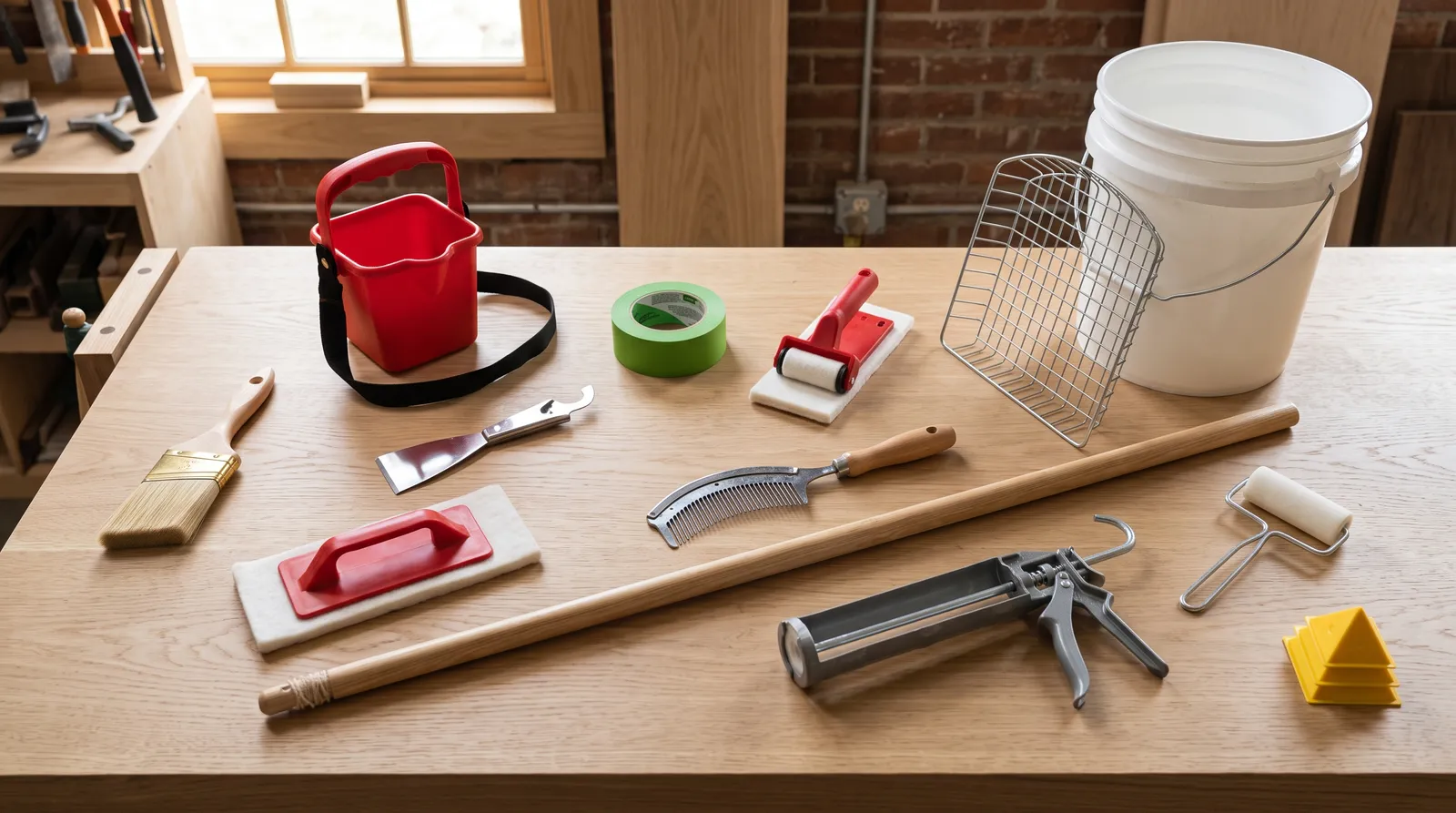
Twelve cheap painting tools I use on every job, all under $25. Top pick: the Wooster Shortcut 2-inch angle sash brush, plus the pail, edger, comb, and 5-in-1 that finish the kit.

Disclosure: Some links below are affiliate links. We earn a commission if you buy through them, at no extra cost to you.
Top pick: the Wooster Shortcut 2-inch angle sash brush, about $8. It wins on grip and on line control, and it is the one item on this list that changes how your paint job looks rather than how fast it goes. It falls short overhead, where the stubby handle gives up leverage. Everything else here is a supporting cast member: the Bercom HANDy Paint Pail for cut-in, the Purdy Contractor 5-in-1 for prep, FrogTape Multi-Surface for the lines you can’t cut, the Shur-Line Premium Paint Edger for ceilings you can’t reach, and a Purdy Brush Comb so the brush you just bought is still good in three years.
Twelve tools. All under $25. Together they run about $130.
This is a shopping list, not a tournament. Nothing here beats anything else, because none of these tools do the same job. What I care about is whether each one earns a slot in a bucket you carry from room to room.
Why a Kit Beats a Kit-in-a-Box
Walk into any home center and you’ll find a $25 clamshell with a frame, two covers, a tray, a brush, and a stir stick. Buy it and you own two things you’ll keep (the tray, maybe the frame) and three things you’ll throw out after the first wall.
The brush is the tell. A bundled brush is a stamped-plastic handle with a loose ferrule and filament that fans out on the second dip. It leaves ropes in the paint, and you’ll spend forty minutes sanding those ropes out of trim before the second coat.
Build the kit item by item instead. Nine of these twelve are reusable indefinitely if you rinse them.
How I Tested These
Three projects over five weeks, all with tools I bought at retail. Nothing on this page was supplied by a manufacturer.
Guest bedroom, 12 by 14 ft. Two coats of Benjamin Moore Regal Select eggshell over previously painted drywall, ceiling and trim included. The pail, pole, bucket grid, and edger did their work here. I measured cut lines against a chalk line at three points per wall and logged how many linear feet of trim I could cut before my grip hand quit.
Stairs and hallway. Sixteen oak treads, painted risers, 90 linear feet of baseboard in Sherwin-Williams ProClassic. Fourteen tubes of siliconized acrylic went through the caulk gun. Stairs punish anything with a long handle and reward anything you can hold in a fist.
Twelve kitchen cabinet doors. Primed MDF, waterborne enamel, faces rolled and edges brushed. The pyramids, the pad applicator, and the brush comb earned or lost their spots here.
Cleanup got its own protocol. Every brush and cover ran ten wash cycles, then went under a raking LED so I could see filament splay and nap matting. A tool that dies in cleanup is not a cheap tool.
The Twelve, at a Glance
| Tool | What it does | Price tier | Reusable |
|---|---|---|---|
| Wooster Shortcut 2-inch angle sash | Cuts wall-to-trim and wall-to-ceiling lines | $ | Years |
| Bercom HANDy Paint Pail | Holds a quart on your hand while you cut | $$ | Years (liners are consumable) |
| Purdy Contractor 5-in-1 | Scrapes, opens cans, squeezes roller covers dry | $ | Permanent |
| FrogTape Multi-Surface 1.41-inch | Masks trim, seals the edge against bleed | $$ | Consumable |
| Shur-Line Premium Paint Edger | Cuts a ceiling line on a pole, no ladder | $ | Pad replaced every ~3 rooms |
| Wooster Pad Applicator | Lays stain and thin finishes flat, no brush marks | $ | 6–10 jobs |
| Purdy Brush Comb | Clears dried paint out of the ferrule | $ | Permanent |
| Wooster Acme extension pole (4 ft) | Reaches ceilings and high walls from the floor | $$ | Decades |
| Wooster Snap Screen bucket grid | Turns a 5-gallon bucket into a roller tray | $ | Permanent |
| Newborn 250 dripless caulk gun | Runs a clean bead of caulk without dripping | $$$ | Decades |
| Purdy brush and roller spinner | Spins covers and brushes dry in 20 seconds | $$ | Years |
| Wooster painter’s pyramids | Lifts doors and shelves off the bench | $ | Permanent |
Price tiers on this page: $ is under $10, $$ is $10 to $18, $$$ is $18 to $25.
1. Wooster Shortcut 2-Inch Angle Sash, Top Pick
Every other tool here saves you time. This one changes the finish.
The Shortcut is a stubby brush with a soft rubber handle about four inches long, which means you hold it in a closed fist instead of pinching it like a pencil. That grip is the whole point. A pinch grip fatigues in about fifteen minutes and a tired hand wobbles, and a wobble on a baseboard line is exactly the defect that makes a room look amateur. On the stair job I cut 90 linear feet of baseboard in one session without switching hands. With a long-handled sash brush I switch at about 50 feet.
The filament is Wooster’s Shergrip blend, and it holds a real load. Loaded with ProClassic, it laid a wet line about six feet long before I had to reload, and it released the enamel without dragging tramlines through it. My cut lines measured within 1/16 inch of the chalk line at all three check points on two of three walls. The third wall was my fault, not the brush’s.
It gives up leverage overhead. A short handle puts your hand right at the ceiling, which is a bad angle on a ladder and worse on a pole (it doesn’t take one). Use a long-handled sash brush or the Shur-Line edger below for that line. And 2 inches is slow across a wide door panel; go to a 2-1/2-inch for those.
| Spec | Value |
|---|---|
| Width | 2-inch angle sash (also 1-1/2-inch, 2-1/2-inch, 3-inch) |
| Filament | Shergrip blend, waterborne paints |
| Best for | Baseboard, casing, sash, tight corners, cut-in |
| Approx. price | $8–$10 |
Buy it if: you cut trim by hand and your grip hand gives out before the wall does. Skip it if: the job is all ceiling lines, or all wide flat panels.
For the full brush lineup, the paint brush round-up covers the long-handled options this one can’t replace.
2. Bercom HANDy Paint Pail, Best Cut-In Pail
Cutting in out of a gallon can is a rookie move that costs you an hour. The can is heavy, the rim fills with paint, the lid stops sealing, and you can’t take it up a ladder without setting it on a rung.
The HANDy Pail is a quart-capacity plastic pail with an elastic strap that slips over your hand, a magnet inside the rim that parks your brush, and a lip you wipe the brush against. Weight sits on the back of your hand rather than your fingers. On the bedroom job that difference showed up around the 40-minute mark, which is when a can starts to feel like a dumbbell.
Buy the liners. A 10-pack is a few dollars and a liner turns a color change into a ten-second operation. The bare pail is a genuine pain to wash because the strap channel traps paint and you’ll never get it all.
A quart is the real limit here. A full room means four or five refills, and you’ll want the gallon standing on a drop cloth nearby.
Buy it if: you cut in more than one room a year. About $13 with a starter liner.
3. Purdy Contractor 5-in-1 Tool, Best All-Purpose Prep
The tool that lives in your back pocket. Scraper blade, chisel point, can opener, nail puller, and a crescent cut-out that squeezes a roller cover dry.
That crescent is worth the price on its own. Run it down a loaded 9-inch cover before you wash it and you’ll recover close to a cup of paint back into the bucket, plus your rinse water runs clear in half the time. The blade takes a hammer strike on the butt cap without mushrooming, so it doubles as a chisel for popping loose paint off a windowsill.
It’s not a putty knife. The blade is too stiff to feather spackle flat, and it dulls on drywall compound faster than a hardened Warner. Keep a flexible 2-inch knife for patching and let the 5-in-1 do the rough work. For patching jobs specifically, the drywall hole repair guide walks through which knife width matches which hole.
Verdict: nine dollars, permanent, in your pocket every job.
4. FrogTape Multi-Surface 1.41-Inch, Best Tape
Tape is the one consumable on this list where the premium version is worth it. FrogTape’s PaintBlock polymer swells when waterborne paint hits the edge and gels into a seal. Plain beige crepe tape has no such mechanism and relies entirely on how hard you pressed it down.
On the bedroom trim I ran FrogTape Multi-Surface against a generic beige crepe on the same baseboard, same paint, same burnish pressure. The FrogTape edge was clean for most of the run with a few short bleed spots at a caulk ridge. The generic bled along a majority of the run and needed a razor and a touch-up brush.
It costs roughly twice the generic. It does nothing for oil-based paint, since PaintBlock needs water to activate. And it sticks poorly to dusty or chalky trim, so wipe the surface before you tape or it lifts at the corners three hours in.
One 60-yard roll masks the trim in a 12 by 14 bedroom with tape left over. The painter’s tape round-up has the delicate-surface and outdoor versions.
Buy it if: you’re taping anything you care about. About $9 a roll.
5. Shur-Line Premium Paint Edger, Best Edger
Controversial pick. Plenty of pros will tell you edgers are junk, and on the ceilings those pros work on, they’re right.
Here’s where it earns a spot anyway. A flat, smooth, previously painted ceiling is the most common condition in an American house built after 1990, and on that ceiling the Shur-Line holds a straighter line than a first-time painter cuts freehand. The guide wheels ride the ceiling, the pad rides the wall, and the geometry does the work instead of your wrist. Thread it onto the Wooster Acme pole and the whole ceiling line happens from the floor.
Two real failures. The wheels pick up wet paint and print it onto the ceiling, so wipe them every few feet. And the pad lays a thinner film than a brush, so an edged line over a dark base usually needs three passes where a brush needs two.
On textured ceilings it’s useless. Popcorn, knockdown, and wavy old plaster all defeat it; the pad rides the high spots and skips the valleys. Tape those or cut them with a brush.
| Spec | Value |
|---|---|
| Pad size | Approx. 3-1/2 by 5 inches, snap-off, washable |
| Handle | Threaded for a standard extension pole |
| Best for | Flat smooth ceilings, straight wall-to-wall color changes |
| Approx. price | $8–$12, replacement pads about $5 |
Skip it if: your ceilings have texture, or you already cut a clean line freehand.
6. Wooster Pad Applicator, Best Pad
Pads are a niche tool that a lot of people buy for the wrong job. They are not wall tools. Try to paint a room with one and you’ll hate it.
Where they win is stain and thin clear finishes on flat wood. On a deck board or a bookshelf, a pad drags material out in an even film with no brush marks to sand out afterward, and it gets into a board seam that a 9-inch roller bridges over. I used one to seal a set of pine shelves during the cabinet job and the difference against a brushed control board was visible under raking light at 30 minutes.
Reload every two or three feet. That’s the trade. The pad holds very little compared with a brush, and on anything textured it skips.
Verdict: buy one if you have a deck, a fence, or shelving. Otherwise skip it. See the wax versus poly comparison before you pick what goes on the pad.
7. Purdy Brush Comb, Best Cleanup Tool
Six dollars. Buy it with your first good brush and treat them as a set.
Paint doesn’t ruin a brush from the outside. It ruins it from the ferrule, where the filament is packed tight and rinse water never reaches. Two or three jobs of “I rinsed it, it looked clean” and the base of the brush is a solid plug. The filament splays. The brush is done.
The comb’s teeth reach in there. Run it from the ferrule out to the tips under running water, four or five strokes each side, and the plug comes out as gray sludge. Under the raking LED at the end of my ten wash cycles, the combed Shortcut showed no measurable splay. An identical Shortcut I only rinsed had visibly fanned tips by cycle seven.
Don’t go hard on fine natural bristle; aggressive combing breaks China-bristle tips. And a comb won’t rescue a brush you already let dry hard. That brush is a stir stick now. There’s a fuller cleanup lineup in the brush and roller cleaner round-up.
8. Wooster Acme Extension Pole, Best Cheap Pole
The 4-foot fixed wood Acme pole runs about $14 and will outlive three telescoping aluminum poles at the same price.
Telescoping poles fail one way: the twist lock slips mid-stroke, the pole collapses six inches, and you plant a roller edge into a ceiling you just finished. A fixed pole has no joint to slip. It’s a stick with a threaded tip, and there is nothing on it to break.
The thread is standard Acme, which is the compatibility spec that matters. It fits Wooster frames, Purdy frames, the Shur-Line edger, most pole sanders, and a bucket-mounted scrub brush. Check the thread before you buy any frame.
You give up adjustability. Buy the length that matches your ceilings (4 ft for 8-foot ceilings, 6 ft for 9- and 10-foot) and accept that you own a stick. The wood soaks up splatter and gets slick if you never wipe it. Both are fine trades.
If you want the telescoping convenience anyway, the extension pole round-up covers the locking mechanisms that actually hold.
9. Wooster Snap Screen Bucket Grid, Best Bucket Grid
The cheapest upgrade in this whole list, and the one most homeowners have never tried.
Snap the grid into a 5-gallon bucket, pour in two gallons, and roll directly out of the bucket. No tray to kick over. No tray liner to buy. No ramp leaving a fat wedge of paint on one end of your cover.
Three things get better at once. The cover unloads evenly against the ribbed face, which kills the heavy edge you get off a tray ramp. The bucket holds a full room’s worth of paint so your color stays consistent from the first wall to the last (boxing two gallons together also cancels batch variation). And a lid seals it overnight instead of skinning over the way a tray does in twenty minutes.
You need the bucket, about $6, which still puts the whole setup under a decent tray-and-liner system. A half-full bucket is heavy on a ladder, so keep it on the floor and use the pole.
Verdict: eight dollars, permanent, and it makes a $6 roller cover lay a better film. For nap selection, see the roller cover round-up.
10. Newborn 250 Dripless Caulk Gun, Best Caulk Gun
Caulk is where a repaint stops looking like a repaint and starts looking like a remodel. A bad gun makes it look like neither.
The Newborn 250 is a steel-frame gun with a 10:1 thrust ratio and a dripless plunger release. Ten to one means the trigger pushes stiff siliconized acrylic without the two-handed wrestling match a $4 ratchet gun turns into. The dripless release actually stops the flow when you let go, so the end of a bead is a clean stop instead of a blob you then smear.
Fourteen tubes went through it on the stair-and-baseboard job. The frame never twisted, the rod never slipped, and I ran full 8-foot beads without stopping to re-seat.
It’s heavy next to a hardware-store gun and your forearm will know it after fifty tubes. And 10:1 is underpowered for cold-weather polyurethane sealant, which needs the 26:1 gun.
At about $18 it’s the most expensive tool here and the one I’d argue hardest for. For which caulk to load into it, see the caulk round-up, and for the gap-filling order of operations, the repaired drywall guide.
11. Purdy Brush and Roller Spinner, Best Cleanup Accessory
Covers don’t die from painting. They die from sitting wet in a garage overnight, matting flat, and never coming back.
The spinner is a pump-action shaft that spins a washed cover at high speed and throws the water out of the nap in about 20 seconds. Do that and hang the cover on a nail and it’s fluffy the next morning. Skip it and you’re buying new covers every job. Same tool dries a brush without splaying the filament the way whacking it against a wall does.
Use it inside a 5-gallon bucket or outdoors. It throws paint water in roughly a 4-foot circle, and doing this over a kitchen sink is how people end up repainting a kitchen. Store it dry; the shaft binds if you put it away wet.
About $15. It’s the tool that makes the rest of your tools last, which is the whole argument for this list.
12. Wooster Painter’s Pyramids, Best Cabinet Accessory
Small plastic cones with a point on top. Ten dollars for a 10-pack. They do one thing.
Set a cabinet door or a shelf on four of them and the workpiece floats about an inch off the bench, which means you can paint the face and wrap the edges in one session instead of waiting for a face to cure before you flip it. On the twelve-door refinish that cut a full day off the schedule.
The point leaves a contact mark. It’s a dot instead of the flat smear a scrap block leaves, and you put the dot on the back face where nobody looks. They slide on a slick bench under a heavy door, so put a strip of rosin paper or a drop cloth under them. And use four per door, not two, on anything solid.
If you’re doing cabinets, read the kitchen cabinet project guide first. The pyramids are step nine; the prep is steps one through eight.
Tools I Tried and Cut
- Three-for-$5 polyester roller covers. Shed filament into wet paint on the first wall. The hour you spend picking lint out of an eggshell finish costs more than the covers saved.
- Plastic-handled chip brushes. Fine for glue and solvent. They fan out on the second dip in latex and leave ropes in trim paint.
- Telescoping aluminum pole, $14 tier. The twist lock slipped twice in one ceiling session. The fixed Acme pole costs the same and does not do that.
- Tray-and-liner kits. Not bad, just beaten. A bucket and an $8 Snap Screen outperform them on film quality and on cleanup.
- Generic beige crepe masking tape. Bled along most of a baseboard run in the head-to-head. It has a place on rough exterior masking, not on interior trim.
- Corner-cutting gadget rollers. The little wheeled corner tools sold near the edgers. Every one I’ve tried leaves a fat ridge of paint at the corner that you then have to brush out.
Making the Cheap Stuff Last
Rinse before the paint sets, not after. Waterborne paint starts to skin in about twenty minutes on a warm day, and once it does, the ferrule plug I described earlier begins. A two-minute rinse at the end of each session buys years.
Brushes. Rinse under warm water until runoff is clear, then comb from ferrule to tips on both sides. Spin, then wrap in the original keeper so the chisel edge stays chiseled. A brush lying flat in a drawer dries splayed.
Roller covers. Squeeze with the 5-in-1 crescent first to recover the paint, rinse from the open end, spin 20 seconds in the bucket. Hang on a nail through the core.
The caulk gun. Wipe the nozzle plate and the rod. Dried acrylic on the rod is what makes a gun ratchet rough two years later.
The edger pad. Pull it off the head and rinse it separately. A pad left on the tool dries paint into the guide wheels and they stop turning. That’s the failure that makes people say edgers don’t work.
Realistic life across a homeowner’s decade: brush 3–5 years, comb and 5-in-1 and grid and pyramids permanent, pole and caulk gun decades, spinner 5+ years, pad applicator 6–10 jobs, edger pad about 3 rooms.
Mistakes I Still See
- Buying the $25 all-in-one kit. You get one keeper and four throwaways. Build the kit piece by piece and every piece is a keeper.
- Cutting in straight out of the gallon can. Rim fills, lid stops sealing, and the weight kills your hand by the second wall. Pour a quart into a HANDy Pail.
- Taping over dust. FrogTape can’t seal against a chalky baseboard. Wipe the trim with a damp rag and let it dry before you tape.
- Running an edger on a textured ceiling. It will skip and you’ll blame the tool. Brush that line or tape it.
- Rinsing a brush and calling it clean. The ferrule holds the paint that kills the brush. Comb it, every time.
- Skipping caulk because the gun is annoying. Uncaulked gaps at casing and baseboard are the single most visible sign of a DIY repaint. An $18 gun removes the excuse.
- Leaving covers to dry unspun. A matted cover is trash. Twenty seconds in a spinner is the whole fix.
What I’d Buy First
If you’re starting from nothing and want to spend $50: Wooster Shortcut 2-inch ($9), HANDy Paint Pail with liners ($13), Purdy Contractor 5-in-1 ($9), FrogTape Multi-Surface ($9), Purdy Brush Comb ($6). That’s the cut-in and prep kit, and it covers a single room once you add a roller and a drop cloth.
At $100, add the Wooster Acme 4-foot pole ($14), the Snap Screen bucket grid ($8), a 5-gallon bucket ($6), and the Purdy spinner ($15). Now you’re rolling out of a bucket from the floor and your covers survive.
At $130 you have all twelve, including the Newborn 250 and the pyramids, which is the point where you can caulk a whole house and refinish a set of cabinet doors without buying anything else.
Work out how much paint goes with it using the coverage and gallons calculator, and put a real cloth under all of it from the drop cloth round-up.
The tools last. The tape and the covers are the consumable. Don’t economize on the brush and waste the wall.
Ask a Question