Best Electric Drywall Sanders
Six electric drywall sanders tested on new board, patched walls, and ceilings. The best drywall sander for most people is the WEN 6369 — plus where each one falls short.

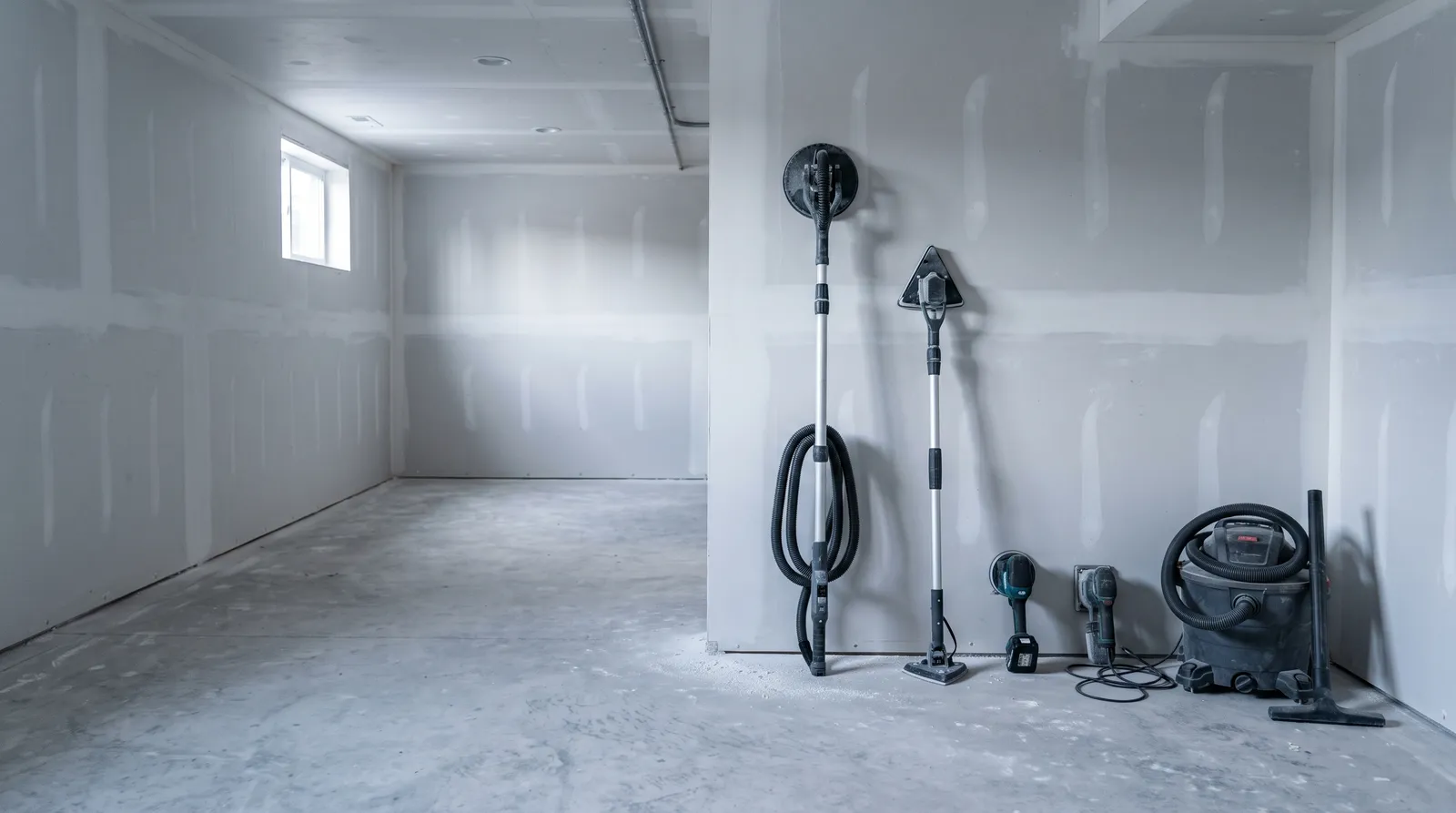
Disclosure: Some links below are affiliate links. We earn a commission if you buy through them, at no extra cost to you.
Top pick: the WEN 6369. About $160, a 5-amp motor, a 9-inch pivoting head on a pole that telescopes to five feet, and a 15-foot hose that mates to a shop vac. It wins on reach and on price, and it finished my basement ceiling without a ladder. It falls short on the vacuum port, which does not seal on most shop vacs without an adapter, and on longevity, since a brushed 5-amp motor is not a tool a drywall crew runs daily. If you hang board for a living, the Festool PLANEX easy is the one worth its four-figure price. If you want a cordless for occupied homes, the DEWALT DCE800B. If you are sanding fourteen patches in one bedroom and nothing else this year, the WEN DW1085 handheld does that job for under $100 and takes up a shelf, not a corner.
There is no version of drywall sanding that is pleasant. There is only the version where the dust ends up in a vacuum instead of on your kitchen counters.
Why the Machine Beats the Pole
A manual pole sander costs $25 and works. I own two. For a single patch or a closet, the hand tool is faster than uncoiling a hose.
Past about one room, the math flips hard. An electric sander cuts compound roughly three times faster than a screen on a pole, and more importantly it pulls the dust off the wall as it makes it. That second part is the actual product. Hand-sanding a 480 square foot basement put a visible layer of fines on every horizontal surface two floors up, in a house with the door taped. The same room with a sander hooked to a filter-bagged shop vac left dust on the floor along the baseboard line and nowhere else.
Fatigue is the other half. Pressing a pole sander into a ceiling is a shoulder exercise you repeat for hours. The electric tool weighs more but you stop pushing it, which is why people who have used both never go back for ceilings. For the hand tools that still earn a place in the kit, see the manual pole sander round-up and the sanding block guide.
Skip the machine if your entire project is one patch. Buy it the moment you have a whole wall.
How I Tested These
Three real jobs over five weeks, six sanders, same abrasives, same protocol.
The basement. 480 square feet of new board, three coats of USG All Purpose over paper tape, about 90 linear feet of seams plus a full 9-foot flat ceiling. This is the job that separates the tools, because it is long enough that fatigue and dust containment both show up.
The bedroom. Fourteen patches where a wall of shelving came out, plus two corners skim-coated to feather old texture into new. Short reach, lots of starting and stopping, the job most homeowners actually have. That kind of repair work is covered in the drywall repair painting guide and the hole-patching walkthrough.
The ceiling. A knockdown ceiling in a 1978 ranch, high spots taken down before repaint. Overhead, awkward, and unforgiving of a tilted pad.
Every tool ran 120 grit for the cut and 150 for the finish. Every tool ran twice: once on a 6-gallon shop vac with a drywall filter bag, which is what most people already own, and once on a HEPA dust extractor. The vacuum changes the outcome more than the sander does, and any review that tests only with a premium extractor is telling you about the vacuum.
Scoring, in weight order: dust escaping the shroud, gouging and swirl in fresh compound, fatigue at ceiling height, reach without a ladder, pad-change time, corner access, and noise at the ear.
Finish quality got checked the way a painter checks it. Rake a work light down the wall at a shallow angle after a wipe-down, then look again after primer goes on. Primer is where sanding sins surface, which is also the argument for not cheaping out on the coat that reveals them. The primer explainer covers why.
Comparison at a Glance
| Model | Power | Pad | Reach | Dust setup | Best for | Price |
|---|---|---|---|---|---|---|
| WEN 6369 | 5A corded, 600–1500 RPM | 9-inch round, pivoting | Telescopes to 5 ft | 15-ft hose to your vac | Whole rooms and ceilings on a budget | ~$160 |
| Festool PLANEX easy LHS-E 225 EQ | Corded, 8.82 lbs | 8.5-inch round + edge pad | Full-length tube | Festool CT extractor | Whole-house and daily pro use | $$$$ |
| DEWALT DCE800B | 20V MAX brushless | 9-inch, soft or hard backing | Handheld | Hose to vac | Occupied homes, no cord | ~$400 bare |
| DEWALT DWE7800 | 4.7A corded | 9-inch hook-and-loop | Handheld | Hose to vac | Daily remodel work, rental fleets | ~$350 |
| WEN 6377 | 5A corded, 600–1500 RPM | 9-inch round + 11-1/4-inch triangle | Telescopes to 5 ft | 15-ft hose to your vac | Corners, stairwells, trimmed rooms | ~$190 |
| WEN DW1085 | 10A corded, 1500–2300 RPM | 8.5-inch base | Handheld, 6 lbs | 7.5-ft hose + bag | Patches and single walls | ~$92 |
1. WEN 6369, Top Pick
The 6369 is the tool that made me stop renting drywall sanders. Five amps, 600 to 1500 RPM on a dial, a 9-inch hook-and-loop pad on a head that swivels in every direction, and a pole that telescopes to about five feet. Nine pounds all in. It ships with the 15-foot hose and six grits, so the only thing missing from the box is a vacuum.
The pivot is what earns the pick. Set the head against the wall at any angle and it lies flat on its own. I sanded 90 linear feet of seams in the basement and put two gouges in fresh compound, both in the first ten minutes, both my fault for leaning on it before I trusted the float. Once you let the tool’s weight do the pressing, it tracks clean.
The ceiling test is where the pole pays for itself. A 9-foot flat ceiling, feet on the floor, no ladder moved once. Speed dialed down to about 700 RPM over the softer second coat, back up to 1200 on the proud butt joints.
Two real complaints. The vacuum port is sized for a generic hose and it does not seal on most shop vacs. I wrapped mine in a turn of tape and it was fine, but at $160 the fitting should fit. And the motor is a homeowner motor. It sanded three jobs without complaint; I would not put it in a work van and expect it to see a second year.
| Spec | Value |
|---|---|
| Motor | 5 amp, 600–1500 RPM variable |
| Pad | 8.5-inch pivoting head, 9-inch discs |
| Reach | Telescopes to about 5 ft |
| Weight | 9 lbs |
| In the box | 15-ft hose, six grits (60 to 240), 2-year warranty |
| Approx. price | $130–$160 |
Buy it if: you have a room or more of board to sand and you already own a shop vac. Skip it if: you sand drywall for a living, or your whole project is one patch behind a couch.
2. Festool PLANEX easy LHS-E 225 EQ, Best for Whole-House Work
Different tool, different buyer. The PLANEX easy costs more than every other sander in this test combined, and then you buy the CT extractor to go with it. Nobody stumbles into this purchase.
What you get is 8.82 pounds with the motor mounted low on the tube instead of out at the head. Overhead, that is the entire difference. I ran the knockdown ceiling with the WEN and then with the PLANEX easy, back to back, and the fatigue gap was not close. The WEN pass ended when my shoulders did. The Festool pass ended when the ceiling did.
Dust containment is the other reason crews buy it. Paired with a Festool extractor and the brush-ring seal at the wall, this was the only sander in the test that left no visible haze on the floor. Not less haze. None.
Cost is the whole con. Below roughly 3,000 square feet of board a year, the numbers do not work, and the abrasives are Festool-priced, so you will not be grabbing replacements at the home center on a Saturday.
Buy it if: you hang and finish board for money and your shoulders are an asset you plan to keep. Skip it if: you are a homeowner. This is not the tool, and the WEN does your job for a tenth of the price.
3. DEWALT DCE800B, Best Cordless
The 20V MAX brushless DCE800B solves one specific problem: cords in occupied houses. You are already dragging a vacuum hose across a floor with wet mud on it. Removing the second tether is worth more than it sounds like when you are working around a family’s furniture.
The brushless motor is the real upgrade over the budget tools. Lean into a proud seam with the WEN and you hear it bog. The DEWALT holds its speed. It takes both the DWE7801 soft backing pad and the DWE7802 hard pad, which is a genuinely useful pair: soft for feathering skim coat, hard for cutting down a high seam without following the hump.
The honest limit is that cordless removes half the tether, not all of it. You still need a hose to a vacuum, and the battery hangs off the tail adding weight exactly where you do not want it overhead. Sold bare, which is right if you own 20V MAX batteries and wrong if you do not.
Buy it if: you work in occupied homes and already own the battery platform.
4. DEWALT DWE7800, Best Corded Pro-Duty
The DWE7800 is what you buy when the WEN’s motor is the thing you do not trust. 4.7 amps corded, a 9-inch hook-and-loop pad, variable speed on a dial, and a housing built to be dropped off a bench without ending the day. Three-year limited warranty, and DEWALT service centers stock the wear parts, which no budget brand can say.
On the wall it sands about as fast as the WEN. That is the awkward truth of this category. The spec sheet that costs twice as much does not remove compound twice as fast; it removes it for five more years.
The missing feature is reach. No telescoping pole, so ceilings mean a ladder or stilts. For a remodeler doing walls and 8-foot ceilings daily, that is a fair trade for the build quality. For a homeowner facing one basement, it is not.
Verdict: the durable corded pick, and the one to put in a rental fleet. About $350.
5. WEN 6377 Dual-Head, Best for Corners
Same motor as the 6369, same pole, same 600 to 1500 RPM dial, plus a second head. The 11-1/4-inch triangular pad is the point. A round pad cannot get flat into a wall-ceiling corner, and the triangle can push its point most of the way in.
Head swap is tool-free and takes about fifteen seconds, so switching mid-room does not break the rhythm. In a stairwell with heavy trim, where a third of the sanding is within six inches of an edge, this is the tool I reached for.
The triangular head does not float as freely as the round one. It chatters if you rush it. And you now own two sets of abrasives instead of one. The last inch of a true inside corner still gets a sanding sponge, so the triangle reduces hand work rather than eliminating it.
For about $30 over the 6369, it is worth it in any house with a lot of corners. Skip this if your rooms are open boxes.
6. WEN DW1085 Handheld, Best for Patches
Ten amps, 1500 to 2300 RPM, six pounds, no pole, and about $92. Wrong tool for a room. Right tool for the job most people actually have.
The bedroom test was fourteen patches. The pole sanders were clumsy for it, because a five-foot tube is dead weight when the work is at chest height and spread across a wall. The DW1085 is one-handed. It came with a collection bag, which meant one patch did not require dragging the shop vac up from the basement.
That bag fills fast and starts leaking fine dust once it does. Past one or two patches, hook it to a vacuum. And the higher speed range cuts patching compound quickly enough that parking it in one spot will burnish and dish the patch. Keep it moving.
Buy it if: your project is repairs, not a remodel. Skip it if: there is a ceiling involved.
What Actually Matters When You Buy One
Dust Collection Is the Spec
The shroud is not the dust control. Suction through the shroud is the dust control. Without air moving, the shroud holds dust for about two seconds and then puffs it out around the rim, and you have made an expensive mess.
A 6-gallon shop vac with a drywall filter bag handles a room. For a house, get a HEPA extractor with automatic filter cleaning. A standard shop vac filter clogs with drywall fines in well under an hour and loses suction long before the canister looks full. That drop is gradual, so you will not notice until you see the dust on the floor.
Wear a respirator either way. See the painting respirator round-up for what an N95 does and does not cover.
Where the Motor Sits
Head-mounted motors put the mass at the wall end of a five-foot lever. Tube-mounted motors put it near your hands. On walls it barely registers. On a ceiling it decides how long you last. This is the single spec that separates the Festool from everything under $200, and it is why the price gap is defensible even though both tools sand at similar rates.
Pad Float and Gouging
The pivot has to let the head lie flat on its own. Press one edge into fresh compound and the leading edge digs a crescent you will be re-mudding tomorrow. Every gouge I put in a wall during this test came from the same mistake: pushing instead of guiding. Let the tool’s weight do the work and steer.
Variable Speed, and Why the Low End Matters
600 RPM on soft second-coat compound. 1200 to 1500 on a cured, proud butt joint. A single-speed tool set at 1500 will burnish soft mud into a shiny, dished spot that shows through eggshell like a thumbprint. Any sander without a real low end is a sander for cured compound only.
Grit Is Not Where You Save Money
120 to cut, 150 to finish. That covers nearly everything. Below 100 grit you tear the paper facing at seam edges and leave scratches that print through two coats. Above 180 the disc loads with compound and stops cutting in about a minute. Hook-and-loop 9-inch discs should be a shelf item at your home center, not a special order. The sandpaper guide has the full grit breakdown for paint prep.
Sanders I Considered and Cut
- Porter-Cable 7800. The long-running corded pole sander a lot of crews still swear by. Heavier at the head than the current DEWALT, and parts availability has gotten patchy. If you find one cheap used, it is a fine tool.
- Makita XLS01 cordless. Solid brushless sander, but it only makes sense if you are already on 18V LXT. Same logic as the DEWALT, different battery religion.
- YATTICH and the Amazon house brands. They sand. The pivots develop slop within a job or two and the vacuum fittings are worse than the WEN’s, which is saying something.
- Random-orbit sanders with a drywall pad. People try this. The orbit pattern leaves swirl in soft compound and the dust port was never designed for fines this small. Use one on wood, not on mud. The orbital sander round-up covers where they do belong.
Care, Cleanup, Longevity
Drywall dust kills these tools, and it kills them through the bearings and the vacuum path.
Every job. Blow out the motor housing vents with compressed air. Fines pack into the vents, the motor runs hot, and heat is what ends a brushed motor. Two minutes of air after each job roughly doubles the life of a $160 sander.
Hook-and-loop pads. The hooks fill with compound and stop gripping. Scrub the pad face with a stiff nylon brush when discs start flying off mid-pass. A pad that will not hold a disc is a $20 replacement part, not a dead tool.
Hoses. Rinse and hang to dry. A hose with damp compound inside hardens into a rough tube that restricts airflow, and restricted airflow is the same as no dust collection.
Vacuum filters. Replace the drywall bag every room, not every job. Tap the pleated filter out between rooms if you are running a plain shop vac.
Realistic life: the WEN pole sanders run three to five whole-house jobs of homeowner use before the pivot loosens. The DEWALT corded tool goes years in daily remodel work. The Festool is a ten-year tool with parts available the whole time, which is what the price actually buys.
The Kit I Would Actually Buy
For a homeowner with a basement, a bonus room, or any single remodel: the WEN 6369 at about $160, a 6-gallon shop vac you probably own, a $12 pack of drywall filter bags, a 25-pack each of 120 and 150 grit discs, and an N95 or better. Around $220 all in, and the sander is worth more than half of that at resale when you are done.
For anyone with corners and stairwells, spend the extra $30 on the 6377 instead.
For a remodeler: the DWE7800 corded, plus the DCE800B when you work in occupied homes, plus a HEPA extractor that costs more than either sander. The extractor is the purchase you will not regret.
For a drywall crew: you already know. Buy the Festool and stop reading round-ups.
Ask a Question