Best Sanding Blocks and Sponges in 2026
Five sanding blocks and sponges tested across trim profiles, drywall patches, and between-coat scuff. Top pick: 3M Pro-Pad — plus where each falls short.

Disclosure: Some links below are affiliate links. We earn a commission if you buy through them, at no extra cost to you.
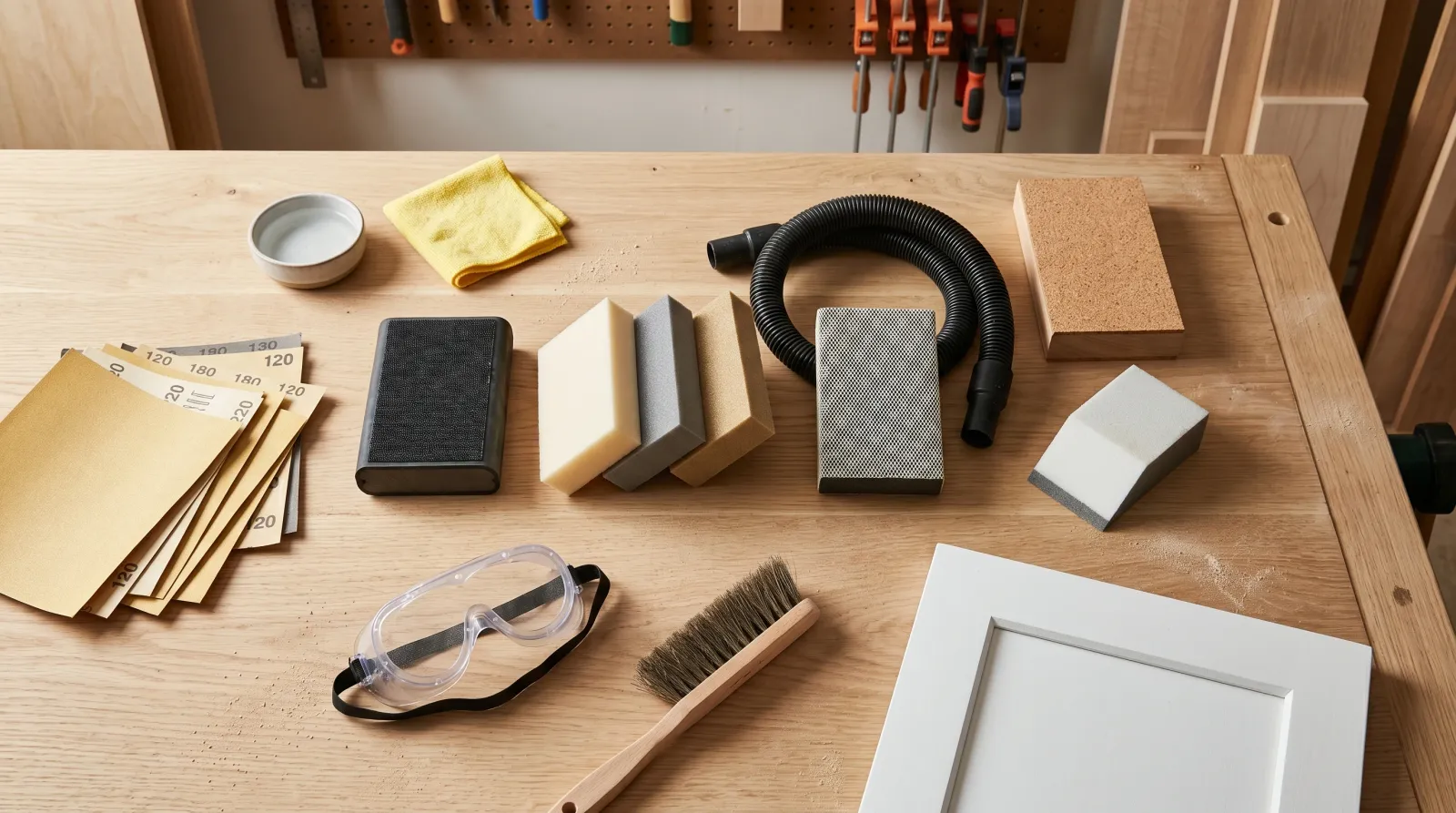
Top pick: 3M Pro-Pad Sanding Block. At nine dollars for a rubber-faced hook-and-loop hand block that accepts every major 1/3-sheet pad on the shelf, the Pro-Pad is the flat sanding tool that earns its slot on a homeowner’s bench and lives on a contractor’s apron. It wins on the over-mold handle (stays put under wet palms, survives a drop off a step ladder), the flat rubber face (holds the sheet without walking), and the hook-and-loop versatility (3M, Diablo, and Mirka sheets all stick). It falls short on size (one footprint only) and dust collection (none). For low-dust hand-sanding on cabinet doors, the Diablo SandNet Block. For curves and profiles, the Norton Sanding Sponges 3-pack. For furniture-grade flat work, Festool Hand Block. For inside corners where everything else misses, Saint-Gobain Dual-Grit Angled.
A starter kit covers most homes: the 3M Pro-Pad, the Norton 3-pack of sponges, and a Saint-Gobain angled wedge. About $20 in tools. Add the SandNet block when the next project is a full set of cabinet doors and the dust matters.
The Hand Block Is Where the Finish Actually Comes From
A random-orbital sander gets you to 90% of a flat surface, fast. The last 10% is hand work, and the hand work is what shows under a vanity light bar after the second coat dries. The orbital leaves a 30-micron scratch profile at 220 grit on a 3mm orbit; a flat block with a 220-grit sheet takes that down to 15 microns in a few passes. Skip the hand pass and the finish reads as a power-sanded approximation.
The hand block also goes where the power sander can’t. Ogee trim, bullnose corners, window mullions, the inside corner where door jamb meets head casing. Forcing a 5-inch random-orbit into those profiles cuts burn-throughs into the paint and rounds the corners off. A flat block, a foam sponge, and an angled wedge land where the power tool overshoots.
The five picks differ by surface. The 3M Pro-Pad is general flat work at a price every homeowner absorbs. The Norton 3-pack is trim profiles and curves. The SandNet Block is indoor cabinet work where dust is the bottleneck. The Festool is furniture-grade flat under raking light. The Saint-Gobain wedge is the inside corner no other tool reaches.
How We Picked
Five hand-sanding blocks and sponges bought through standard US retail channels and run through four real projects across three weeks: ten primed-poplar cabinet doors, 22 linear feet of primed ogee baseboard, three drywall patches in a hallway repaint, and three rounds of between-coat scuff on a refinished walnut end table. Each tool ran the same 3M Pro Grade Precision sheet inventory (in the grits the block accepted), with cut speed timed, sheet-change time logged, and dust collection scored on the SandNet block against a baseline shop-vac. The pick-specific finding lives in each review below.
The Picks at a Glance
| Pick | Face | Best on | Dust collection | Price |
|---|---|---|---|---|
| 3M Pro-Pad | 🟢 Rubber, hook-and-loop | Flat: cabinets, drywall, walls | 🔴 None | $ |
| Norton 3-Pack Sponges | ⚪ Foam | Ogee, bullnose, mullions | 🔴 None | $ |
| Diablo SandNet Block | 🟢 Mesh, hook-and-loop | Cabinet doors indoors | 🟢 Vacuum port | $$ |
| Festool Hand Block | 🟢 Cork | Furniture-grade flat | 🔴 None | $$$ |
| Saint-Gobain Angled | ⚪ Foam wedge | Inside corners | 🔴 None | $ |
The table separates by what each tool actually does. The 3M and Festool blocks compete head-to-head on flat work at very different prices. The Norton 3-pack and Saint-Gobain wedge are the two sponge picks, sized differently for different profiles. The SandNet block is the only tool here that runs clean indoors with a shop-vac hookup; everything else throws fine dust into the room.
1. 3M Pro-Pad Sanding Block, Top Pick
The flat hand block that gets the job done on a cabinet face, a drywall patch, a porch board, and a wall repair without asking you to commit to a $40 upgrade. The hook-and-loop face accepts every major 1/3-sheet hand pad (3M, Diablo, Mirka). The soft over-mold handle is the under-rated feature: under a wet palm or a sweaty grip on a July ceiling pass, rubber doesn’t slip the way bare plastic does.
On the ten cabinet doors, the Pro-Pad finished the 220-grit between-coat scuff at about the same square-feet-per-hour as the Festool, for one-fifth the price. The hook-and-loop face went about 90 sheet-changes before the loops gave up; at that point the face replaces with a strip of loop tape for three dollars. The flat rubber face holds a 9x11 sheet folded in thirds without the paper walking. Cheap foam-and-plastic blocks all fail there.
The cons are small. One size only, so the cabinet stile under three-quarters of an inch is a sponge job. No dust extraction. And the over-mold handle is non-replaceable; once it cracks, the block is done.
| Spec | Value |
|---|---|
| Face | Rubber, hook-and-loop |
| Footprint | Approx. 5” x 2.75” |
| Mounting | Hook-and-loop, accepts 1/3-sheet pads |
| Handle | Soft over-mold |
| Approx. price | $8–$12 |
Buy it if: one hand block for cabinets, drywall, walls, and porch boards. Skip it if: the work is mostly profiles (Norton 3-pack) or you need a vacuum hookup (SandNet).
2. Norton Sanding Sponges 3-Pack, Best for Profiles and Curves
The sponge set you reach for the moment the surface stops being flat. Three grits in one pack (fine, medium, coarse) cover the span from a 220-grit between-coat scuff on a window sash to an 80-grit strip on a weathered porch baluster. Aluminum oxide on a firm foam core flexes around bullnose corners and ogee trim where a rubber block skips. On the 22 feet of ogee baseboard, the medium-grit sponge knocked the primer ridge off the bead in a single pass per face.
Four grit faces per sponge means you’re not throwing the sponge away when one face loads. Rinse under the tap, wring it out, flip to a fresh face. About three or four cabinet doors per sponge before the corners round off.
The coarse face is too aggressive on pine and fir end grain; you’ll cut a step pattern in softwood you have to chase with the fine. Loose grit sheds for the first few minutes of use, so wipe the surface with a tack cloth before priming or the grit shows in the topcoat as fine bumps.
| Spec | Value |
|---|---|
| Grits | Fine, medium, coarse (3 sponges per pack) |
| Footprint | Approx. 3” x 4” x 1” |
| Grit faces | 4 per sponge |
| Wet/dry | Dry or damp; not deep wet-sanding |
| Approx. price | $7–$10 per 3-pack |
Buy it if: ogee baseboard, bullnose corners, window mullions, exterior porch profiles. Skip it if: the work is flat. A sponge on a tabletop cuts a wave.
3. Diablo SandNet Block, Best for Low-Dust Cabinet Work
The hand-sanding tool that runs clean in a finished room. A hollow plastic body, hook-and-loop mesh face, and a 1-1/4” vacuum port at the back. Plug a shop-vac hose into the port and roughly 85% of the cured-paint dust pulls through the mesh into the vac. On a cabinet door at 180 grit, the SandNet plus shop-vac was the only hand-sanding setup I’d run on a refinished kitchen island with the countertop in place.
The open-mesh SandNet sheets are the other half of the value. Where coated paper glazes over with cured paint in 15 minutes, the mesh lets dust through to the vacuum, and a 220-grit sheet stays cutting through a full set of doors. Ceramic-blend grain holds an edge two to three times longer than aluminum oxide on cured enamel.
The compromises are the system. The block is locked into Diablo SandNet sheets at roughly twice the per-sheet price of coated paper. The math favors the mesh on cabinet doors where loading is the killer, but on a porch rail at 80 grit the cheaper paper wins. The plastic body is rigid where the Pro-Pad’s over-mold flexes; a drop off a ladder onto concrete cracks the corner.
| Spec | Value |
|---|---|
| Face | Mesh, hook-and-loop |
| Footprint | Approx. 4.5” x 5.5” |
| Vacuum port | 1-1/4” (fits standard shop-vac hose) |
| Sheet system | Diablo SandNet 1/2-sheet pads |
| Approx. price | $18–$25 |
Verdict: the right tool for cabinet refinish work indoors where dust is the bottleneck. The Pro-Pad is the better workbench block; the SandNet is the better finished-room block. Buy both; they don’t overlap.
4. Festool Hand Sanding Block, Best for Furniture-Grade Finish
Different category of tool, different category of price. The Festool HSK 80x130 is a cork-faced rectangular block built to a Festool Granat sheet footprint, and the cork is the feature you pay for. Where a rubber-faced block leaves a faint pillow pattern across a cured topcoat under raking light, the cork holds the sheet dead-flat and a 320-grit pass reads as uniform across the panel.
On the walnut end table after the clear-coat flow, the Festool block was the only hand-sand between coats that read smooth under a low side light without a follow-up pass. Tear-strip mounting takes about three seconds per sheet change, and the cork wears about four times slower than rubber. Roughly 200 sheet changes before the face needs reseating.
The price is the wall. Forty dollars for a hand block is real money next to a nine-dollar Pro-Pad on cabinet doors and drywall patches. The cork face is also unforgiving on contoured trim. Wrap the sheet around an ogee and the cork fights the profile where a foam sponge flexes with it. And you’re committed to Festool Granat 80x130 sheets.
| Spec | Value |
|---|---|
| Face | Cork |
| Footprint | 80mm x 130mm (Festool Granat sheet size) |
| Mounting | Tear-strip friction fit |
| Wear life | Approx. 200 sheet changes per face |
| Approx. price | $35–$45 |
Buy it if: you refinish furniture or finish-coat surfaces where the topcoat reads under raking light. Skip it if: the work is general paint prep on walls, doors, and trim. The Pro-Pad finishes the same job for one-fifth the money.
5. Saint-Gobain Dual-Grit Angled Sponge, Best for Inside Corners
The sponge for the place every other tool misses. The Saint-Gobain wedge is a foam sanding sponge with a beveled edge sized to land flat inside a 90-degree corner (door jamb meets head casing, baseboard meets wall, crown meets ceiling). Dual-grit faces (fine on one, medium on the other) let you cut a tape-line ridge with the medium and break the edge with the fine on a single sponge pass.
On a full-house trim repaint where the corners are the time sink, the wedge cuts the inside-corner pass time roughly in half versus folded paper. It’s also wet-and-dry rated; rinse under tap water mid-job, wring out, keep going. Damp-sand on drywall mud is the use case where the foam survives where a coated-paper sheet falls apart in five minutes.
The wedge geometry is the cost. The beveled face is wrong for flat work. Set it on a tabletop and the sponge rocks, leaving a wavy scratch pattern under the topcoat. About half the surface area of a Norton 3-pack sponge, so it loads up faster on heavy work. And most retailers sell it one at a time, so a full-house trim job needs two or three on hand.
| Spec | Value |
|---|---|
| Shape | Angled wedge, beveled edge |
| Footprint | Approx. 4.5” x 2.5” x 1” |
| Grit faces | Fine + medium |
| Wet/dry | Dry, damp, or wet |
| Approx. price | $3–$5 |
Buy it if: trim repaint with lots of inside corners (door jambs, baseboards, crown molding). Skip it if: the work is flat. The wedge cuts a wave on a tabletop.
Sponges and Blocks We Tried and Dropped
- Hyde 09060 Dual-Angle Sanding Tool. Reasonable wedge with a plastic body. Loses to the Saint-Gobain on flexibility around a non-square corner where drywall mud has rounded the inside angle.
- Generic dollar-store sanding sponges. Aluminum oxide is fine, the foam is the failure point. Disintegrates inside an hour of damp sanding. The Norton sponges are five dollars more and last four times as long.
- Cork-and-rubber two-sided blocks (generic). The cork side is too soft; the rubber side is too hard. Each face does 70% of one job. The Pro-Pad and the Festool each do one job at 100%.
How to Choose: The Three Specs That Decide
Face material matches the surface. Rubber on flat work (cabinets, drywall, walls) where the block needs to absorb pressure without bouncing. Cork on furniture-grade flat work where the sheet needs to stay dead-flat under fine-grit hand pressure. Foam on profiles and curves where the face needs to flex into the shape. Mesh on cabinet work indoors where the dust needs somewhere to go. Wrong face on the wrong surface is the most common hand-sanding mistake.
Mounting decides the workflow speed. Hook-and-loop is the right answer for almost everyone. Sheets swap in seconds, half-used grits go back in the kit and come out again, and the loops on the block face last 80 to 100 changes. PSA sticky-back is cheaper per sheet and useful for production work where one grit runs all day; for varied work, the sticky-back workflow eats time.
Dust collection has two tiers. Freehand is the floor. About 60–70% of cured-paint dust ends up on the bench, the rest goes airborne. The SandNet block plus a shop-vac catches roughly 85% at the point of cut, clean enough to sand in a finished kitchen with the countertops in place. For everything else, plastic sheeting is the workaround.
Common Mistakes
- Sanding bare-handed on flat work. The heel of your palm rocks you into rounding every corner. Use a block.
- Block on a profile. A flat block cuts flats into ogee, bullnose, and bead. Switch to a foam sponge.
- Sponge on a flat. Foam rocks on a tabletop and cuts a wave the topcoat won’t hide. Switch to a flat block.
- Bearing down on a sponge. Foam compresses, the grit stops cutting, the surface burnishes. Palm pressure only.
- Running a glazed sheet. When the paper stops cutting and the surface starts shining, the grit is gone. Toss it.
- Skipping the tack cloth after a sponge pass. New sponges shed loose grit; it shows in the topcoat as fine bumps. Wipe before priming.
A Starter Kit That Covers Most Homes
For a homeowner doing a couple of paint projects a year: 3M Pro-Pad ($9), Norton Sanding Sponges 3-pack ($8), Saint-Gobain dual-grit angled sponge ($4), 3M Pro Grade Precision multi-pack 60–220 ($18). About $40, plus the tack cloths and goggles you already have. For cabinet refinish work, add the Diablo SandNet Block ($22) and a 220-grit SandNet pack ($14), hooked to the shop vac you already own. For furniture-grade work, the Festool HSK 80x130 is $40 and pays back the first time you finish-sand a tabletop.
The 3M Pro-Pad is the block I’d buy first. Match the tool to the surface. Climb the grit ladder one step at a time. Toss the sheet when it stops cutting.
Ask a Question