Best Deck Stain Applicators
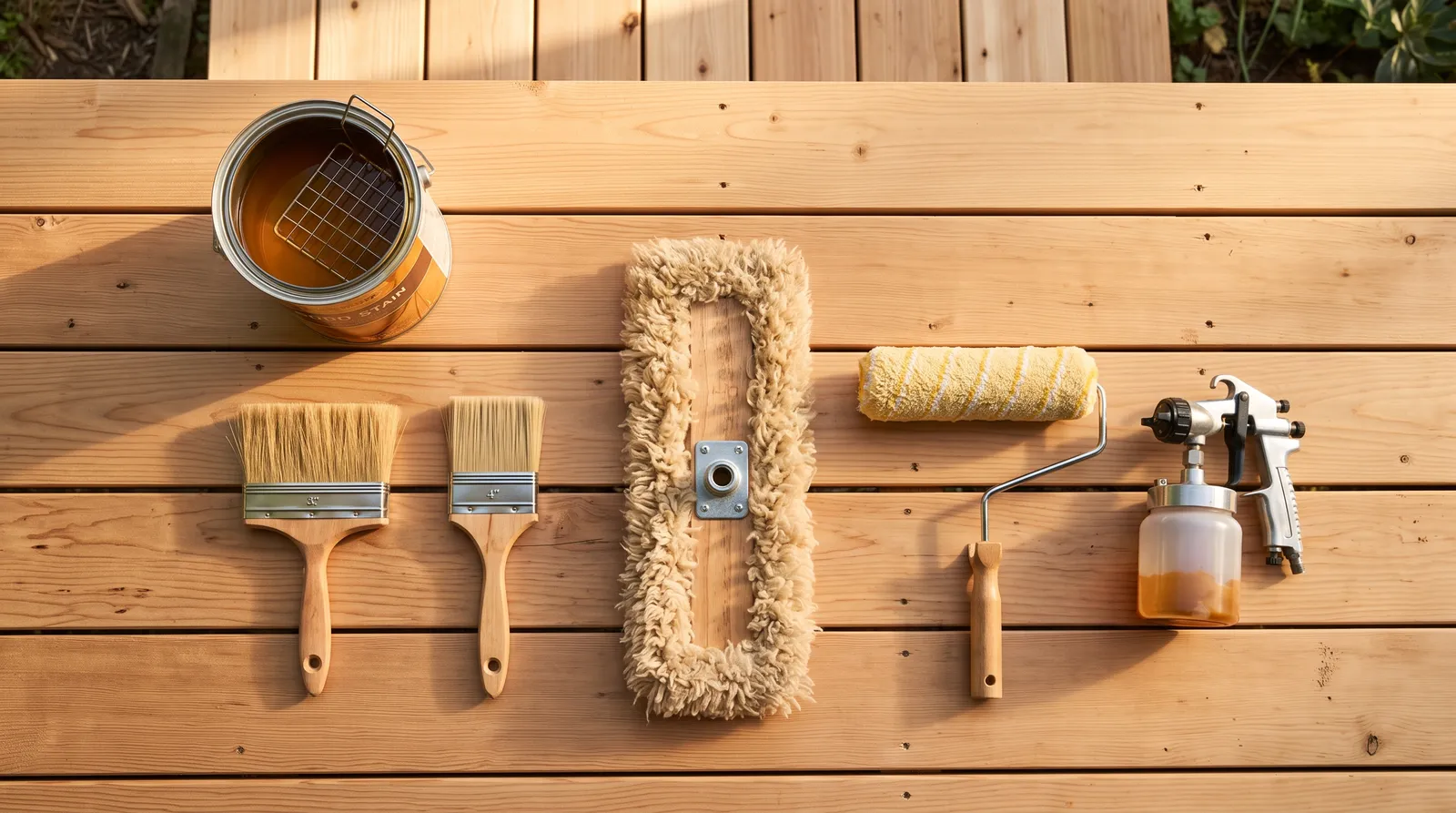
Five deck stain applicators tested on 900 square feet of cedar and pressure-treated pine. Top pick: the Wooster Bravo Stainer, plus where each brush, pad, roller, and sprayer falls short.

Disclosure: Some links below are affiliate links. We earn a commission if you buy through them, at no extra cost to you.
Top pick: the Wooster Bravo Stainer, 4-3/4 inch. About $18, natural bristle, and the only applicator in this test that put oil stain into twelve-year-old cedar instead of laying it on top. It wins on penetration and on load capacity, which together are the whole game on a deck. It falls short on speed and on your knees, because there’s no pole thread and you will be crawling. Skip this if your stain is waterborne; natural bristle turns to a mop in water, and the Purdy XL Swan 4 inch is the brush that holds its shape. For 400 square feet of open field boards, the Wooster Wool Floor Applicator on a pole is three times faster than anything else here. For grey, splintered, checked decking, the Purdy Colossus 3/4 inch nap gets stain down into the damage. For 74 turned spindles, the Wagner Control Stainer 350 turns an hour of fiddling into a few minutes.
No single applicator finishes a deck.
Every deck job is two tools: something fast for the field, something bristled following behind. Plan for both and the job takes an afternoon. Plan for one and you’ll be sanding lap marks in September.
What a Deck Does to an Applicator That a Wall Doesn’t
A wall is flat, primed, sealed, and vertical. A deck is none of those.
Deck boards are absorbent in some spots and sealed in others, sometimes on the same board. The end grain drinks four times what the face does. Boards check as they age, opening hairline splits along the grain that a stain has to get down inside or the wood keeps taking on water. The surface is horizontal, so gravity puts stain into every gap instead of holding it on the substrate. And the sun is on it, which means your wet edge sets in a fraction of the time it would indoors.
That last one drives most of the tool choice. On a 90-degree July afternoon on south-facing cedar, an oil semi-transparent starts skinning in about two minutes. A 16-foot board has to go end to end inside that window or the overlap shows as a dark band forever. Board length matters more than deck square footage when you’re picking an applicator, because whatever you buy has to cross the longest board without a reload.
A deck also punishes anything that only touches the high points of the grain. Pads and short-nap rollers ride the surface. On new smooth pine that’s fine. On weathered cedar it’s a coat that looks great for three weeks and then shows every low spot the applicator skipped.
Matching the Applicator to the Stain and the Wood
Three questions decide this, in order.
What’s the stain chemistry? Oil-based penetrating stains want natural bristle. Bristle is hollow, it wicks, it holds an enormous load, and it releases slowly. Waterborne stains want nylon and polyester filament, because natural bristle swells in water and loses its chisel about ten minutes in. That’s not a preference. It’s a materials problem, and it’s the single most common mistake we see on homeowner deck jobs. Get the drying times for your specific product before you start, because water-based deck stains set faster than oil and change how big a section you can work.
What condition is the wood in? Run your palm across a board. Smooth new lumber under two years old takes a pad beautifully. Grey, fuzzy, or checked wood needs bristles or a long nap to get stain down into the openings. If the boards are splintering, a pad is going to catch and shed fibers into the finish. Prep decides half of this, and the exterior wood prep guide is worth reading before you buy anything.
How big is the field and how long are the boards? Under 200 square feet with short boards, a brush alone is fine and takes about three hours. Over 400 square feet, you want something on a pole for the open areas or your back is done by noon. Over 600 square feet with 16-foot runs, you want two people.
Everything else is detail. Spindle count decides whether the sprayer earns its keep. Deck height decides whether the stain dripping through the board gaps lands on dirt or on your patio furniture.
Comparison at a Glance
| Brand / Model | Type | Best stain | Best deck condition | Pole thread | Price tier |
|---|---|---|---|---|---|
| Wooster Bravo Stainer 4-3/4 in. | Natural bristle block brush | Oil-based | Any, especially checked and weathered | No | $$ |
| Purdy XL Swan 4 in. | Nylon/poly flat brush | Water-based | Any | No | $$ |
| Wooster Wool Floor Applicator 12 in. | Lambswool pad | Oil or water | Smooth, newer lumber | Yes | $$ |
| Purdy Colossus 9 in., 3/4 in. nap | Woven roller cover | Oil or water | Grey, splintered, heavily checked | Via frame | $$ |
| Wagner Control Stainer 350 | Handheld HVLP sprayer | Thin semi-transparent | Railings, spindles, lattice | N/A | $$$ |
1. Wooster Bravo Stainer 4-3/4 Inch, Top Pick
The Bravo Stainer is a block brush built for one job. Wooster lists it for oil-based stains, sealers, and wood toners, and the whole design serves that: a thick natural-bristle head, a short handle you grip like a scrub brush, and enough load capacity that a full dip crosses a 16-foot board with stain left over.
That load capacity is the reason it wins. On the cedar job, a single dip carried the brush across a full 16-foot 5/4 board and back about two feet. Nothing else in the test did that. The Purdy XL Swan needed two dips for the same run, and two dips means a pause in the middle of a board, and a pause in the middle of a board on hot cedar means a lap line.
Penetration is the second reason. We wiped a rag across cured boards a week after staining. The brushed boards came back clean with color locked in the grain. The padded boards left a faint surface film on the rag, which is stain sitting on top rather than in the wood. On checked boards the difference was obvious with the naked eye: the brush had worked color down into the splits, the pad had bridged them and left a pale seam.
The cons are real and they’re both about labor. There’s no pole socket, so every square foot of decking gets done on your knees. Kneepads are not optional on a job over 300 square feet. And cleanup is oil-stain cleanup: two changes of mineral spirits, a brush comb, then soap and water, about fifteen minutes if you’re honest about it.
The other limit is chemistry. Natural bristle in a waterborne stain swells, splays, and stops laying a clean line, and no amount of technique fixes it. Wooster does sell the Bravo Stainer in a bristle and polyester blend, which handles both. If you only want to own one deck brush, that’s the one to get.
| Spec | Value |
|---|---|
| Type | Natural bristle block stain brush |
| Sizes | 2-3/4, 4, 4-3/4, 5-1/2 inch |
| Coatings | Oil-based stains, sealers, wood toners |
| Pole thread | No |
| Approx. price | $14–$22 depending on width |
Buy it if: you’re using an oil-based penetrating stain on anything, and especially if the deck is older than five years. Skip it if: your stain is waterborne, or the deck is big enough that you need a pole tool as your primary applicator.
2. Purdy XL Swan 4 Inch, Best for Water-Based Stain
Different chemistry, different brush. The XL Swan is a nylon and polyester flat brush rated for latex, oil paint, and oil stain, and it is the one we reached for on the waterborne pine job.
The filament is the point. Two hours into a gallon of water-based semi-transparent, the Swan still had a straight chisel and enough stiffness to work stain into the grain rather than smear it around. A natural-bristle brush in the same conditions was noticeably softer at the thirty-minute mark and flopping by the end of the first hour. Cleanup was warm water and about three minutes.
Where it gives ground is capacity. A 4-inch flat head holds meaningfully less than a block stainer, so you reload more often, and a 5-1/2 inch deck board takes a pass and a half instead of a single clean stroke. On short boards nobody notices. On a long run in direct sun you’ll feel it.
Verdict: the brush for any waterborne deck stain, and a fine general exterior brush the rest of the year. About $16–$20 for the 4 inch. If you want the wider comparison across brush lines, see the paint brush round-up.
3. Wooster Wool Floor Applicator 12 Inch, Best for Big Flat Decks
Speed tool. On open field boards, nothing else here is close.
The wool pad threads onto a standard extension pole, and a 12-inch head spans two deck boards plus the gap between them. On the 280 square foot pine deck, working standing up, the field boards were done in about forty minutes. The same area brushed on hands and knees took just under two hours on the cedar side.
The lambswool also meters well. Semi-transparent stain wants a thin, even coat, and the pad is better at that than a roller by a wide margin. Where a 3/4 inch nap dumps product and floods the gaps, the pad lays down close to the right film thickness on the first pull.
Then the limits show up.
The pad rides high spots. On the twelve-year-old cedar it skipped the checking entirely, leaving pale lines along every split, which is exactly the wood that most needs the stain. It drools into the board gaps and onto whatever sits under the deck, so tarp the patio set. It loads unevenly straight out of the tray and needs a couple of passes on a scrap board to even out. And if you let oil stain dry in the wool once, the pad is finished; it mats into a hard mitt and never lays flat again.
Use it as the field tool with a brush working behind you, never as the only tool. Any pole works; the extension pole round-up covers which ones don’t flex under a loaded 12-inch head.
Buy it if: the deck is smooth, newer lumber and over roughly 300 square feet. Skip it if: the boards are grey, fuzzy, or checked. It’ll look right for a month and wrong for a year.
4. Purdy Colossus 3/4 Inch Nap, Best for Weathered Boards
The Colossus is 100 percent woven polyamide built for semi-rough to extra-rough surfaces, which is a fair description of a decade-old cedar deck.
Woven, not knit, is the spec that matters here. A knit cover on splintered grey wood snags and sheds fiber into the finish, and you spend the back-brush pass picking lint out of wet stain. The Colossus came off 620 square feet of rough cedar with the nap intact and no shed we could find in the cured film. It also cleaned back to usable after an oil job, which is rare enough for a roller cover to be worth mentioning.
The 3/4 inch nap gets down into checking and saw-kerf texture that the wool pad rode straight over. On the worst boards on the deck, the ones with splits you could lose a dime in, the roller plus a back-brush was the only combination that filled them.
It puts down too much stain. That’s the trade-off and it isn’t negotiable. Rolled stain sits proud on the surface and will cure into a shiny film if you leave it, so every pass needs a brush behind it inside about a minute. Roll two or three boards, back-brush, move up. It also throws fine spatter off the ends of the cover, which lands on siding and on your shoes. And on smooth new pressure-treated pine it’s the wrong tool completely; use the pad.
Verdict: the fast applicator for wrecked wood, paired with a brush and a second person. About $9–$13 per cover.
5. Wagner Control Stainer 350, Best for Railings, Spindles, and Lattice
Railings are where deck staining stops being fun.
Seventy-four turned spindles, each one with a bulge and two coves that a 4-inch brush can’t follow, plus two lattice panels with 300-odd little diamond openings. Brushed, that section of the cedar deck was a full afternoon. With the Control Stainer 350, an HVLP handheld that Wagner sizes for small and medium stain projects, the spraying itself took under fifteen minutes.
Semi-transparent stain sprayed straight from the can with no thinning. HVLP atomizes at low pressure, so the overspray stayed close to the work instead of drifting across the yard, though we still masked the siding and hung plastic on the shrubs. If you’re comparing sprayer categories more broadly, the sprayer round-up covers airless and HVLP side by side.
Four honest cons. You still back-brush everything you spray, so the sprayer buys you application time and not finish time. Masking a railing system takes longer than spraying it does. The cup is small enough that anything past a stair rail run means refills. And solid-body stain will clog the nozzle unless you strain it first.
Buy it if: your deck has a railing system, lattice skirting, or a pergola. About $100. Skip it if: the deck is a floating platform with no verticals. You’d be masking a house to save twenty minutes.
How We Ran the Testing
Three real jobs, one stain season, same scoring on every tool.
The cedar job. 620 square feet of twelve-year-old western red cedar, heavily checked and grey, pressure-washed and left four days to dry, finished in an oil-based semi-transparent penetrating stain. This was the hard test. Any applicator that can’t get into a check fails here.
The pine job. 280 square feet of pressure-treated pine built the previous fall, still smooth, finished in a waterborne semi-transparent. This is where pads look brilliant and natural bristle looks bad.
The railing job. 74 turned spindles, 96 linear feet of top and bottom rail, two 4x8 lattice panels under the stair. The sprayer test.
Five axes. Coverage speed in square feet per hour on open field boards, timed. Penetration, judged by wiping a clean rag across cured boards a week out and looking for surface film. Lap-mark visibility on 16-foot runs, photographed in raking morning light where every overlap shows. Comfort over a two-hour continuous session. Cleanup time from last stroke to dry stored tool.
Every roller, pad, and sprayer pass got back-brushed inside 60 seconds, because that’s how a deck actually gets stained. We also tracked stain consumption on a marked 40 square foot cedar panel per applicator. The roller used the most by a clear margin. The pad used the least.
The Bravo Stainer won penetration and lap marks. The wool pad won speed on open field. The Colossus won on checked wood with a brush behind it. The Control Stainer 350 won the railing job outright and was irrelevant everywhere else. The XL Swan won the waterborne job for the simple reason that it was the only brush still holding a chisel at the end of it.
Applicators We Tried and Dropped
- Foam brushes. Cheap, and they collapse. Oil stain softens the foam and the head folds over inside twenty minutes. Fine for a handrail touch-up, useless for a deck.
- Deck stain “pad on a stick” kits from the big-box seasonal aisle. The pad itself is usually fine; the pole connection is a plastic socket that wobbles under a loaded head. Buy a Wooster pad and a real pole instead.
- Garden sprayers. People do this and then spend the next day back-brushing a mess. A pump sprayer has no atomization control and floods the low spots.
- Airless sprayers. Overkill on a residential deck. Too much material, too much overspray, and you still back-brush. The airless round-up explains where they do make sense.
- Old T-shirts and rags. Works on furniture, not on 600 square feet. You’ll run out of hand strength before you run out of deck.
Cleanup, Storage, and How Long These Last
Oil stain is the hard part. Don’t put it off.
Natural bristle after oil stain. Work the brush out on a scrap board until it stops giving up color. Wash in mineral spirits in a clean container, comb from the ferrule outward, dump the dirty solvent, and do it again in fresh. Two changes, not one. Finish with warm water and dish soap, spin out the water, comb straight, and store it flat in the original keeper. Treated that way a Bravo Stainer runs five or six seasons.
Synthetic after waterborne stain. Warm water, a little soap, comb, spin, keeper. Three minutes. This is the whole argument for waterborne stain on a deck you’ll re-coat often.
The wool pad. Rinse or flush it the moment you stop, and do not let stain cure in the wool. One dried oil job and the pad mats into a hard mitt. Ours survived the pine job and the flat sections of the cedar job before the wool started to feel stiff.
The roller cover. Most people toss these after an oil job. The Colossus is one of the few worth cleaning: work it out on cardboard, spin it, spirits, spin again, spirits, stand it on end to dry. Expect three or four deck jobs out of one cover.
The sprayer. Flush immediately per the manual, every time, no exceptions. A stain sprayer that sat overnight with product in the passages is a warranty claim waiting to happen.
Realistic life: Bravo Stainer 5–6 seasons, XL Swan 4–5 seasons, wool pad 2–3 decks, Colossus cover 3–4 decks, Control Stainer 350 years if you flush it and one season if you don’t.
Mistakes We Still See on Decks
- Natural bristle in a water-based stain. The brush goes limp, the finish streaks, and people blame the stain. Match the filament to the chemistry.
- Staining in direct afternoon sun. The stain skins before it penetrates and you get a blotchy surface film. Follow the shade around the deck, or start early.
- Skipping the back-brush after a roller or pad. This is the number one reason deck stain fails in year one. Rolled stain sits on top. Brushed stain goes in.
- Staining wet wood. Four days after a pressure wash, minimum, and longer in humidity. Water in the cells means the stain has nowhere to go. Related failure mode: the same trapped-moisture problem that drives peeling exterior paint.
- Ignoring the board ends. End grain drinks about four times what the face does, and unsealed ends are where rot starts. Dip a brush and flood every cut end, including the ones under the rail.
- Buying one applicator. Every deck needs a fast tool and a brush. One tool means either a slow job or a bad finish.
- Staining over a deck that needed prep. No applicator fixes a mill-glazed or dirty board. Wash it, let it dry, and check the pressure washer round-up if you’re renting.
A Kit That Covers a Real Deck
For a typical 400 square foot deck with a railing, in oil-based stain: a Bravo Stainer 4-3/4 inch ($18), a 12-inch Wooster wool floor applicator ($25) and a pole you probably own, one Purdy Colossus 3/4 inch cover ($11) for the rough sections, and a 5-gallon pail with a grid. Call it $60 and an afternoon with a helper.
If the railing has more than about 40 spindles, add the Control Stainer 350 and you’ll get that time back on the first job.
If the stain is waterborne, swap the Bravo for the XL Swan 4 inch and cut your cleanup time by 80 percent.
Buy the brush no matter what else you buy. Then pick the stain properly, because a good applicator with a bad product is still a deck you’re re-doing in two years. Our deck stain round-up has the products, and the full deck staining walkthrough has the order of operations.
Ask a Question