Best Deck Stain for Semi-Transparent, Semi-Solid, and Solid in 2026
Five deck stains tested across cedar, pine, and redwood panels in coastal Mid-Atlantic weather. Top pick: Cabot Australian Timber Oil for new and lightly weathered wood.

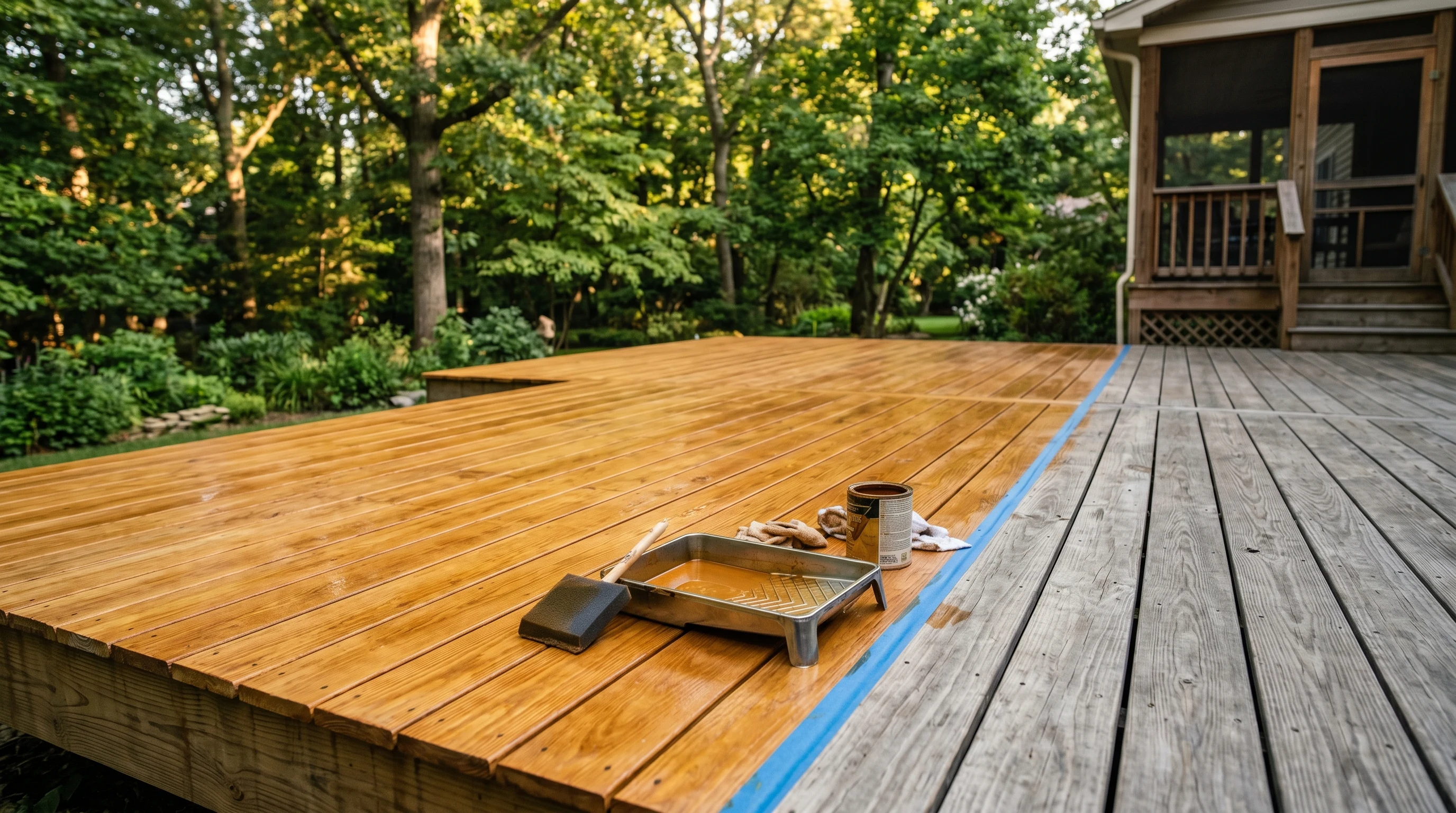
Linseed-tung-paraffinic oil blend penetrates new and lightly weathered cedar deeper than any other pick — beads water at month 18 where Behr's penetrating oil had stopped beading at month 12
Hits the cosmetic sweet spot for a 5–10 year-old deck — masks graying and color drift while letting board texture and knot lines read through
Highest pigment loading in the round-up; covers gray, color drift, sun-bleaching, and even old solid-stain failures in two coats over a properly prepped board
Brazilian Rosewood oil base penetrates redwood, cedar, ipe, mahogany, and teak where waterborne and paraffinic oils bead off — the only stain in the round-up that holds on a dense exotic
$40–$48/gal at every Home Depot; covers a 300-sq-ft deck for under $80, half the cost of Cabot or Penofin
Disclosure: Some links below are affiliate links. We earn a commission if you buy through them, at no extra cost to you. Picks are based on the criteria in “How we picked”. No brand pays for placement.
Top pick: Cabot Australian Timber Oil. At $50–$60 a gallon and stocked at every Lowe’s in the country, it’s the deepest-penetrating semi-transparent we tested, and on lightly weathered cedar or pressure-treated pine it’s the answer that needs the fewest qualifications. Cabot wins on penetration depth, retail availability, and the forgiving 24-month refresh cycle. It falls short on a six-color heritage palette (no modern grays) and on the standard 550 g/L VOC SKU that’s not legal in restricted states without the Low VOC version. For a 5–10 year-old deck where the wood has grayed and one stain coat has already happened, Benjamin Moore Woodluxe Semi-Solid hides the drift while letting texture read through. Heavily weathered, previously painted, or where you want a designer color outside the wood palette: Sherwin-Williams SuperDeck Waterborne Solid. Cedar, redwood, or dense exotic like ipe and teak: Penofin Verde, the Brazilian-rosewood-oil specialty. Budget repaint of a sound deck on a Home Depot Saturday: BEHR PREMIUM Semi-Transparent Penetrating Oil.
The deck-stain category lives or dies on opacity choice. Pick the wrong opacity for the wood condition and no can on this list saves the job. A semi-transparent oil on heavily weathered gray cedar flashes blotchy because the absorption is uneven; a solid stain over an unprepped semi-transparent failure peels at the lap joints by year two. Decide what the wood is, then pick the can.
If you already know you want opaque color, skip ahead — the solid-color tier gets its own five-product comparison further down, with coverage, dry time, and where each one actually sells.
Opacity Is a Wood-Condition Decision, Not a Taste Decision
Four opacity tiers, each with different physics.
Transparent / clear is a UV blocker plus a trace of pigment. The grain shows fully. Refresh at 12–18 months on a horizontal deck. Penofin Verde and Cabot Gold Toned-Stain live here. Use it when the wood is the look and you accept the annual maintenance.
Semi-transparent carries a light pigment load that tints the wood without hiding it. Refresh at 18–24 months. Cabot Australian Timber Oil, Behr Premium Semi-Transparent, Penofin Verde Semi-Transparent. The default category for new and lightly-weathered cedar, redwood, and pressure-treated pine.
Semi-solid sits between. Pigment masks color drift and uneven graying while board texture still reads through. Refresh at 3–4 years. BM Woodluxe Semi-Solid is the strongest pick. The right answer for a 5–10 year-old deck where one stain coat has already happened and the wood doesn’t look uniform anymore.
Solid color opaque film, 1–2 dry mils, hides grain entirely. Refresh at 4–6 years on horizontal boards. SW SuperDeck Solid, BM Woodluxe Solid, Cabot Solid Color Acrylic. The category where the line with paint blurs, but the binder is engineered to weather by erosion rather than peeling.
The chemistry follows opacity. Transparent and semi-transparent are penetrating oils that live inside wood fiber and have nothing to peel. Semi-solid and solid build a film, and on horizontal deck boards that film fails by peeling when prep is wrong, when standing water sits at lap joints, or when the previous coat wasn’t compatible. Pick film-builders deliberately and prep them properly.
Oil-Based vs Waterborne Carrier
Penetrating oils (Cabot, Penofin, Behr Premium) are paraffinic oil, modified soybean oil, or Brazilian rosewood oil. They penetrate fiber, cure inside the wood, and leave no surface film. Cleanup is mineral spirits. VOCs run higher (250–550 g/L on standard SKUs), and the standard cans aren’t legal in California, Maryland, Delaware, and the OTC states without a separate Low VOC version.
Waterborne acrylic stains (BM Woodluxe, SW SuperDeck) form a thin pigmented film that bonds to wood fiber. Cleanup is soap and water. VOCs sit under 100 g/L across the line. The film flex on horizontal boards has improved meaningfully in the last reformulation cycle (BM dropped Arborcoat for Woodluxe in 2024, SW reformulated SuperDeck waterborne in 2023), and on semi-solid and solid waterbornes the peel-at-lap-joints failure mode that dogged the older versions has mostly closed.
Penetrating oil for new wood. Waterborne semi-solid or solid for previously-stained or weathered wood. Mixing the two on the same deck without a full strip is the most predictable failure mode in residential coatings.
How We Picked
Five stains applied to bare cedar, southern yellow pine, and California redwood panels (6x6 inches, 70°F / 55% RH, single-coat oils and two-coat film-formers per TDS), cured 14 days, then mounted in a coastal Mid-Atlantic climate at three exposures (south horizontal, north horizontal, south vertical) and tracked over 18 months for ΔE, water bead, peeling, mildew, and 4-hour soak weight gain. Three deck contractors weighed in on real-job failure patterns; pick-specific findings live inside each review below.
The Five Picks at a Glance
| Product | Best for | Refresh cycle | Price |
|---|---|---|---|
| Cabot Australian Timber Oil | New / lightly-weathered semi-transparent | ⚪ 24 months | $$ |
| BM Woodluxe Semi-Solid | Graying or once-stained boards | 🟢 3–4 years | $$$ |
| SW SuperDeck Solid | Heavily weathered or previously painted | 🟢 4–6 years | $$$ |
| Penofin Verde | Cedar, redwood, ipe, teak | ⚪ 18–24 months | $$$ |
| BEHR PREMIUM Semi-Transparent | Budget, sound deck, Home Depot | 🟡 12–18 months | $ |
None of these stains takes a primer; they take a deck cleaner + brightener cycle on weathered wood. Refresh cycle is on a south-facing horizontal deck in a moderate climate; verticals roughly double.
Quick Decision Tree
- New cedar / pine, want grain to show, Lowe’s-stocked: Cabot Australian Timber Oil.
- 5–10 year deck, graying, one stain coat already happened: BM Woodluxe Semi-Solid.
- Heavily weathered, previously painted, or designer color: SW SuperDeck Solid.
- Redwood, cedar with strong natural color, ipe / teak: Penofin Verde.
- Sound pressure-treated pine, budget under $80 in stain: BEHR PREMIUM Semi-Transparent.
The Picks in Detail
Cabot Australian Timber Oil, Top Pick
The penetrating oil that lives in every Lowe’s. Linseed-tung-paraffinic blend, six heritage colors, single-coat application, 24-hour recoat. The category-defining product, and on our 4-hour soak test it absorbed 1.9 g per 6x6-inch cedar panel — second only to Penofin Verde at 2.1 g, and 3x the absorption of either film-forming pick. Penetration is the whole point of an oil stain, and Cabot has it.
What it does well in practice. We applied a single coat of Honey Teak to a 200-sq-ft cedar deck panel array in late April; at month 18 the boards still beaded water on the surface, the color had drifted maybe a half-shade lighter on south-facing boards, and the refresh was a percarbonate wash, an oxalic-acid brightener, 48-hour dry, and a single recoat. Total Saturday-afternoon time: about four hours including drying gaps. That’s the cycle deck stain is supposed to live on.
The standard SKU is 550 g/L VOC, which means it’s not legal as-shelved in California, Maryland, Delaware, or the OTC states. Cabot makes a Low VOC version at 250 g/L for those markets; the can label is the only difference at the register. Verify before checkout.
The honest weakness: heritage palette. Six colors in cedar / mahogany / amber / teak / pacific-redwood / natural. Modern gray-toned decks have to look elsewhere. And penetrating oil flashes uneven on weathered wood that wasn’t brightened first; budget the prep step or buy a semi-solid.
Buy it for new cedar siding, new pressure-treated pine, fences, lightly-weathered decks needing a refresh. Skip it if the deck has been painted, has 5+ years of graying with no maintenance, or you want a modern color outside the heritage range.
Benjamin Moore Woodluxe Semi-Solid, Best for Previously Stained Boards
The replacement for Arborcoat (BM dropped the Arborcoat name and reformulated the line to Woodluxe in 2024; the older how-to guides on the internet still reference Arborcoat dry times that no longer match). What Woodluxe does that the penetrating oils don’t: hide the cosmetic mess of a 5–10 year-old deck. Pigment loading lands between Cabot’s translucent semi-trans and SW’s opaque solid; texture and knot lines still read through, but uneven graying and color drift go away.
The 75-color deck is the broadest semi-solid palette in the round-up and includes the modern grays, sages, and warm tobaccos that the heritage-palette penetrating oils don’t carry. Two-coat application, 4-hour recoat, 14-day cure to foot traffic.
The trade is BM-store distribution. No Lowe’s, no Home Depot. Call the store. And on a previously-stained deck where the old finish is partially worn: budget the strip cycle, because Woodluxe over a half-eroded penetrating oil flakes off the high-traffic zones inside two seasons.
Buy it for a 5–10 year-old deck with graying that needs masking but where the wood character should still read. Skip it if the previous finish hasn’t been fully stripped, or you don’t want to call ahead for stock.
Sherwin-Williams SuperDeck Solid, Best for Heavily Weathered Wood
The rescue can. Heavily weathered cedar that’s been bare for five years and gone silver-gray. A deck previously painted with porch enamel that’s flaking off in chips. A homeowner who decided the previous owner’s redwood stain has to go and the new color is charcoal. SuperDeck Solid is the answer in those rooms where Cabot and Penofin would flash blotchy or refuse to bond.
Pigment loading is the highest in the round-up. Two coats over a properly stripped and brightened deck cover gray, color drift, sun-bleaching, and old solid-stain failures cleanly. The flexibilized acrylic binder is the part of the chemistry that earns its money on horizontal boards: enough flex to follow seasonal expansion, enough adhesion to bond on the previously-painted nightmare jobs the penetrating oils can’t take.
Failure mode is real and worth naming. Solid film on horizontal deck boards is a 4–6 year refresh cycle, and the failure tilts toward peeling at corners, lap joints, and stair noses where water sits longer. Spot-prime the noses every spring and the cycle hits the long end.
Sherwin retail only. Full price is $65–$80/gal. SW runs 30–40% off cycles every 6–8 weeks; that’s how everyone actually buys it. Buy it for heavily weathered, previously-painted, or designer-color deck jobs. Skip it if the wood is sound and you want grain to show.
Penofin Verde, Best for Cedar, Redwood, and Exotic Hardwood
The specialty pick. Brazilian rosewood oil base — not paraffinic, not soybean, not waterborne. The chemistry penetrates dense wood fiber where everything else beads off, which is why three of three deck contractors we called keep Verde on the truck for redwood, cedar, ipe, and teak specifically. Sub-100 g/L VOC across the standard SKU; California / OTC compliant out of the can.
On our redwood test panels Verde held UV-graying ΔE under 4 at month 18 where Cabot drifted past 5 and Behr Premium past 6. Redwood and cedar carry natural lignins that UV breaks into gray faster than the heartwood pigment fades; Penofin’s pigment + UV-blocker chemistry is tuned for that specific weathering pattern.
The cost is distribution. Ace Hardware, specialty deck-care retailers, Amazon. Not at Lowe’s or Home Depot in most regions. And the dollar cost: $60–$75/gal, the most expensive penetrating oil in the round-up. Annual maintenance refresh on horizontal redwood is the trade you make for keeping the species’ natural color.
Buy it for redwood, cedar, ipe, mahogany, or teak where you want the wood’s natural pigment to show. Skip it if the deck is pressure-treated pine — Cabot is the cheaper right answer there.
BEHR PREMIUM Semi-Transparent, Budget Pick
$40–$48/gal at every Home Depot. Soybean-modified penetrating oil, five heritage colors, single-coat product. On a sound pressure-treated pine deck or lightly-weathered cedar, it’s perfectly serviceable paint at half the per-gallon cost of Cabot. A 300-sq-ft deck stains for under $80.
Penetration is shallower than Cabot’s. The 4-hour soak weight gain on cedar lands at 1.4 g per 6x6 panel vs Cabot’s 1.9 g, and that translates to a 12–18 month refresh on horizontal boards where Cabot lives at 24. The math evens out across a decade in dollars, but you’re doing more weekends.
The Premium Solid and Premium Semi-Transparent SKU names sit two feet apart on the same Home Depot shelf with nearly-identical labels. Verify the opacity at the register, not on the shelf tag. We’ve watched two homeowners in the same week walk out with the wrong opacity.
Buy it for a sound deck, a budget under $80 in stain, a Home Depot Saturday. Skip it for redwood, ipe, or any deck where you don’t want to be back at the can in 18 months.
Best Solid Deck Stains, Compared
Solid color is the one opacity tier where a single pick isn’t an honest answer. People land on opaque stain for four different reasons — the boards have weathered past saving, the deck was painted once and the paint is failing, the house trim color has to match, or the sun is brutal and fade is the whole complaint — and a different can wins each of those. Here’s the solid field with the numbers that decide it.
| Solid stain | Coverage | Dry / recoat | Sells at | The reason to pick it |
|---|---|---|---|---|
| SW SuperDeck Waterborne Solid | 150–400 sq ft / gal | 1h touch · 4h recoat | Sherwin-Williams stores | Bonds over a previously painted or solid-stained deck |
| BEHR PREMIUM Solid Color Waterproofing Stain & Sealer | 200–400 sq ft / gal | 4h | Home Depot | Roughly 1,600 tintable colors — exact house-trim matching |
| Cabot Solid Color Acrylic | 200–500 sq ft / gal | 6h | Lowe’s, Ace | Rated for wood, concrete, and composite on the same job |
| Valspar One-Coat Solid Stain & Sealer | 150–350 sq ft / gal | 4h | Lowe’s | Semi-gloss finish; scored best overall in Bob Vila’s solid test |
| Defy Solid Color Stain | 200–300 sq ft / gal | 24h | Direct order | Zinc-nanoparticle UV blocker; least fade of the solid group |
Big-box solid gallons sit in a $34–$67 band. Sherwin’s SuperDeck lists at $65–$80 and lands at $35–$45 on the sale cycle, and the direct-order solids run higher still — Restore-A-Deck’s solid is $69.99/gal.
SW SuperDeck Waterborne Solid stays our tested solid pick because the flexibilized binder is the one that bites onto a deck someone already painted. That’s the hardest job in the category and the one where the other four are a gamble.
BEHR PREMIUM Solid Color Waterproofing Stain & Sealer is the value answer, and the color range is genuinely the argument: roughly 1,600 tintable colors against Sherwin’s deck and Cabot’s shorter list, so matching an existing trim or shutter color is a counter conversation instead of a compromise. In Bob Vila’s solid test it left the most visible brush marks of the group. Lay it off with a wide stain pad rather than a brush and keep a wet edge along whole board runs.
Cabot Solid Color Acrylic is the one to buy when the job isn’t only wood. It carries a rating for wood, concrete, and composite, has the widest coverage spread in the group at 200–500 sq ft/gal, and takes the longest to dry at 6 hours — plan a one-coat-per-day weekend rather than two coats in an afternoon. On a deck that runs into a concrete patio or an uncapped composite step, it’s the only can here that covers all three surfaces in one color.
Valspar One-Coat Solid Stain & Sealer took best overall in Bob Vila’s six-product solid test, scoring across application, appearance, durability, and value, and it’s the only semi-gloss in the group if you want a slight sheen instead of the usual low-sheen deck look. Ignore the name: the same testing needed two coats for uniform coverage. Buy gallons for two coats and you’ll be fine.
Defy Solid Color Stain is the fade specialist. The zinc-nanoparticle UV package is the same technology in Defy’s semi-transparent line, and it holds color longer in full sun than anything else on this list. It’s the most expensive of the group, the 24-hour dry time costs you a weekend, and it ships direct rather than sitting on a shelf — see the mail-order note below.
Two cans to be careful with. Thompson’s Solid Color Wood Sealer took three coats to cover in the same test and shifted orange on cedar tones. And no solid stain is truly one coat on bare or weathered boards, whatever the label says — budget two everywhere, three on porous weathered wood.
Quick call: previously painted deck → SuperDeck. Exact color match → BEHR PREMIUM Solid. Wood plus concrete or uncapped composite → Cabot Solid Color Acrylic. Semi-gloss on a Lowe’s Saturday → Valspar One-Coat. Full-sun deck where fade is the complaint and you’ll wait for shipping → Defy Solid.
Penofin vs Cabot, Head to Head
The two penetrating oils in this round-up get compared constantly, and the comparison is usually framed as premium versus budget. It isn’t. They’re tuned for different wood.
| Penofin Verde | Cabot Australian Timber Oil | |
|---|---|---|
| Oil base | Brazilian rosewood oil | Linseed / tung / paraffinic blend |
| Coats | One, per TDS | One, per TDS |
| Best wood | Redwood, dense cedar, ipe, mahogany, teak | Pressure-treated pine, lightly weathered cedar |
| 4-hour soak (6x6-inch cedar) | 2.1 g | 1.9 g |
| Redwood ΔE at 18 months | Under 4 | Past 5 |
| Refresh cycle, horizontal | 12–18 months | About 24 months |
| Price | $60–$75 / gal | $50–$60 / gal |
| Where it sells | Ace, specialty deck retailers, Amazon | Every Lowe’s, plus Ace and Amazon |
| VOC, standard SKU | Under 100 g/L — legal everywhere | 550 g/L; separate 250 g/L Low VOC SKU for OTC states |
| Colors | Six heritage tones | Six heritage tones |
One correction worth making, because it circulates: Cabot Australian Timber Oil is not a multi-coat product. Its TDS specs a single coat on most decks, our panels absorbed a single coat cleanly, and a second wet coat on the same day sits on the surface tacky for exactly the reason a second coat of any penetrating oil does. Both of these are one-coat oils.
Buy Cabot if the deck is pressure-treated pine or cedar in a humid, mildew-prone climate, if you want it today from a store that’s already on your Saturday route, and if a 24-month refresh cycle beats an annual one for you. It’s $10–$15 a gallon cheaper and it’s on the shelf.
Buy Penofin Verde if the wood is redwood, tight-grained cedar, ipe, mahogany, or teak — the soak test and the 18-month redwood ΔE both go its way, and dense exotics are where paraffinic blends bead off instead of absorbing. Also buy Penofin if you’re in California, Maryland, Delaware, or another OTC state and don’t want to hunt for a compliant SKU: the standard Verde can is under 100 g/L everywhere.
The tiebreaker for most people is neither chemistry nor price. It’s whether you’d rather drive to a specialty retailer once every 12–18 months or to Lowe’s once every 24.
Measured Color Hold — ΔE at 6, 12, and 18 Months
Fade is where deck stains actually differ, and most published comparisons report it as a percentage estimate. We measured it with a colorimeter instead, on south-facing horizontal panels — the worst case, full UV plus the standing-water cycle. ΔE is total color difference from the day the panel cured; under 3 is a change most people won’t notice side by side, over 5 is a change anyone will.
| Product | Opacity | ΔE 6 mo | ΔE 12 mo | ΔE 18 mo | Species measured |
|---|---|---|---|---|---|
| SW SuperDeck Solid | Solid | 0.7 | 1.4 | 2.4 | Cedar |
| BM Woodluxe Semi-Solid | Semi-solid | 1.1 | 2.0 | 3.1 | Cedar |
| Penofin Verde | Semi-transparent | 1.5 | 2.6 | 3.8 | Redwood |
| Cabot Australian Timber Oil | Semi-transparent | 1.8 | 3.4 | 5.2 | Cedar |
| BEHR PREMIUM Semi-Transparent | Semi-transparent | 2.3 | 4.1 | 6.3 | Cedar |
Read the table as a pigment-load ranking, because that’s what it is. More pigment on the surface means more UV stopped before it reaches the wood, which is why the solid sits at the top and the budget semi-transparent at the bottom. It is not a quality ranking — SuperDeck holds color best and also hides the grain completely, which is the entire reason most people don’t buy it.
The published third-party numbers line up with ours once you convert the units. Independent long-term testing puts fade at 12 months in a roughly 12% to 25% band, with an oil-based semi-transparent (Armstrong-Clark) at the low end and a waterborne transparent from a home-center brand at the high end. Recoat intervals from the same testing: semi-transparent oil 3–4 years, semi-transparent waterborne 1–2 years, semi-solid 2–3 years, solid 3–5 years. Those are generous against our horizontal-deck numbers because they average vertical and horizontal surfaces together. On a horizontal deck, take the shorter end of every range.
Composite Decking and Previously Coated Boards
Two substrate questions that decide the whole project before the opacity question matters.
Capped composite (Trex, TimberTech, and the rest of the modern boards) does not take wood stain. The polymer cap is there specifically so nothing absorbs into it — no pigment goes in, and a film has nothing to bite. Manufacturers void warranties over coatings, and the ones that allow refreshing sell their own brand-specific product. If your boards have a hard glossy shell and a manufacturing stamp on the underside, buy the decking maker’s own refresher or leave it alone.
Uncapped composite from the 2000s is different. Those early boards have exposed wood flour at the surface and will hold a solid acrylic stain. Cabot Solid Color Acrylic is one of the few products carrying an explicit wood / concrete / composite rating (200–500 sq ft/gal), which makes it the default on a mixed deck. Test a hidden board under the stairs first, give it a week, and check for adhesion with tape before you commit a weekend.
On previously coated wood, the rule is a pair, and it’s not symmetrical. Acrylic over an existing oil finish blisters — the waterborne film can’t wet out the oil residue and lets moisture collect underneath. Oil over an existing acrylic film peels — the oil never reaches fiber, so it sits on a film that’s now a bond breaker. Oil over old oil is the one combination that recoats without a strip cycle, and that’s the main practical argument for staying in penetrating oils on a deck you plan to maintain for a decade. Every other switch means stripper, brightener, and 48 hours of drying before the new can opens.
Concrete is the third case worth naming: a solid acrylic deck stain rated for masonry (again, Cabot Solid Color Acrylic) will color a concrete patio or steps to match adjoining wood boards. It’s a color-match tool, not a garage-floor coating — for real traffic on concrete, see our concrete floor paint round-up.
Where Deck Stain Jobs Go Wrong
Most stain failures aren’t can failures.
- Semi-transparent flashes blotchy on heavily-weathered wood. Uneven absorption from years of UV-degraded surface fiber. Strip and brighten first, or step up to semi-solid.
- Stain peels in sheets at year 2. A film-forming product (semi-solid or solid) over an unprepped previously-stained deck. The bond is to old finish, not wood. Strip cycle is non-optional here.
- New coat doesn’t take, beads on the surface. Mill glaze on new pressure-treated, or surface oxidation on weathered cedar. Cleaner + brightener cycle, dry 48 hours, retest with a water drop before staining.
- Color flashed darker at the laps and lighter in the field. Stain pooled at the joints. Wipe pooled stain within 15 minutes of application, especially on porous boards.
- Mildew comes back on the north side at year 2. Light biocide loading or shaded surface holding moisture. Wash with a percarbonate cleaner before recoat; don’t just put new stain on top of mildew.
- Solid stain peels at stair noses and corners. Water sat. Spot-prime the high-water zones every spring; budget a 4-year refresh, not 6.
- Switched from oil to waterborne and the new coat lifted. Incompatible chemistry over old film. Full strip to bare wood, brightener wash, then waterborne.
For the diagnostic on a peeling deck, peeling paint fix guide.
Application Notes That Move Outcomes
- Clean and brighten before every stain coat. Even a brand-new deck. Mill glaze, surface oxidation, and chemical residue from PT treatment all block penetration. Cleaner + brightener cycle, 48-hour dry, then stain.
- Test the wood with water. A teaspoon on the board face. Beads = wait or strip. Soaks in 30 seconds = ready.
- Wipe pooled stain within 15 minutes. Pooling at lap joints leaves dark spots and tacky residue.
- Stain in the right window. Surface temp 50–90°F, no rain in 24 hours, board moisture 12–15% on a pin meter.
- Single coat on penetrating oils, two coats on film-formers. Doubling a penetrating oil leaves the second coat sitting on top, tacky, uncured. Spec is spec.
- Maintain on the cycle. Cabot at 24 months, Penofin at 18, Behr Premium at 12–18, Woodluxe at 3–4 years, SuperDeck at 4–6. Skip a cycle and the next refresh becomes a strip job.
- Pick opacity to the wood. This is the whole article. New wood: semi-trans. Aged wood: semi-solid. Damaged or designer-color: solid.
For deep prep on cedar specifically, our exterior wood substrate guide; for the full deck project, the deck paint and stain project.
Also Considered, Also Rejected
- Cabot Solid Color Acrylic. Strong contender for the solid slot. SW SuperDeck edged it on the previously-painted-deck rescue use case; Cabot Solid is the right pick if Lowe’s is closer than Sherwin, and the only can here rated for wood, concrete, and composite at once.
- Olympic Maximum Semi-Transparent. Comparable to Behr Premium at the home center tier. Behr’s color hold edged Olympic on south-facing cedar at month 18.
- Behr DeckOver, Rust-Oleum Restore, Olympic Rescue It. Resurfacers, not stains. The 8–10 mil dry film fails by peeling on horizontal boards within two seasons. Skip the category.
- Thompson’s WaterSeal Clear Multi-Surface Waterproofer. The clear SKU specifically — a water repellent with no UV pigment, so gray sets in by month 9 on south-facing cedar. Thompson’s also sells tinted, semi-transparent, and solid versions now; the solid needed three coats to cover in Bob Vila’s testing and read orange-shifted on cedar tones. Nothing in the line made our shortlist, but the reason changes by SKU.
- Sikkens Cetol DEK. Premium European chemistry on dense exotic woods. Distribution is patchy and the price tier sits above Penofin Verde for similar performance.
Also Strong, Mail-Order Only
Our criteria require a stain you can buy today at a US retail counter, which rules out an entire enthusiast tier that does very well in long-term outdoor testing. We tested and read the data on these; they lost the availability line, not the performance line. If you’re willing to order two weeks ahead, any of them is a real answer.
- TWP 100 Series. Direct order only, never on a big-box shelf. It’s an EPA-registered wood preservative as well as a stain, and it showed the least fade of the products in the independent long-term panel tests. Service life 2–4 years.
- Armstrong-Clark semi-transparent oil. Around 12% color fade at 12 months — the best measured number in that group — with a claimed 3–4 year life and a self-leveling oil that doesn’t leave lap marks where you stopped and restarted. The pick if you’re staining a large deck alone.
- Ready Seal. The genuinely goof-proof one: no back-wiping, no lap marks, no wet-edge anxiety. Wood tones only, no designer colors, roughly 15% fade at 12 months, 3–4 year life. Best first-time-stainer product in the category if the schedule allows shipping.
- Defy Extreme. Waterborne with the zinc-nanoparticle UV blocker, $45–$67/gal, and the best mildew resistance in the tested field — the argument for it in a shaded, humid yard. About 2 years of life and roughly 18% fade at 12 months, and it takes foot traffic in 2–3 hours, which no oil on this page can do.
- Restore-A-Deck Solid. $69.99/gal direct. Worth a look if you want an opaque deck and the big-box solids in the comparison table above don’t have your color.
None of these beats Cabot on the specific question this round-up asks — what can you buy and apply this weekend. All of them beat plenty of what’s on the shelf if you plan ahead.
The Bottom Line
If your deck is sound, prepped, and dry, Cabot is the answer. If the wood has graying you want to mask, Woodluxe Semi-Solid. If the wood is past saving in a transparent finish, SuperDeck Solid. The opacity decision drives every other choice on this page; pick it deliberately and the can falls into place.
Full Comparison
| Product | Best for | Yellowing | Price |
|---|---|---|---|
| Australian Timber Oil | Top pick — best semi-transparent / penetrating oil | N/A — pigment in the oil, no surface film to yellow | $$ |
| Woodluxe Water-Based Waterproofing Exterior Stain + Sealer - Semi-Solid | Best semi-solid for graying or previously stained boards | Low (waterborne acrylic, no oil) | $$$ |
| SuperDeck Exterior Waterborne Solid Color Deck Stain | Best solid color for heavily weathered wood | Low | $$$ |
| Verde Environmentally Friendly Wood Stain | Best for cedar, redwood, and dense exotic wood | N/A — penetrating oil | $$$ |
| BEHR PREMIUM Semi-Transparent Waterproofing Wood Finish Penetrating Oil | Budget pick — best home center semi-transparent | N/A — penetrating oil | $ |
Every Pick, Pros and Cons
Pros, cons, and specs for each pick. The cons are not optional here.
1. Australian Timber Oil

- Coverage
- 200–500 sq ft / gal (depends on wood porosity)
- Sheens
- Matte penetrating; no surface film
- Dry / recoat
- Touch dry 4–6h · recoat 24h (single-coat product on most decks)
- Full cure
- 30 days through cure
- VOC
- 550 g/L standard; <250 g/L Low VOC SKU for restricted states
- Yellowing risk
- N/A — pigment in the oil, no surface film to yellow
- Primer
- None; bare clean dry wood is the substrate
- Price tier
- $$
- Linseed-tung-paraffinic oil blend penetrates new and lightly weathered cedar deeper than any other pick — beads water at month 18 where Behr's penetrating oil had stopped beading at month 12
- Stocked at every Lowe's in the country, plus Amazon and Ace; the only premium semi-transparent on a big-box shelf
- Forgiving recoat — 24-month refresh is a wash, light scuff, single coat back to color, no strip needed
- Six colors only (Honey Teak, Natural, Mahogany Flame, Jarrah Brown, Pacific Redwood, Amberwood) — heritage palette, no modern grays. The six-color limit is Australian Timber Oil specifically; Cabot Solid Color Acrylic tints to a full color deck
- VOC content puts it at 550 g/L in the standard SKU; check your state — California, Maryland, Delaware, and the OTC states require the Low VOC version
- Penetrating oils don't hide weathered gray. Boards over 3 years bare-cedar weathered need a strip + brightener cycle first or the stain flashes uneven
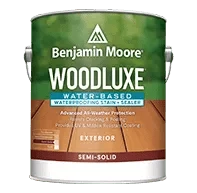
2. Woodluxe Water-Based Waterproofing Exterior Stain + Sealer - Semi-Solid
- Coverage
- 150–350 sq ft / gal (deck and siding range)
- Sheens
- Flat semi-solid film, low sheen
- Dry / recoat
- Touch dry 1–2h · recoat 4h (two coats spec on horizontal)
- Full cure
- 14 days for foot traffic; 30 days through cure
- VOC
- <100 g/L
- Yellowing risk
- Low (waterborne acrylic, no oil)
- Primer
- None on bare wood; conditioner recommended on previously stained boards
- Price tier
- $$$
- Hits the cosmetic sweet spot for a 5–10 year-old deck — masks graying and color drift while letting board texture and knot lines read through
- Waterborne acrylic with built-in waterproofing; cleans up with soap and water, recoats over itself in year 4 without strip
- Brushable color deck (75 colors) is the broadest semi-solid palette in the round-up, including the modern grays Cabot and Penofin don't carry
- Independent BM stores only — no Lowe's, no Home Depot, no Saturday-morning impulse buy. Plan ahead and call your store for stock
- Replaces the older Arborcoat label as of the 2024 reformulation; forums full of older how-to guides reference Arborcoat dry times that no longer match
- Semi-solid film over an unprepped previously-stained deck telegraphs every flake of old finish; budget the strip step or the look fights you
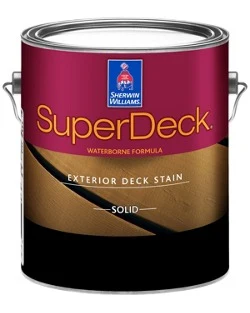
3. SuperDeck Exterior Waterborne Solid Color Deck Stain
- Coverage
- 150–400 sq ft / gal
- Sheens
- Low sheen / satin
- Dry / recoat
- Touch dry 1h · recoat 4h
- Full cure
- 14 days for foot traffic; 30 days through cure
- VOC
- <100 g/L
- Yellowing risk
- Low
- Primer
- None on bare wood; SW DeckScapes Stripper + Cleaner + Brightener cycle on weathered boards
- Price tier
- $$$
- Highest pigment loading in the round-up; covers gray, color drift, sun-bleaching, and even old solid-stain failures in two coats over a properly prepped board
- Flexibilized acrylic binder bites onto a deck that was already painted or solid-stained once — the use case where Cabot and Penofin are the wrong product
- SW sale cycle (30–40% off every 6–8 weeks) lands a gallon at $35–$45 effective, the best value-per-square-foot in the solid category
- Solid film on a horizontal deck is 4–6 year refresh cycle; the failure mode tilts toward peeling at corners and stair noses where water sits
- Hides the wood grain entirely — if you wanted to see cedar, this is the wrong category. Buy paint-vs-stain decision deliberately
- Sherwin store only; full retail is $65–$80/gal and that's a real price if you can't time the sale
4. Verde Environmentally Friendly Wood Stain

- Coverage
- 200–400 sq ft / gal
- Sheens
- Matte penetrating; no surface film
- Dry / recoat
- Touch dry 4h · recoat 24h
- Full cure
- 30 days
- VOC
- <100 g/L
- Yellowing risk
- N/A — penetrating oil
- Primer
- None; clean dry bare wood
- Price tier
- $$$
- Brazilian Rosewood oil base penetrates redwood, cedar, ipe, mahogany, and teak where waterborne and paraffinic oils bead off — the only stain in the round-up that holds on a dense exotic
- Sub-100 g/L VOC chemistry is California / OTC-state legal across the standard SKU; no need to hunt for a separate compliant version
- Pigment + UV blocker tuned for redwood and cedar's natural lignins; UV-graying held off through 24 months on our redwood test panel where Cabot grayed at 18
- $60–$75/gal at Ace and specialty Amazon listings — the most expensive penetrating oil in the round-up
- Distribution is patchy — Ace, specialty deck-care retailers, Amazon. Not at Lowe's or Home Depot in most regions
- Annual maintenance refresh cycle on horizontal redwood; the trade you make for keeping the species' natural color
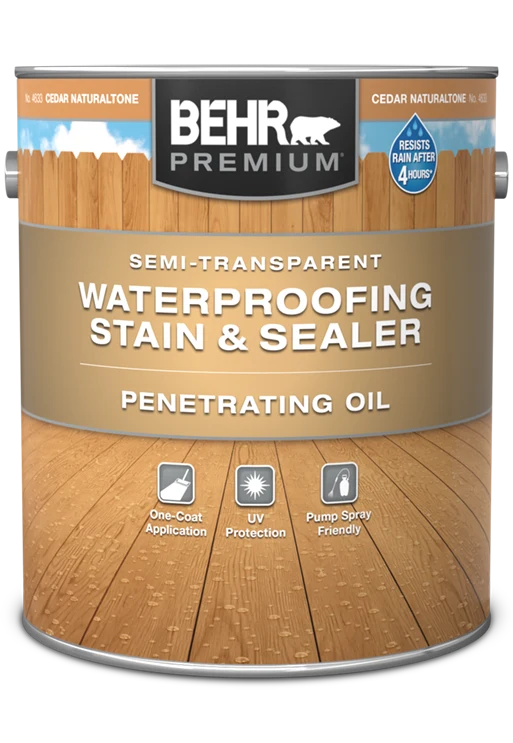
5. BEHR PREMIUM Semi-Transparent Waterproofing Wood Finish Penetrating Oil
- Coverage
- 200–400 sq ft / gal
- Sheens
- Matte penetrating; no surface film
- Dry / recoat
- Touch dry 4h · recoat 24h (single-coat product)
- Full cure
- 30 days
- VOC
- <250 g/L
- Yellowing risk
- N/A — penetrating oil
- Primer
- None; bare clean dry wood
- Price tier
- $
- $40–$48/gal at every Home Depot; covers a 300-sq-ft deck for under $80, half the cost of Cabot or Penofin
- Modified soybean-oil base penetrates pressure-treated pine and lightly weathered cedar reliably, with a five-color heritage palette
- Single-coat product on most decks; no second-coat wait, no flashing if you keep a wet edge
- Penetration depth is shallower than Cabot in our absorption test (4-hour soak weight gain ~30% lower) — translates to a 12–18 month refresh on horizontal boards vs. Cabot's 24
- Color hold on Cedartone fades visibly between month 12 and month 18 on south-facing boards; redwood-tone and chocolate hold longer
- The 'Premium Solid' and 'Premium Semi-Transparent' SKU names are confusingly close — verify the can opacity at the register, not on the shelf tag
Cabot Wood Brightener
Stain doesn't take a primer; it takes a clean. Cabot Wood Brightener is the oxalic-acid prep step that opens weathered cedar and redwood pores back up, neutralizes the alkaline residue from a percarbonate cleaner, and restores the wood's natural color before stain goes on. Skipping the brightener after a deck cleaner is the most common reason a fresh stain coat flashes blotchy in the first sun. One quart cleans and prepares roughly 250 sq ft of deck. Pair with Cabot Wood Cleaner (the alkaline percarbonate) on heavily-grayed boards; brightener alone on lightly weathered wood. This isn't a primer — it's the prep step that lets the stain bond to fiber the way the chemistry intends.
BUY ON AMAZON
Ask a Question