What Is Stabilizing Solution (and When You Need It)?
Stabilizing solution is a thin penetrating sealer that binds chalky, powdery masonry before paint. What it does, when to use it, and how it differs from primer.

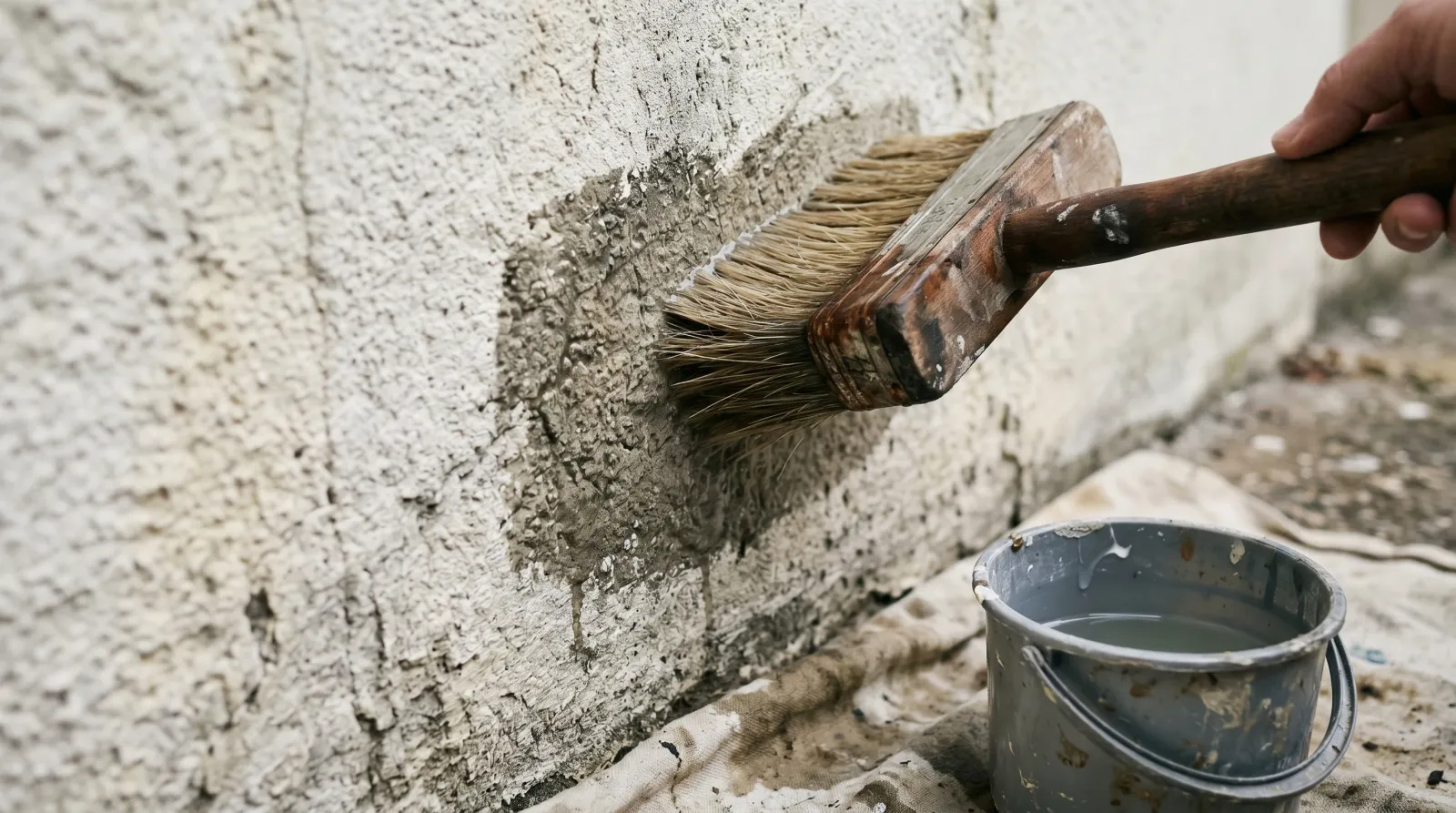
Run your hand across an old render wall or a sun-baked stucco facade and your palm comes away dusted, like you touched a chalkboard. That powder is the problem. Stabilizing solution is a thin, watery sealer (often a dilutable acrylic that you cut as much as 1:5 with water) designed to soak 1 to 3 mm into that loose surface and glue the powder back into a solid layer. It penetrates instead of forming a film, so it binds the substrate from the inside rather than coating it. You brush or roll it on, let it dry 4 to 24 hours, and then paint over a surface that has something to grip.
The reason any of this matters comes down to one rule of adhesion: a coat of paint is only as well-stuck as the layer directly beneath it. Lay a premium masonry paint over a chalky surface and the paint bonds beautifully to a skin of loose dust, and that dust is bonded to nothing. The whole stack lets go on the first damp-and-dry cycle. Stabilizer fixes the weak link by converting the friable surface into a cohesive one before the topcoat ever touches it.
What Stabilizing Solution Actually Does
Chalking is a substrate failure. On old masonry paint, UV breaks down the binder at the surface and leaves the pigment loose. On bare cement render and lime-based stucco, the surface carbonates and weathers into a powdery skin over years. Either way you end up with a layer that has no cohesion of its own.
A stabilizing solution carries a low-viscosity acrylic resin in a thin water or solvent vehicle. Because it’s thin, capillary action pulls it down into the pores instead of leaving it sitting on top. As the carrier evaporates, the resin coalesces around and between the loose particles, locking the dust into a continuous matrix that’s keyed into the sound material below. The surface goes from something you can rub off to something you’d have to scrape.
It is, in effect, a deep primer for a substrate that’s failing structurally rather than just needing adhesion help. That distinction is the whole game.
When to Use It
Use stabilizing solution for:
- Chalky, powdery exterior render, stucco, or rough-cast that dusts when you wipe it
- Old, weathered masonry paint that’s lost its binder and rubs off as pigment
- Friable cement, breeze block, or cinder block where the surface crumbles slightly under a fingernail
- Sound but very porous bare masonry that’s drinking your topcoat unevenly
- A wall you’ve washed and scraped but that still releases fine powder after it dries
The wipe test decides it. Drag a dark cloth across the dry surface. If it picks up a film of pigment or dust, stabilize. If it stays clean, you almost certainly don’t need it.
When NOT to Use It
Stabilizer is a corrective, not a default. Reaching for it on a sound wall wastes money and can leave a glossy, sealed surface your topcoat struggles to bite into.
Skip stabilizing solution on:
- Sound, previously painted masonry that passes the wipe test clean. Use a standard masonry primer instead.
- Flaking or blistering paint that’s peeling in sheets. Stabilizer binds powder, not loose flakes. Scrape and treat the peeling paint first, then assess what’s left.
- Damp walls with an active moisture source. Sealing the face traps water behind the film and pushes the failure deeper. Find and fix the water first.
- Bare lime render or limewash you intend to limewash over. A non-breathable acrylic stabilizer fights the vapor-open behavior those systems depend on. See what limewash is before sealing anything you plan to limewash.
- Efflorescence. The white salt bloom is a symptom of moving moisture, not a chalking problem. Treat the efflorescence on brick before any sealer goes near it.
How It Compares
Stabilizing solution sits between a sealer and a primer, and people mix all three up constantly.
| Stabilizing solution | Masonry primer | PVA / general sealer | |
|---|---|---|---|
| What it fixes | A chalky, friable surface | A sound surface needing adhesion | Porosity (poorly) |
| How it works | Penetrates 1–3 mm, binds powder | Thin film on top | Forms a re-wettable film |
| Leaves a film | Almost none | Yes, thin | Yes |
| Water resistance | Good (acrylic) | Good | Poor — re-emulsifies |
| Right for chalking | Yes | No | No |
For the broader question of sealing porous surfaces before paint, the wall sealing explainer covers where each product belongs. And if you’re unsure whether you even need a separate product, the what-is-primer guide draws the line between priming and sealing.
Common Mistakes
- Using diluted PVA glue as a cheap stand-in. PVA forms a water-soluble film that re-emulsifies the next time the wall gets damp, and your paint floats off on it. Buy the acrylic product sold as masonry stabilizer. This is the single most common failure on the whole topic.
- Applying it to a wall that isn’t chalking. On a sound, slightly glossy surface, stabilizer can seal the face so tight the topcoat won’t bite. Do the wipe test first.
- Over-diluting to stretch the can. The acrylic content is what does the binding. Cut it past the label ratio and there isn’t enough resin to lock the powder. The wall still dusts after it dries.
- Painting over it too soon. The carrier has to fully leave and the resin has to coalesce inside the masonry. Trap it under topcoat at hour two and you get soft, milky patches and poor adhesion. Wait the full recoat time.
- Sealing over a moisture problem. A bound, sealed face over a damp wall just relocates the failure. The paint blisters from behind a few months later.
What It Looks Like
When stabilizer is doing its job, the surface visibly darkens and goes slightly translucent as the liquid soaks in, then dries back to a more uniform, matte, dust-free finish. A flooded coat on a thirsty wall can disappear in seconds. A sealed or sound wall, by contrast, leaves the liquid pooling and beading on the surface, which is your sign you didn’t need it there.
Where to Buy / What to Look For
Look for a product explicitly labeled “masonry stabilizing solution,” “stabilizing primer,” or “chalk binder,” and check the data sheet for an acrylic or styrene-acrylic resin and a stated dilution ratio. Zinsser Peel Stop and Rust-Oleum’s masonry stabilizer are common U.S. shelf names, alongside the stabilizing solutions in most exterior masonry systems. Avoid anything that’s just a thinned interior PVA sealer.
For the topcoat that goes over it, the best masonry paint round-up covers the exterior lines worth pairing with a stabilized surface. And if your real problem is an old facade shedding pigment everywhere, the chalking exterior fix walks through diagnosis before you commit to a sealer.
The takeaway is narrow and worth holding onto: stabilizing solution exists for one job, and that’s turning a powdery surface into a solid one. Do the wipe test. If the cloth comes back dusted, stabilize, wait the full recoat window, then paint. If the cloth stays clean, save your money and prime as normal.
Ask a Question