What Is Wall Sealer? PVA Primer and Drywall Sealing
Wall sealer is a thin water-based primer (usually PVA) that closes off porous drywall so your finish paint stops getting eaten. Here is how it works.

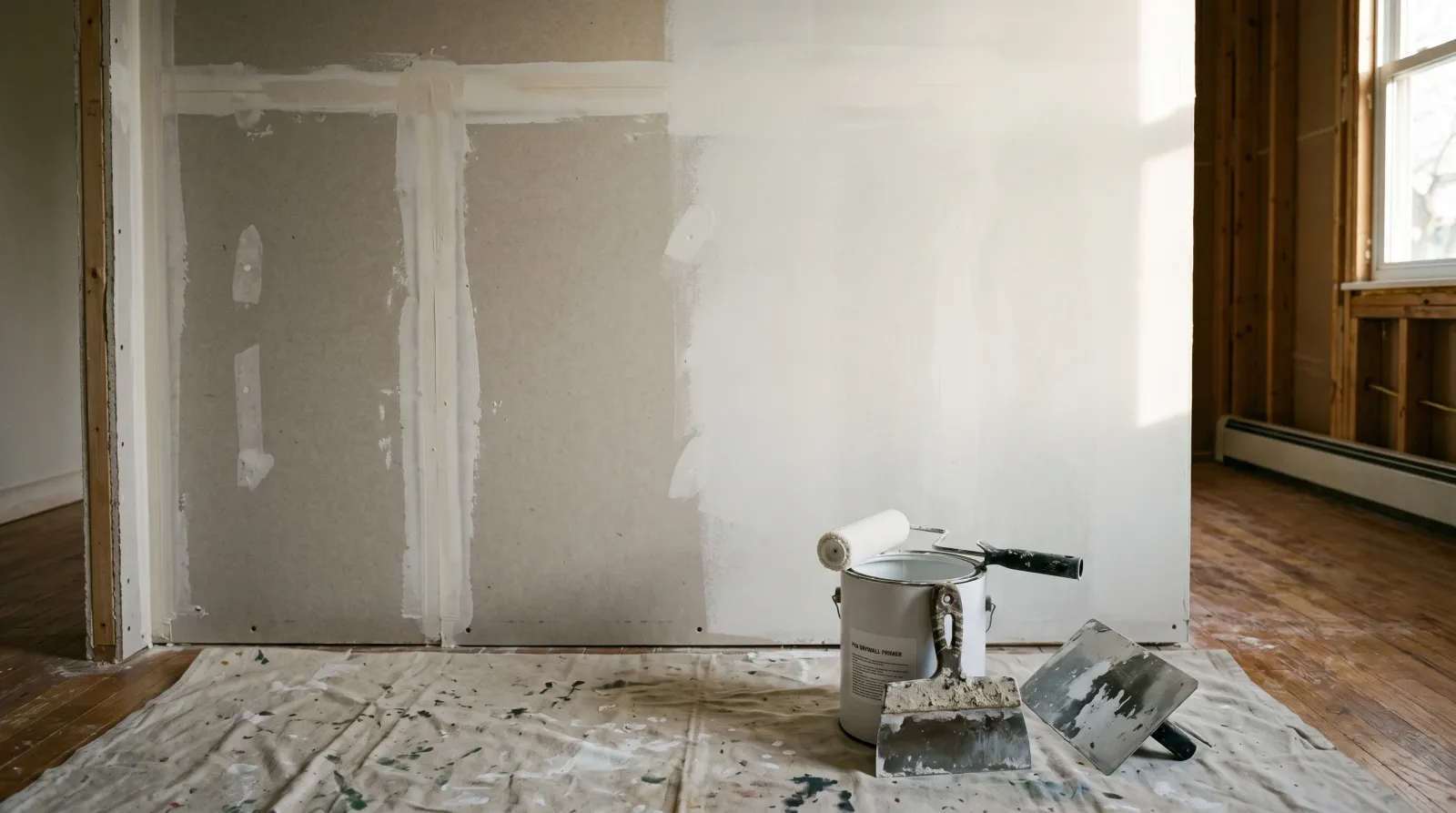
Most people meet this problem the same way. You finish taping a fresh drywall job, roll on a coat of your real wall paint, step back, and the seams are visible. The mudded joints look duller than the paper field around them, and the field itself looks patchy. That is not a paint problem. That is a sealing problem, and the fix is a $20 gallon of PVA primer.
Here is the working definition. A wall sealer is a thin, water-based primer engineered to soak into porous gypsum drywall and dried joint compound, equalize their absorbency, and leave a uniform low-sheen film for the topcoat to grip. The reference product is a polyvinyl acetate (PVA) primer like Zinsser Bulls Eye Drywall PVA. Numerically: 200–400 square feet per gallon, recoat in about an hour, around $18–25 a gallon, VOC under 50 g/L.
That is the whole story in one paragraph. The rest of this page is why it works, when you need it, and when a PVA is the wrong call.
How PVA Wall Sealer Actually Works
Drywall is two materials with very different thirst. The paper face is a porous cellulose mat — think kraft paper with the sizing washed out. The joint compound covering the seams is gypsum dust mixed with a little binder, dried into a chalky cake. Both pull water out of a wet paint film fast, but they pull at different rates. The mud is thirstier than the paper, and an untreated wall holds both side by side.
When you roll a topcoat over that, the binder particles in the wet film never get the time they need to coalesce evenly. Water flashes out of the joints faster than the field, the binder collapses in place rather than fusing into a continuous film, and you get optical flashing — duller patches where the substrate stole the water, glossier patches where it did not. The seams show because they were the thirstiest spots on the wall.
PVA sealer fixes this with chemistry, not coverage. The resin is a polyvinyl acetate latex — the same family as white school glue, picked because it has small particles that wick into porous substrates and a soft film that fills surface roughness without building height. It soaks into the paper and the mud, dries into a flat sealing layer, and presents a single uniform porosity to the next coat. The topcoat film then forms the same way across every square inch of the wall.
It is cheap because it does not need to be more. PVA carries low pigment loading, no bonding promoters, and no stain-blocking resins. You are paying for the cheapest engineered seal in the primer aisle.
When to Use a PVA Sealer
Use it for:
- New drywall, taped and sanded, that has never seen paint.
- Patched areas inside a previously painted wall — spot-prime the patch before the full topcoat.
- Skim-coated walls where you have re-mudded a whole surface for a level-5 finish.
- Plaster or stucco interiors that are fully cured and porous.
PVA is also the right answer when budget is the constraint and the substrate is honest — bare gypsum, no stains, no glossy paint to bond to. A whole-room interior repaint after a renovation is the textbook job.
When NOT to Use a PVA Sealer
Do not use it for:
- Water-stained ceilings or walls. The stain dissolves into the wet PVA, dries with it, and bleeds straight up into the topcoat. Reach for shellac (Zinsser BIN).
- Glossy oil-painted trim, melamine cabinets, factory-finished doors. PVA has no adhesion promoters and will peel off the gloss in months. Use a urethane-acrylic bonding primer like Insl-X Stix.
- Knotty pine, cedar, redwood — anything with tannin or knot bleed. BIN or oil-based Cover Stain only.
- Exterior surfaces. PVA is rated interior; the resin chalks and degrades fast in UV.
- Bare metal, masonry below grade, or anything wet. Wrong chemistry across the board.
If the substrate is anything other than honest porous drywall or plaster, PVA is not your primer.
How PVA Compares to the Other Drywall Primers
| PVA sealer | General-purpose primer | Shellac primer | |
|---|---|---|---|
| Reference | Zinsser Drywall PVA | Zinsser Bulls Eye 1-2-3 | Zinsser BIN |
| Carrier | Water | Water | Alcohol |
| Sealing porous drywall | 🟢 Excellent | 🟢 Excellent | ⚪ Works, expensive |
| Bonding to glossy surfaces | 🔴 No | 🟡 Limited | 🟢 Yes |
| Stain-blocking | 🔴 No | 🟡 Light water stains | 🟢 Anything |
| Price per gallon | 🟢 $18–25 | 🟡 $28–35 | 🔴 $55–65 |
PVA and 1-2-3 do the same sealing job. The difference is that 1-2-3 also bonds to existing latex paint and blocks light water stains, so it is the better pick for a repaint where the wall has history. On virgin drywall with no history at all, PVA is the cheaper sibling that does the one job that matters. See the primer chemistry explainer for the full family tree.
Common Mistakes
- Skipping the seal on new drywall because the topcoat says self-priming. Self-priming means it bonds to existing latex paint, not that it seals raw gypsum. The first finish coat flashes and the seams telegraph through two more coats.
- Using a thick nap roller cover. PVA wants to soak into the paper, not sit on top of it. A 3/8-inch or 1/2-inch nap is right; 3/4-inch leaves a stippled film that fights uniform absorbency.
- Letting the sealer dry overnight in a cold room. PVA film keeps softening if the temperature drops below 50°F before it has fully coalesced. Heat the room to at least 60°F until the next coat goes on.
- Tinting PVA to match a deep topcoat. It will accept some tint but the pigment load is too low to actually hide color shifts. For deep colors, use a tinted 1-2-3 instead.
- Rolling PVA over a water stain to seal it. Wrong chemistry. The water-soluble stain dissolves into the wet sealer and reappears in the finish coat. Spot-prime stains with BIN first.
Where to Buy
Zinsser Drywall PVA is the reference SKU and lives at every big-box paint counter for $18–22 a gallon. Behr, KILZ, and PPG all sell house-brand PVAs in the same range. For the full primer SKU list across families — sealing, bonding, stain-blocking — see the best primer round-up.
The shortest way to think about a PVA sealer is this. It is the layer that turns thirsty raw drywall into a uniform surface, so the finish paint can stop fighting the wall and start being paint.
Ask a Question