Can You Paint Composite Decking?
Yes on old uncapped boards, mostly no on capped Trex and TimberTech. How to tell which you have, what it costs you in warranty, and the paint system that actually sticks.

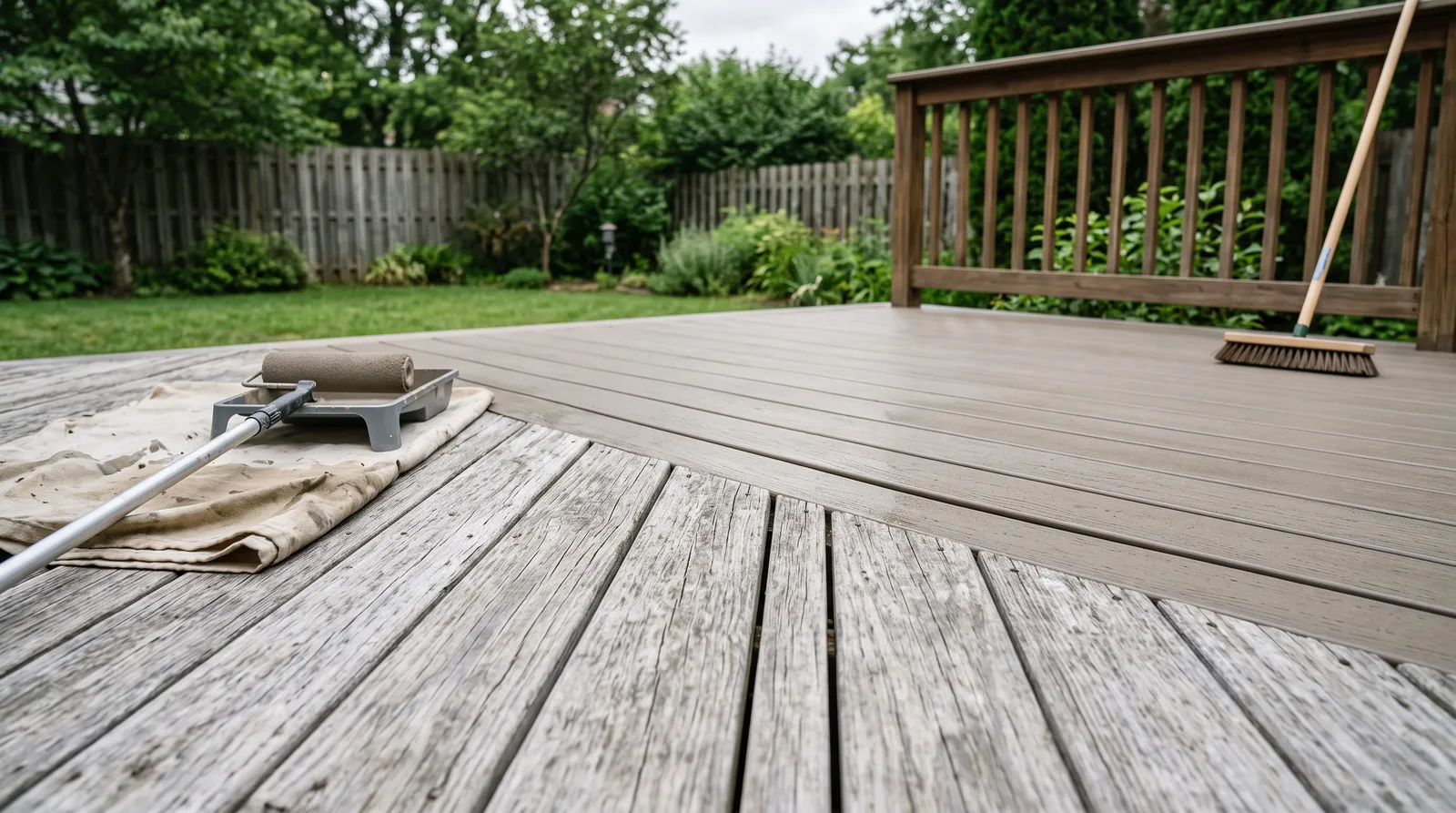
Composite decking was sold to you as the deck you never paint. Ten summers later it’s the color of a parking lot and you want it to look like something again. Fair enough.
You can paint it. Whether you should comes down to one thing, and you can check it in ten seconds with your eyes.
Can You Paint Composite Decking?
Yes on early-generation uncapped boards — pre-2010 Trex and its peers are porous, out of warranty, and take a solid-color coating fine. On capped boards, the newer ones with the slick plastic shell, you can but mostly shouldn’t: the cap fights adhesion, the coating voids a 25-to-50-year warranty, and you trade a no-maintenance deck for a three-to-five-year recoat cycle.
Here’s the why. Wood is porous, so paint sinks in and locks into the grain. A capped composite board is wrapped in a polyethylene shell, and polyethylene is a low-surface-energy plastic — liquids bead on it and films don’t grip. Same reason a sticker peels off a milk jug. Roll paint straight onto a capped board and you’ve made a sticker.
Movement is the second problem. A dark composite board in July sun runs 30 to 50 degrees hotter than the air, and it grows and shrinks across that swing harder than wood does. A film that isn’t flexible cracks at the board edges, water gets under it, and the peel starts there.
The third one is the one nobody mentions until the board splits. A coating seals the top face. Trex’s own position is that a film on a capped board traps moisture inside the composite core, and a core that can’t dry out can eventually crack the board. Peeling paint is a weekend with a scraper. A cracked board is a replacement.
None of that applies the same way to an uncapped board. Those are porous all the way through, they were designed to fade, and the manufacturer has no objection to coating them. That’s why the first job is figuring out which one is under your feet.
Capped or Uncapped: The Ten-Second Test
Find a cut board end, a stair nosing, or anywhere you can see a cross-section. Look at it.
| Uncapped (early-generation) | Capped (2010 and newer) | |
|---|---|---|
| Cross-section | One uniform color straight through | Thin outer shell over a differently colored core |
| Surface feel | Slightly porous, chalky when faded | Slick, plastic |
| Typical condition | Faded to driftwood gray | Color mostly holding, maybe blotched |
| Paints? | Yes — stain straight on it | Only with scuff-sand plus bonding primer |
| Warranty left | Usually none | Often 25 to 50 years |
Don’t go by the year the deck was built. Capped Trex arrived in 2010 with Transcend. The uncapped Accents and Origins boards stayed on sale until about 2013. A deck built in that window could be either one, and guessing wrong means buying the wrong system.
One more thing before you panic about color. Early-generation composite was designed to weather to a final tone, and Trex says those boards get there within roughly 12 to 16 weeks of install. If your deck is four months old and turning gray, nothing failed. That’s the color it was always going to be.
What the Warranty Costs You
This is the step people skip and a few of them regret.
Trex, TimberTech, and Fiberon all list paint, stain, and surface coatings as things that void the fade-and-stain warranty. TimberTech says it flatly: apply paint, stain, or other coating materials and the warranty is void. Trex allows coating on the underside and the cut ends of newer boards only — never the walking surface.
Look at what you’re handing back. Trex Transcend carries a 50-year fade-and-stain warranty. Enhance carries 25. TimberTech and Fiberon run in the same range. That’s decades of coverage traded for a film that lasts three to five years.
So the rule is simple. If your boards are still covered and the complaint is fading, blotching, mold inside the board, or color loss well ahead of schedule, that’s a claim, not a paint job. Make the phone call first. A partial board replacement under warranty beats painting the whole deck and losing coverage on all of it.
If the warranty expired years ago — which is the situation most people painting composite are actually in — then the boards are yours and this is a straight cost decision.
Try This Before You Commit to Paint
Half the decks people want to paint don’t need paint. They need a real wash.
Composite collects a film wood doesn’t: UV-degraded surface plastic, pollen, mildew in the embossed grain, and on most decks, grease blown off the grill. That film reads as “faded” long before the board itself has given up. A deck cleaner and a brightener will often bring back more color than people expect, and it costs a fraction of a coating job.
Use an oxygenated composite deck cleaner, not chlorine bleach — bleach lightens the board unevenly and does nothing for grease. Scrub it with a stiff-bristle brush on a pole, working with the board grain, and let it dwell per the label. Hit grill spatter with a TSP solution first. Our deck cleaners and brighteners round-up covers what actually pulls gray fiber versus what just makes foam.
If you pressure wash, keep it gentle. 1,500 PSI ceiling, 25-degree tip, 12 inches off the board, moving with the grain. Crank it up and you’ll fuzz the surface into a furry texture that never coats clean and never looks right bare either. On uncapped boards especially, high pressure tears the surface open. Gouging a composite board with a pressure washer is permanent — there’s no sanding it back out the way you would on cedar.
Wash the whole deck, let it dry, and look at it in daylight. If that got you 70 percent of the way there, stop. You just saved a weekend and a warranty.
The Right Products, and the Ones to Walk Past
Three product categories sit on that shelf and only one of them belongs on composite.
Acrylic porch-and-floor paint or acrylic solid-color deck stain. This is the answer. The binder is what matters, not the brand on the can. Acrylic stays flexible and moves with the board through the heat swing. Rust-Oleum Porch and Floor, Sherwin-Williams Porch and Floor Enamel, SuperDeck Waterborne Solid Color Stain, and the equivalent from Behr, Benjamin Moore, or Valspar all work. Oil-based and alkyd floor enamels are out — they go brittle on the plastic cap and crack at the edges inside a season.
Penetrating semi-transparent stains. Wrong tool, no argument. These are wood products that work by soaking into grain. There’s no grain to soak into on a capped board, and even on a porous uncapped one you want an opaque coating, not a translucent one. Our Behr Premium Semi-Transparent review is honest about the limit even on real wood — it earns its keep on fences and railings, and the same review says skip it on a deck floor, where owners report it filming on top and peeling in sheets between 18 months and two years. On plastic, “filming on top” isn’t a failure mode, it’s the only thing it can do. If you’re still sorting out opacity levels, the deck stain opacity guide lays out what each one is actually for.
Thick resurfacers. The labels allow it. We still say no. This one needs explaining because it looks like a loophole. Behr Advanced DeckOver lists composite decking as an approved surface right on the can, and Rust-Oleum Restore 10X Advanced lists most composite decks too. Both are legitimately good at one job: burying splinters and bridging quarter-inch checks in a wrecked old wood deck. Composite doesn’t splinter and doesn’t check. You’d be paying for filler you don’t need.
What you’d get with it is a rigid, high-build film on a substrate that grows and shrinks every hot afternoon. Our DeckOver review scores durability and adhesion 4 out of 10 and documents peeling after a single freeze-thaw winter even with textbook prep. Restore scores the same 4 out of 10 on adhesion, and the original formula drew a $9.3 million class-action settlement in 2016 over bubbling and peeling. Both products’ failures trace to a thick film over something that moves or holds water. A plastic deck cap does both. Thin and flexible is the right answer here. Thick and rigid is the wrong one.
And the removal math kills it. A failed DeckOver film doesn’t come off with chemical stripper — that’s mechanical removal, 36-grit or a Diamabrush wheel on an angle grinder. On composite, aggressive grinding doesn’t just strip the coating, it destroys the cap under it. Now you’re buying boards.
How to Paint Composite Decking
Lead with the rule: the primer is the whole job. Everything else is technique.
- Clean. Oxygenated composite cleaner, stiff brush, gentle rinse. TSP on grease spots.
- Dry 48 hours. Minimum, in dry weather. The embossed grain holds water longer than the surface reads, and primer over a damp cap blisters off in a month.
- Scuff-sand. 80 to 120-grit across the whole field on a capped board — you’re cutting tooth into plastic. 240-grit on an uncapped board, where you’re only deglossing and knocking down fuzz. Coarse paper on a porous board leaves scratches the coating telegraphs. Target is a uniform dull haze with no shiny spots. Shiny means slick, and slick is where the peel starts.
- Vacuum and wipe. Every speck. Dust under primer is the same as no primer.
- Prime. Capped boards get a bonding primer — INSL-X Stix or Zinsser Bulls Eye 1-2-3 Plus, both urethane-modified acrylics built to grip glass, tile, and PVC. A standard deck primer or a paint-and-primer-in-one will not bite a polyethylene cap, whatever the front of the can promises. Roll it thin with a 3/8-inch nap and brush the board edges and gaps. Thin is the word: a heavy primer coat on plastic just builds a thicker thing to peel later. Uncapped boards don’t need Stix — a regular exterior acrylic primer is enough, or skip primer entirely and go straight to a composite solid-color stain. If you want the chemistry behind why one primer grips and another doesn’t, see what a bonding primer is.
- Two coats of acrylic. Brush the edges and gaps first, back-roll the faces while the brush work is still wet, and stop at the end of a board — never mid-board. Stopping mid-board is how you get lap marks, and lap marks show up the second the low evening sun rakes across the deck. One coat on a walking surface is a marketing claim, not a job spec.
- Cure long. Touch-dry 2 to 4 hours, recoat 4 to 6, light foot traffic at 24 to 48. Keep furniture and planters off for a full week. Film over plastic cures slower than the same film over wood, because wood wicks water out the back of the film and a sealed cap doesn’t — it can only dry from the top.
Never work in direct afternoon sun. A hot cap flashes the primer before it can wet out the surface and you lose the grip you came for. Work the shaded side as it moves.
The full version of this job, with the material math and the per-step photos, is in our composite decking painting walkthrough.
What It Costs and What You Get
| Route | 300-square-foot deck | What it buys |
|---|---|---|
| DIY paint (primer + two coats) | $200–350 in materials | 3–5 years, then recoat |
| Professional deck painting | $2–5 per sq ft, so $600–1,500 | 3–5 years, then recoat |
| Replace with new capped boards | $30–60 per sq ft installed, so $9,000–18,000 | 25–50-year warranty, no coating |
Painting is thousands cheaper up front and that’s a real argument. Read the third column honestly, though. Paint is a recurring cost on a three-to-five-year cycle, and new boards are the only line on that table that asks nothing of you afterward.
Expect the film to fail at the board edges first, not in the middle of the traffic lanes the way it does on wood — that’s the heat movement working on the sharpest part of the film. Stair treads and the south-facing field go first. Wash it twice a year with the same composite cleaner, no high pressure on a cured film. When you see the first edge lift, scuff that area, spot-prime, and recoat the board before it spreads. If you catch it late and it’s sheeting, our peeling paint fix covers getting back to a sound surface — carefully, because grinding on composite is how you turn a coating problem into a lumber problem.
Common Mistakes
- Guessing capped or uncapped from the install year. Look at a board end. Wrong guess, wrong system, one summer of adhesion.
- No bonding primer on a capped board. The single most common failure. Standard deck primer sheets off plastic.
- Leaving shiny spots in the scuff-sand. The embossed grain valleys are where a sander skips and where the peel starts.
- Reaching for a thick resurfacer. The label allows composite. The physics doesn’t. Thin flexible acrylic instead — see solid stain vs paint for a deck for how the film types differ.
- Pressure washing at full trigger. Gouged composite doesn’t sand back out. 1,500 PSI ceiling, 25-degree tip.
- Painting a deck that’s still under warranty. Make the claim call first. Free beats $300 every time.
- Painting damp boards. 48 hours dry, and meter them if you’re unsure.
- Oil or alkyd floor enamel. Brittle on a cap that flexes. Cracks at the edges in a season.
The Part That Bites You in Two Years
Nobody regrets the first coat. They regret the third summer.
What gets people is the edges. You’ll walk out one May and see a hairline lift along one board, and it looks like nothing. Leave it and water gets under the film, works across the board in both directions, and by August you’re pulling up strips the size of a floor mat. Catch it in May with a sanding sponge and a spot coat and it’s a twenty-minute job.
And the bigger one: you painted the no-maintenance deck. That’s the trade. It’s cheap per cycle and it looks great for a while, but it is now a deck that needs you every three to five years, forever, and there’s no going back to bare composite. Go in with your eyes open, or wash it hard, live with the gray, and keep the warranty.
Ask a Question