How to Paint Composite (Trex) Decking
How to paint composite decking like Trex: why the plastic cap fights adhesion, the bonding primer that actually grips, and the warranty trap nobody warns you about.

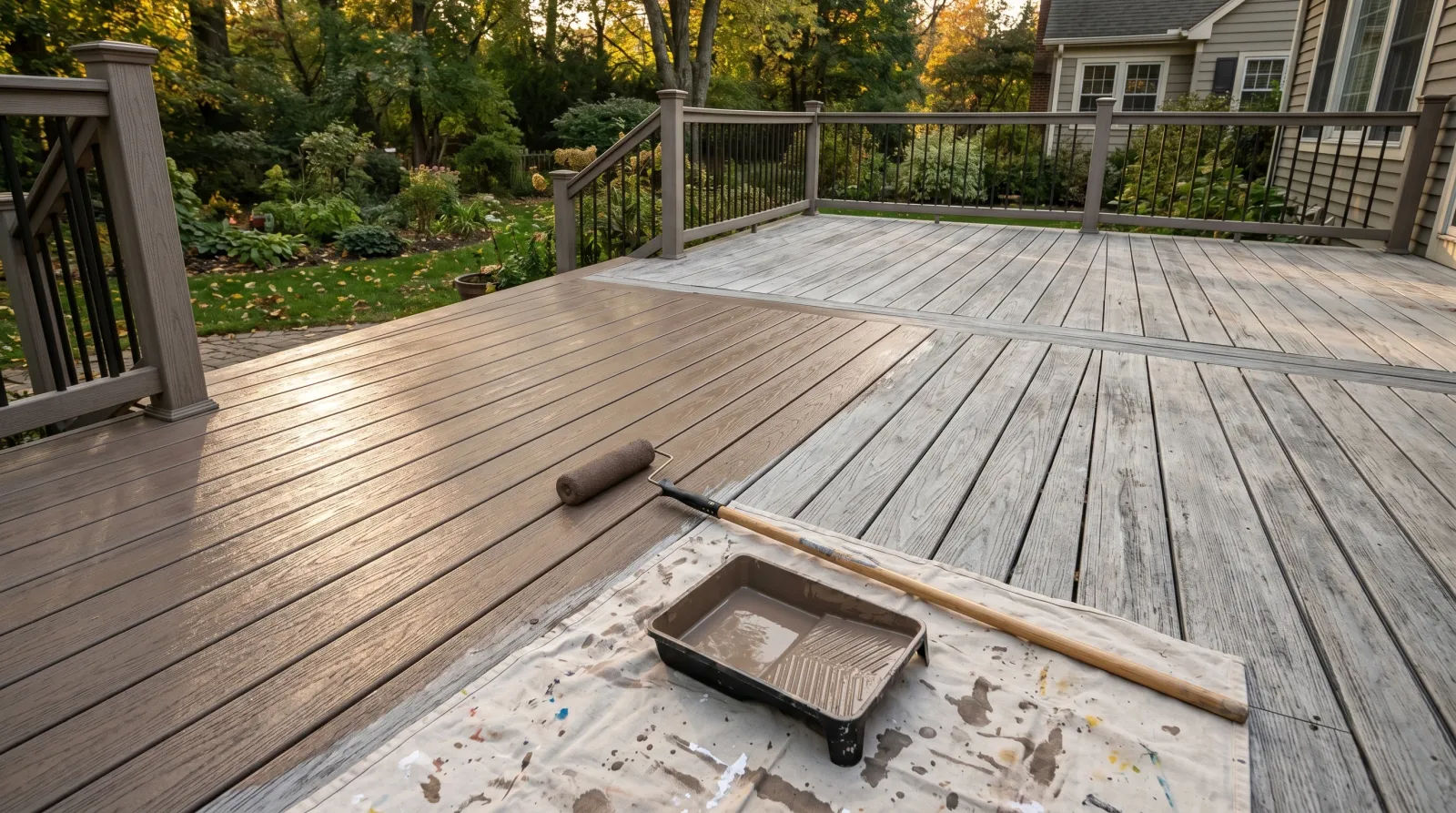
Composite decking is sold as the deck you never have to paint. So if you’re here, the no-paint promise wore out and now you want a new color over a faded gray board. You can do it. But the boards will fight you, the warranty will probably bite, and the primer call is the whole job.
TL;DR
- Identify the board first: capped (2010 and newer) or uncapped early-gen. It changes the whole job
- Check the warranty: painting voids most surface warranties, and Trex’s run 25 to 50 years
- Clean: composite deck cleaner, scrub, rinse, 48 hours dry
- Scuff-sand: 80 to 120-grit on a capped cap, 240-grit on porous uncapped boards
- Primer: bonding/adhesion primer (INSL-X Stix) on capped boards, not a standard deck primer
- Paint: 100% acrylic porch-and-floor paint or acrylic solid-color deck stain, two coats
- Uncapped shortcut: composite solid-color stain straight onto the board, no bonding primer
- Cure: 3-7 days before furniture and foot traffic, longer on the field that bakes
- Cost: $200–350 in DIY materials for a 300-square-foot deck vs $9,000+ to re-deck it
- Skill: hard on capped boards. Get the primer wrong and it peels in one summer
What Composite Decking Actually Is
Composite decking is wood-plastic composite, usually called WPC. It’s wood flour or rice hulls mixed with a plastic binder, mostly polyethylene, pressed and extruded into board shapes. Trex, TimberTech, Fiberon, and Deckorators are the names you’ll see in a US backyard.
Two kinds matter for paint. Uncapped composite is the older stuff: the wood-plastic mix runs all the way through, and the surface is porous enough to fade and stain. Capped composite is newer: the same core, wrapped in a thin polyethylene or PVC shell on the top and sides. The cap is what gives newer boards their stain resistance. It’s also what makes them miserable to paint.
Which one is under your feet decides everything that follows, so start there.
Which Trex Do You Have: Capped or Uncapped
Capped Trex arrived in 2010 with the Transcend line. Enhance and Select followed. The early-generation uncapped boards, Accents and Origins, were wood-plastic all the way through and stayed on sale until about 2013. So a deck built between 2010 and 2013 could be either one, and the install year alone won’t tell you. Look at the board instead.
The test takes ten seconds. Find a cut end, a stair nosing, or anywhere you can see a cross-section of a board.
- Uncapped: one uniform wood-plastic color straight through the board, edge to core. The top feels slightly porous, and it has almost certainly faded to a driftwood gray.
- Capped: a thin outer shell wrapped over a core that’s visibly a different color. The surface feels slick, like plastic, because that’s what it is.
One more thing worth knowing before you buy anything. Early-gen Trex was designed to weather to a final color, and Trex says those boards get there within roughly 12 to 16 weeks of install. If your deck is a few months old and turning gray, nothing has failed. That’s the color it was always going to be.
Most decks people actually want to paint are the faded pre-2010 uncapped ones, long out of warranty. Those are the easier job, and they get their own shorter path further down this page. The six steps below are the capped-board version, which is the hard one.
Why Composite Fights Paint Harder Than Wood
Wood is porous. Paint and primer sink in and lock mechanically into the grain. A plastic cap doesn’t do that. Polyethylene is a low-surface-energy plastic, which means liquids bead up and films don’t grip. It’s the same reason a sticker peels off a milk jug. Roll paint straight onto a capped board and you’ve made a sticker that’s waiting to let go.
Then there’s movement. Composite expands and contracts with heat more than wood does. A dark board in full July sun can run 30 to 50 degrees hotter than the air, and the board grows and shrinks across that swing. A brittle film can’t follow it. It cracks at the board edges first, water gets under, and the peel starts.
There’s a third failure mode too, and it has nothing to do with adhesion. A paint film seals the board. Trex’s own position is that a coating on a capped board traps moisture inside the composite core, and a core that can’t dry out can eventually split or crack the board. Peeling paint is a weekend of scraping. A cracked board is a replacement.
Plastic, heat, movement, and trapped moisture. Four reasons the can label that says “exterior floor paint” isn’t enough on its own.
What Trex Says About Painting Its Decking
The manufacturer’s answer is more specific than most people expect, and it splits the same way this guide does.
On early-generation boards, the pre-2010 uncapped ones, Trex says they can be painted or stained. No objection. Those boards are porous, they fade, and a coating is a legitimate fix for a deck that’s out of warranty and only looks tired.
On the current capped lines, Transcend and Enhance, Trex says painting is unnecessary and warns about that moisture-trap failure — the film seals the cap, the core holds water, and the board can split or crack. Where Trex does allow a coating on newer boards, it’s the underside and the cut ends only. Never the walking surface.
Then there’s what you hand back. Trex residential warranties are long: Transcend carries a 50-year fade-and-stain warranty, Enhance 25 years. Coat the walking surface and that coverage is gone. If your boards are eight years into a 50-year warranty and fading is the whole complaint, the phone call to the manufacturer is worth more than a gallon of primer.
When Not to Paint a Composite Deck
Some decks shouldn’t be painted at all. Walk this list before you buy anything.
- The boards are capped and still under warranty. 25 to 50 years of coverage beats a 3-to-5-year paint film. File the claim first.
- The deck is only a few months old. Early-gen boards reach their final driftwood gray in roughly 12 to 16 weeks. What looks like premature failure is the designed color arriving on schedule.
- The problem is stairs and high-traffic walkways. Film wear is fastest exactly where feet land and pivot. A painted stair tread starts showing through while the open field still looks new.
- Boards show mold in the core, rot, or structural damage. Paint hides a failing board and keeps it wet. Pull those boards and replace them.
- The fade or staining looks like a warranty claim. Blotchy discoloration, mold bloom inside the board, or color loss well ahead of schedule is the manufacturer’s problem, not yours.
Paint makes sense when the opposite is true: the boards are uncapped early-gen, out of warranty, structurally sound, color is the only thing wrong with them, and you’re fine recoating every three to five years.
Paint vs Replace: What Each Actually Costs
The comparison people want, with real numbers, on a typical 300-square-foot deck.
| Route | 300-square-foot deck | What it buys you |
|---|---|---|
| DIY paint (primer + two coats) | $200–350 in materials | 3–5 years, then recoat |
| Professional deck painting | $2–5 per sq ft, so $600–1,500 | 3–5 years, then recoat |
| Replace with new capped boards | $30–60 per sq ft installed, so $9,000–18,000 | 25–50-year warranty, no coating |
The DIY materials math: roughly $60–75 for a gallon of bonding primer, $40–55 a gallon for acrylic porch-and-floor paint, plus cleaner, abrasives, and sundries.
So yes, painting is thousands cheaper up front, and that’s a real argument. Just read the third column honestly. Paint is a recurring cost on a three-to-five-year cycle, not a one-time fix, and new capped boards are the only option on that list that needs nothing from you afterward.
Step 1: Check the Warranty (Yes, Before You Sand)
This is the step everybody skips and a few people regret. Trex, TimberTech, Fiberon, and most major brands list paint, stain, and any surface coating as something that voids the surface warranty. Some void it the moment a coating touches the board.
The stakes are bigger than the phrase “voids the warranty” makes them sound. Trex Transcend comes with a 50-year fade-and-stain warranty and Enhance with 25 years, and competing brands are in the same range. That’s decades of coverage you’re trading for a film that lasts three to five.
If your deck is still under coverage and your complaint is fading or a stain you hate, call the manufacturer first. A fade or defect claim, or a partial board replacement, may cost you less than painting and then losing the warranty on the whole deck.
If the warranty’s already expired, or you’ve read it and accept the trade, keep going. The boards are yours to coat.
Step 2: Clean the Deck
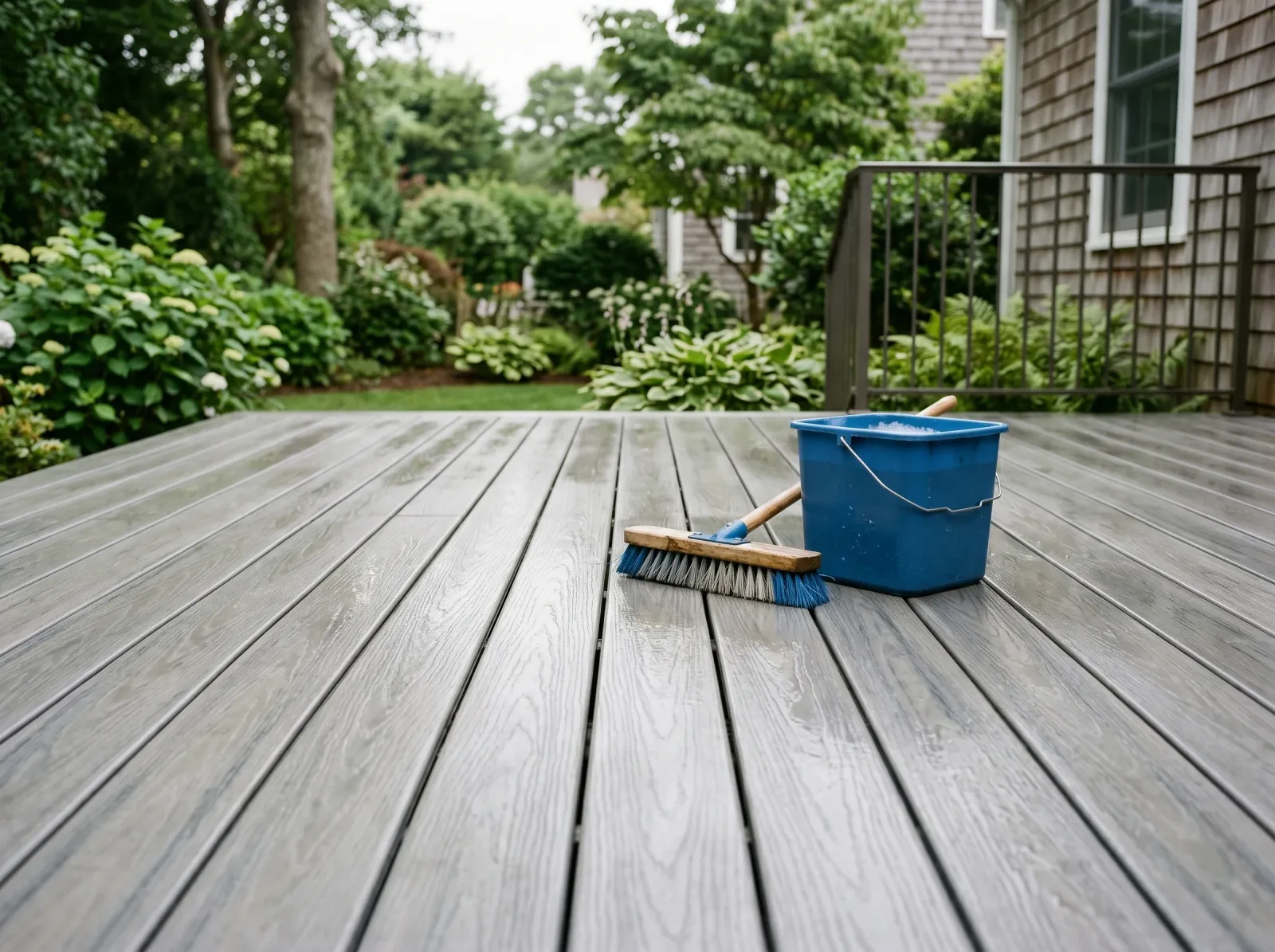
Composite-specific cleaner scrubbed in, rinsed, and 48 hours of dry weather before anything touches a brush.
Composite collects a film that wood doesn’t: a slick mix of UV degradation, pollen, mildew, and on a lot of decks, grease blown off the grill. Paint won’t grip through any of it.
Use a composite deck cleaner, the oxygenated kind, not chlorine bleach. Bleach can lighten the board unevenly and it does nothing for grease. Scrub it in with a stiff-bristle brush on a pole, working with the board grain, and let it dwell per the label. For grill spatter and grease, hit those spots with a TSP solution first.
You can pressure wash, but keep it gentle. 1,500 PSI ceiling, 25-degree tip, 12 inches off the board, moving with the grain. Crank it higher and you’ll fuzz the cap into a furry texture that never paints clean. On uncapped composite especially, high pressure tears the surface open.
Then wait. 48 hours of dry weather minimum. Composite holds surface water in the grain texture longer than a smooth board reads, and primer over a damp cap blisters off in a month.
Step 3: Scuff-Sand the Cap
Plastic that slick needs to be roughed up so the primer has tooth. This is the mechanical half of adhesion, and on a capped board it’s not optional.
Run 80 to 120-grit across the whole field. A random-orbit sander on a pole, or a sanding pole by hand on a small deck. You’re not removing material or trying to expose the core. You want a uniform dull haze across the cap, no shiny spots left. Shiny means slick, and slick means the primer won’t bite there.
Pay extra attention to the board edges and the embossed wood-grain texture, where a roller skips and leaves the original gloss in the valleys. Those missed valleys are exactly where peeling starts.
Blow or vacuum every speck of dust off when you’re done. Wipe with a damp rag and let it flash dry. Dust under primer is the same as no primer.
Step 4: Prime With a Bonding Primer
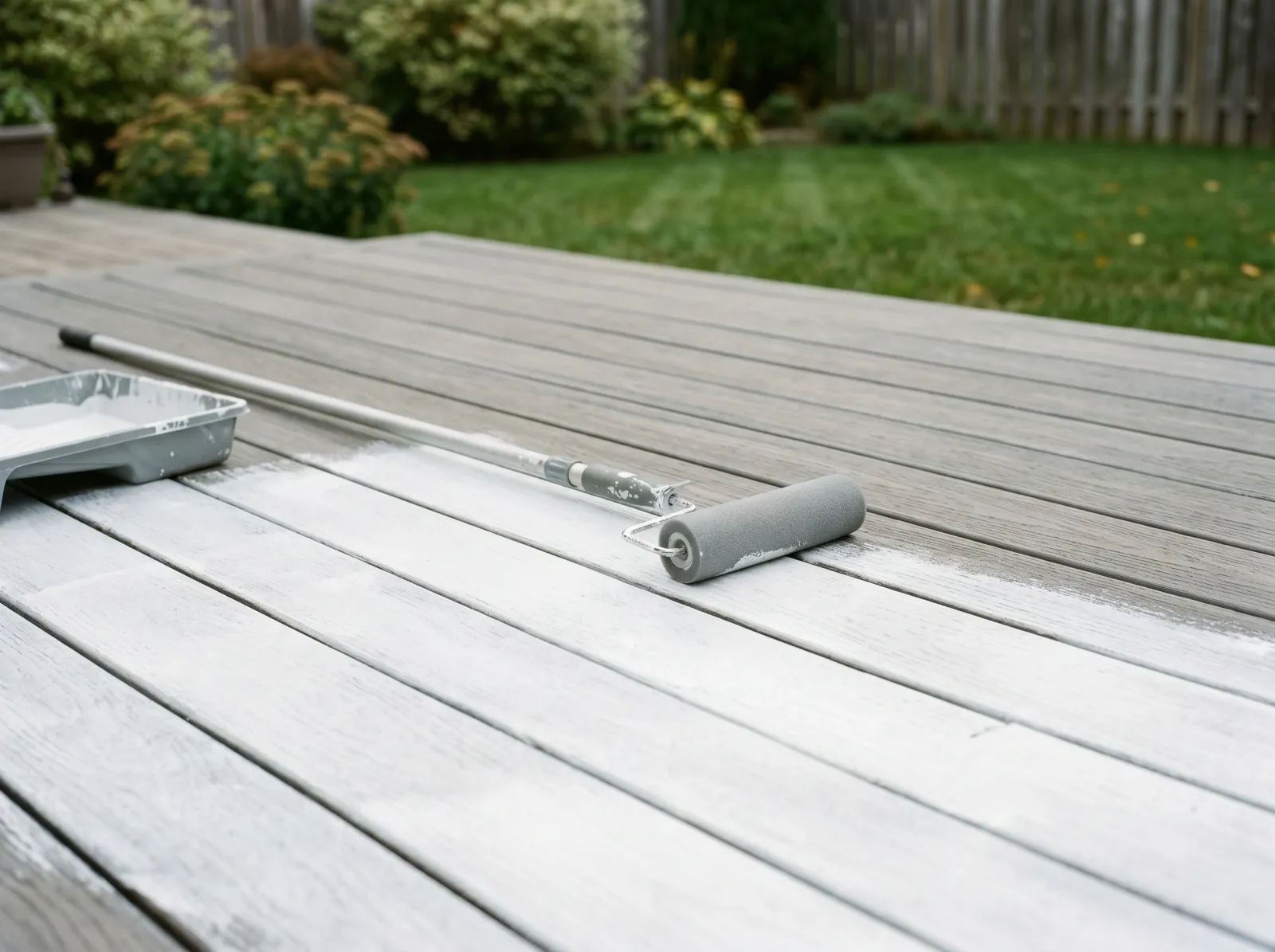
A thin coat of adhesion primer over the scuffed cap. The cap is plastic, and plastic needs a primer that bites it.
Here’s where the job is won or lost. A standard latex deck primer is built for porous wood. It will not grip a polyethylene cap. Neither will a paint-and-primer-in-one, no matter what the front of the can promises.
You need a bonding primer made for slick, hard-to-coat surfaces. INSL-X Stix is the default. Zinsser Bulls Eye 1-2-3 Plus is the backup. Both are urethane-modified acrylics formulated to grip glass, tile, PVC, and laminate, which is the same problem a plastic deck cap presents.
Roll a thin, even coat with a 3/8-inch nap, and brush the board edges and the gaps between boards where a roller can’t reach. Thin is the word. A thick primer coat on plastic just builds a thicker thing to peel later. One uniform coat is the target.
Stix is touch-dry in about 30 minutes and recoats in an hour in warm dry weather. Don’t rush the topcoat onto it before it’s set. And don’t prime in direct afternoon sun. A hot cap flashes the primer before it can wet out the surface, and you lose the grip you came for.
Step 5: Paint or Solid-Color Stain
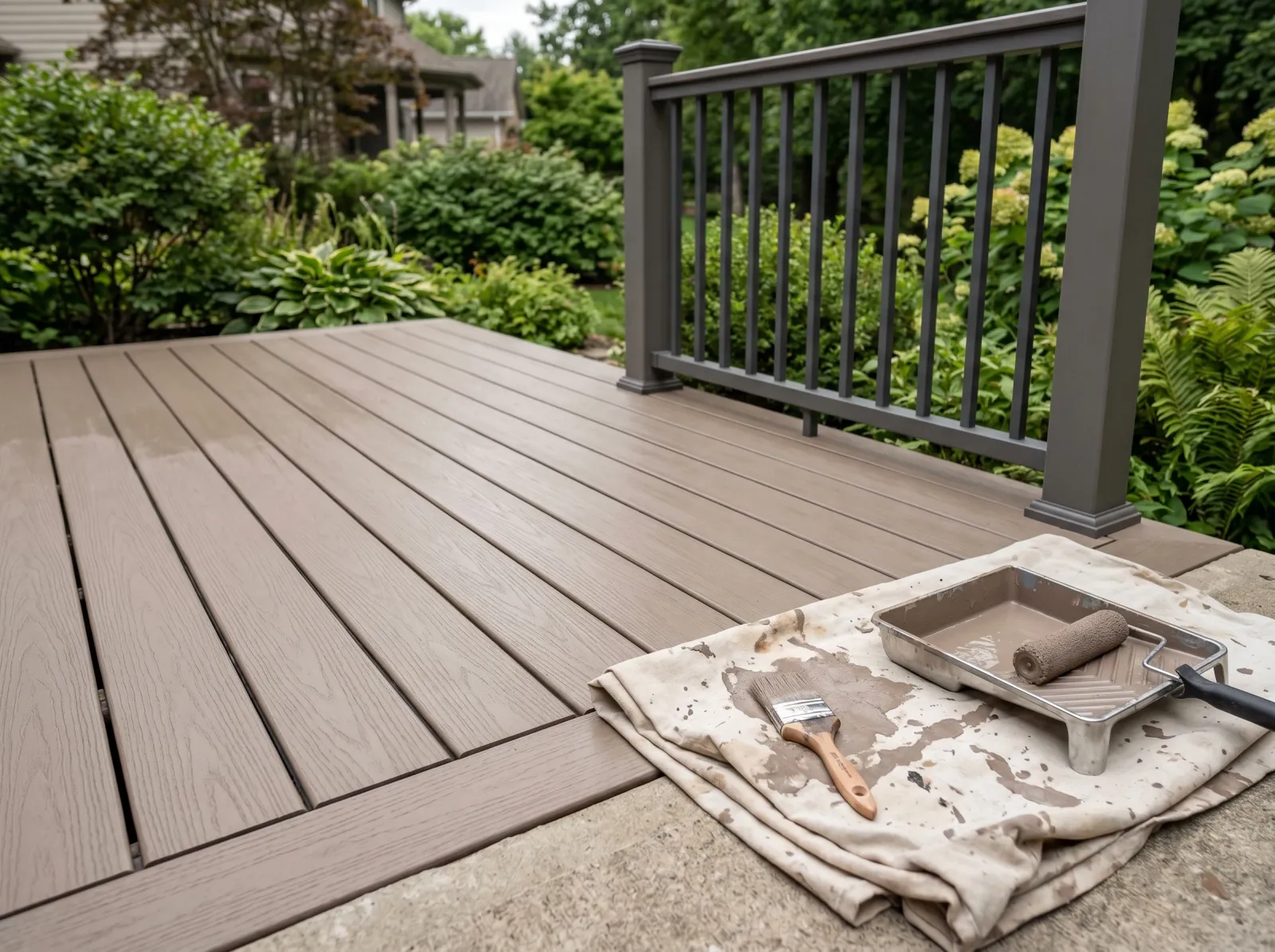
Brush the board edges and the gaps first, then back-roll the faces. Stop at a board end, never mid-board.
Two products work over the primer. A 100% acrylic porch-and-floor paint gives you the most color choice and the most opaque, uniform finish. An acrylic solid-color deck stain sits a touch thinner, hides the grain a little less, and tends to wear more gracefully on a flexing surface.
Either way, the binder has to be acrylic. Acrylic stays flexible and moves with the board through the heat swing. Oil-based and alkyd floor enamels go brittle on the plastic cap and crack at the edges inside a season. For the longer version of why the chemistry matters here, see the breakdown of oil-based vs water-based paint.
Brush the board edges and the gaps first, then back-roll the faces while the brush work is still wet. Stop at the end of a board, never in the middle of a run. Stopping mid-board is how you get lap marks, and lap marks show up the second the low evening sun rakes across the deck. For the full deck workflow including railings and stairs, the deck painting project walkthrough covers the order of operations.
Two coats. Always two. One coat on a deck floor is a marketing claim, not a job spec. Foot traffic eats a single thin film fast.
What to Actually Buy
The products people ask for by name, all sold either at the big boxes or at the brand’s own stores: Rust-Oleum Porch and Floor, Sherwin-Williams Porch and Floor Enamel, and Sherwin-Williams SuperDeck Exterior Waterborne Solid Color Stain. Behr, Benjamin Moore, and Valspar all sell a porch-and-floor enamel in the same class. Any 100% acrylic porch-and-floor enamel or waterborne solid-color deck stain from a real brand will do this job — the binder matters far more than the label on the can.
Sherwin-Williams’ own spec on the SuperDeck route is a useful benchmark whichever brand you buy: two coats on anything you walk on, one coat on spindles and railings, and check the decking manufacturer’s guidelines before you start. That last line is the same advice at the top of this page, and it comes from the paint company.
How much to buy, on a 300-square-foot deck:
| Product | Coverage per gallon | Buy for 300 sq ft |
|---|---|---|
| INSL-X Stix bonding primer | 300–400 sq ft | 1 gallon |
| Acrylic porch-and-floor paint | 350–400 sq ft per coat | 2 gallons (two coats) |
| Acrylic solid-color deck stain | 350–400 sq ft per coat | 2 gallons (two coats) |
Round up rather than down. Board edges and the gaps between boards drink more than the flat-area math predicts, and a mid-job store run is how lap marks happen.
Skip the Thick Textured Resurfacers
On the same shelf you’ll see the heavy resurfacers — KILZ Over Armor and the DeckOver class of products, sold as thick textured coatings with primer built in. On composite, walk past them.
Two reasons. First, those coatings have a long, documented history of peeling on horizontal decks, where standing water and foot traffic work on a thick film from both sides. Second, and worse here: they’re rigid films, and you’d be laying one on a plastic cap that swings 30 to 50 degrees over air temperature and moves every summer day. Thick and rigid is the wrong answer to a substrate that flexes. Thin and flexible is the right one.
If your deck has splinters and cracks to fill, that’s a wood-deck problem and the resurfacers were built for it. Composite doesn’t splinter. You don’t need the filler, and you don’t want the film.
For picks on the actual product, the best deck stain and solid-color coating round-up lists what holds up on a horizontal surface that takes sun and foot traffic.
Step 6: Dry, Recoat, and Cure
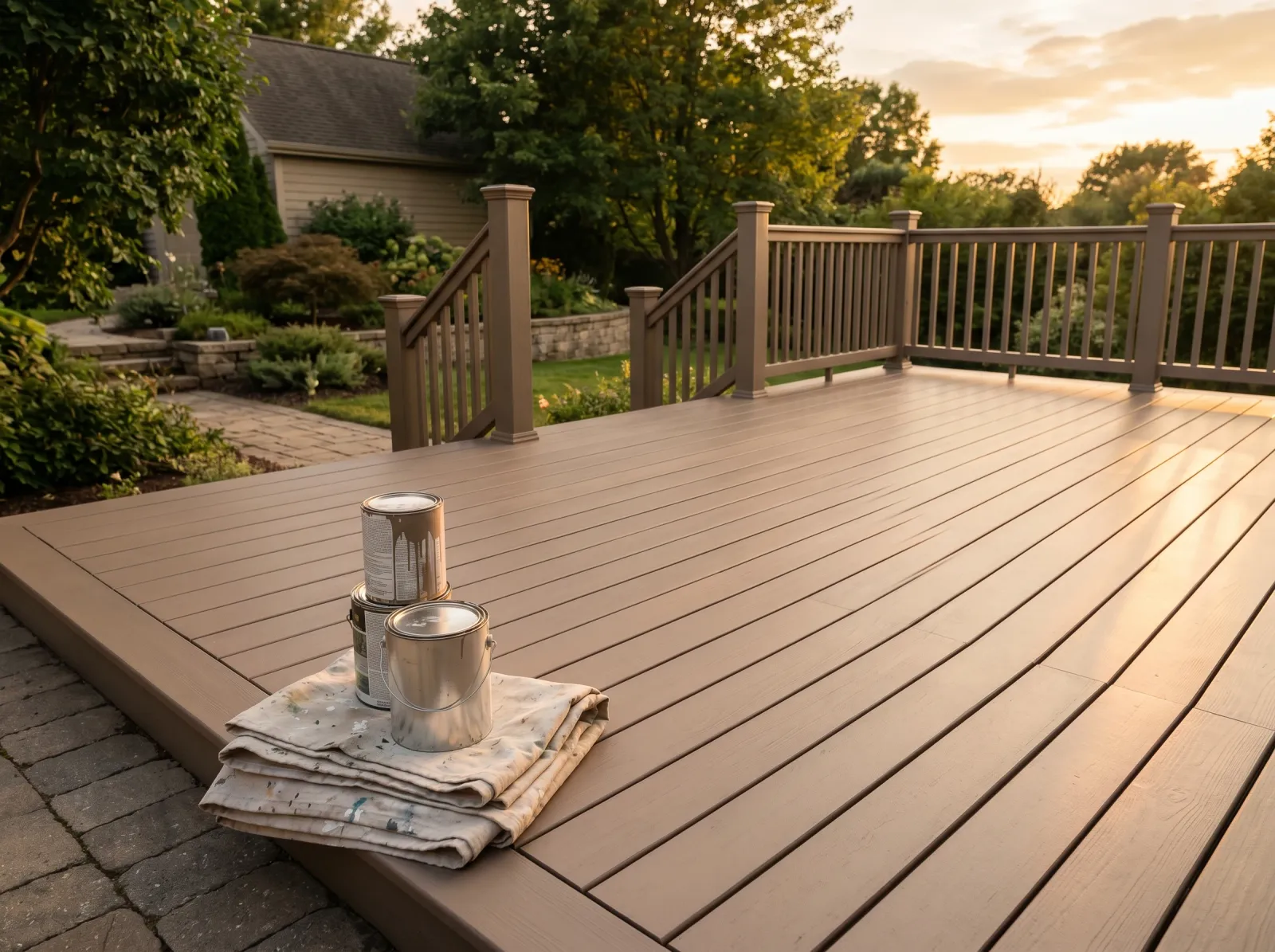
Two coats, fully cured before furniture goes back. The film on plastic stays soft longer than the can claims.
Read the can, then add a margin, because film over plastic cures slower than the same film over wood. Wood wicks solvent and water out of the back of the film. A sealed cap doesn’t, so the film can only dry from the top.
Rough numbers in warm, dry weather: touch-dry in 2 to 4 hours, recoat in 4 to 6, light foot traffic at 24 to 48 hours. Hold furniture and planters off the deck for a full week. A planter set on a soft film leaves a permanent ring and traps moisture under the pot, and that’s where the first failure shows up.
Full cure runs longer in humidity or shade. Don’t drag a grill across it or set a hot fire pit on it for two weeks.
The Shorter Path for Uncapped Early-Generation Boards
Everything above is the capped-board job, and it’s the hard version, because a slick plastic shell is about the worst thing in a backyard to make paint stick to. If the cross-section test said uncapped, you get an easier day. Those boards are porous. They fade, they stain, and they take a coating much the way a tired wood deck does.
- Clean. Same as Step 2: oxygenated composite cleaner, stiff brush, gentle rinse, 48 hours of dry weather. Keep the pressure washer even lower than you would on a capped deck — a porous board tears open at pressures a cap shrugs off.
- Light scuff, 240-grit. Not 80. On capped boards, coarse paper is cutting tooth into plastic. Here you’re only deglossing and knocking down surface fuzz, and coarse paper just leaves scratches the coating will telegraph.
- Coat it. Two routes, and the first one is what Trex itself points to:
- Composite-specific solid-color deck stain, straight onto the board. No bonding primer. It soaks into the porous surface instead of sitting on top, which means it wears by fading rather than peeling — and a faded stain recoats with a wash and a fresh coat instead of a scraper.
- Acrylic primer plus acrylic porch-and-floor paint. More color choice and a more opaque, uniform look. A standard exterior acrylic primer is enough on a porous board. You don’t need Stix here.
Second coat goes on in 4 to 6 hours in decent weather. Same rules as the capped job: brush the edges and gaps first, keep a wet edge, and stop at the end of a board, never mid-run, or the lap marks show the first evening the low sun rakes across the deck.
Two coats on the walking surface, one is usually plenty on spindles and railings.
Common Mistakes
- No bonding primer. Standard deck primer or paint-and-primer-in-one over a capped board peels in sheets the first hot summer. Use INSL-X Stix or Bulls Eye 1-2-3 Plus, scuff-sanded first.
- Skipping the scuff-sand. The cap is too slick for even a bonding primer to fully grip. 80 to 120-grit across the whole field, no shiny spots left.
- Using capped-board grit on uncapped boards. 80-grit on a porous early-gen board leaves scratch marks the stain shows off. 240-grit is all a soft, porous surface needs.
- A thick textured resurfacer. The heavy DeckOver-class coatings peel on horizontal decks and are far too rigid for a plastic cap that moves with every hot afternoon. Thin flexible acrylic instead.
- Assuming your deck is capped because of the year. Capped boards started in 2010, uncapped ones sold until about 2013. Check a board cross-section instead of guessing, or you’ll buy the wrong system.
- Oil-based or alkyd floor paint. Goes brittle on the flexing plastic cap and cracks at the board edges within a season. Acrylic only.
- Painting in full sun. A dark composite board in July sun runs 30 to 50 degrees over air temp. The coat flashes before it levels and you get a dead, weak film. Work the shaded side, early or late.
- Painting a damp deck. The grain texture holds water longer than the surface reads. 48 hours dry, and meter the boards if you’re unsure.
- Ignoring the warranty. Coating composite voids most surface warranties. If yours is still active, that’s a real cost to weigh before you start.
- One coat to save time. A single thin film on a foot-traffic floor wears through at the door and the stair nosing inside a year. Two coats, full mil build.
Maintenance and Longevity
Painted composite holds three to five years on the open field, less on stair treads and any board that bakes in full afternoon sun. The film fails at the board edges first, because that’s where the heat movement is sharpest and where water finds an opening.
Wash it twice a year with the same composite cleaner, soft brush, no high pressure on the cured film for the first year. Watch the high-traffic lanes, the door threshold, and the south-facing field. When you see the first edge lifting, scuff-sand the failed area, spot-prime with Stix, and recoat that section before it spreads across the whole board.
A coated composite deck is a maintenance deck now. That’s the trade you made when you painted the no-maintenance deck — cheap per cycle, as the cost table above shows, but a cycle all the same. If you’d rather not sign up for the recoat cycle, the honest answer is to replace faded boards rather than paint them, or to switch to a real wood deck where pressure-treated lumber takes a finish the way it’s meant to. And when the film does start lifting, the peeling paint fix walks through stripping it back to a sound surface.
Will it bite you in two years? Only if you skipped the bonding primer, left the cap shiny, or painted it in the afternoon sun. Get the primer call right and the deck holds its color until the next recoat comes due.
Ask a Question