Best Deck Cleaners and Brighteners
Six deck cleaners and brighteners tested on grayed cedar, PT pine, and composite boards. Top pick: Wolman DeckBrite for the percarbonate wash before stain.

Oxygen-activated powder concentrate that foams and clings, so it stays put on railings and pickets instead of running to the bottom rail in 40 seconds
Ready to use out of the jug at 200-250 sq ft per gallon, so there is no dilution math at the exact moment you are already tired and wet
One jug makes up to 20 gallons and covers up to 5,800 sq ft, which is three average decks and a fence for the price of one premium gallon of stain
EPA Safer Choice listed, which is the only third-party plant-and-pet claim in this round-up that is actually audited
Spray and walk away. No scrubbing, no rinsing, no pressure washer, no kneeling on a deck for three hours
Pulls half-worn semi-transparent oil and old clear sealer off the board so the next coat bonds to wood instead of to a failing film
Disclosure: Some links below are affiliate links. We earn a commission if you buy through them, at no extra cost to you. Picks are based on the criteria in “How the Test Ran”. No brand pays for placement.
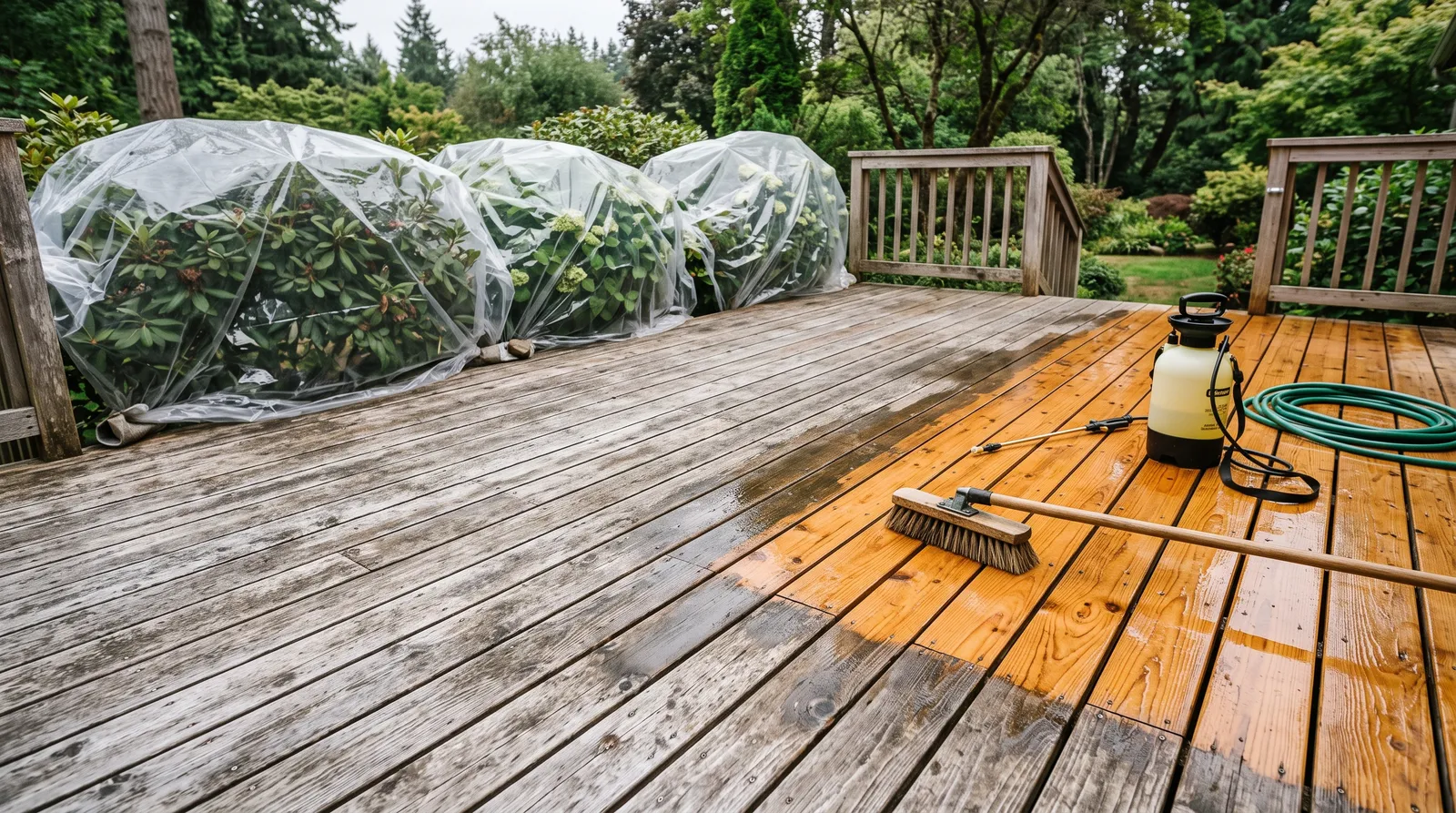
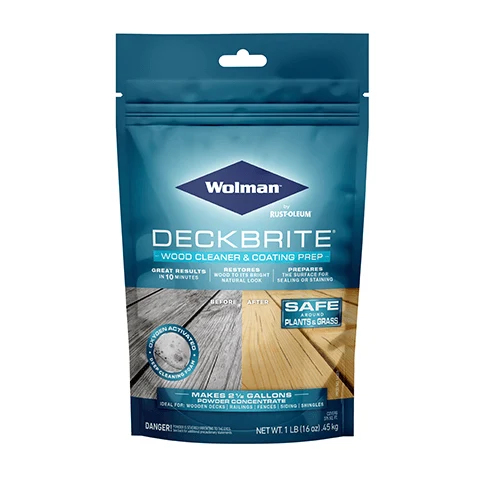
Top pick: Wolman DeckBrite Wood Cleaner & Coating Prep. It’s an oxygen-activated powder that foams, clings to railings, and pulls dead gray fiber off weathered cedar in a ten-minute dwell, and on my north-side test boards it cleared black mildew in one pass where two liquid cleaners needed two. DeckBrite wins on cleaning power per dollar and on staying put where you sprayed it. It falls short on shelf life once mixed, and it does nothing about the pH it leaves behind. Buy Cabot Wood Brightener with it. Those two cans are the actual answer to this category.
Here’s the thing nobody selling deck cleaner wants on the label: cleaning is half a job.
Cleaner and Brightener Are Two Different Chemicals Doing Two Different Jobs
A deck cleaner is alkaline. Sodium percarbonate, mostly, which is dry hydrogen peroxide bonded to soda ash. Add warm water and it fizzes oxygen through the surface fiber of the board, floating dirt, pollen, mildew, mill glaze, and the dead gray cells that UV has been killing for the last three summers. Scrub it, rinse it, and the board comes back looking like wood again.
It also comes back at a pH somewhere north of 10.
That matters because stain absorption is pH-sensitive. Alkaline wood takes semi-transparent oil unevenly and often darker than the color chip promised, and the residue keeps working on the fiber after you think you’re done. A brightener is the correction. Oxalic acid, water-thin, 15 minutes of dwell, and it drops surface pH back to roughly neutral while dissolving the rust halos around every deck screw and the black tannin streaks that run under railing posts on cedar and redwood.
Skip the brightener and the deck still looks clean on Sunday. The problem shows up three weeks later, when the stain you paid $60 a gallon for has flashed light and dark across boards that looked identical when they were wet.
I’ve run that mistake on purpose, on a control section, more than once. It’s consistent.
How the Test Ran
Six products across three real decks: a 14-year-old western red cedar deck in coastal Mid-Atlantic humidity, a 6-year-old pressure-treated southern yellow pine deck, and a composite deck in year 9. Each product got a 6-foot section of each surface plus a taped-off unwashed control strip down the middle of every board, so the before-and-after sits in the same photo under the same light. I measured L* and b* with a colorimeter at 24 hours and again at 30 days, scored mildew under UV-A on the shaded boards, and checked hostas and boxwood inside the rinse zone for leaf burn at day seven. Every cedar section then got brightened, dried to 12-15% on a pin meter, and coated with the same semi-transparent oil so I could see which cleaner left a surface that took stain evenly.
Prices checked at Home Depot, Lowe’s, Ace, and Amazon in July 2026. Pick-specific results sit inside each review below.
The Six, Compared
| Product | Best for | Mildew clearance | Composite-safe | Price |
|---|---|---|---|---|
| Wolman DeckBrite | Full prep before stain | 🟢 One pass | Yes | $ |
| Cabot Wood Brightener | Neutralizing + rust stains | ⚪ N/A (acid step) | Not needed | $ |
| Krud Kutter Deck & Fence | Pressure washer owners | 🟢 One pass | Yes | $ |
| Simple Green Oxy Solve | Plants and pets nearby | 🟡 Two passes on deep shade | Yes | $ |
| Wet & Forget Outdoor | No-scrub maintenance | 🟢 Slow but total | Yes | $ |
| Wolman DeckStrip | Old finish still on the boards | ⚪ N/A (stripper) | No | $$ |
Every one of these is under $40 a container. The cost that matters in this category is your Saturday, not the jug.
Pick in One Line
- Bare or nearly bare wood, staining in the next two weeks: Wolman DeckBrite, then Cabot Wood Brightener.
- You own a pressure washer: Krud Kutter Deck & Fence Concentrate through the siphon tube.
- Garden beds hard against the deck: Simple Green Oxy Solve.
- North-facing deck that’s green every spring and you’re tired: Wet & Forget, once a year, walk away.
- Old stain still visible on 40% of the boards: Wolman DeckStrip first. Nothing else on this list will get through it.
- Composite decking: any of the four composite-safe picks. No brightener.
The Picks in Detail
Wolman DeckBrite Wood Cleaner & Coating Prep, Top Pick
Powder in a tub. Mix with warm water, spray or mop it on, wait ten minutes, scrub the bad spots, rinse.
The foaming is the part that earns the top slot, and I didn’t expect to care about it. Liquid cleaners on a deck railing run down the pickets and pool at the bottom rail inside a minute, which means the top of every picket gets 15 seconds of contact and the bottom gets ten minutes. DeckBrite’s foam clings. On my cedar test rails the vertical surfaces came out matching the horizontal ones, which was not true of the two liquids in this round-up. On the flat boards, L* lifted 11 points against the taped control strip after one application, and the deep-shade north-side section cleared black mildew completely on the first pass.
It’s chlorine-free, which is why it also works on composite decking without leaving the pale chalky patch that bleach cleaners burn into wood-plastic boards. On new pressure-treated pine it took mill glaze off cleanly, and the water-drop test soaked in under 20 seconds afterward where the untreated control still beaded.
Two real weaknesses. Mixed percarbonate solution loses strength within a few hours, so mix per section, not per deck. And it leaves the board alkaline. DeckBrite is not a one-can answer no matter how the shelf tag reads.
Stocking is the other frustration. Some Lowe’s stores carry the whole Wolman prep line, some carry none of it, and the online listings shuffle around between seasons. When it’s in stock locally it’s the cheapest way to clean a deck properly; the Amazon listing is the reliable fallback and the tub ships without shipping you a gallon of water.
Buy it for any bare-wood deck heading toward stain, plus composite decks with mildew. Skip it if you want a single product and refuse to do the second step.
Cabot Wood Brightener, Best Brightener
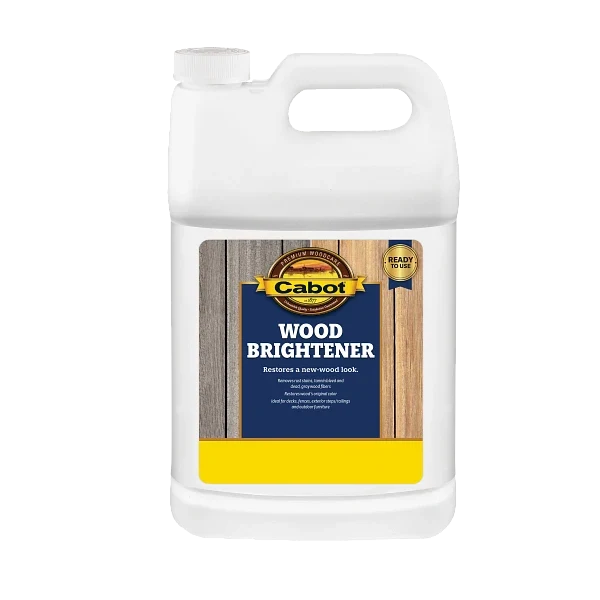
The other half of the top pick. Oxalic acid, ready to use, no dilution, 200-250 square feet per gallon.
What it does that a cleaner can’t: rust. Every deck built with uncoated or partially coated fasteners develops a dark halo around each screw head, iron reacting with wood tannins. Percarbonate leaves those halos exactly where they were. Fifteen minutes of Cabot brightener and they’re gone, along with the tannin bleed streaking down cedar under the railing posts. On my cedar panel the b* value moved 4 points warmer, which in plain language means the boards went from washed-out gray-beige back to honey.
The stain result is the reason it’s here at all. Two adjacent cedar sections, both cleaned with DeckBrite, one brightened and one not, both stained with the same semi-transparent oil 48 hours later. The unbrightened section flashed. Not subtly. Dark patches at the board centers, light at the edges, and the color read a half-shade muddier across the whole section.
Handling notes matter with this one. It’s oxalic acid. Goggles and chemical gloves, and don’t let it dry on the board on a hot afternoon; mist lightly if the surface starts flashing off. And the coverage claim is optimistic on thirsty weathered cedar. Buy 1.5 gallons for a 400-square-foot deck and you won’t be running to Lowe’s mid-job.
It’s usually cheaper at a Lowe’s or Ace store than shipped, since you’re paying to move a gallon of water. The Amazon listing is worth it if you’re already ordering the rest of the prep kit.
Krud Kutter Deck & Fence Pressure Washer Concentrate, Best for Pressure Washer Owners
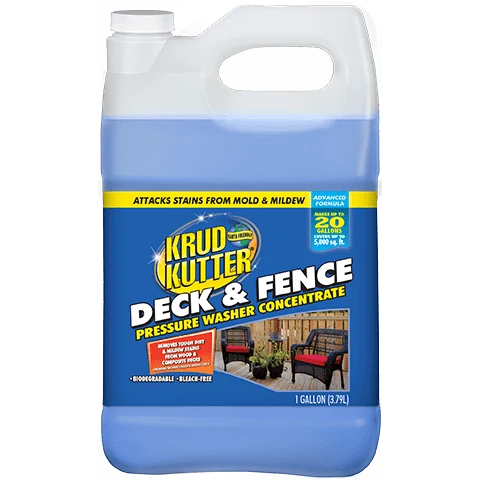
If you own the machine, this is the cheapest cleaned square foot in the round-up by a wide margin. One jug makes up to 20 gallons of working solution and covers up to 5,800 square feet, which is a deck, a fence, and the neighbor’s deck if you’re feeling generous.
It runs straight through the downstream siphon tube. No bucket, no pump sprayer, no second tool to rinse out afterward. Apply at low pressure through the black soap tip, let it dwell 5-10 minutes, switch to the 40-degree tip at 1,500 psi and rinse with the grain. On my pressure-treated pine section that sequence cleared 14 years of gray and mildew in one pass, and the whole 6-foot section took under four minutes of actual machine time.
The catch is structural. Hand-applied, it’s a decent bleach-free cleaner, but the economics and the dwell behavior are both built around a washer, and it doesn’t foam or cling the way DeckBrite does. It also doesn’t brighten. Cleaned boards come out clean and slightly flat-looking, and the color pop still comes from the acid step afterward.
One warning that belongs to the machine, not the chemical: 1,500 psi with a 40-degree tip, 12 inches off the board, moving. Crank it to 2,500 with a 15-degree tip and you’ll carve stripes into cedar that stay visible through three coats of stain.
Buy it for a pressure washer household with more than 500 square feet of deck and fence. Skip it if the machine is a rental you’re picking up specially.
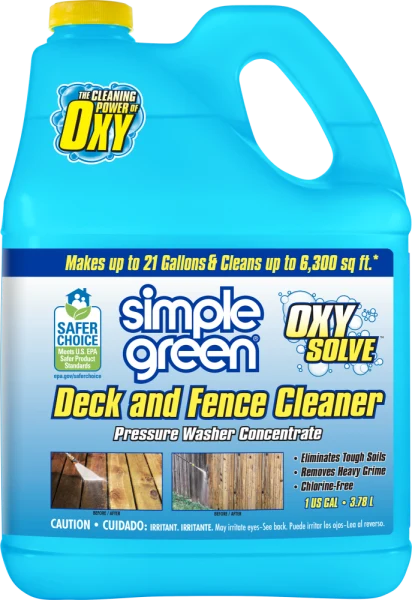
Simple Green Oxy Solve Deck and Fence Cleaner, Best Around Plants and Pets
The only pick here carrying EPA Safer Choice listing, which is a real audited program rather than a green-looking logo the marketing department drew.
That claim held up in the messiest way I could test it. I put hostas and a boxwood inside 4 feet of the rinse zone under a plastic tarp thrown on the way a normal person throws a tarp, with gaps. At day seven, no leaf burn. Peroxide chemistry rather than chlorine is doing that work, and if you have planting beds hard against the deck framing where runoff has nowhere to go but down, this is the can to buy.
Cleaning performance sits a step below the powder. One gallon makes up to 21 gallons at 1:20 and covers up to 6,300 square feet, so cost is fine. On lightly weathered pressure-treated pine it was even with everything else. On the deep-shade north-side cedar, black mildew needed a second application where DeckBrite and Krud Kutter each cleared it in one.
The dwell window is the practical annoyance. Three to five minutes, and the label is firm about never letting it dry on the boards. On an 85-degree July afternoon that puts you working in 8-foot sections with a hose in your other hand. Start early or work the shaded side first.
Wet & Forget Outdoor Spaces, Best No-Scrub Maintenance
Different product category wearing similar packaging. Spray it on, leave it, never rinse, never scrub.
For the right reader that’s a genuinely great deal. North-facing deck, a canopy of oaks overhead, green algae film every April, and no interest in spending a Saturday on your knees with a stiff brush. The hose-end version reaches roughly 24 feet, which means a second-floor railing from the ground, and it’s bleach-free and color-safe on composite, painted railings, and the fence behind the deck. Once a year in spring and the surface stays clear.
The trade is time. Green algae stains fade over a few weeks. Black mold and moss can take most of a season. On my composite test section the algae film was visibly gone at week three and fully clear at week seven with zero physical effort, which is a real result, just not a fast one.
It’s not prep. It doesn’t open wood fiber, doesn’t lift mill glaze, and won’t get a deck ready to stain next weekend. It also needs 4-5 dry hours after application, which in a wet spring is a scheduling puzzle of its own.
Skip this if there’s a stain job on the calendar. Buy it if the deck is composite, or if it’s wood you’re keeping bare and just want to stop looking green.
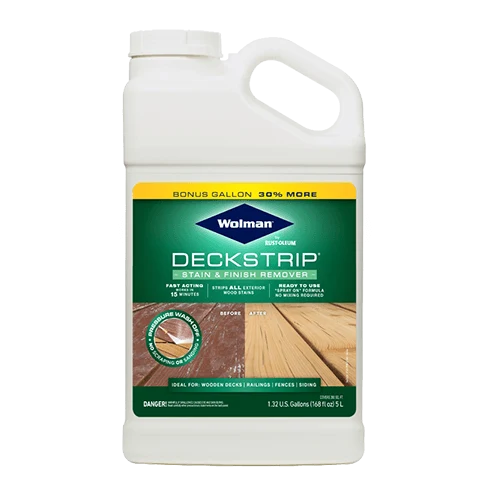
Wolman DeckStrip Stain & Finish Remover, When a Cleaner Won’t Cut It
Here’s the diagnostic that decides whether you need this can. Drop a teaspoon of water on the worst-looking board. If it soaks in within 30 seconds, the old finish is gone and a cleaner is enough. If it beads or sits, there’s still film on the wood, and no percarbonate cleaner on earth is getting through it.
DeckStrip is an alkaline stripper built for that. It pulls half-worn semi-transparent oil and old clear water sealer off the board so the next coat bonds to wood instead of to a failing film. On my cedar test section it took about 100-150 square feet per gallon with 15-20 minutes of dwell and honest scrubbing, and the boards came out bare, dark, and slightly furry.
That fur is the point of the warning. Alkaline stripping raises grain and darkens fiber, so the brightener afterward isn’t optional here, it’s part of the process. Strip, rinse, brighten, rinse, then 48 hours of drying before any stain goes down. Budget the whole weekend.
Check the label carefully at the register. Regular DeckStrip is for oils and clear sealers. Solid and semi-solid acrylic stain needs DeckStrip-ASR instead, and the two cans sit next to each other looking nearly identical. For thicker paint-type coatings that neither one touches, see the paint stripper round-up.
Where Deck Cleaning Goes Sideways
Most of the failures I get emails about aren’t product failures.
- Cleaner dried on the boards. Every product here wants to be rinsed wet. Dried percarbonate leaves a white haze; dried acid leaves streaks. Work in sections you can finish, and mist ahead of yourself in the heat.
- Pressure washer damage. Stripes across the boards, visible forever. 1,500 psi, 40-degree tip, 12 inches, keep moving.
- Stain went on too soon. The deck looked dry. The pin meter said 19%. Water trapped under a finish blisters. Give it 48 hours and test.
- Cleaned but never brightened. Blotchy stain three weeks later on wood that looked flawless the day you cleaned it.
- Bleach on composite. Permanent pale patches. There’s no fix, only replacement boards that won’t match.
- Only cleaned the horizontals. Railings, pickets, and stair risers gray at a different rate. A deck with clean floor boards and gray rails looks worse than one that’s uniformly dirty.
- Plants died. Tarps slip. Wet the beds first, cover them, then wet them again afterward.
For a deck where the old finish is actively coming off in sheets rather than just fading, the exterior peeling diagnosis sorts adhesion failure from normal erosion before you buy anything.
Application Notes
- Work in shade, or work early. Every product on this list performs worse on a hot board because the dwell window collapses.
- Mix percarbonate powder in warm water. Cold water leaves undissolved grit that does nothing but scratch.
- Use a stiff synthetic brush, not a wire brush. Wire brushes leave steel fragments in the wood that rust-stain within a month.
- Clean top-down on verticals, rinse bottom-up. Starting the rinse at the bottom keeps dirty runoff from streaking clean wood.
- Cover and pre-wet the plants. Twice. Before and after.
- Two-day rule before stain. 48 hours minimum, pin meter at 12-15%, water-drop test as the field check.
- Don’t sand after brightening. Sanding closes the fiber you just opened and the stain sits on top instead of soaking in. If a board needs sanding, sand first, then clean, then brighten.
For the full prep-to-finish sequence, the deck staining project guide has the order of operations; for the substrate chemistry underneath all of it, the exterior wood prep guide goes deeper on why weathered fiber behaves the way it does. If you’ve been cleaning with TSP out of habit, the TSP substitute explainer covers why percarbonate replaced it for wood.
Also Considered
- Behr Premium All-In-One Wood Cleaner. Convenient, sold in every Home Depot, and genuinely fine on a lightly dirty deck. The all-in-one framing is where I get off: cleaner and brightener chemistry neutralize each other, so you get a mild version of both. Good for a bare deck being rinsed and left alone.
- Thompson’s WaterSeal Oxy Deck Cleaner. Comparable percarbonate chemistry to DeckBrite at a similar price. It didn’t foam or cling as well on vertical rails in my testing, and the mildew clearance on shaded cedar took a second pass.
- Star brite Non-Skid Deck Cleaner. Excellent product, built for fiberglass boat decks. Wrong chemistry for exterior wood.
- Chlorine bleach and water. Cheapest thing in this article and the reason a lot of decks turn furry. It degrades lignin, corrodes fasteners, and kills landscaping. There’s no version of this I recommend on wood.
- Corte-Clean. Purpose-built for composite decking and it works, but the four composite-safe picks above cover the same job at lower cost and wider availability.
If your deck is bare wood and stain is going on this month, buy the DeckBrite and the Cabot brightener together and plan two days. If it’s composite and you just want the green gone with no effort, Wet & Forget and patience. The only genuinely wrong move is cleaning a deck properly, skipping the acid step, and blaming the stain.
Full Comparison
| Product | Best for | Yellowing | Price |
|---|---|---|---|
| Wolman DeckBrite Wood Cleaner & Coating Prep | Top pick — best all-around percarbonate cleaner | N/A | $ |
| Cabot Wood Brightener | Best brightener — the step most people skip | N/A | $ |
| Krud Kutter Deck & Fence Pressure Washer Concentrate | Best for pressure washer owners | N/A | $ |
| Simple Green Oxy Solve Deck and Fence Cleaner | Best around plants and pets | N/A | $ |
| Wet & Forget Outdoor Spaces Moss, Mold, Mildew & Algae Stain Remover | Best no-scrub maintenance for shaded and composite decks | N/A | $ |
| Wolman DeckStrip Stain & Finish Remover | Best when a cleaner is not enough | N/A | $$ |
Every Pick, Pros and Cons
Pros, cons, and specs for each pick. The cons are not optional here.
1. Wolman DeckBrite Wood Cleaner & Coating Prep
- Coverage
- About 250 sq ft per mixed gallon on a horizontal deck
- Sheens
- N/A — surface prep, no film
- Dry / recoat
- 10-minute dwell, rinse wet, 24 hours before brightener or stain
- Full cure
- N/A
- VOC
- Powder concentrate, no solvent VOC
- Yellowing risk
- N/A
- Primer
- Follow with an oxalic-acid brightener before any stain
- Price tier
- $
- Oxygen-activated powder concentrate that foams and clings, so it stays put on railings and pickets instead of running to the bottom rail in 40 seconds
- Chlorine-free chemistry lifts mill glaze off new pressure-treated pine and gray fiber off weathered cedar without bleaching the wood pale
- Ten-minute dwell is short enough that a 400-square-foot deck cleans in sections without the first section drying out
- Safe on wood-plastic composite decking, where a chlorine cleaner leaves a chalky washed-out patch you cannot undo
- Powder has to be mixed in warm water and used the same day; the activated solution loses strength within a few hours
- Does not neutralize its own alkalinity, so a follow-up oxalic-acid brightener is not optional if stain goes on afterward
- Stocking is regional. Some Lowe's stores carry the whole Wolman prep line, some carry none of it, and the online listings move around
2. Cabot Wood Brightener
- Coverage
- 200-250 sq ft / gal
- Sheens
- N/A — surface prep, no film
- Dry / recoat
- 15-20 minute dwell, rinse, 24-48 hours dry before stain
- Full cure
- N/A
- VOC
- Water-based, no solvent VOC
- Yellowing risk
- N/A
- Primer
- Use after a percarbonate cleaner, before stain
- Price tier
- $
- Ready to use out of the jug at 200-250 sq ft per gallon, so there is no dilution math at the exact moment you are already tired and wet
- Oxalic acid pulls rust halos around deck screws and tannin bleed streaks under railings that no percarbonate cleaner touches
- Drops surface pH back into the range where oil and waterborne stain both absorb evenly, which is the whole reason the step exists
- Fifteen to twenty minutes of dwell on a hot board dries too fast; you end up misting the surface to keep it working
- Oxalic acid burns eyes and skin. Goggles and gloves, not sunglasses and optimism
- One gallon does not go as far as the label implies on thirsty weathered cedar. Budget 1.5x for a 400-square-foot deck
3. Krud Kutter Deck & Fence Pressure Washer Concentrate
- Coverage
- Up to 5,800 sq ft per jug (makes up to 20 gal diluted)
- Sheens
- N/A — surface prep, no film
- Dry / recoat
- Dwell 5-10 minutes, rinse before it dries
- Full cure
- N/A
- VOC
- Water-based concentrate
- Yellowing risk
- N/A
- Primer
- Follow with brightener if stain is going on
- Price tier
- $
- One jug makes up to 20 gallons and covers up to 5,800 sq ft, which is three average decks and a fence for the price of one premium gallon of stain
- Feeds straight through a pressure washer's downstream siphon tube, so there is no bucket, no sprayer, no second tool to clean
- Bleach-free and biodegradable, and it is rated for composite decking as well as wood
- Built around the pressure washer. Hand-scrubbing it works, but the value case collapses if you do not own or rent the machine
- Does not brighten. Cleaned boards come out clean and slightly dull; the color pop needs an acid rinse afterward
4. Simple Green Oxy Solve Deck and Fence Cleaner
- Coverage
- Up to 6,300 sq ft per gallon concentrate (makes up to 21 gal at 1:20)
- Sheens
- N/A — surface prep, no film
- Dry / recoat
- 3-5 minute dwell, rinse before dry
- Full cure
- N/A
- VOC
- Water-based concentrate
- Yellowing risk
- N/A
- Primer
- Brightener recommended before stain
- Price tier
- $
- EPA Safer Choice listed, which is the only third-party plant-and-pet claim in this round-up that is actually audited
- Peroxide chemistry instead of bleach, so the hydrangeas at the deck edge survive an imperfect tarp job
- One gallon makes up to 21 gallons at 1:20 and cleans up to 6,300 sq ft; sold at Home Depot, Lowe's, and Amazon
- Three-to-five-minute dwell is the shortest here, and the label is firm about not letting it dry on the boards. On an 85-degree afternoon you are working in 8-foot sections
- Light on heavy black mildew. Deep-shade north-side boards took a second pass where the Wolman powder cleared them in one
- Sold as a liquid, so you are shipping water; the powder concentrates are cheaper per cleaned square foot
5. Wet & Forget Outdoor Spaces Moss, Mold, Mildew & Algae Stain Remover

- Coverage
- Hose-end reaches up to 24 ft; concentrate dilutes 1:5
- Sheens
- N/A — no film
- Dry / recoat
- Leave on; no rinse
- Full cure
- Visible results in weeks to months
- VOC
- Water-based, bleach-free
- Yellowing risk
- N/A
- Primer
- Not a stain-prep product
- Price tier
- $
- Spray and walk away. No scrubbing, no rinsing, no pressure washer, no kneeling on a deck for three hours
- Hose-end version reaches roughly 24 feet, which covers a second-story railing from the ground
- Bleach-free and color-safe on composite decking, painted railings, and the fence behind the deck
- Results take weeks to months. Green algae fades in a few weeks, black mold and moss stains can take a full season
- This is maintenance, not prep. It does not open wood fiber, remove mill glaze, or get a deck ready for stain next weekend
- Needs dry weather for 4-5 hours after application, which is its own scheduling problem in a wet spring
6. Wolman DeckStrip Stain & Finish Remover
- Coverage
- About 100-150 sq ft / gal depending on old finish build
- Sheens
- N/A — surface prep, no film
- Dry / recoat
- 15-20 minute dwell, scrub, rinse; 48 hours dry before stain
- Full cure
- N/A
- VOC
- Water-based alkaline stripper
- Yellowing risk
- N/A
- Primer
- Brightener required after stripping
- Price tier
- $$
- Pulls half-worn semi-transparent oil and old clear sealer off the board so the next coat bonds to wood instead of to a failing film
- Sold alongside DeckBrite and the Wolman brightener, so the three-step sequence comes from one chemistry family
- Cheaper and far less brutal than sanding 400 square feet of deck with an orbital
- Alkaline stripper darkens and roughens wood fiber. The brightener step afterward is mandatory, not a nice-to-have
- Wrong product for solid or semi-solid acrylic stain; that needs DeckStrip-ASR instead, and the two cans look similar on the shelf
- Adds a full day to the schedule. Strip, rinse, brighten, rinse, then 48 hours of drying before stain
Ask a Question