Solid Stain vs Deck Paint — Same Coating in a Can?
Solid stain and deck paint both block the grain, but only one survives a horizontal board through a freeze-thaw cycle. Pick the right film for deck, fence, or porch.

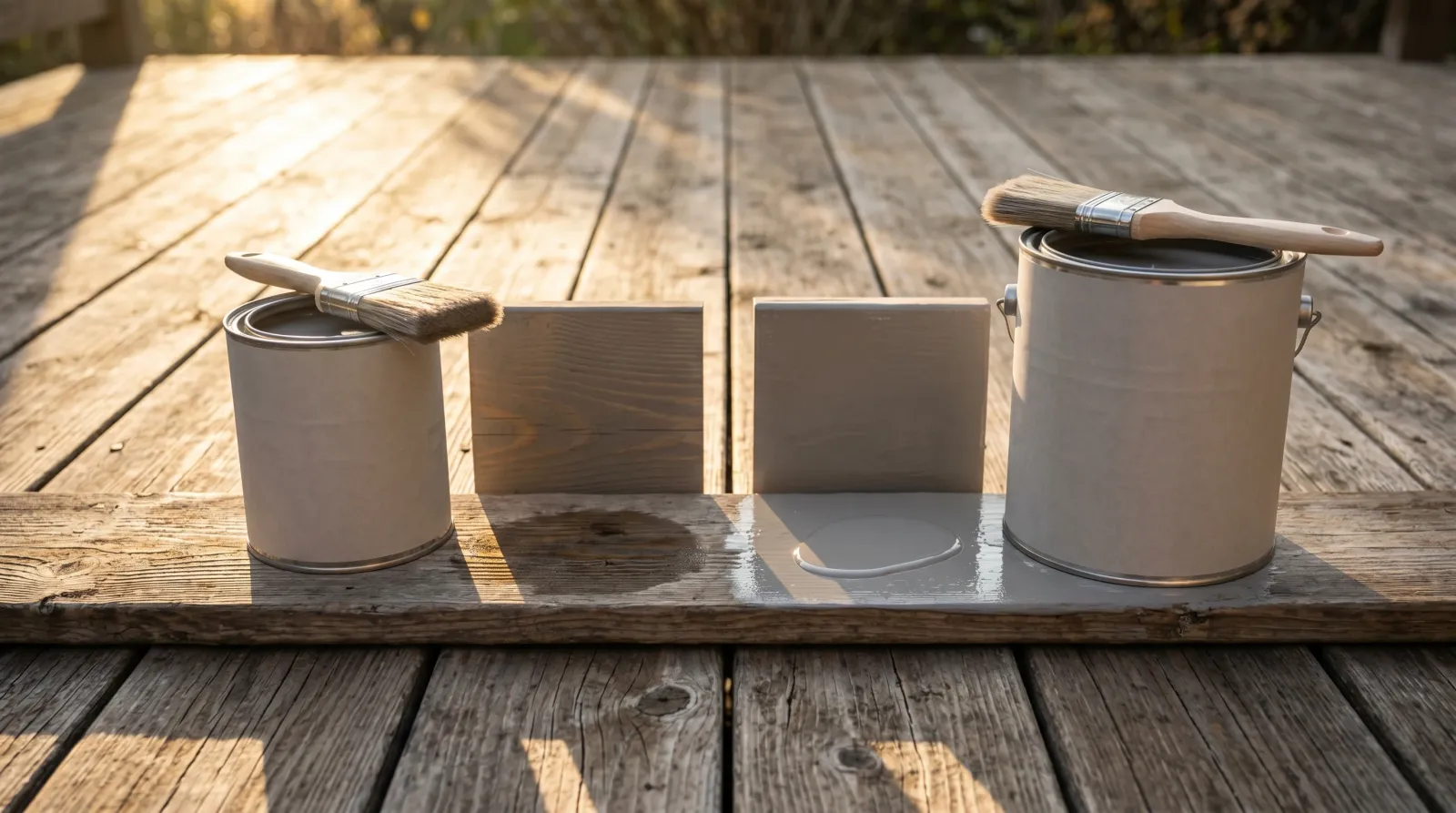
The 30-Second Answer
On a deck, buy solid stain. On a fence, buy deck paint. That’s the whole article, but you came here for the why.
Solid stain and deck paint look identical in the can and on a fresh board. Both block the grain color, both come in matte and satin, both cost about the same per gallon. The difference is film thickness. Solid stain lays down 2-4 mils that flex when the board swells and shrinks. Paint lays down 4-8 mils that crack when the board moves. On a horizontal deck that flexes daily, the thinner film wins. On a vertical fence that barely moves, the thicker film wins.
At a Glance
| Solid Stain | Deck Paint | |
|---|---|---|
| Film thickness | 🟢 2-4 mils (flexes) | 🔴 4-8 mils (cracks) |
| Grain hiding | 🟡 Color blocked, texture shows | 🟢 Fully opaque, flat |
| Adhesion to weathered wood | 🟢 Bonds into the fiber | 🟡 Sits on top |
| Horizontal lifespan | 🟢 3-5 years | 🔴 1-3 years |
| Vertical lifespan | 🟢 6-8 years | 🟢 5-7 years |
| Traction underfoot | 🟢 Texture remains | 🟡 Smooth, slick when wet |
| Recoat at year 3 | 🟢 Scrub and recoat | 🔴 Scrape, sand, prime, recoat |
| Cost per gallon | $35-55 | $40-60 |
How to Tell Which One You’ve Got
Stand at a low raking angle to the board. If you can see the wood grain telegraphing through the film — ridges, valleys, the lines of the lumber — it’s solid stain. If the surface reads as flat as a tabletop and the grain is invisible, it’s paint.
Backup test: scratch a fingernail across an inconspicuous spot. Solid stain digs in shallow. Paint chips off in a small flake with a visible thickness to it.
Film Thickness and Flex
The whole comparison turns on this number.
Solid stain is an acrylic emulsion with a high pigment load and almost no leveling additives. It goes on at 2-4 mils wet, dries to 1-2 mils, and stays flexible because the binder is engineered to move with the substrate. When a cedar board takes on moisture in May and gives it up in August, the deck swells maybe 3-5% in width across the boards. The stain stretches.
Deck paint is a higher-build acrylic with more binder, more leveling, and a thicker target dry film. It goes on at 4-8 mils wet, dries to 3-4 mils, and sets up into a harder film that resists scuffing and abrasion. That same May-to-August moisture swing on a deck board cracks the paint at the seam between two boards, at every screw head, and along the edge of each plank. Once it cracks, water gets under, and you’re back at the scraper next spring.
A vertical fence sees roughly a quarter of the moisture cycling of a horizontal deck because rain runs off instead of pooling and sun hits at an angle instead of straight down. The boards barely move. The thicker paint film never gets asked to flex, which is exactly the duty cycle paint was built for. That’s why the same can of deck paint that fails in 18 months on a deck gives you six clean years on a privacy fence.
Winner: Solid stain on horizontal wood. Paint wins on vertical wood that barely moves.
Adhesion to the Wood
Solid stain bonds because the carrier penetrates the first half-millimeter of fiber before the film sets. The pigment locks into the cell walls. You can pressure-wash it without lifting it.
Paint sits on top. It bonds to the surface and only to the surface. On a previously-finished deck, paint adhesion is fine because it’s sticking to old paint or primer, not raw wood. On bare or weathered wood, it needs an exterior primer first or it peels at the first freeze-thaw cycle.
Pressure-treated lumber complicates the paint side further. Fresh PT wood ships wet from the treatment chemicals and needs 30-90 days to dry out before it’ll hold any finish at all. Paint over wet PT lumber peels in months because the moisture can’t escape through the thicker film. Solid stain breathes enough that a slightly damp board can still hold the finish without trapping moisture.
That penetration is also why solid stain handles a recoat without drama. Year three, scrub the deck, rinse, dry, and roll a maintenance coat. No scraping. Paint at year three usually means a scraper, a sander, and a long weekend.
Winner: Solid stain.
Recoat Behavior at Year 3
Watch a painted deck through a Midwest winter. The film cracks at every board edge by spring. Water gets under, freezes, and pops the paint off in a strip you can lift with a putty knife. By summer, the deck has paint islands separated by bare wood. The only fix is to strip the rest, sand back to bare, prime, and repaint.
A solid-stained deck at year three looks faded and dull, never peeled. Recoat is a one-day job: deck wash, rinse, dry overnight, roll one maintenance coat the next morning.
This is the bite-you-in-two-years problem. A deck painted in 2024 looks great in 2025 and miserable in 2026. The reader who buys deck paint for the look pays for it in labor at the first recoat.
Winner: Solid stain.
Slip and Traction
Deck paint dries smooth. Wet bare feet on smooth painted deck boards is how people end up on their back. Some deck paints include an anti-slip additive (or sell a separate grit packet); they help but they don’t fully fix it.
Solid stain leaves the wood texture intact because the film is too thin to fill the grain valleys. Wet feet have something to grip.
Winner: Solid stain.
Cost and Coverage
Per gallon, paint runs $40-60 and solid stain runs $35-55. Both cover 200-300 sq ft per gallon on rough cedar or pressure-treated lumber. Two coats on a 16x16 deck (256 sq ft) takes about 2 gallons of either.
The real cost is at year three. The painted deck needs a full restoration cycle every 2-3 years — strip, sand, prime, repaint, two days minimum. The stained deck needs a single maintenance coat every 3-5 years. Over a decade, the stained deck costs you one weekend of work. The painted deck costs you four or five.
Winner: Solid stain on total cost of ownership. Push.
Verdict by Use Case
- Pick solid stain if: the surface is a deck, a set of stair treads, a covered porch floor, or any horizontal exterior wood that takes foot traffic and weather. Pick it for the recoat schedule alone.
- Pick deck paint if: the surface is a fence, a porch ceiling, a railing, a garden shed wall, or any vertical exterior wood that doesn’t get walked on or sit in standing water. Paint hides the wood completely and lasts longer on vertical work because the boards barely move.
- It’s a tie when: you’re refinishing previously-painted wood and can’t afford to strip it. Both will fail eventually on top of old paint, but solid stain fails more gracefully (fade) than fresh paint (peel). Recoat with what’s already there if the existing film is sound.
Top Picks by Side
Going with solid stain on a deck? See best deck stain for the verified picks.
Going with paint on a fence? See best fence paint for vertical wood, and best exterior stain if you want to compare the stain options on the same surface.
Working with weathered or stripped boards first? See the weathered wood guide for the prep that decides whether either finish actually sticks.
Related
- Best deck stain — verified picks for horizontal exterior wood
- Best fence paint — vertical exterior wood
- Best exterior stain — siding, fence, and trim
- Paint vs stain — when each finish is the right call
- Exterior wood guide — prep, primer, and finish system
- Weathered wood guide — strip, neutralize, refinish
Frequently asked questions
Can I paint over an old solid stain?+
Will solid stain hide the grain like paint does?+
How long does each one last on a deck?+
- Best deck stain — verified picks for horizontal exterior wood
- Best exterior stain — siding, fence, and trim
- Best fence paint — vertical exterior wood
- Paint vs stain — when each is the right finish
- Stain vs paint — the deeper explainer
- Exterior wood — prep, primer, and finish system
- Weathered wood — strip, neutralize, refinish