Stain vs Paint — What's the Difference?
Stain soaks pigment into wood fiber; paint builds a film on top. Here's the chemistry, why stain breathes and paint cracks, and a decision tree by substrate.

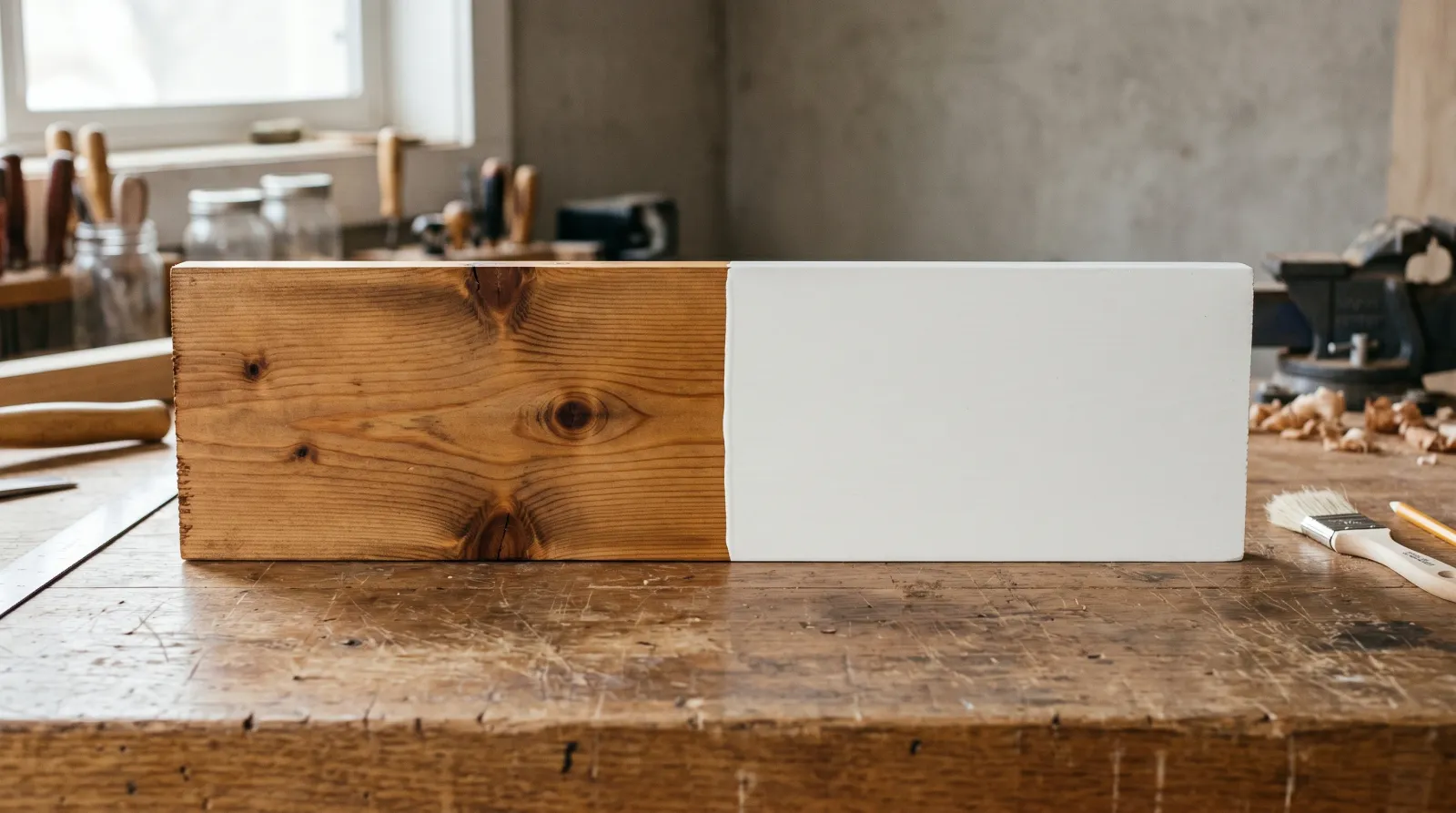
People notice the difference without naming it. A painted fence chips at the corners after two summers. The neighbor’s stained fence, same age, same sun, has just gone a little duller. Both finishes started life as a can of liquid pigment and binder. The reason one peels and the other does not is a chemistry decision the manufacturers made before the can was filled.
Here is the working definition. Paint is a film-former. It is a high-pigment, high-binder coating that dries to a continuous 2.5–4 mil skin sitting on top of the substrate. Stain is a penetrant. It is a low-solids carrier that delivers pigment and a small amount of binder into the top millimeter of wood fiber, then mostly evaporates. The cans look similar at the store. The films they leave behind are physically and mechanically different products.
What Is in Each Can
A typical exterior paint runs 35–50% pigment volume concentration with an acrylic or alkyd binder loaded heavy enough to coalesce into a flexible-but-continuous film. The pigment provides color and opacity. The binder is the structural material. It is what locks the pigment particles together into a sheet you can scrub.
A typical exterior stain runs 5–25% solids. Most of the can is carrier (water in waterborne stains, mineral spirits in oil). The pigment is finely milled to fit between wood fibers. The binder is present but lean, often a modified alkyd or linseed oil that soaks into the fiber and cures inside the wood rather than on top of it.
Same two ingredients, very different ratios. Paint is mostly solids and dries into a sheet. Stain is mostly carrier and dries into the substrate.
Why Stain Breathes and Paint Cracks
Wood is a hygroscopic material. It absorbs water from humid air and releases it in dry air, and it changes dimension as it does. A cedar board can swell 4–8% across the grain between a dry winter and a wet spring. The wood does not ask the finish for permission.
A paint film is rigid relative to that movement. When the boards swell, the film stretches; when they shrink, it has nowhere to go and compresses. Acrylic exterior paints are formulated for some elasticity (100% acrylic resins flex better than vinyl-acrylic), but no continuous film matches the cycle of bare wood indefinitely. After enough seasons, microcracks open at high-stress points like board edges, knots, end grain. Water gets in behind the film, the film loses adhesion to the wood from underneath, and the next freeze-thaw lifts a chip. That is the peeling story.
Stain has no continuous film to crack. The pigment and binder are inside the wood, distributed through the top millimeter of fiber. When the wood moves, the pigment moves with it. The finish fails instead by UV erosion. Sunlight breaks down the binder, water washes the loose pigment off the surface, and the wood gradually goes silver underneath. Slower failure, gentler recovery: wash, scuff, recoat.
This is the single biggest reason stain belongs on horizontal exterior wood (decks, fence rails, railing tops) where moisture and movement are worst, and paint belongs on dimensionally stable substrates (siding that has been primed, trim, doors that are not flexing).
The Substrate Decision Tree
The chemistry decides where each finish belongs. The map is short.
| Substrate | Best finish | Reason |
|---|---|---|
| Deck boards | Stain (semi-transparent or solid) | Foot traffic + standing water destroys films |
| Cedar / redwood siding | Stain or paint | Both work; stain shows the grain, paint hides it |
| Pressure-treated lumber (new) | Stain only, after 3–6 months drying | Mill glaze + residual moisture defeat paint adhesion |
| Bare exterior trim | Paint (primed) | Dimensionally stable, wants opacity and scrub resistance |
| Drywall, plaster | Paint | No fibers to penetrate; stain has no substrate |
| Interior furniture | Either; design choice | Stain shows the wood, paint hides MDF and pine knots |
| Concrete deck | Solid stain or concrete paint | A concrete stain is a different category (acid or acrylic) |
| Composite decking | Neither (most do not accept either) | Manufacturer cleaner only, unless you want a 1-year topcoat |
A second sorting question, once the substrate is decided: do you want the grain to show? Transparent and semi-transparent stains show wood. Solid-color stain and paint hide it. If you are looking at a stack of pressure-treated boards and trying to decide between a solid stain and a paint, the practical difference is mostly maintenance. They look similar from ten feet.
Common Mistakes
- Painting a deck. The number-one peel job in the country. Walking surfaces flex, hold water, bake in the sun. Use a deck stain, semi-transparent for new wood, solid for older boards.
- Staining over a primed surface. Primer is engineered to block penetration. Stain over primer beads up and wipes off. If a board has primer on it, the substrate is paint-bound now.
- Skipping the wood prep. Stain is unforgiving of dirty wood. Pollen, mill glaze, old finish residue all block penetration unevenly, which shows as blotchy color. Wash, brighten, dry to under 15% moisture, then stain.
- Stacking finishes. Painting over old stain without a bonding primer is a fish-eye job. Staining over old paint is impossible without stripping. Switching directions costs a prep day.
What It Looks Like
A side-by-side wood panel comparison, half painted and half stained, will show the difference instantly. The painted half hides the grain and reads as a colored surface. The stained half shows every ring and knot and reads as wood with color in it. Both can be the same hue from ten feet. Up close they are not the same finish.
Where to Buy
For the exterior wood category, see the best exterior paint round-up and the deck stain picks. On the chemistry of waterborne versus oil-based formulas under either label, the oil vs water-based paint piece covers the binder trade-off in more depth.
Ask a Question