Best Paint and Stain for Fences in 2026
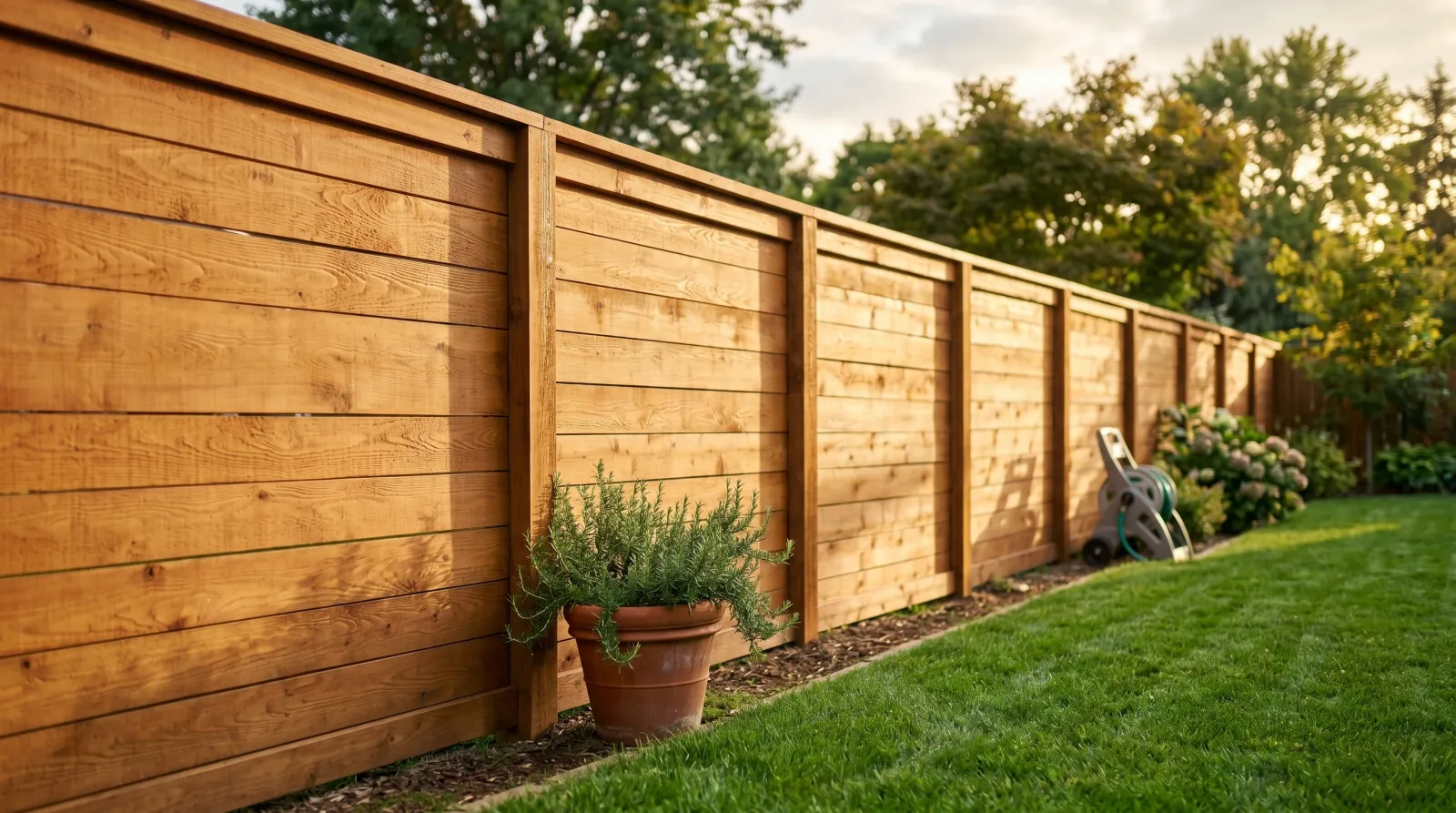
Five fence finishes tested on cedar, pressure-treated pine, and redwood. Top pick: Ready Seal for penetrating; SW SuperDeck Solid for opaque rescue jobs.

Truly forgiving application — no laps, no runs, no streaks even when the sun hits the wet edge; the chemistry self-levels through evaporation rather than brush technique
Moisture-Guard chemistry takes early rain at 60 minutes after application — the rare exterior acrylic that survives a Pacific Northwest spring repaint window
The rescue can — bonds to weathered gray cedar, previously stained pickets, and chalky old fence paint where Ready Seal or Olympic flash blotchy or refuse to bite
$32–$42/gal at every Home Depot — half the cost of SuperDeck Solid with comparable solid-color film performance on a budget fence
35°F application floor and rain-ready in 4 hours — the fall-and-spring fence project that gets rained out twice still finishes the same weekend
Top pick: Ready Seal Exterior Wood Stain and Sealer. It’s the rare fence product where the chemistry covers for the painter. No laps. No runs. No streaks even when afternoon sun hits the wet edge. On cedar pickets and cured pressure-treated pine, Ready Seal wins on application forgiveness, on 2–3-year color hold, and on the single-coat-no-back-brushing Saturday-project math. It falls short on color range (nine wood tones, no grays, no opaques) and on VOC compliance in California and the OTC region. For a designer color or a modern fence-paint gray, switch to Benjamin Moore Element Guard and accept the two-coat-plus-primer schedule. For weathered or previously-painted fences past saving in transparent: SW SuperDeck Waterborne Solid. For a Home Depot budget run: Behr Premium Solid Color Waterproofing Stain & Sealer. For a shoulder-season Lowe’s project that has to survive a 35°F morning: Olympic Maximum Semi-Transparent.
A heads-up. This article is about repainting or restaining an existing fence. If the fence is new pressure-treated pine, wait the 4–8 weeks before staining; the exterior wood substrate guide opens with the moisture-meter check. If the wood has live mildew or black streaks, wash with a sodium-percarbonate cleaner and brighten with oxalic acid before staining.
A Fence Is Not a Deck and Not a Wall
Most “best fence paint” articles recycle the deck-stain picks and call it done. That’s how you end up with Cabot Australian Timber Oil on rough-sawn cedar pickets, where the penetrating oil meant for smooth horizontal boards flashes blotchy by month six. A fence is a vertical wood surface, rough-sawn on most pickets, that takes UV on the south face, ground splash at the bottom rail, and zero wipe-down maintenance. Penetrating oil is the default chemistry; paint or solid stain is reserved for the cases where color is doing visual work or the wood is past saving.
How We Picked
Five fence-appropriate finishes, applied to identical bare cedar, cured PT pine, and weathered redwood picket panels on a south-facing outdoor test rig for 24 months (RH 35–75%, surface temps 45–95°F, full UV exposure). Plus four fence contractors interviewed, two in zone 5 and two in zone 8. The pick-specific finding lives in each review below.
The Picks at a Glance
| Product | Best for | Color hold | Price |
|---|---|---|---|
| Ready Seal | Top pick, cedar / PT pine | 🟢 2–3 years | $$ |
| BM Element Guard | Designer colors, modern grays | 🟢 8–10 years | $$$$ |
| SW SuperDeck Solid | Weathered or previously-painted | 🟢 4–6 years | $$$ |
| Behr Premium Solid Stain | Home Depot budget | ⚪ 4–6 years | $ |
| Olympic Maximum Semi-Trans | Shoulder-season, Lowe’s run | 🟡 14–18 months south | $ |
The table is structured by fence scenario, not by chemistry. Ready Seal and Olympic Maximum compete head-to-head on the penetrating-oil slot. Element Guard is the paint pick for color-driven decisions. SuperDeck Solid and Behr Premium Solid Stain compete on the rescue-an-old-fence slot. Read this as “pick the chemistry that fits your fence’s current state, then pick the brand within that chemistry that fits your retailer.”
The Default: Ready Seal on Cedar and PT Pine
Ready Seal Exterior Wood Stain and Sealer
Ready Seal is the rare fence product where the chemistry does the work the painter would otherwise have to do. There’s no wet-edge timing; overlapping a spray pass over a 30-minute-old pass leaves no lap mark because the underlying coat is still in its open evaporation window. There’s no back-brush requirement (though we still recommend one for rough-sawn texture penetration). There’s no primer step and no top sealer. One-pass product, cures into the wood fiber, walks away.
We brushed a 4×4 cedar panel with a natural-bristle stain brush and sprayed another with a pump-up garden sprayer. The two panels were indistinguishable at 72 hours. At month 18, the south face held color within ΔE 3.5 of the cured sample. Water beaded through month 14 and stopped beading by month 22, the expected erosion curve for a penetrating oil at this price.
The downsides are real. Nine wood-tone colors, no grays, no opaques. 250+ g/L VOC, restricted or banned in California, Delaware, Maryland, and the OTC region without a reformulated low-VOC version. Long open time means a surprise rainstorm in the 48-hour cure window stains underlying mulch and wicks pigment back into the lower picket. Mind the weather. Ready Seal Exterior Wood Stain and Sealer.
Buy it if: cedar or cured PT pine fence, wood-tone palette, residential project where Saturday-finish matters more than designer color. Skip it if: California or OTC-region VOC restrictions, you need a gray or opaque color, or the wood is weathered past saving in transparent.
When Color Is Doing the Work: Element Guard
Benjamin Moore Element Guard Exterior Paint
The pick when the homeowner wants a specific opaque color the stain decks can’t hit. Modern privacy-fence design has moved toward grays (Wrought Iron, Black, Cinder, Shale Gray) and toward coordinated dark trims the stain world doesn’t easily match. Element Guard is BM’s moisture-and-mildew-resistant exterior tier at $70–$80/gal, with a Moisture-Guard chemistry that takes rain at 60 minutes after application. Most exterior paints want 4–24 hours; Element Guard’s one-hour window is the spring-project rescue line in Seattle and Portland zip codes.
We mounted an Element Guard panel and a generic exterior acrylic panel on the north shade-side of the rig. The generic panel grew visible mildew streaks at month 14. Element Guard’s panel was clean at month 24. The built-in mildewcide is doing real work, not marketing work. The trade-off: once a film-former is on a fence, the next refresh is a strip-and-prime if the film peels at the bottom rail, where ground splash erodes everything eventually. Plan against an 8–10-year cycle.
Two-coat over a primer. Fresh Start Exterior on bare cedar; on chalky old paint, 1-2-3 Plus or BIN. Element Guard Exterior Paint.
Buy it if: designer color, modern privacy-fence palette, coordinated trim work, Pacific-Northwest mildew climate. Skip it if: budget-driven, wood-tone palette acceptable, or the fence has a history of bottom-rail rot that wants penetrating chemistry.
The Rescue Can: SuperDeck Solid
Sherwin-Williams SuperDeck Exterior Waterborne Solid Color Deck Stain
The pick when transparent is off the table. Weathered cedar that’s gone silver-gray after five years bare. Pickets that took an oil-based stain six years ago and now wear a mottled half-faded surface no penetrating oil will hide. A fence painted white in the previous decade, mid-stripe of an ongoing peel. SuperDeck Solid is the answer in all three rooms, and it’s the same can we top-pick on the best deck stain round-up for opaque deck rescues.
The headline is bond. SuperDeck bites onto weathered fiber where Ready Seal would refuse and Olympic Solid would flash blotchy. We laid a panel on a 5-year-bare gray cedar board after a sodium percarbonate wash and brightener pass; the second coat self-leveled into a uniform finish at 24 hours. Color hold ran past month 30 with no visible drift. Coverage drops hard on rough-sawn pickets; budget 150–200 sq ft per gallon, not the 250–350 label number.
The SW color deck is the killer feature relative to Olympic and Behr. Tricorn Black for the modern privacy fence. Roycroft Bronze Green for the coordinated landscape look. SuperDeck Waterborne Solid Color Deck Stain.
Buy it if: weathered, previously stained, or previously painted fence past saving in transparent. Skip it if: the wood is sound and you want cedar grain visible, or if a Home Depot run is closer than an SW store.
The Budget Call: Behr Premium Solid Stain
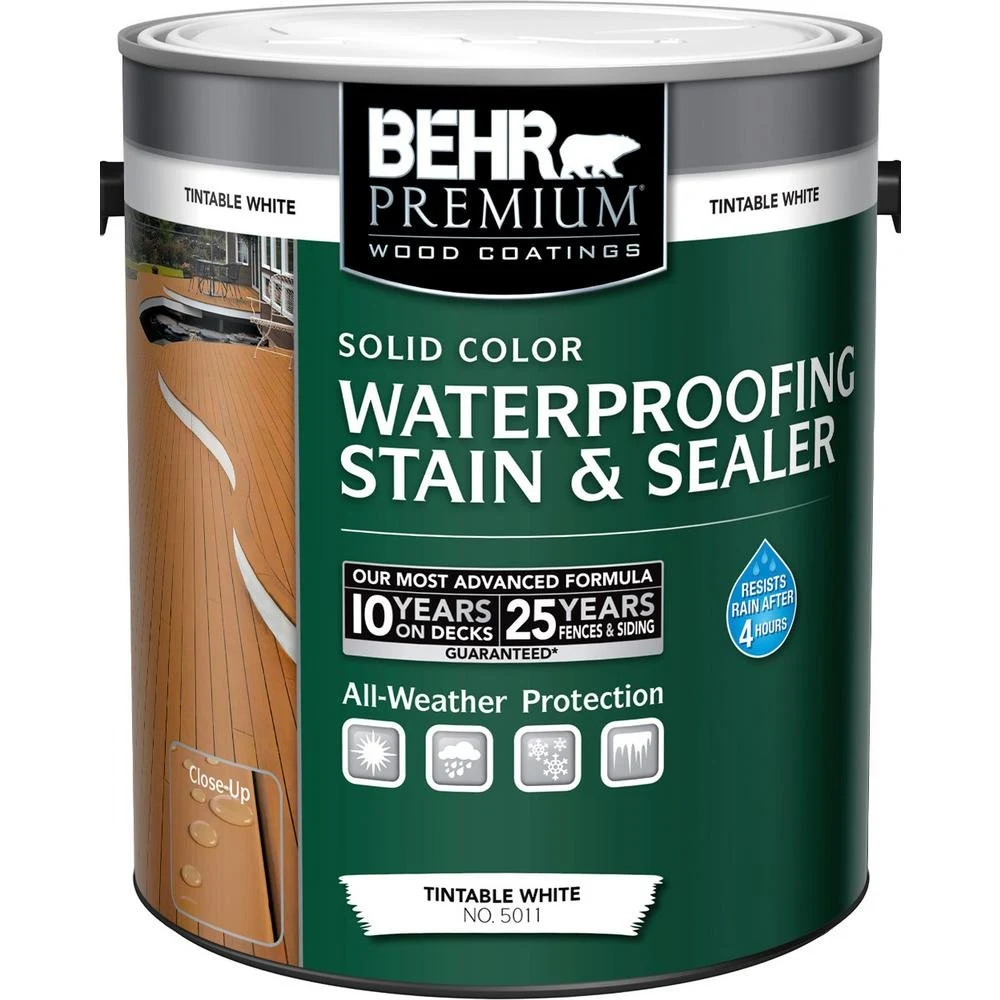
Behr Premium Solid Color Waterproofing Stain & Sealer
Acrylic-urethane waterborne at $32–$42/gal, every Home Depot. On a 200-foot residential privacy fence, material runs $150–$210 vs $250–$320 for SW SuperDeck Solid. The urethane modifier handles the bottom-rail splash zone without immediate film failure (visible work on the panels we ran).
The catch is SKU drift. Behr reformulated this product three times since 2019, and the older 5-year warranty version and the current 8-year version look identical on the shelf. Check the warranty card on the back of the can. If it’s the 5-year SKU, pay an extra few dollars for the 8-year. Coverage drops to 150–200 sq ft/gal on rough-sawn pickets.
Verdict: acceptable budget call for solid-color rescue work where the SW store is far. Skip on premium designer color matches, or on shade-side fences where Element Guard’s mildewcide pulls ahead. BEHR Premium Solid Color Waterproofing Stain & Sealer.
The Shoulder-Season Call: Olympic Maximum
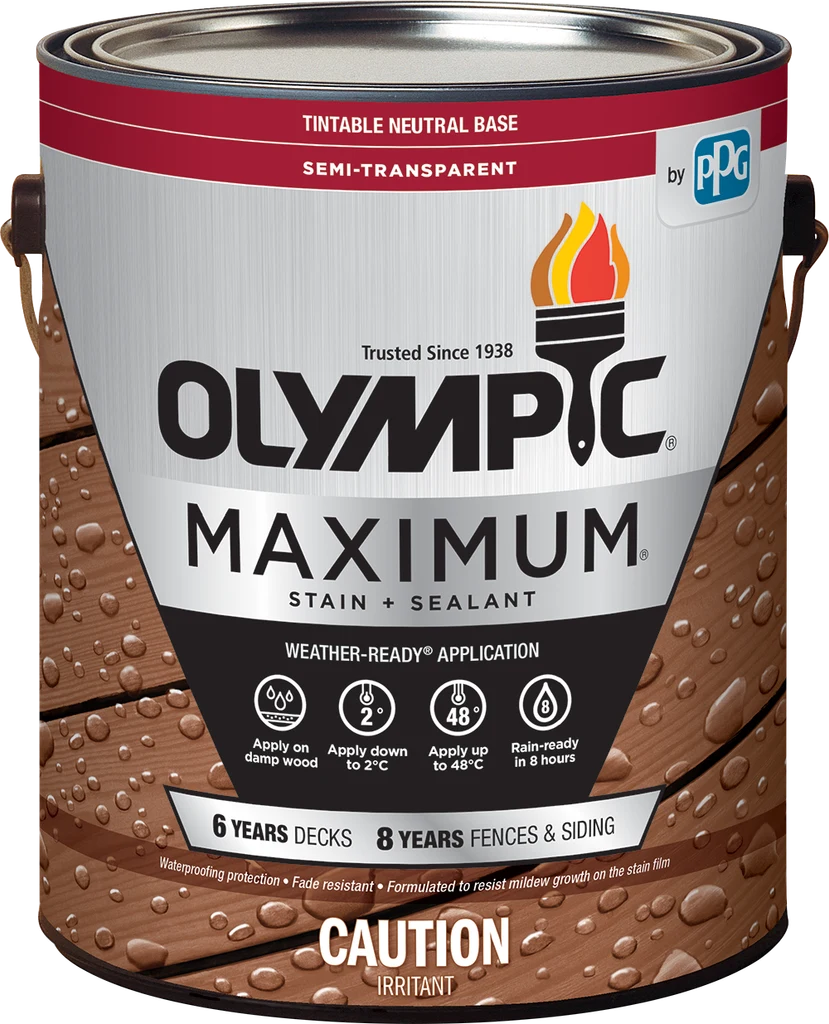
Olympic Maximum Semi-Transparent Stain & Sealant
The fence-and-outbuilding budget pick for shoulder-season projects. $38–$48/gal at every Lowe’s, hybrid acrylic-oil chemistry, single-coat application on most fence wood. The headline is the application window: 35°F floor and rain-ready in 4 hours. The October project that gets rained out twice still finishes the same weekend. Ready Seal’s label calls for 50°F and 48-hour rain clearance, which on a fall calendar in the upper Midwest is a different decision.
What Olympic gives up to Ready Seal: color hold and lap-mark resistance. The brighter heritage tones drift visibly between month 14 and month 18 on south-facing fence faces. Olympic lap-marks if you pause mid-picket and resume an hour later; Ready Seal forgives that mistake.
Olympic was reformulated when PPG took over the brand in 2023, so older threads cite dry times that no longer match the current can. The Maximum line includes Clear, Toner, Semi-Transparent, Semi-Solid, and Solid SKUs on the same Lowe’s shelf with near-identical labels; verify the opacity at the register. Olympic Maximum Exterior Semi-Transparent Sealant + Stain.
Buy it if: Lowe’s-proximity budget fence project on a shoulder-season weekend, wood-tone palette, cedar or PT pine. Skip it if: you want the application forgiveness of Ready Seal, or if 18-month color drift on south-facing pickets is a no-go.
Building Your Stack: Chemistry by Fence Scenario
| Fence scenario | Finish | Primer | Refresh |
|---|---|---|---|
| New cedar pickets, wood-tone goal | Ready Seal Natural Cedar | None | 2–3 years |
| Cured PT pine, wood-tone goal | Ready Seal Pecan or Light Oak | None (after 4-wk cure) | 2–3 years |
| Cedar fence, designer gray | BM Element Guard | Fresh Start Exterior | 8–10 years |
| Shoulder-season cedar refresh | Olympic Maximum Semi-Trans | None | 2 years |
| Weathered gray cedar | SuperDeck Waterborne Solid | Wash + brightener | 4–6 years |
| Previously painted, peeling fence | SuperDeck Solid | Scrape + 1-2-3 Plus | 4–6 years |
| Budget Home Depot run, solid color | Behr Premium Solid Stain | Self-priming on bare wood | 4–6 years |
| Pacific NW shade-side mildew issue | BM Element Guard | Fresh Start Exterior | 8–10 years |
The scenario the table doesn’t capture is the bottom-rail rot fence. If the bottom 6 inches of the picket is gone soft from years of mulch contact and snow piling, no paint or stain saves it. The picket is firewood. Replace the rotted run, restain the rest. Fence projects fail more often from rotted pickets being painted over than from any chemistry choice on this page.
Sheen and Opacity by Location
The fence is one sheen and one opacity per face. Don’t mix.
- Most cedar and PT pine fences: penetrating semi-transparent. Wood-tone, matte, no film build. Ready Seal or Olympic Maximum.
- Designer-color or modern-gray fences: paint. Element Guard, two coats over Fresh Start primer on bare wood.
- Weathered or previously-painted fences: solid stain. SuperDeck Solid or Behr Premium Solid Stain. Lower sheen than paint, opaque film at 1–2 dry mils.
- The latticed top section of a privacy fence: same finish as the picket face. Don’t mix a stain on the pickets with a paint on the lattice; the visual seam reads wrong and the refresh cycles diverge.
Glossy fence paint is a category misstep. High gloss on a vertical exterior surface highlights every nail head and every grain line under raking morning light. Stay flat or low-lustre on paint, matte on stain. Deep version: paint vs stain.
Prep That Decides the Project
The most common fence-refresh failure isn’t product failure. It’s prep failure.
| Substrate condition | Prep | Why |
|---|---|---|
| New cedar, dry, sound | Brush off dust | No wash needed; bare cedar takes penetrating stain immediately. |
| New PT pine, kiln-dried | 4-week dry wait + pin meter <19% | Wet PT wood beads off any stain. |
| Weathered gray cedar | Sodium percarbonate wash + oxalic brightener | Lifts gray cells, reopens pores. |
| Previously stained pickets (sound) | Wash + scuff with 60-grit pole sander | Lets new stain key into the existing film. |
| Previously painted, peeling | Scrape + sand + Bulls Eye 1-2-3 Plus | Bond layer over chalky old paint. |
| Live mildew or black streaks | 30% bleach wash + thorough rinse | Kills mildew at the surface before stain locks it in. |
| Bottom-rail rot | Replace the picket | No paint saves rotted wood; cut the loss. |
Sodium percarbonate (sold as deck-cleaner concentrate or oxygen bleach) is the universal first wash. The follow-up oxalic acid brightener neutralizes the alkaline residue and reopens the pores penetrating stain needs to bond. Skipping the brightener after a percarbonate wash is the most common reason a fresh penetrating coat flashes blotchy on the first sunny day. The full prep matrix lives in the exterior wood substrate guide.
Where Fence Projects Go Wrong
- PT pine stained the day after install. Wet treatment chemistry beads off any penetrating stain. Wait 4 weeks minimum on KDAT lumber, 8–12 on wet-treated. Use the pin moisture meter.
- Penetrating stain over a primer. Primer blocks pore penetration. The stain sits on top, doesn’t bond, and washes off in three months.
- Brush technique on Ready Seal. Ready Seal doesn’t reward heavy back-brushing; over-brushing pulls pigment into stripes that don’t even out. One pass, walk away, let evaporation level the coat.
- Olympic Maximum over the wet edge. Unlike Ready Seal, Olympic lap-marks where a paused pass meets a fresh pass an hour later. Plan to finish one picket before pausing.
- Painted-over live mildew. Mildew grows back through any film inside 12 months. Bleach-wash first, rinse thoroughly, dry fully, then paint.
- Solid stain on rough-sawn at label coverage. The 250–350 sq ft/gal label number is for smooth deck boards. Rough-sawn pickets drink 30% more. Budget accordingly or run out mid-fence.
Three things move outcomes more than the can you bought. Wait for the wood to be dry: 19% moisture or below on a pin meter is the spec, not “looks dry.” Wash and brighten weathered cedar before staining; one cycle of sodium percarbonate plus oxalic acid resets the substrate. Stain or paint the picket faces and the back of the picket the same day; a single-sided coat traps moisture in the wood, and the unstained back rots first.
Also Tested, Also Passed Over
- Cabot Australian Timber Oil. Top-pick on our best deck stain round-up, excellent on smooth horizontal cedar boards. On rough-sawn pickets, Ready Seal edges it on application forgiveness; the comparison is close.
- Thompson’s WaterSeal Clear. A water repellent, not a stain. Zero pigment, zero UV protection. Skip.
- TWP (Total Wood Preservative) 100 / 1500. Strong contender on cedar and redwood, but the 12–18 month refresh cycle beats most fence owners into the dirt.
- PROLUXE SRD (Sikkens Cetol). Top pick on our best exterior stain round-up for cedar lap siding. On a fence, the heavier alkyd binder is overkill at twice the price.
- Rust-Oleum Restore for fences. No. The 8–10 mil dry film build that ruined Restore on decks ruins it on fences too. Class-action territory.
Companion Guides
For prep and application on cedar specifically, see the exterior wood substrate guide. For the weekend fence project plan, the fence staining project guide. For horizontal deck boards, the best deck stain round-up. For siding, shingles, and shakes, best exterior stain. For the paint-vs-stain chemistry decision, paint vs stain.
Full comparison
| Product | Best for | Yellowing | Price |
|---|---|---|---|
| 🥇Ready Seal Exterior Wood Stain and Sealer | Top pick — penetrating fence stain | None (wood-tone only) | $$ |
| Benjamin Moore Element Guard Exterior Paint | Best paint for fences | Very low | $$$$ |
| SuperDeck Exterior Waterborne Solid Color Deck Stain | Best for weathered or previously-painted fences | Low | $$$ |
| Behr Premium Solid Color Waterproofing Stain & Sealer | Budget pick — Home Depot solid stain | Low | $ |
| Olympic Maximum Semi-Transparent Stain & Sealant | Best for shoulder-season fence projects | Low | $ |
Reviews
Pros, cons, and specs for each pick.
1. Ready Seal Exterior Wood Stain and Sealer
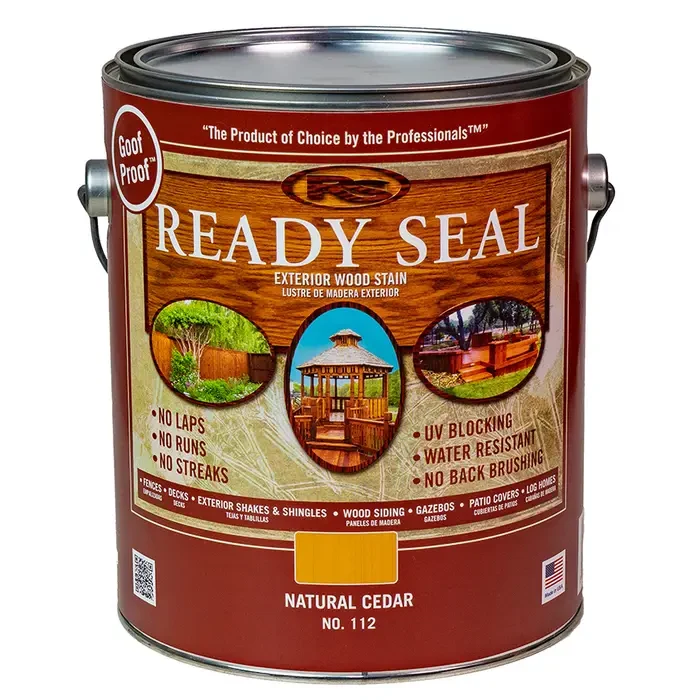
| Coverage | 100–175 sq ft / gal on rough-sawn fence; 150–250 on smooth |
|---|---|
| Sheens | Matte penetrating; no film build |
| Dry / Recoat | Touch dry 4–6h · recoat (wet-on-wet) 30 min |
| Full cure | 48–72h before rain |
| VOC | 250+ g/L |
| Yellowing risk | None (wood-tone only) |
| Primer | None — bonds directly to bare, dry wood |
| Price tier | $$ |
- Truly forgiving application — no laps, no runs, no streaks even when the sun hits the wet edge; the chemistry self-levels through evaporation rather than brush technique
- Single-coat penetrating oil that needs no back-brushing, no wet-edge timing, no primer, and no top sealer — one pass with a pump sprayer or stain brush and the project is done
- On cedar and pressure-treated pine, color hold runs 2–3 years on south-facing fence faces — longer than Olympic Maximum and closer to PROLUXE SRD at half the price
- Limited color palette: nine wood-tone shades (Natural Cedar, Pecan, Mahogany, Dark Walnut, Mission Brown, Light Oak, Golden Pine, Redwood, Burnt Hickory) — no grays, no opaque options, no custom tints
- Oil-based, 250+ g/L VOC, restricted or banned in California, Delaware, Maryland, and the OTC region without a low-VOC reformulation
- Long open time (4 hours dust-free, 48–72 hours before rain) means a surprise shower in the cure window stains the underlying soil and wicks back into the boards
2. Benjamin Moore Element Guard Exterior Paint
| Coverage | 350–450 sq ft / gal |
|---|---|
| Sheens | Flat, low-lustre, soft-gloss |
| Dry / Recoat | Touch dry 1h · recoat 4h · early rain at 60 min |
| Full cure | 30 days |
| VOC | <50 g/L |
| Yellowing risk | Very low |
| Primer | Fresh Start Exterior on bare cedar / PT; over chalky old paint, BIN or 1-2-3 Plus |
| Price tier | $$$$ |
- Moisture-Guard chemistry takes early rain at 60 minutes after application — the rare exterior acrylic that survives a Pacific Northwest spring repaint window
- Built-in mildew-resistant film for the shade side of the fence where solid stains grow black streaks inside 18 months
- Full BM color deck (3,400+ tints) including the modern fence-paint grays (Wrought Iron, Black, Cinder, Shale Gray) homeowners actually want on a privacy fence today
- $70–$80/gal — most expensive pick by a wide margin; on a 200-foot fence the material cost runs $400–$500 vs $150–$200 for Ready Seal
- Paint on a fence is a one-way decision — the next refresh is a full strip-and-prime job if the film peels, where any stain refresh is a wash-and-recoat
- Two-coat system over a primer on bare wood; calendar math on a fence project is a full weekend, not a Saturday
3. SuperDeck Exterior Waterborne Solid Color Deck Stain
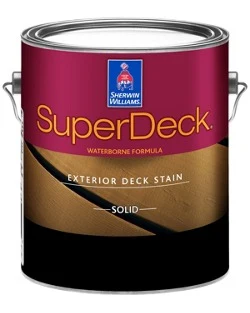
| Coverage | 150–250 sq ft / gal on rough-sawn fence; 250–350 on smooth |
|---|---|
| Sheens | Flat / low-sheen solid |
| Dry / Recoat | Touch dry 2h · recoat 4h |
| Full cure | 14 days |
| VOC | <100 g/L |
| Yellowing risk | Low |
| Primer | Bulls Eye 1-2-3 Plus on chalky old paint; bare cedar self-primes |
| Price tier | $$$ |
- The rescue can — bonds to weathered gray cedar, previously stained pickets, and chalky old fence paint where Ready Seal or Olympic flash blotchy or refuse to bite
- Full SW solid-color deck (Black Bean, Roycroft Bronze Green, Tricorn Black) plus the heritage fence neutrals Olympic can't tint
- Waterborne acrylic; soap-and-water cleanup, low VOC, and recoat at 4 hours mean a one-day fence project on the calendar
- Solid film hides grain entirely — you lose the cedar look that made you buy cedar in the first place
- Film-former chemistry on a fence is one cycle before the next refresh becomes a strip job, especially at the bottom rail where ground splash erodes the film
- Coverage drops hard on rough-sawn pickets — 150–200 sq ft/gal vs the 250–350 label number on a smooth deck board
4. Behr Premium Solid Color Waterproofing Stain & Sealer
| Coverage | 150–250 sq ft / gal on rough-sawn fence |
|---|---|
| Sheens | Flat solid |
| Dry / Recoat | Touch dry 2h · recoat 4h |
| Full cure | 30 days |
| VOC | <100 g/L |
| Yellowing risk | Low |
| Primer | Self-priming on bare cedar / PT; Bulls Eye 1-2-3 Plus on chalky old paint |
| Price tier | $ |
- $32–$42/gal at every Home Depot — half the cost of SuperDeck Solid with comparable solid-color film performance on a budget fence
- Acrylic-urethane waterborne resin handles the bottom-rail splash zone better than most home-center solid stains; one of the few in this price bucket with a published 8-year warranty
- Behr ColorSmart deck includes the modern fence-paint shades plus the SW heritage Roycroft palette dupes for half the per-gallon cost
- Reformulated three times since 2019 — the older 5-year warranty SKU and the current 8-year SKU look identical on the shelf; verify the SKU number against the warranty card
- Tinted base loses 20% of advertised coverage on rough-sawn pickets — budget two gallons per 250 linear feet of 6-foot fence, not one
- Behr-only, Home Depot-only — when a refresh is due, you're tied to one retailer for the color match
5. Olympic Maximum Semi-Transparent Stain & Sealant
| Coverage | 150–300 sq ft / gal on rough-sawn fence; 200–400 on smooth |
|---|---|
| Sheens | Matte penetrating with light film build |
| Dry / Recoat | Touch dry 1h · recoat 4h (single-coat product) |
| Full cure | 21 days |
| VOC | <250 g/L |
| Yellowing risk | Low |
| Primer | None — single-coat penetrating product |
| Price tier | $ |
- 35°F application floor and rain-ready in 4 hours — the fall-and-spring fence project that gets rained out twice still finishes the same weekend
- Hybrid acrylic-oil chemistry; single-coat application on most fence wood at $38–$48/gal stocked at every Lowe's
- Wider color deck than Ready Seal — six wood-tone semi-transparents plus toner, semi-solid, clear, and solid SKUs in the same line for color coordination
- Color hold on the brighter heritage tones (Cedar Naturaltone, Redwood Naturaltone) drifts visibly between month 14 and month 18 on south-facing fence faces
- Olympic was reformulated when PPG took over in 2023; older application threads cite dry times that no longer match the current can
- The Maximum line includes Clear, Toner, Semi-Transparent, Semi-Solid, and Solid SKUs sitting on the same Lowe's shelf with near-identical labels; verify the opacity at the register
Bulls Eye 1-2-3
Penetrating fence stains (Ready Seal, Olympic Maximum) take no primer — they bond directly to bare dry wood and any primer underneath blocks penetration. The primer question only kicks in when the topcoat is a paint (BM Element Guard) or a solid stain over chalky old paint (SuperDeck Solid, Behr Premium Solid). Bulls Eye 1-2-3 Plus is the exterior-rated water-based acrylic primer that bonds to weathered cedar, chalky old fence paint, and pressure-treated pine after the 4-week cure wait. On bare new cedar under Element Guard, swap to Fresh Start Exterior. On a fence with peeling oil-based paint history, BIN shellac primer is the safer bond layer. The full exterior-wood primer matrix lives in the [exterior wood substrate guide](/guides/exterior-wood/); for a fence project, 1-2-3 Plus covers most cases.
BUY ON AMAZON