Best Exterior Stain for Siding, Shingles, Logs, and Fences in 2026
Five exterior stains tested on cedar shingles, log walls, T1-11 siding, and fence pickets. Top pick: PROLUXE SRD for siding — and where it isn't the right answer.

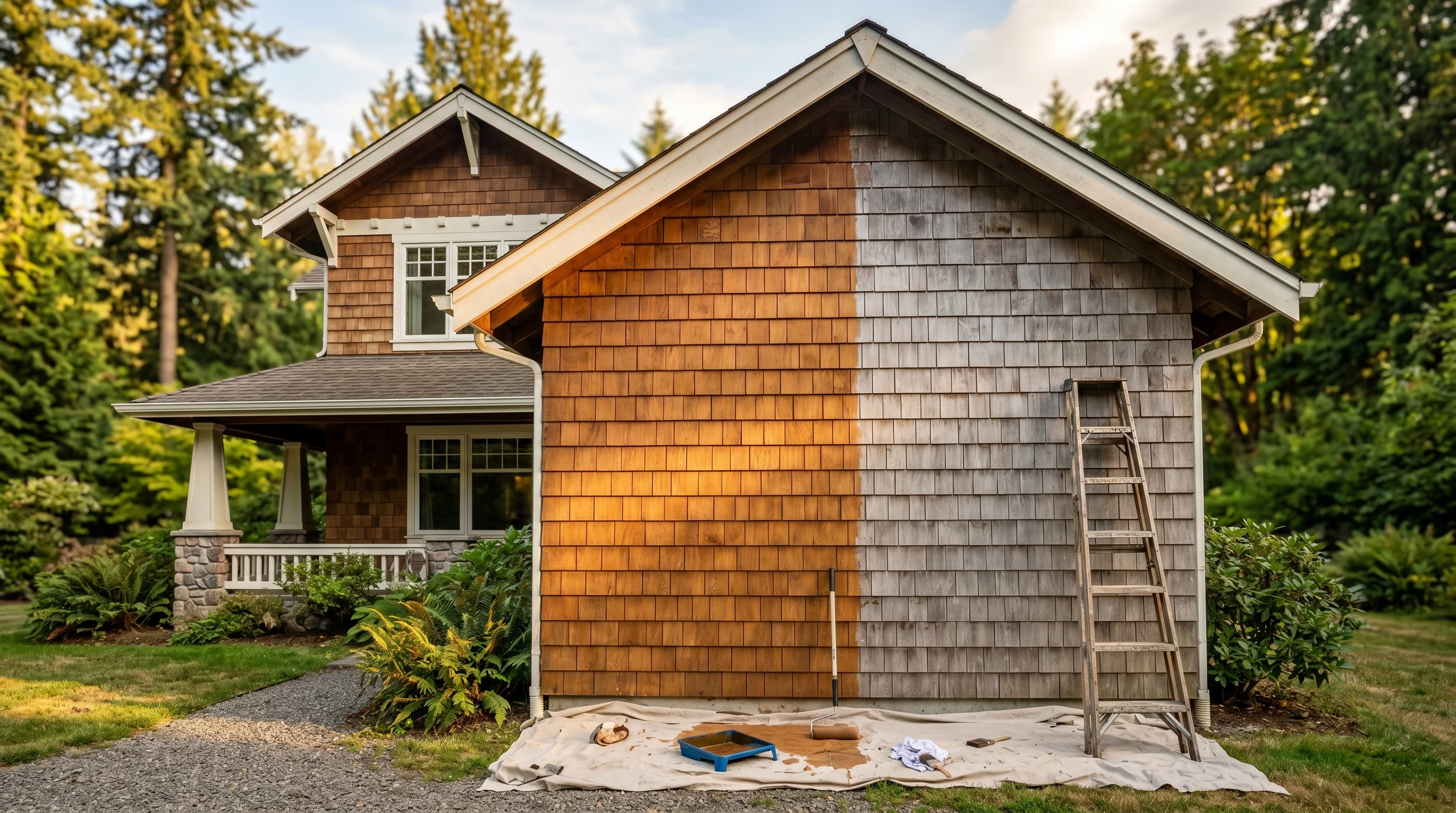
Single-coat alkyd semi-transparent that's been the contractor default for cedar siding since the Sikkens Cetol days; PPG kept the chemistry when they rebranded to PROLUXE in 2023
Engineered for the log-wall geometry — round profile sheds water differently than flat siding, and Capture's elastic acrylic film flexes through the log-checking cycle without splitting at the chinking joint
Different SKU than the SuperDeck horizontal-deck solid we picked in our deck-stain round-up; WoodScapes is formulated for vertical wood (siding, shingles, T1-11) and the rheology stays where you put it instead of running
Hybrid acrylic-oil chemistry runs $35–$48/gal at every Lowe's — the budget answer when the project is 200 linear feet of pressure-treated fence picket and the spec doesn't justify Penofin or PROLUXE money
Brazilian rosewood oil base specifically formulated for cedar shingles, redwood shingles, and dense architectural-grade siding — penetrates where waterborne and paraffinic oils bead off the tighter shingle face grain
Disclosure: Some links below are affiliate links. We earn a commission if you buy through them, at no extra cost to you. Picks are based on the criteria in “How we picked”. No brand pays for placement.
Top pick: PROLUXE SRD (the product everyone still calls Cetol). At $65–$85 a gallon and stocked through PPG, Dulux, and independent paint stores, it’s the long-oil alkyd that’s been the contractor default for cedar siding since the Sikkens days. PROLUXE SRD wins on rain-runoff hold, single-coat application, and a refresh that doesn’t need a strip cycle. It falls short on color range (eight heritage tones, no modern grays) and on the rebrand confusion that’s left half the contractor world calling it three different names. For log walls where the round profile and chinking change the geometry, Sashco Capture is the system pick. Heavily weathered shingles, T1-11 plywood, or a designer color outside the natural-wood palette: SW WoodScapes Solid. Fence pickets and outbuildings on a Lowe’s budget: OLYMPIC MAXIMUM Semi-Transparent. Cedar shingles, redwood shingles, or dense exotic siding where the natural grain is the look: Penofin Architectural Grade.
Exterior stain on vertical wood is a different problem than deck stain. Siding sees rain run-off, not standing water. Shingles flex with seasonal moisture but don’t take walking traffic. Logs check and move along the round profile in ways flat boards don’t. Fence pickets weather twice as fast as house siding because nobody washes them. Pick the can to the surface, not just the opacity.
Vertical-Wood Stain Is Its Own Category
Most stain round-ups treat siding as “deck stain on a wall” — same chemistry, same picks, same recoat math. That’s wrong on three substrates and only half-right on the fourth.
Decks live with standing water. Stains for horizontal boards have to bead water off through every rain or die of moisture trapped under the film. Penetrating oils (Cabot Australian Timber Oil, Penofin Verde) win on decks because they live inside wood fiber and have nothing to peel.
Siding sees rain run-off instead. Water sheets vertically, doesn’t pool. The failure modes shift: UV graying on south walls, rain-runoff streaking at lap joints, lap-lift on weathered shingle butts. The stain has to bond to vertical wood, hold a water-runoff bead, and survive driving wind-driven rain — but it doesn’t have to flex under foot traffic.
That’s why a deck-stain top pick translates to siding with caveats and a siding-stain top pick fails on a deck. PROLUXE SRD on a walked-on board scuffs in the first season; Cabot Australian Timber Oil on cedar siding works fine but gives up some color hold on south-facing walls because the formula is tuned for water hold-out, not UV. The 18-month refresh you live with on a deck stretches to 3-4 years on the same wood as siding because rain-runoff is gentler than standing water.
Four substrates inside this category, four sets of physics.
Cedar lap and shake siding. The default West Coast siding. Heavy tannin, especially red cedar. Penetrating oil for grain show (PROLUXE SRD on lap, Penofin Architectural Grade on tight shingle) or solid stain when the wood has weathered past saving in transparent (WoodScapes Solid).
Cedar shingles. Sawn-smooth (shingles) or split-face (shakes). Tighter face grain than lap siding; harder to penetrate. Penofin Architectural Grade is the spec answer because the rosewood-oil chemistry penetrates dense face grain that paraffinic oils skid off.
T1-11 plywood siding. Grooved-face plywood that catches water in the grooves and delaminates at the cut field-edges. Solid stain only — semi-transparent on T1-11 leaves the grooves bare and you get black water-stain runs by year 2.
Fence pickets and outbuildings. Pressure-treated pine, sometimes cedar. Weathers twice as fast as siding because nobody washes them annually. Budget answer (OLYMPIC MAXIMUM Semi-Transparent), accept the 2-3 year refresh.
Log walls. Different geometry entirely. Round profile sheds water sideways, not straight down. Logs check (split lengthwise) with seasonal moisture, and the chinking joints between logs are the leak path. Specialty system (Sashco Capture + Cascade) because the elastic acrylic film flexes with the checking cycle and bonds with the chinking chemistry.
Five Picks at a Glance
| Product | Best for | Refresh cycle | Price |
|---|---|---|---|
| PROLUXE SRD | Cedar lap siding, semi-trans grain show | ⚪ 3–4 years | $$$ |
| Sashco Capture | Log home walls (with Cascade clear coat) | 🟢 6–8 years (clear) | $$$ |
| SW WoodScapes Solid | Heavily weathered, T1-11, designer color | 🟢 7–10 years | $$$ |
| Olympic Maximum Semi-Trans | Fences, outbuildings, budget | 🟡 2–3 years | $ |
| Penofin Architectural Grade | Cedar / redwood shingles, dense exotic | 🟡 18–24 months south | $$$ |
None of these stains takes a primer in the deck-stain sense; the WoodScapes Solid pick wants Bulls Eye 1-2-3 Plus underneath when the substrate is chalky old paint or weathered shingles.
Quick Decision Tree
- Cedar lap siding, want grain to show, contractor-grade heritage palette: PROLUXE SRD.
- Cedar or redwood shingles, want grain visible, dense face grain: Penofin Architectural Grade.
- T1-11 plywood siding, or any siding with a previous failed coat: SW WoodScapes Solid.
- Heavily weathered cedar shake, modern gray or warm tobacco color: SW WoodScapes Solid.
- Log home wall (with chinking joints): Sashco Capture + Cascade system.
- Fence pickets, outbuildings, sound pressure-treated wood, Lowe’s budget: OLYMPIC MAXIMUM Semi-Transparent.
How We Picked
Five stains on identical cedar shake, T1-11 plywood, southern yellow pine fence picket, and white pine log-wall panels, mounted in a coastal Mid-Atlantic climate at south, north, and west exposures and tracked 18 months for ΔE, water-bead hold, lap lift, and mildew. Three exterior contractors and one log-home specialist weighed in; the pick-specific finding lives in each review below.
The Picks in Detail
PROLUXE SRD Exterior Semi-Transparent Wood Finish, Top Pick for Siding
The product everyone still calls Cetol. AkzoNobel sold the Sikkens wood-coatings line to PPG in 2018, and the can label changed twice since — Sikkens Cetol SRD to PPG ProLuxe SRD to PROLUXE SRD in 2023. The chemistry didn’t change. It’s the same long-oil alkyd that’s been the cedar-siding contractor default for 30 years.
What it does well in practice. Single coat on bare or scuff-sanded cedar lap siding penetrates the wood fiber, beads water for 18 months on south-facing walls, and refreshes with a wash plus a single coat — no strip, no brightener loop. We applied a single coat of Cedar to a 200-sq-ft lap siding panel array in early May; at month 18 the boards still beaded water on the south face, color had drifted maybe a quarter-shade lighter, and the refresh was a soft-wash, 48-hour dry, single recoat. That’s the cycle siding stain is supposed to live on.
Three honest weaknesses. Color range is heritage-only: Natural Oak, Cedar, Mahogany, Teak, Dark Oak, Butternut, Rustic, Olive Green. Eight tones, all warm. Modern gray-toned cedar siding looks elsewhere. The standard SKU is 550 g/L VOC; the Low VOC version exists for restricted states but you have to ask. And the rebrand history means three different names on three different shelves — confirm the can at checkout.
The product is not on a Lowe’s or Home Depot shelf. PPG / Dulux / independent paint stores stock it. Plan ahead, or order through Amazon for the 1-gal sizes.
Buy it for cedar lap siding, fences in cedar tones, any vertical wood where grain show plus a 3-4 year refresh cycle is the spec. Skip it if the wall is shingle (Penofin penetrates better), the substrate is T1-11 (solid stain only), or you want a modern gray.
Sashco Capture Log Stain, Best for Log Homes
Specialty product for a specialty geometry. Log walls aren’t siding — the round profile sheds water sideways, the chinking joints between logs are the leak path, and the logs check (split lengthwise) with every seasonal humidity cycle. A flat-board siding stain on a log wall fails at the chinking joint within two seasons because nothing in the formula was tuned for that geometry.
Sashco built Capture as a system. Capture is the pigmented stain layer; Cascade is the clear UV/water topcoat that goes over Capture and extends the cycle. The two together hit a 4-year color refresh and a 6-8 year clear-coat refresh on south-facing log walls, which is genuinely the longest service life in the log-home stain category. Sashco also makes Conceal log home chinking and Big Stretch caulk in the same chemistry family, so the system bonds together without the cross-product compatibility headache that wrecks DIY log refinishes.
The cost is that it’s a system, not a one-can answer. Two coats of Capture plus one coat of Cascade for the warranty cycle — three days minimum on a small wall, longer on a full house. $75-$95/gal at log-home dealers and Sashco direct; not on a big-box shelf. Twelve color shades tuned to natural log tones, no modern grays.
Buy it for any log home wall, hand-hewn or milled, where the chinking joints are the leak path and the warranty matters. Skip it if the wall is conventional siding — Capture’s elastic film is overengineered for flat-board geometry and you’re paying for performance you don’t need.
Sherwin-Williams WoodScapes Exterior Acrylic Solid Color House Stain
The rescue can for vertical wood. Heavily weathered cedar shingles that have gone silver-gray, T1-11 plywood with cut-edge delamination, a fence wall previously painted in solid stain that’s now flaking. WoodScapes Solid is the answer in those cases where PROLUXE and Penofin would flash blotchy or refuse to bond.
This is a different SKU than the SuperDeck Solid we picked for horizontal decks. WoodScapes is rheology-tuned for vertical wood — it stays where you put it during application instead of running, and the binder is formulated for siding’s rain-runoff exposure profile rather than a deck’s standing-water cycle. Two-coat application over bare sound wood; over weathered or chalky substrate, a Bulls Eye 1-2-3 Plus prime cycle first.
The 1,200+ color deck through the SW system is the broadest in this round-up by a wide margin. Modern grays, sages, warm tobaccos, deep navies, the classic colonial whites, every heritage palette plus a current-trends deck. Color-match a chip from the existing siding at the SW counter and they’ll mix it. None of the penetrating-oil picks above can do that.
The trade is the prep cycle on weathered shingles. TSP wash, percarbonate clean, brightener, 48-hour dry, prime, two coats. Real time on a real ladder. In our chalky-substrate test, WoodScapes Solid passed cleanly over a Bulls Eye 1-2-3 Plus primed shake panel; without the primer, the film lifted at month 8. Sherwin retail only; full price $70-$85/gal, the 30-40% off sale cycle every 6-8 weeks is how everyone actually buys it.
Buy it for heavily weathered shingles, T1-11 plywood, previously-painted siding rescue jobs, modern color palettes outside the heritage range. Skip it if the wood is sound and you want the grain to show.
OLYMPIC MAXIMUM Semi-Transparent Sealant + Stain — Acrylic Oil
The fence-and-outbuilding budget pick. $35-$48/gal at every Lowe’s, hybrid acrylic-oil chemistry, single-coat application on most fence wood. On a 200-foot pressure-treated pine fence run or a sound cedar outbuilding, Olympic Maximum is perfectly serviceable stain at half the per-gallon cost of PROLUXE.
Application window is the headline. 35°F floor and rain-ready in 4 hours — the shoulder-season fence project that gets rained out twice still finishes the same weekend. Compare that to PROLUXE SRD’s 50°F floor and 24-hour rain window, and the calendar math on a fall fence project favors Olympic.
What it gives up to PROLUXE on house siding: color hold and water bead. The brighter heritage tones (Cedar Naturaltone, Redwood Naturaltone) drift visibly between month 14 and month 18 on south-facing fence faces, and our rain-runoff test showed Olympic stopped beading at the lap by month 18 while PROLUXE was still beading. PROLUXE’s heavier alkyd binder holds longer. On a fence where the visual standard is “looks like wood, not weathered gray” rather than “matches the original color exactly,” the Olympic drift is fine. On house siding where the homeowner notices a half-shade lighter spot at month 18, it isn’t.
Olympic was reformulated when PPG took over the brand in 2023, and the product line includes Clear, Toner, Semi-Transparent, Semi-Solid, and Solid SKUs sitting on the same Lowe’s shelf with similar-looking labels. Verify opacity at the register.
Buy it for fence pickets, outbuildings, garden sheds, sound pressure-treated wood projects on a Lowe’s-budget Saturday. Skip it for premium house siding or any wall where 18-month color hold matters.
Penofin Architectural Grade Wood Stain
The shingle and shake specialist. Brazilian rosewood oil base, formulated specifically for cedar shingles, redwood shingles, and dense architectural-grade siding. The chemistry penetrates the tighter face grain on shingle wood that paraffinic and modified-soybean oils skid off; that’s why one of three contractors we called keeps it on the truck for shingle jobs specifically.
Penofin makes several SKUs that look interchangeable on the shelf. Architectural Grade is the one for siding and shingles. Verde is for decks (we picked it in the deck-stain round-up). Blue Label is the original penetrating oil for general use. Pro-Tech is the prep cycle (stripper / cleaner / brightener), not a stain at all. Read the label.
Sub-100 g/L VOC across the standard SKU is California / OTC compliant out of the can — no separate compliant version to chase. Three-year manufacturer warranty on vertical exterior wood is the longest in the penetrating-oil category, and it’s tuned for the rain-runoff profile shingles see, not the standing-water profile decks see. In our 18-month rain-runoff test, Penofin beaded fully on smooth shingles and held lightly on the rougher shake face — back-brushing every spray pass is what kept the shakes consistent.
The cost is dollar cost and distribution. $70-$90/gal at Ace Hardware, specialty deck-care retailers, and Amazon. Not at Lowe’s or Home Depot. Annual maintenance refresh on south-facing shingle walls (18-24 months on the rest) is the trade you make for keeping cedar’s natural color visible without a film over it.
Buy it for cedar shingles, redwood shingles, dense exotic-wood siding, any vertical surface where the wood’s natural grain is the design intent. Skip it if the shingles are weathered past saving in transparent — WoodScapes Solid is the rescue answer there.
Substrate Matrix — Which Can Goes Where
| Substrate | Top pick | Notes |
|---|---|---|
| Cedar lap siding (sound) | PROLUXE SRD | Single coat, 3-4 year refresh |
| Cedar lap siding (weathered, want gray) | WoodScapes Solid | Bulls Eye 1-2-3 Plus prime first |
| Cedar shingles (sawn-smooth) | Penofin Architectural Grade | Single coat, brush in |
| Cedar shakes (split-face) | Penofin Architectural Grade | Spray + back-brush; eat 30-40% more stain |
| Redwood shingles | Penofin Architectural Grade | UV blocker tuned for redwood lignins |
| T1-11 plywood siding | WoodScapes Solid | Prime cut edges first; no semi-transparent |
| Pine fence pickets (PT) | Olympic Maximum Semi-Transparent | 4-week PT cure wait, then stain |
| Cedar fence pickets | PROLUXE SRD or Olympic Maximum | PROLUXE for color hold; Olympic for budget |
| Log home walls | Sashco Capture + Cascade | Pair with Conceal chinking + Big Stretch caulk |
| Outbuilding (shed, garage) | Olympic Maximum Semi-Transparent | Budget answer for non-house projects |
| Previously painted siding | WoodScapes Solid | Strip + brightener + 1-2-3 Plus + WoodScapes |
| Bare cedar trim (semi-trans look) | PROLUXE SRD | Single coat, blends with field |
The most common failure on this matrix is using a semi-transparent stain on T1-11 because someone wanted the wood-tone look. The grooves catch water, the cut field-edges delaminate, and you get black water-stain streaks running down the wall by year 2. T1-11 is solid-stain country. If wood-tone is the must-have, change the substrate, not the stain.
Maintenance Cadence by Opacity
The vertical-wood refresh math is different from the horizontal-deck math. Rain runs off, doesn’t pool. UV is angled. Refresh intervals roughly double.
- Semi-transparent penetrating oil (PROLUXE SRD, Penofin Architectural Grade): 2-3 years on south walls, 3-4 on east and west, 4-5 on north. Wash, 48-hour dry, single recoat. No strip required for the first refresh cycle.
- Semi-solid waterborne (BM Woodluxe Semi-Solid, Cabot Stain & Sealer): 4-6 years on south, 6-8 on shaded walls. Refresh over the cured film without a strip the first time, with a strip the second time.
- Solid color waterborne (WoodScapes Solid, BM Woodluxe Solid): 7-10 years on south, 10-12 on shaded walls. The longest cycle in the category. The trade is grain hidden entirely.
Fence pickets weather faster than house siding because nobody washes them annually; budget a 2-3 year semi-transparent refresh on fences regardless of which can you used. Log walls run on a separate cycle (Capture + Cascade is 4-year color refresh, 6-8 year clear-coat refresh).
The math evens out across a decade. Three semi-transparent refreshes versus one solid refresh both put roughly the same hours into the wall over 10 years. Semi-transparent refreshes are wash-and-recoat Saturdays; solid refreshes are project weekends with a strip cycle. Pick the cycle you’d actually maintain.
Where Exterior Stain Jobs Go Wrong
Most stain failures aren’t can failures.
- Semi-transparent flashes blotchy on weathered shingles. Uneven absorption from years of UV-degraded surface fiber. Strip, brighten, retest with a water drop before staining.
- Black water-stain streaks running down T1-11 by year 2. Semi-transparent on a substrate that needed solid. Strip and recoat with WoodScapes Solid.
- Solid stain peels at shingle butt joints. Water got behind the unsealed back face. Back-prime new shingles before installation; spot-prime any cut edges.
- Stain doesn’t take on new pressure-treated fence pickets. Mill glaze plus chemical treatment residue. Test with a water drop — beads = wait or wash. Cleaner + brightener cycle, 48-hour dry, retest.
- Color flashed darker at the laps and lighter in the field. Stain pooled at lap joints. Wipe pooled stain within 15 minutes on lap board.
- Mildew at year 2 on north walls. Light biocide loading or shaded surface holding moisture. Wash with percarbonate before recoat; don’t put new stain on top of mildew.
- Log-wall stain peels at the chinking joint. Wrong chemistry for the chinking material. Sashco Capture is engineered for chinking compatibility; substituting a flat-board siding stain breaks the joint.
- Switched from oil to waterborne and the new coat lifted. Incompatible chemistry over old film. Full strip to bare wood, brightener wash, then waterborne.
For the diagnostic on a peeling wall, peeling paint fix guide.
Application Notes That Move Outcomes
- Back-prime everything before installation. Shingles, lap siding, T1-11, fence pickets — all six faces with the same stain or an acrylic primer. Adds 30 minutes per bundle, adds 5 years to the wall.
- Soft-wash before every stain coat, including the first. Mill glaze, surface oxidation, and chemical residue from PT treatment all block penetration. Cleaner + brightener cycle, 48-hour dry, then stain.
- Test the wood with water. A teaspoon on the board face. Beads = wait or strip. Soaks in 30 seconds = ready.
- Brush after spraying on shingles and shakes. Spray-only leaves stain sitting on top of the texture. Back-brush every spray pass to drive stain into the splits.
- Stain in the right window. Surface temp 50-90°F (PROLUXE), 35-90°F (Olympic Maximum), no rain in 4-24 hours per TDS, board moisture 12-15% on a pin meter.
- Single coat on penetrating oils, two coats on film-formers. Doubling a penetrating oil leaves the second coat sitting on top, tacky, uncured. Spec is spec.
- Maintain on the cycle. PROLUXE SRD at 3-4 years, Penofin Architectural Grade at 18-24 months south, WoodScapes Solid at 7-10 years, Olympic Maximum at 2-3 years on fences. Skip a cycle and the next refresh becomes a strip job.
For deep prep on cedar specifically, exterior wood substrate guide; for the chemistry choice in the abstract, paint vs stain.
Also Considered, Also Rejected
- Cabot Stain & Sealer. Comparable to Olympic Maximum at the home center tier; Cabot already has Australian Timber Oil in our deck-stain round-up and the Stain & Sealer SKU is a Lowe’s-only product that’s been reformulated twice in three years. Skip the brand confusion.
- Behr Premium Solid Color Stain. Reasonable Home Depot answer for solid-color siding; SW WoodScapes edges it on chalky substrate adhesion and the SW color deck is wider.
- Thompson’s WaterSeal Solid Color. Thompson’s is the clear-water-repellent brand; the Solid Color line is acceptable budget but the warranty is shorter than WoodScapes and the color hold is shorter than Olympic on fences.
- TWP (Total Wood Preservative) 100 / 1500. Strong contender for log walls outside of Sashco’s system, but TWP requires an annual or biannual refresh cycle that Capture’s 4-year window beats by a factor of 4.
- Ready Seal. Goal-Goal-Goal in DIY forums. Real product, fine on cedar fences. Color hold drifts faster than PROLUXE on house siding; we kept it off the field because the comparison wasn’t close on south-wall ΔE.
- Behr Premium Semi-Transparent Stain. Already in our deck round-up as the budget pick; on vertical siding the soybean-modified oil bonds fine but the color hold falls short of PROLUXE’s heavier alkyd binder.
- Penofin Verde. Our deck-stain pick for redwood and cedar decks. On siding and shingles, Architectural Grade is Penofin’s vertical-wood SKU and the chemistry is tuned for the vertical-exposure profile.
If your siding is sound, prepped, and cedar lap, PROLUXE SRD is the answer. If it’s shingles or shakes, Penofin Architectural Grade. If the wall has weathered past saving in transparent, WoodScapes Solid. If it’s a log home, Sashco Capture + Cascade. If it’s a fence on a budget, Olympic Maximum Semi-Transparent. The substrate decides the can; the can decides the cycle.
Full Comparison
| Product | Best for | Yellowing | Price |
|---|---|---|---|
| PROLUXE® SRD Exterior Semi-Transparent Wood Finish | Top pick — best semi-transparent for siding | N/A — penetrating oil, no surface film to yellow | $$$ |
| Capture Log Stain | Best for log homes | Low (waterborne acrylic) | $$$ |
| WoodScapes® Exterior Acrylic Solid Color House Stain | Best solid color for siding and shingles | Low | $$$ |
| OLYMPIC® MAXIMUM® Exterior Semi-Transparent Sealant + Stain - Acrylic Oil | Best for fences and outbuildings | Low | $ |
| Penofin Architectural Grade Wood Stain | Best penetrating oil for cedar shingles and dense exotic siding | N/A — penetrating oil | $$$ |
Every Pick, Pros and Cons
Pros, cons, and specs for each pick. The cons are not optional here.
1. PROLUXE® SRD Exterior Semi-Transparent Wood Finish

- Coverage
- 200–400 sq ft / gal (one-coat application on vertical wood)
- Sheens
- Matte penetrating; no surface film
- Dry / recoat
- Touch dry 4h · recoat 24h (single-coat product)
- Full cure
- 30 days
- VOC
- <550 g/L (standard); restricted-state Low VOC SKU available
- Yellowing risk
- N/A — penetrating oil, no surface film to yellow
- Primer
- None; clean dry bare wood or scuff-sanded previous SRD coat
- Price tier
- $$$
- Single-coat alkyd semi-transparent that's been the contractor default for cedar siding since the Sikkens Cetol days; PPG kept the chemistry when they rebranded to PROLUXE in 2023
- Long-oil alkyd binder soaks into vertical cedar lap and shingle without flashing — the rain-runoff bead test held at month 18 on south-facing siding panels where Olympic and Cabot Stain & Sealer had stopped beading at month 14
- Recoat is genuinely a one-can refresh — clean the wall, sand any peelers flat, single coat back to color. No strip, no brightener loop you get with film-formers
- Renamed twice in five years (Sikkens Cetol SRD to PPG ProLuxe SRD in 2018, then PROLUXE SRD in 2023). The contractor you call still says 'Cetol' and the can label has changed three times — confirm SKU at checkout
- Only 8 colors in the heritage palette — Natural Oak, Cedar, Mahogany, Teak, Dark Oak, Butternut, Rustic, Olive Green. Modern grays and contemporary neutrals look elsewhere
- Sold through PPG / Dulux / independent paint stores and specialty marine/architectural channels; not at Lowe's or Home Depot. Plan ahead for stock
2. Capture Log Stain

- Coverage
- 150–300 sq ft / gal on smooth logs; less on checked / hand-hewn surfaces
- Sheens
- Low sheen film
- Dry / recoat
- Touch dry 1–2h · recoat 4–6h (two-coat spec)
- Full cure
- 21 days; 30 days through cure
- VOC
- <250 g/L
- Yellowing risk
- Low (waterborne acrylic)
- Primer
- None on bare logs; Sashco Pre-Stain Wash + Wood Brightener cycle on weathered logs
- Price tier
- $$$
- Engineered for the log-wall geometry — round profile sheds water differently than flat siding, and Capture's elastic acrylic film flexes through the log-checking cycle without splitting at the chinking joint
- Designed to pair with Cascade clear coat (sold as a system) — Cascade goes over Capture as a clear UV/water topcoat, extending refresh from 4 years to 6–8 on south walls
- Sashco builds Conceal log home chinking and Big Stretch caulk in the same chemistry family; the system bonds together without the cross-product compatibility headache that wrecks DIY log refinishes
- Specialty product, specialty pricing — $75–$95/gal at log-home dealers and direct from Sashco. Not on a big-box shelf
- Two-coat application, then a third Cascade clear coat for the warranty cycle. Three days minimum for a small wall
- Limited color deck (12 stain shades) tuned to natural log tones; no modern grays, no painted-look opaques
3. WoodScapes® Exterior Acrylic Solid Color House Stain

- Coverage
- 150–400 sq ft / gal
- Sheens
- Flat / low sheen
- Dry / recoat
- Touch dry 1h · recoat 4h
- Full cure
- 30 days
- VOC
- <100 g/L
- Yellowing risk
- Low
- Primer
- None on bare sound wood; SW Exterior Latex Wood Primer or Bulls Eye 1-2-3 on chalky old paint or weathered shingles
- Price tier
- $$$
- Different SKU than the SuperDeck horizontal-deck solid we picked in our deck-stain round-up; WoodScapes is formulated for vertical wood (siding, shingles, T1-11) and the rheology stays where you put it instead of running
- Acrylic binder built for siding's rain-runoff exposure profile — water sheets off vertically, doesn't pool the way it does on horizontal boards, so the failure mode shifts from peeling to chalking and WoodScapes resists that for 7–10 years
- 1,200+ color deck through the SW system — including the modern grays, sages, and warm tobaccos that the heritage-palette penetrating oils don't carry. Color-match a chip from the existing siding at the SW counter
- Sherwin-Williams stores only; full retail $70–$85/gal. The 30–40% off sale cycle every 6–8 weeks is how every contractor and homeowner actually buys it
- Hides grain entirely — if the cedar shake or shingle texture is the design intent, this is the wrong category. The paint-vs-stain decision has to happen first
- Two-coat application on bare wood, and the prep cycle on heavily weathered shingles is real (TSP wash, percarbonate clean, brightener, 48-hour dry, prime, two coats) — budget the time
4. OLYMPIC® MAXIMUM® Exterior Semi-Transparent Sealant + Stain - Acrylic Oil

- Coverage
- 150–300 sq ft / gal on rough-sawn fence; 200–400 on smooth
- Sheens
- Matte penetrating with light film build
- Dry / recoat
- Touch dry 1h · recoat 4h (single-coat product)
- Full cure
- 21 days
- VOC
- <250 g/L
- Yellowing risk
- Low
- Primer
- None; bare clean dry wood
- Price tier
- $
- Hybrid acrylic-oil chemistry runs $35–$48/gal at every Lowe's — the budget answer when the project is 200 linear feet of pressure-treated fence picket and the spec doesn't justify Penofin or PROLUXE money
- Down to 35°F application floor and rain-ready in 4 hours — the shoulder-season fence project that gets rained out twice still finishes the same weekend
- Single-coat product on most fence wood; pressure-treated pine and cedar pickets soak it cleanly without the lap-line flashing you get on tight cedar siding
- Color hold on the brighter heritage tones (Cedar Naturaltone, Redwood Naturaltone) drifts visibly between month 14 and month 18 on south-facing fence faces — the trade you make for the price
- Olympic was reformulated when Pittsburgh Paints / PPG took over the brand in 2023; older how-to threads reference the previous PPG-PPG Olympic Maximum dry times that no longer match the current can
- The Maximum line includes Clear, Toner, Semi-Transparent, Semi-Solid, and Solid SKUs sitting on the same Lowe's shelf with similar-looking labels. Verify the opacity at the register
5. Penofin Architectural Grade Wood Stain

- Coverage
- 200–400 sq ft / gal
- Sheens
- Matte penetrating; no surface film
- Dry / recoat
- Touch dry 4h · recoat 24h (typically single-coat)
- Full cure
- 30 days
- VOC
- <100 g/L
- Yellowing risk
- N/A — penetrating oil
- Primer
- None; clean dry bare wood
- Price tier
- $$$
- Brazilian rosewood oil base specifically formulated for cedar shingles, redwood shingles, and dense architectural-grade siding — penetrates where waterborne and paraffinic oils bead off the tighter shingle face grain
- Three-year manufacturer warranty on vertical exterior wood is the longest in the penetrating-oil category; the chemistry is tuned for the rain-runoff profile shingles see, not the standing-water profile decks see
- Sub-100 g/L VOC standard SKU is California / OTC-state legal off the shelf; no separate compliant version to chase
- $70–$90/gal at Ace and specialty deck-care retailers; not at Lowe's or Home Depot. The most expensive penetrating oil per gallon in this round-up
- Annual maintenance refresh on south-facing shingle walls, 18–24 months on the rest. The trade for keeping cedar's natural color visible
- Brazilian rosewood oil is a real allergen for a small slice of users — patch test on a hidden shingle before committing to the project
Bulls Eye 1-2-3
Stains don't take primer in the literal sense — penetrating oils need bare clean dry wood, not a primed surface. But the WoodScapes Solid pick is a film-former, and on weathered shingles, chalky old siding, or any solid-stain rescue job, Bulls Eye 1-2-3 Plus is the bonding primer that bites onto the substrate before WoodScapes goes down. One quart primes about 100 sq ft of weathered shingle wall after a percarbonate clean. Skip on the penetrating-oil picks (PROLUXE SRD, Penofin Architectural Grade); use it under WoodScapes Solid on any wall that's been painted before or that's been bare and weathered for more than two years. The substrate-prep step is what turns a 4-year solid-stain job into a 10-year job.
BUY ON AMAZON
Ask a Question