Water-Based vs Oil-Based Wood Stain: A Chemist's Head-To-Head
Oil penetrates 4-8 mils into the fiber; water-based sits at 2-4 mils. Why that one number drives every other difference, plus VOC, dry times, and the recoat rules that prevent peeling.

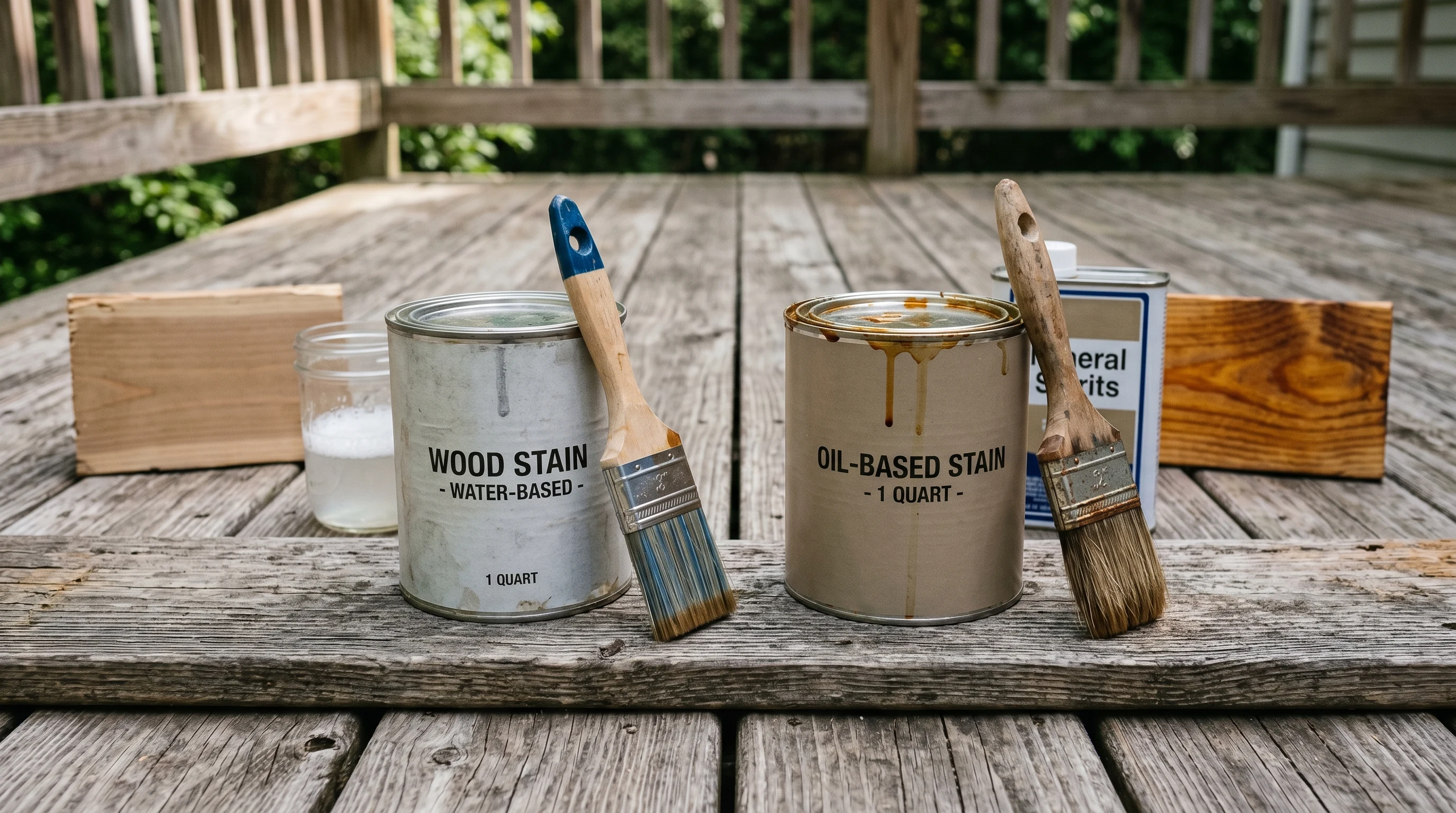
The 30-Second Answer
Oil stain wins on penetration. Water-based wins on everything else for most modern jobs. Oil drives 4-8 mils into wood fiber and reveals grain on cedar, redwood, and mahogany like nothing else, but it yellows in UV, smells for days, and is regulated out of retail in CA, NY, and the OTC states. Water-based sits at 2-4 mils, holds the chip color truer over years, dries in hours, and cleans up with soap. First-time finish on porous open-grain species: oil. Annual deck maintenance, indoor work, regulated states: water-based.
At a Glance
| Water-based stain | Oil-based stain | |
|---|---|---|
| Carrier | Water | Linseed, tung, or paraffinic oil + mineral spirits |
| Binder | Acrylic emulsion | Alkyd or natural oil |
| Penetration | 2-4 mils | 4-8 mils |
| Grain reveal on cedar / redwood | Moderate | Deep |
| UV color hold | True to chip; fades to duller original | Yellows to warm amber; richer fade |
| Touch-dry | 1-4 hours | 8-24 hours |
| Recoat | 2-4 hours | 24+ hours |
| Full cure | 7-14 days | 30 days |
| Cleanup | Soap and water | Mineral spirits |
| VOC | 50-200 g/L | 350-500 g/L |
| Regulated states | Compliant | Restricted in CA, NY, OTC |
| Repaint over previous water-based | Direct | Strip first |
| Repaint over previous oil | Sand + clean first | Direct |
How the Chemistries Actually Differ
Two different wetting mechanisms.
Oil stain dissolves its pigment in a carrier of linseed, tung, or paraffinic oil (mineral spirits thin the can to a workable viscosity), with an alkyd or natural-oil binder. When the brush hits the wood, capillary action pulls the low-viscosity oil mixture deep into the lumens of the wood cells. Mineral spirits flash off; the oil binder oxidizes over a week, cross-linking the fatty-acid chains into a polymer that lives inside the fiber. The pigment goes wherever the oil went. On cedar or redwood with open porous structure, that reach is 4-8 mils.
Water-based stain is an acrylic emulsion: synthetic dyes or pigments dispersed in water with an acrylic binder and surfactants that let the water wet the wood. Wood resists water. The lignin and waxes in cedar actively repel it. The stain wets the surface but doesn’t drive as deep. The acrylic emulsion coalesces as the water evaporates, forming a thin pigmented film in the top 2-4 mils.
Oil reaches deeper because it’s chemically compatible with what wood is made of. Water sits shallower because wood is built to shed water. Every other difference flows from there.
Penetration Depth
The headline difference. On porous open-grain species, oil’s 4-8 mils of penetration produces a finish where the grain reads three-dimensional under raking light. The pigment is in the fiber, not on it. Light hits the surface, refracts through the cell walls, bounces off pigment particles at varying depths. The wood looks alive.
Water-based stain at 2-4 mils reads flatter. The pigment sits in a thin acrylic film at the surface; the grain is visible but reads more like a printed image than refracted depth. On dense closed-grain species (maple, oak, birch) where neither finish penetrates deeply, the gap closes. On softwoods with open porous structure, oil wins clearly.
Winner: Oil. Decisively on cedar, redwood, mahogany, ipe.
Color Hold and UV Resistance
Different fade mechanisms.
Oil stain yellows. Linseed and alkyd binders contain unsaturated fatty acids that oxidize on UV exposure, producing a slow shift toward warm amber. A clear oil sealer at year three reads honey-colored even where the original was almost transparent. A semi-transparent cedar oil at year three reads richer than day one, then drifts toward orange-brown. Some homeowners like this. Some don’t.
Water-based stain doesn’t yellow. The acrylic binder is UV-stable and the synthetic pigments are light-fast. The fade mechanism is different: pigment loss from the surface film as UV breaks down the binder around it. The color stays true to the chip, then dilutes toward a duller version of itself. A water-based deck stain at year two reads as the same color, just less saturated.
If you want the deck at year five to read like the chip, water-based is the safer call. If you like the warm patina of weathered oil, oil delivers it on schedule.
Winner: Water-based on color truth. Oil if the amber drift is the goal.
Dry and Recoat Windows
Oil cures slowly because the binder isn’t drying, it’s polymerizing with atmospheric oxygen. Touch-dry runs 8-24 hours depending on humidity and temperature, recoat wants 24 hours minimum, and full cure takes 30 days. A two-coat deck job in oil is a four-day project minimum.
Water-based dries by water evaporation and acrylic coalescence. Touch-dry runs 1-4 hours, recoat is 2-4 hours, full cure lands at 7-14 days. The same two-coat deck finishes in a single day with time to spare.
For weather windows in shoulder seasons (a Saturday with rain forecast Sunday), the difference decides whether the project happens this weekend or waits two weeks for another dry stretch.
Winner: Water-based.
Cleanup
Oil needs mineral spirits, then soap. Brushes get worked through three to five spirit rinses until the solvent runs clear, then a soap rinse, then air-dried. Contaminated spirits go to hazardous waste, never down the drain. Rags soaked in oil stain can spontaneously combust as the oil oxidizes; lay them flat outside or seal in a metal can with water before disposal.
Water-based cleanup: rinse the brush under tap water until it runs clear. Roughly 90 seconds. Rags are inert.
Winner: Water-based.
Smell and VOC
Oil stain runs 350-500 g/L VOC depending on the formulation. The mineral spirits flash off slowly during application and continue gassing off for the full week of cure. Open a can of oil deck stain on a calm afternoon and the smell carries across two yards. In an enclosed space (deck under a covered porch, garage, indoor floor), the VOC load is significant and the room is unusable for the rest of the day.
Water-based runs 50-200 g/L. The smell is mild glycol-and-acrylic, fades within hours of recoat, and doesn’t persist into the cure week. Indoor staining of stair treads or a vanity top is tolerable in a normally ventilated room.
The regulatory consequence matters. CARB, OTC, and several state-specific rules restrict architectural finishes above category caps that vary by product class. Traditional high-VOC oil stains are hard to find at retail in CA, NY, DC, DE, MD, NJ, PA, VA, and several New England states. The shelf reality matches even where the law is more lenient: major brands have largely converted consumer lines to lower-VOC water-based or hybrid formulations.
Winner: Water-based. Decisively on smell, VOC, and regulatory availability.
Repaintability
This is the cure-the-failure section.
Water-based over previous water-based. Clean, light scuff if glossy, recoat. Direct compatibility because both films are acrylic.
Water-based over previous oil. Possible with prep. The cured oil film is hydrophobic; fresh water-based stain beads up on it unless you give it a mechanical key and clean it of oxidation residue. Standard procedure: scuff to 80-grit, wash with TSP-PF substitute, rinse, dry to under 15% moisture, then apply. Skip the prep and the new finish peels in a season.
Oil over previous water-based. This is the failure direction. The mineral spirits in fresh oil stain pull moisture out of the cured acrylic film, lifting it off the wood. The stain might look fine for a month, then the underlying water-based layer releases and both finishes come off in sheets. The fix is to strip the water-based layer first, sand to bare wood, then apply oil. Most homeowners don’t strip; they just stay with water-based on the recoat.
Oil over previous oil. Standard. Clean, lightly sand any glossy spots, apply.
The asymmetry pushes most maintenance schedules toward water-based once a deck has been finished in either chemistry. Year-after-year recoats in water-based work cleanly; year-after-year recoats in oil work too but ask for more prep each cycle.
Winner: Water-based on long-term maintainability.
Verdict by Use Case
- Pick oil-based stain if: the wood is unfinished cedar, redwood, mahogany, or ipe and you want the deepest grain reveal; the project is restoration of severely weathered wood where you need penetration to stabilize; the look you want is a warm amber patina that develops over years; you live outside the regulated states and don’t mind the smell, the cure week, and the cleanup.
- Pick water-based stain if: you live in CA, NY, or an OTC state; the project is annual or biennial deck maintenance where ease wins; the substrate is interior (stair treads, furniture, vanity tops) where odor matters; the wood was previously finished in water-based; you want the day-one color to read true at year five.
- It’s basically a tie when: the substrate is closed-grain hardwood (oak, maple, birch) where neither penetrates deeply anyway, and the project is a one-time interior finish under a polyurethane topcoat. Both stains tint the wood; the topcoat does the protection.
Top Picks by Side
Going with oil? The category standards are Penofin, Cabot Australian Timber Oil, and Minwax Wood Finish for interior projects. See best wood stain for verified picks across species, and best exterior stain for siding and fence work.
Going with water-based? Benjamin Moore Woodluxe, Sherwin-Williams SuperDeck Waterborne, Olympic Maximum Water-Based, and Cabot Stain & Sealer Waterborne are the verified shelf options. See best deck stain for the deck-specific round-up.
Related
- Paint vs stain — when each finish is the right call
- Best deck stain — verified picks for horizontal exterior wood
- Best wood stain — interior and exterior across species
- Best exterior stain — siding, fence, and trim
- Exterior wood guide — prep, primer, and finish system
- Oil-based vs water-based paint — sibling comparison for paint, not stain
Ask a Question