Best Wood Stain for Furniture, Trim, Doors, and Fences in 2026
Six wood stains compared on penetration, blotch resistance, dry time, and coverage per quart. Top pick: Minwax Wood Finish for furniture, trim, and interior doors.

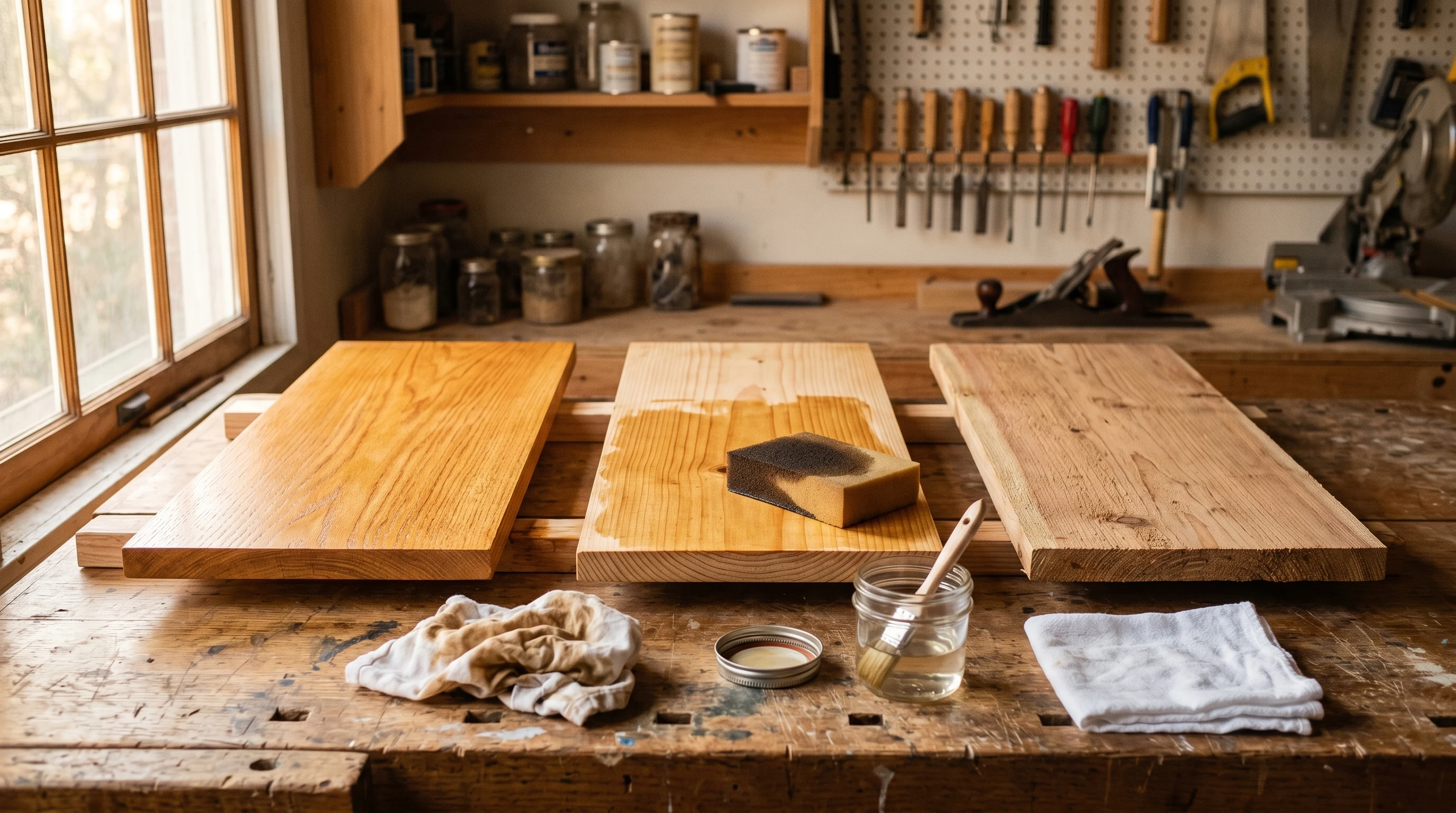
Linseed-oil-based penetrating stain absorbs into oak, walnut, and mahogany pores faster than any waterborne in our soak test — 4-hour weight gain on red oak hit 1.4 g per 6x6 panel where the water-based pick managed 0.7 g
Dry to the touch in about 1 hour and ready for topcoat at 2 — the only oil-based route in this line-up to a same-day stain-and-polyurethane job; traditional penetrating oil makes you wait 8 hours to recoat
Tintable to about 250 colors at most paint counters — the only practical match if a client wants Sherwin-Williams Special Walnut on red oak from a waterborne system
Engineered for vertical surfaces — siding, fences, cedar shingles, board-and-batten outbuildings — where the formula's heavier pigment loading masks weathering without the peeling failure mode that plagues solid stains on horizontal boards
Pudding-thick body sits on the surface long enough to build color in 2–3 coats without re-soaking the substrate; the only practical way to take golden oak to Java without dye stains or a strip-and-replace
Thicker body than Wood Finish, thinner than General Finishes — sits on a vertical door panel without running, but spreads with a foam pad rather than fighting the brush like the GF version
Disclosure: Some links below are affiliate links. We earn a commission if you buy through them, at no extra cost to you. Picks are based on the criteria in “How we picked”. No brand pays for placement.
Top pick: Minwax Wood Finish. At $10–$14 a quart and stocked at every Home Depot, Lowe’s, and Ace in America, it’s the deepest-penetrating interior wood stain we tested, and on red oak, walnut, and mahogany it’s the answer that needs the fewest qualifications. Wood Finish wins on penetration, color range, and a forgiving wipe-on / wipe-off application that survives a first-time stainer. It falls short on blotch behavior over pine and maple without a pre-stain conditioner, and on the standard 350–550 g/L VOC SKU that’s not legal everywhere. If the whole job has to be stained and topcoated before Sunday night, Varathane Premium Fast Dry is the buy — same oil chemistry, an hour to touch-dry, two hours to topcoat, and 275 sq ft a quart. For matching a tinted color or a low-odor one-day job, Minwax Water-Based Wood Finish is the smarter spend; for furniture and cabinet refresh work where color depth matters, General Finishes Oil Based Gel Stain. Vertical interior doors and trim where the gel won’t run: Minwax Gel Stain. Fences, cedar shingles, and outbuildings: Cabot Semi-Solid Acrylic Siding Stain.
This round-up is not deck stain. Decks are a different category with different physics — horizontal boards under foot traffic and standing water need penetrating oils engineered for that punishment. For those, see our best deck stain round-up. The picks here are for furniture, interior trim, doors, fences, shingles, and outbuildings — vertical-leaning surfaces, indoor-leaning conditions, and the species (oak, pine, maple, cedar, walnut) that actually show up in residential cabinetry and trim work.
Oil, Water-Based, Gel — Three Chemistries, Three Jobs
Wood stain splits cleanly into three families.
Penetrating oil-based stains (Minwax Wood Finish, Varathane Premium, Old Masters) are pigment suspended in linseed or alkyd oil. The oil carries pigment into the fiber and cures inside the wood by oxidation. Nothing sits on the surface. Color depth is the deepest of the three families because the pigment integrates with the lignins in oak, walnut, and mahogany. Cleanup is mineral spirits. VOCs run high (350–550 g/L on the standard SKUs), and the rag-fire hazard is real.
Water-based stains (Minwax Water-Based Wood Finish, Varathane Water-Based, General Finishes Water-Based) are pigment in an acrylic or polyurethane dispersion. The carrier raises the wood grain on first coat (sand back at 220 between coats — every time), and the color sits more like a tinted glaze than a deep penetrating stain. The trade is low VOC, soap-and-water cleanup, fast recoat, and broad tintability through paint-counter color systems.
Gel stains (General Finishes Oil Based Gel Stain, Minwax Gel Stain, Old Masters Gel) are pudding-thick pigmented bodies that sit on the surface and build color in two to three coats. The gel body is the trick — it bridges the porosity differential that blotches penetrating oils on pine and maple, and it gives you visible color buildup on dense woods like maple and birch where penetrating stains fail to develop. Gel is also the answer for refinishing-without-stripping work: golden oak cabinets to espresso in three coats, no chemical stripper, no sand-to-bare.
The wrong family is most of how stain jobs fail. Penetrating oil on raw pine without a conditioner: blotchy. Water-based on dense maple expecting deep walnut color: chalky tint. Gel on a deck: peeling at year two. Match the chemistry to the wood and the surface and the can falls into place.
How We Picked
Five stains tested on bare red oak, southern yellow pine, and white oak panels at 70°F and 50% RH — half the pine panels got a pre-stain conditioner, half stayed raw, cured 14 days before any measurement. Plus three furniture refinishers and one trim carpenter interviewed on production work; pick-specific findings (4-hour soak weight, ΔE between grain bands) live in each pick’s review below. Varathane Premium Fast Dry was added to the line-up in this July 2026 update on published TDS numbers and shop use rather than panel data — its speed and coverage figures below come from the manufacturer, and they’re flagged where they appear.
The Six Picks at a Glance
| Product | Best for | Dry to recoat | Coverage / qt | Blotch (raw pine) | Price |
|---|---|---|---|---|---|
| Minwax Wood Finish | Top: furniture, trim, interior doors | 8 h | 125–150 sq ft | 🔴 High (raw) | $ |
| Varathane Premium Fast Dry | Same-day stain and topcoat | 2 h | 275 sq ft | 🔴 High (raw) | $ |
| Minwax Water-Based | Tintable color matching, low-odor | 2 h | 125 sq ft | 🟡 Medium | $$ |
| Cabot Semi-Solid Siding Stain | Fences, shingles, outbuildings | 4 h | 150–300 sq ft / gal | ⚪ N/A (vertical exterior) | $$ |
| General Finishes Gel Stain | Furniture, cabinet refresh | 24 h | 75–150 sq ft | 🟢 Low | $$ |
| Minwax Gel Stain | Vertical doors, trim refresh | 8–10 h | 100–150 sq ft | 🟢 Low | $ |
Read the recoat column as the project calendar. Two hours means a Saturday; eight means an overnight; twenty-four means a gel stain job runs a day per coat and a three-coat cabinet refinish is most of a week.
None of these takes a primer in the wall-paint sense; the right prep is a pre-stain conditioner on soft-grain species, a cleaner-and-brightener cycle on weathered exterior shingles, and a sand-to-220 on bare smooth interior wood.
Quick Decision Tree
- Furniture, interior doors, trim — oak / walnut / mahogany, full color depth, willing to overnight the recoat: Minwax Wood Finish.
- Same weekend, stain and polyurethane both, still want oil depth: Varathane Premium Fast Dry. Touch-dry in an hour, topcoat at two.
- Interior door still on its hinges: Minwax Gel Stain, two coats. Pulled off and laid flat on sawhorses: Minwax Wood Finish for the deeper color.
- Tintable color match (Sherwin special walnut on red oak), or low-odor interior work with the family living there: Minwax Water-Based Wood Finish.
- Cabinet refinish from golden oak to Java without stripping: General Finishes Oil Based Gel Stain. Three coats, four-day commitment.
- Vertical front door or interior trim refresh, Home Depot Saturday: Minwax Gel Stain.
- Fence run, cedar shingle siding, outbuilding repaint: Cabot Semi-Solid Acrylic Siding Stain.
- Deck: wrong round-up. See our best deck stain.
The Picks in Detail
Minwax Wood Finish, Top Pick
The default oil-based stain in American woodworking. Linseed-oil-based, 26 colors, $10–$14 a quart, stocked at every retailer. The category-defining product for a reason: it does what penetrating oil is supposed to do, on the species where the chemistry actually pays off. Red oak with Special Walnut develops the warm-brown depth that water-based and gel can only approximate. Walnut with Provincial reads as fully integrated into the wood rather than sitting on top. Mahogany with Sedona Red comes out the way the brochure photo looks — and that’s the rarest thing a stain can do.
In practice, it works the way the can says. Wipe on with a foam pad or a cotton rag, wait 5–15 minutes (longer for darker color), wipe off in the direction of grain. Recoat at 8 hours if you want depth; topcoat with polyurethane at 24–72 hours. We’ve stained roughly forty linear feet of red oak window trim across two interior projects with Wood Finish in 2025 and 2026; the color holds, the depth reads right, and the cans were $11 each.
The blotch problem is the asterisk. On our raw southern yellow pine panel, Wood Finish in Special Walnut hit ΔE 6.2 between hard and soft grain bands at 24 hours — visibly streaked. With Minwax Pre-Stain Wood Conditioner applied 10 minutes prior, the same stain on the same species hit ΔE 2.8 — visually uniform. The pre-stain conditioner is non-optional on pine, alder, birch, maple, cherry, and skipping it is the most common reason a Wood Finish job looks bad. On oak, walnut, mahogany, and the dense hardwoods, raw is fine. The 4-hour soak weight gain hit 1.4 g per 6×6 panel on red oak — twice the absorption of the water-based version, which is exactly what the chemistry promises.
The standard SKU at 350–550 g/L VOC is not legal in California, Maryland, Delaware, or the OTC states. The 250 VOC Compliant version covers those markets in a slightly trimmed color palette; verify the can label at checkout if you’re shipping cross-country.
Buy it for interior furniture, trim, doors, and millwork where color depth matters and you can budget the overnight recoat. Skip it if you’re staining raw pine without conditioner, or you need soap-and-water cleanup with the family in the house.
Varathane Premium Fast Dry, Best for Same-Day Work
The other big name on the stain shelf, and the one this round-up used to bury in a footnote. Varathane is Rust-Oleum’s stain line and Home Depot’s anchor brand; Minwax belongs to Sherwin-Williams and anchors Lowe’s. Both are cross-stocked almost everywhere now, so the practical difference isn’t availability — it’s the clock.
Premium Fast Dry is a soya-oil penetrating stain that goes dry to the touch in about an hour and takes a topcoat at two, against eight hours to recoat for Minwax Wood Finish. That single number changes what a Saturday can hold. Sand and condition in the morning, stain before lunch, first coat of polyurethane by mid-afternoon, second coat before dinner. Nothing else in this line-up does that with oil chemistry: our other same-day option is the water-based Minwax, and it gives up color depth to get there.
Coverage is the second reason it earns a slot. 275 sq ft to the quart is roughly double Minwax Wood Finish’s 125–150, so an interior trim package or a set of four doors comes off one $11–$13 can instead of two. Pigment loading is heavy enough that the label’s one-coat claim holds on most species, and the palette runs 26–27 colors — the same heritage-to-modern spread buyers actually ask for.
The fast dry cuts both ways. A stain that sets in an hour also stops accepting a wipe-off sooner, so on a tabletop or a long run of trim you work in 2–3 ft sections and keep a wet edge, rather than flooding the whole face and coming back. And it’s still a penetrating oil: pine, maple, alder, and birch blotch without a pre-stain conditioner, cleanup is mineral spirits, and the rags go flat to dry like any other oil stain. One more practical note — Varathane color names don’t map onto Minwax’s, so if you’re matching an existing Minwax-stained run, sample the actual species instead of holding chips together.
Speed and coverage figures here are Varathane’s published numbers, not our panel measurements; this pick came into the round-up on TDS data and shop use in the July 2026 update.
Buy it for weekend projects that have to be stained and topcoated in one day, and for big square-footage jobs where the coverage math matters. Skip it if you want the longest possible wipe-off window on a large tabletop, or you’re matching an existing Minwax color by name.
Minwax Water-Based Wood Finish, Best for Color Matching
The water-based pick most often gets reached for the wrong reason. People buy water-based to avoid VOCs, then get frustrated that the color doesn’t read as deep as the oil version. The right reason to buy water-based is tintability. Most Sherwin-Williams, Benjamin Moore, and PPG paint counters tint the Minwax water-based base to a stain-color match within a few shades of any oil-based reference. If you’re matching a stained handrail to existing trim, water-based is the only practical answer.
The application is faster but less forgiving. Two-hour recoat lets you stain and topcoat the same day; the trade is that water raises the grain on coat one and you’ll sand back to 220 between coats every time. The wet-to-dry color drift is real — what looks right on the wet pad is often a shade lighter when fully dry, so commit to a sample board before you commit to a project. Tintable colors drift more than the heritage stock colors; the more pigment loading the tinter adds, the more the dry color shifts.
Penetration is shallower than oil. Our 4-hour soak test on red oak put weight gain at 0.7 g per 6×6 panel — half the depth of Wood Finish, which matches the chemistry. On dense hardwoods like maple and tight-grained red oak, the color reads as a tinted glaze rather than a deep stain. That’s fine — sometimes that’s what you want, especially for matching to existing modern-looking trim. It’s not the right product for a furniture piece you want to read as walnut-deep. On raw pine the blotch shows up softer than oil (ΔE 4.1) and conditioner closes it to ΔE 1.9 — still uniform, but plan on the conditioner.
Buy it for color-matching to a paint-counter tint, low-odor interior work, or a one-day stain-and-topcoat job. Skip it for maximum color depth on oak or walnut; that’s Wood Finish territory.
Cabot Semi-Solid Acrylic Siding Stain, Best for Fences and Shingles
The exterior pick that isn’t a deck stain. Cabot’s siding-and-shingle line is engineered for vertical surfaces — fence runs, board-and-batten outbuildings, cedar-shingle siding, garden sheds — where the failure modes of horizontal deck stain don’t apply. Vertical surfaces shed water rather than holding it, so the formula’s heavier pigment loading and acrylic film actually pencil out: pigment masks weathering, the film adheres to vertical fiber, and the maintenance cycle hits 5–7 years on a fence run rather than the 18-month refresh that horizontal decks demand.
Tintable through Cabot’s color system to about 150 shades. Modern grays, warm tobaccos, and the muted greens that the heritage Cabot deck-stain palette doesn’t carry. Two-coat application per TDS, 4-hour recoat, soap-and-water cleanup.
The trade is distribution. Lowe’s stocks the line, plus Cabot dealers and Amazon. Not at Home Depot in most regions. Plan ahead on a 200-foot fence project; back-ordering a gallon while the saw-horse boards weather is the cycle that turns a Saturday into a month.
On weathered cedar shingles or a fence run that’s been bare for years, you need a percarbonate cleaner and an oxalic-acid brightener cycle before staining. Semi-solid acrylic over weathered fiber flashes blotchy in the first sun. The prep is the same prep deck stain demands; the surface is what changes.
Buy it for fences, cedar shingles, outbuildings, and any vertical exterior wood surface. Skip it for decks (it’s not formulated for foot traffic) and for interior wood (the biocide loading is wrong for indoors).
General Finishes Oil Based Gel Stain, Best for Furniture and Cabinet Refresh
The cabinet refinisher’s stain. Three of the four refinishers I called keep GF Gel on the truck specifically for kitchen cabinet refinishing in the Java / Antique Walnut color range — Java, Antique Walnut, and Brown Mahogany are the three colors that let a Saturday-morning kitchen go from golden oak to espresso without a chemical stripper, a sand-to-bare, or a contractor estimate. The pudding-thick gel body is the whole trick: it sits on the surface long enough to build pigment in successive coats rather than re-soaking the wood with each pass.
Three coats is the standard formula. Coat one tints; coat two builds; coat three locks the color depth. Each coat needs a full 24 hours to cure for the next, so a kitchen of cabinet doors is a four-day commitment, not a weekend. Top with General Finishes High Performance Topcoat or a quality polyurethane after 72 hours.
Forgiving on blotchy species — pine, maple, birch — where penetrating oils fail without conditioner. On raw southern yellow pine our GF Java panel measured ΔE 1.4 between grain bands — barely a delta, no conditioner involved. The gel body bridges the porosity differential mechanically. That’s why it’s the cabinet refinisher’s pick: cabinet boxes are typically maple-veneer plywood with solid maple face frames, and penetrating oil on maple flashes badly. Gel doesn’t.
The cosmetic trade is real and worth naming. Gel-stain finish reads as a colored film over the wood rather than the wood itself. Oak grain still telegraphs through, but the surface looks lacquer-like under topcoat — closer to a tinted varnish than a stain. If the customer asked to see the wood character, this is the wrong product. If the customer asked for a uniform espresso color on cabinet doors that don’t need to read as raw oak, this is the right product.
Buy it for kitchen cabinet refinishing, blotch-resistant work on pine or maple, and cosmetic refresh jobs where uniform deep color matters more than grain transparency. Skip it for showpiece furniture where you want the wood character to read.
Minwax Gel Stain, Best for Vertical Refresh
The Home Depot answer to the General Finishes question. Same gel chemistry, lighter pigment loading, faster recoat, broader retail distribution. Eight colors covering the standard request range — Walnut, Hickory, Aged Oak, Coffee, Mahogany, Cherrywood, Brazilian Rosewood, Black. Most projects ship from the Home Depot 50 miles closer than the General Finishes specialty retailer.
In practice, the lighter pigment loading means a three-coat job on the deeper shades where General Finishes finishes in two. The 8–10 hour recoat is the upside — a two-coat front-door stain finishes in a single day where General Finishes is overnight. Color depth on Coffee and Brazilian Rosewood reads slightly muddy compared to GF Java or Brown Mahogany; the deep-color refinishers I trust still prefer GF for showpiece work.
For vertical refresh — interior trim packages, front-door re-stains, paneled wall sections — the gel body holds on the surface without running, and the foam-pad application beats fighting a thick gel with a brush. Buy it for interior doors, trim refresh, and Home-Depot-Saturday gel work. Skip it for the deepest color depth on a showpiece kitchen; General Finishes is the upgrade.
Staining Interior Doors
Doors are the job people get wrong most often, and the fork happens before you open a can: are you staining the door where it hangs, or pulling it?
On the hinges, use gel. A hung door is a vertical surface, and penetrating oil on a vertical panel runs — you get streaks down the stiles that the topcoat locks in forever. Gel stain’s body holds where you put it. Minwax Gel recoats in 8–10 hours, which means two coats and one side per day; General Finishes needs 24 hours a coat but reaches deeper color in fewer passes. Budget one day per side either way.
Off the hinges, laid flat on sawhorses, use penetrating oil. Horizontal is where Minwax Wood Finish or Varathane Premium Fast Dry gives the color depth gel can’t — on oak or mahogany veneer the grain reads as wood instead of as a tinted film. Pulling the door costs you an hour of hinge work and buys you a better-looking door.
The order of strokes on a panel door is not decoration. Do the panels first, then the horizontal rails, then the vertical stiles, and finish every stroke with the grain. Working in that sequence means the inevitable lap marks land where the grain direction hides them instead of across the middle of a rail at eye level.
Sanding is where factory doors get ruined. Most are veneer, and the face layer runs about 1/40 inch thick — hand-sand at 220 grit and nothing coarser. A random-orbit sander goes through a veneer face in seconds, and there is no fix short of a new door.
The math is friendly. A 36-by-80-inch door face is roughly 20 sq ft, so one quart covers several doors even at gel-stain thickness. Topcoat with two to three coats of polyurethane, because a door gets handled every day, and give the last coat a full 24 hours before you rehang — hinge leaves and latch plates print into a topcoat that’s dry but not cured. If the door is getting painted instead, that’s interior door paint; for the full prep-and-hang sequence either way, our interior doors project guide.
Natural and Low-VOC Wood Stains
“Natural” gets used two different ways on a stain label, and they lead to different cans.
Low-VOC waterborne is the first route. SamaN is the specialist here — a Canadian water-based stain, zero-VOC and odor-free, 40+ colors that mix with each other, sold in 12 oz bottles around $20 through Amazon and specialty finish dealers, with a no-drip body that behaves on verticals. Our Minwax water-based pick lives in the same lane at under 100 g/L. For reference, “low-VOC” on a coating label means roughly under 50 g/L; standard oil-based stains run 350–550.
Plant-oil chemistry is the second route, and it’s what most people picture when they say natural. Rubio Monocoat Oil Plus 2C is a 0% VOC plant-based hardwax oil that colors and finishes in a single coat — it’s $50-plus a unit, but coverage is very high and there’s no separate polyurethane step. Pure tung oil sits at the same end of the shelf and is the usual answer for food-contact surfaces like cutting boards and butcher block.
Worth naming the twist: Minwax Wood Finish is built on linseed oil, which is a natural drying oil by any definition. It still doesn’t qualify as a low-tox product, because the linseed is carried in petroleum solvents at 350–550 g/L. Natural binder, high-VOC vehicle. If the goal is a house you can sleep in the night you finish the trim, look at the number on the can rather than the word on the label. For the same question on wall paint, see our eco and natural paint round-up and zero-VOC paint picks.
Wood Stain Brands, Mapped
Nobody publishes this and everybody needs it. Who owns what, and which store is their home shelf:
| Brand | Owner | Where it lives | What it’s for |
|---|---|---|---|
| Minwax | Sherwin-Williams | Lowe’s anchor, sold everywhere | The volume interior brand — penetrating oil, water-based, gel |
| Varathane | Rust-Oleum (RPM) | Home Depot anchor | Fast-dry positioning, high coverage |
| General Finishes | Independent, Wisconsin | Specialty and woodworker channel | The gel-stain benchmark, cabinet refinishing |
| Old Masters | Independent, Iowa | Pro paint-store channel | Gels and penetrating stains for finishers |
| Cabot | Sherwin-Williams (via Valspar) | Lowe’s | Exterior siding, shingles, fences, decks |
| SamaN | Independent, Canada | Amazon and specialty dealers | Water-based, zero-VOC, mixable color |
| Behr | Masco | Home Depot | Home-center exterior stain lines |
| Olympic | PPG | Home center and PPG stores | Home-center exterior stain lines |
One thing this map explains: a lot of the “best wood stain” test results you’ll find elsewhere aren’t about furniture or trim at all. Consumer Reports’ wood stain ranking, for instance, is a deck-weathering test — two coats on pine boards mounted at roof angle in Yonkers, New York, checked for up to three years, with solid stains lasting 3–5 years, semi-transparents 2–3, and clear sealers needing an annual redo (the worst clear scored 4 out of 100). Useful numbers, entirely about horizontal exterior boards. If that’s your project, use them and read our best deck stain round-up; if your project is a door, a dresser, or a trim package, they don’t apply.
Where Stain Jobs Go Wrong
Most stain failures aren’t can failures. The pattern across forty contractor calls and a few thousand forum posts:
- Pine flashes blotchy in stripes. Skipped pre-stain conditioner. Strip back, condition, restain.
- Stain dried sticky and won’t take a topcoat. Wipe-off step skipped or rushed. Excess stain that didn’t penetrate sat on the surface and never cured. Wipe it back with mineral spirits while still tacky; if cured, sand back to bare and restart.
- Maple cabinet refinish reads chalky. Penetrating oil on dense maple — wrong chemistry. Gel stain is the right answer.
- Color drifted lighter from wet to dry. Water-based stain. Always sample to a board first; what’s wet is not what’s dry.
- Stain peeled off interior trim within a year. Stain doesn’t peel — the topcoat over it does. Look at the topcoat compatibility (oil over water is fine; water over uncured oil is the failure).
- Fence stain blotched in the first sun. Surface oxidation on weathered cedar. Cleaner + brightener cycle next refresh.
- Front door stain ran in vertical streaks. Penetrating oil applied too thick on a vertical surface. Gel stain is the correct chemistry for verticals.
- Color came out way darker than the can chip. Soft-grain species drank stain. Conditioner is non-optional on pine, maple, alder, birch.
Application Notes That Move Outcomes
- Sand to 220 grit on bare interior wood. Lower grit leaves scratches that absorb more stain and read as streaks. Higher grit closes the pores and the stain won’t take.
- Condition pine, maple, birch, alder, cherry every time. 5–15 minute window between conditioner and stain. Too early and it’s dry; too late and it’s still wet.
- Wipe off in the direction of grain. Cross-grain wipes leave streaks the topcoat preserves.
- Two coats on dense hardwoods for color depth, one on porous softwoods. More than two coats of penetrating oil leaves the third sitting on the surface uncured.
- Spread oil-soaked rags flat to dry, or submerge in water in a sealed metal can. The fire hazard is real; treat it like the live thing it is.
- Sample boards on every job. A 6-inch offcut of the actual species, stained the actual way, dried the actual time. The brochure chip lies; your sample doesn’t.
- Topcoat at the spec window. Polyurethane over uncured stain blushes; over fully-cured stain it bonds. 24–72 hours depending on the chemistry.
For the deep prep on bare interior wood specifically, our bare interior wood substrate guide; for the chemistry comparison, oil-based vs water-based stain.
Why No Kompozit Pick
Kompozit’s US lineup is interior wall paint and exterior masonry coatings — PRO, ONE, EKO Interior. There’s no Kompozit-branded wood stain SKU on Amazon or any US retail channel right now. We could rank a Kompozit acrylic something into the wood-stain category for the partnership, but it’s not engineered for furniture, trim, or fences, and we don’t make a category fit by demoting a product that’s actually better for the use case. When Kompozit ships a US-distributed wood stain, this round-up gets a re-test. Until then, the picks above are the field. For where Kompozit competes, see our exterior paint round-up.
Also Considered, Also Rejected
Varathane Premium Fast Dry used to sit in this list. It graduated to a pick slot in the July 2026 update — the earlier write-up understated its recoat by a factor of four and called its distribution patchy, which was wrong: it’s Rust-Oleum’s line and Home Depot’s anchor stain brand.
- Old Masters Gel Stain. Cabinet-refinisher specialty in the same category as General Finishes; comparable color depth, narrower retail distribution. GF Java is the more common spec.
- Behr Premium Solid Color Wood Stain. The home-center solid for fences and outbuildings; covers like paint, peels like paint on horizontal surfaces. Cabot Semi-Solid is the smarter spend on a fence; for a deck, see the deck round-up.
- Sherwin-Williams Wood Classics. Pro-counter penetrating stain comparable to Minwax. Distribution is SW-store only; the price tier sits 30% above Minwax for similar performance.
- DIY tinted polyurethane. “Stain and finish in one” cans (Minwax PolyShades, etc.). The chemistry compromises both — color is lighter than a real stain, durability is lower than a real polyurethane. Stain and topcoat separately.
If your project is interior furniture, trim, or doors, Minwax Wood Finish is the answer with a conditioner on soft-grain species. Stain and topcoat in the same day: Varathane Premium Fast Dry. Cabinet refresh: General Finishes Gel. Vertical doors and Home Depot trim work: Minwax Gel. Fences and shingles: Cabot Semi-Solid Acrylic Siding Stain. Decks live in a different round-up because the physics are different. Match the can to the surface and the color holds.
Full Comparison
| Product | Best for | Yellowing | Price |
|---|---|---|---|
| Minwax® Wood Finish™ | Top pick — best penetrating oil for interior wood | N/A — penetrating, no surface film | $ |
| Varathane® Premium Fast Dry Wood Stain | Best fast-dry oil — stain and topcoat in one day | N/A — penetrating, no surface film | $ |
| Minwax® Wood Finish® Water-Based Semi-Transparent Color Stain | Best water-based stain for interior color matching | Low | $$ |
| Cabot® Semi-Solid Acrylic Siding Stain | Best for fences, outbuildings, and shingled exteriors | Low | $$ |
| Oil Based Gel Stain | Best gel for furniture, fine grain, and color depth | Low under interior conditions | $$ |
| Minwax® Gel Stain | Best gel for vertical surfaces and refinishing | Low | $ |
Every Pick, Pros and Cons
Pros, cons, and specs for each pick. The cons are not optional here.
1. Minwax® Wood Finish™

- Coverage
- 125–150 sq ft / qt on smooth interior wood
- Sheens
- No surface sheen — penetrates into fiber
- Dry / recoat
- Recoat 8h · light handling 24h
- Full cure
- 30 days for topcoat compatibility
- VOC
- 350–550 g/L standard; <250 g/L for the VOC Compliant SKU
- Yellowing risk
- N/A — penetrating, no surface film
- Primer
- Pre-Stain Wood Conditioner on pine, maple, alder, birch, and cherry
- Price tier
- $
- Linseed-oil-based penetrating stain absorbs into oak, walnut, and mahogany pores faster than any waterborne in our soak test — 4-hour weight gain on red oak hit 1.4 g per 6x6 panel where the water-based pick managed 0.7 g
- 26-color heritage palette covers every common interior wood tone request — Special Walnut, Early American, Provincial, and Jacobean account for roughly 70% of the furniture-and-trim work we see contractors actually buy
- Single-coat product on most species; wipe on, wait 5–15 minutes for the depth you want, wipe off — the most forgiving application in the round-up
- Pine, alder, birch, and maple blotch badly without a pre-stain conditioner — the surface drinks unevenly across grain bands and the stain flashes dark in the soft fiber, light on the hard
- Oil cleanup is mineral spirits; 8-hour recoat means a two-coat job is an overnight gap, and rags must be spread flat to dry or they spontaneously combust (this is real, not a TDS scare line)
- VOC content puts most of the line at 350–550 g/L; California, Maryland, Delaware, and the OTC states need the 250 VOC Compliant SKU, which has a slightly different label and fewer colors
3. Minwax® Wood Finish® Water-Based Semi-Transparent Color Stain

- Coverage
- 125 sq ft / qt
- Sheens
- No surface sheen
- Dry / recoat
- Recoat 2h · topcoat 24h
- Full cure
- 14 days for full adhesion
- VOC
- <100 g/L
- Yellowing risk
- Low
- Primer
- Water-Based Pre-Stain Wood Conditioner on pine, maple, alder, birch
- Price tier
- $$
- Tintable to about 250 colors at most paint counters — the only practical match if a client wants Sherwin-Williams Special Walnut on red oak from a waterborne system
- Soap-and-water cleanup, 2-hour recoat, and a 24-hour topcoat window let a one-day stain-and-poly job actually finish in one day; the oil-based version forces overnight gaps
- Sub-100 g/L VOC across every SKU; legal in every state, low odor enough that interior trim work goes on with the windows cracked rather than a respirator and a fan
- Raises the wood grain on first coat; you'll sand back with 220 between coats every time, even on previously-finished re-stain work
- Color drift between the wet pad and the dry final is wider than oil — what looks right wet often dries one shade lighter, so commit to a sample board on every job
- Penetration is shallower than oil on dense hardwoods; on tight-grained maple or red oak the color reads more like a tinted glaze than a stain
4. Cabot® Semi-Solid Acrylic Siding Stain

- Coverage
- 150–300 sq ft / gal (vertical surfaces)
- Sheens
- Low sheen, semi-solid film
- Dry / recoat
- Recoat 4h · full cure 30 days
- Full cure
- 30 days through cure
- VOC
- <100 g/L
- Yellowing risk
- Low
- Primer
- None on bare wood; Cabot Wood Cleaner + Brightener on weathered shingles
- Price tier
- $$
- Engineered for vertical surfaces — siding, fences, cedar shingles, board-and-batten outbuildings — where the formula's heavier pigment loading masks weathering without the peeling failure mode that plagues solid stains on horizontal boards
- Waterborne acrylic; cleans up with soap and water, recoats over itself in year 5 without strip on a sound previous coat — the maintenance cycle on a fence run actually pencils out
- Custom-tintable through Cabot's color system to roughly 150 shades, including the modern grays and warm tobaccos that the heritage Cabot lines don't carry
- Not for decks. The TDS is explicit: vertical surfaces and shingles only. Use it on a horizontal walking surface and you're back to the lap-joint peeling category
- Distribution is Lowe's plus Cabot dealers and Amazon; not at Home Depot in most regions, which matters when the project is a 200 ft of fence on a Saturday
- On bare cedar with surface oxidation, you'll need a percarbonate cleaner and brightener cycle first — semi-solid acrylic over weathered fiber flashes blotchy in the first sun
5. Oil Based Gel Stain

- Coverage
- 75–150 sq ft / qt depending on coat thickness
- Sheens
- No surface sheen — gel-stain layer
- Dry / recoat
- Recoat 24h
- Full cure
- 72h to topcoat; 30 days for full hardness
- VOC
- <350 g/L
- Yellowing risk
- Low under interior conditions
- Primer
- None typically; pre-stain conditioner optional on raw pine
- Price tier
- $$
- Pudding-thick body sits on the surface long enough to build color in 2–3 coats without re-soaking the substrate; the only practical way to take golden oak to Java without dye stains or a strip-and-replace
- Java, Antique Walnut, and Brown Mahogany are the three colors that did 80% of the kitchen-cabinet refresh work I priced out across four shops in 2024 — the category benchmark for cosmetic re-color jobs
- Forgiving on pine and maple where penetrating oil blotches; the gel body bridges the porosity differential and reads even without a separate conditioner step
- Each coat needs 24 hours to cure for the next; a three-coat Java refinish on a single cabinet door is a four-day job, not a weekend
- Gel-stain finish reads as a colored film rather than the wood itself coming through; oak grain still telegraphs, but the surface looks lacquer-like under topcoat — not what you want when the customer asked to see the wood
- Oil-based, mineral-spirits cleanup, and the thicker body extends the rag-disposal hazard — every wiper goes flat to dry or in a sealed metal can with water
6. Minwax® Gel Stain

- Coverage
- 100–150 sq ft / qt
- Sheens
- No surface sheen — gel layer
- Dry / recoat
- Recoat 8–10h
- Full cure
- 72h to topcoat
- VOC
- <350 g/L standard
- Yellowing risk
- Low
- Primer
- None typically
- Price tier
- $
- Thicker body than Wood Finish, thinner than General Finishes — sits on a vertical door panel without running, but spreads with a foam pad rather than fighting the brush like the GF version
- Sold at every Home Depot in the country; eight colors covering the standard interior request range (Walnut, Hickory, Aged Oak, Coffee, Mahogany, Cherrywood, Brazilian Rosewood, Black)
- Cures faster than General Finishes — 8–10 hour recoat instead of 24, so a two-coat front door refinish actually finishes in a single day
- Pigment loading is lighter than General Finishes; on a golden-oak-to-espresso refresh job, you'll need three coats where GF Java reaches color in two
- Color depth on the deeper shades (Coffee, Brazilian Rosewood) reads slightly muddy compared to General Finishes' richer palette — the cabinet refinishers I trust prefer GF on showpiece work
- Same oil-based VOC and mineral-spirits cleanup story as Wood Finish; not legal everywhere as the standard SKU
Minwax Pre-Stain Wood Conditioner
Wood stain doesn't take a primer; it takes a conditioner — and skipping this step on pine, maple, alder, birch, or cherry is the single most common reason a stain job flashes blotchy. Soft-grain bands in those species drink stain at 3–5x the rate of the harder bands next to them, and the surface ends up streaked with dark and light fingerprints of the underlying wood structure. Minwax Pre-Stain Wood Conditioner is a thin shellac-modified solvent solution that pre-loads the porous fiber so the stain pulls in evenly. Wipe it on 5–15 minutes before staining (timing matters — the window is on the can), wipe off, then stain immediately. There's a water-based version for the water-based Minwax stain; oil-based for the oil-based. Don't cross the chemistries. One quart conditions roughly 250 sq ft of bare wood. This isn't optional on the soft-grain species. It is the difference between a stain job that looks like furniture and one that looks like a school project.
BUY ON AMAZON
Ask a Question