Product review · Behr · Updated August 7, 2026
Premium Semi-Transparent StainBehr paint review
6.6/10Buy it for a fence, railings, or siding. On a deck floor, read the 6-year claim as 6 years on the parts nobody walks on.
The color is honestly good and the water beading is real for two summers. Then the horizontal story starts: owners report it filming on top of deck boards and flaking off in sheets at 18 months to two years.

Mark Thompson · Pro Contractor & Field Editor · Updated August 7, 2026
22 years running residential and light commercial repaints across the Midwest. Mark has stained more fences than he can count and still takes side jobs, mostly for friends who need a deck sorted before a sale. About the testing process →
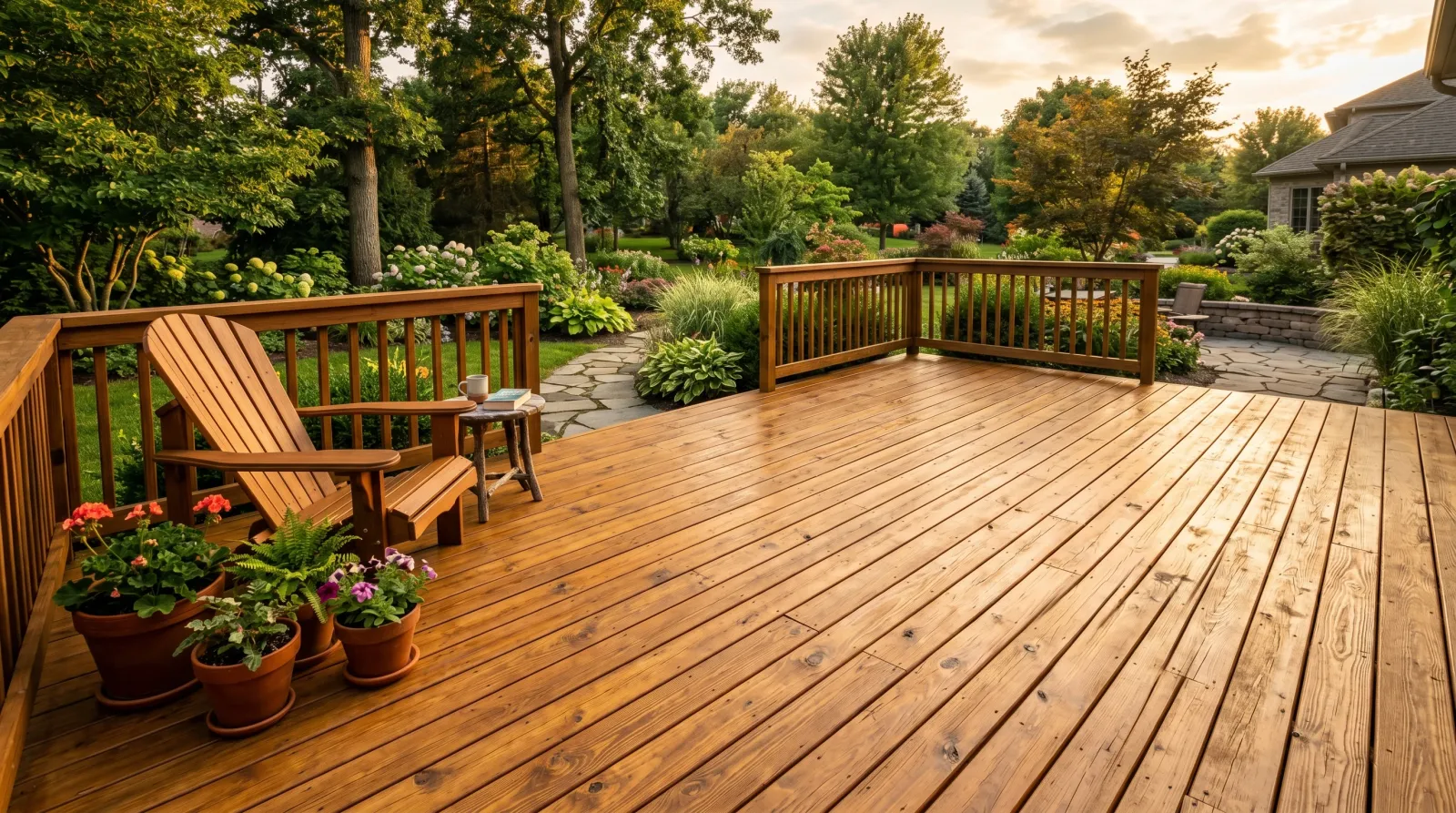
Behr Premium Semi-Transparent Stain2 sheens
Coverage150–250 sq ft / gal new smooth wood
Dry / recoatTouch 1–2 hr
VOCAbout 250 g/L
Full cure24–48 hr before foot traffic
Sheens Low-sheennatural matte
Read this first
The Fast Verdict
On a fence, railings, or siding, yes. At $35 to $48 a gallon it buys honest semi-transparent color that shows cedar and pine grain, holds for years on vertical wood, and beads water like a waxed car through the first two summers. On a deck floor, no. Owner reports say the acrylic films on top of the boards instead of soaking in, and film peels — which turns the refresh into paint-grade stripper and a sander rather than a garden hose.
Best for
Wood fences · Railings and balusters · Siding and shakes · Outdoor furniture · Cedar and pine where you want the grain to read · Anyone who wants the job done this weekend
Skip if
A deck floor you want to clean-and-recoat, not strip · A set-it-and-forget-it six-year deck · Exotic hardwood like ipe · An old solid or film finish you are not willing to strip · Hot 90-degree afternoons with no shade
What it's good at
- Color and grain on cedar and pine — the pigment pulls the grain forward instead of burying it
- Early water repellency; fresh off the second coat it beads like a waxed car for the first two summers
- Cleanup and smell, since it is water-based acrylic and brushes rinse in the sink
- Price and access at $35 to $48 a gallon, tinted into 60-plus colors at any Home Depot in fifteen minutes
- Clean wear on vertical wood, where it thins and fades rather than lifting and a cleaned surface takes a fresh coat without a hard edge
- Spot maintenance on fences and railings, which you can basically leave alone for five years
What it's not good at
- Horizontal deck boards, where owner reports describe peeling in sheets between 18 months and two years
- Living up to the 6-year claim on anything that gets walked on; traffic lanes thin and lose color by month 24 to 30
- Coverage on weathered or rough-sawn wood, which lands near 125 to 150 sq ft a gallon
- Heat — the 30-to-40-minute wet-into-wet window slams shut on a 90-degree afternoon
- Even color on mixed or dense boards, hardwoods, and glossy old growth
- Being removed once it fails; that is paint-grade stripper and a sander, not a garden hose
- Going over an old solid or film finish, which it cannot penetrate and will peel off
Same shelf, different cans
Which Behr Semi-Transparent Are You Buying?
Behr sells a confusing number of exterior wood products under similar names, and people grab the wrong can constantly. This review covers the water-based acrylic Waterproofing Stain & Sealer in semi-transparent opacity. Here is how it sits next to the two cans closest to it on the shelf.
Premium Semi-Transparent Waterproofing Stain & Sealer (this review)
BaseWater-based 100% acrylic
SheensSingle low-sheen natural matte
RecoatSecond coat wet-into-wet at 30–40 min
Buy it if
You want soap-and-water cleanup, low smell, counter tinting into 60-plus colors, and the color on a fence, railings, or siding. It is also the version Home Depot stocks deep.
Avoid if
The wood is dense, rough, and thirsty, or the surface is a deck floor you want to refresh with a wash and a recoat rather than a strip.
Premium Semi-Transparent Penetrating Oil
BaseOil
Buy it if
Rough, dense, or old boards. It soaks in a touch better and re-wets cleaner on the next refresh, which is the whole argument for it.
Avoid if
You are working around the family on a weekend. It smells like a refinery by comparison and it is not a sink-rinse cleanup.
Behr DeckPlus Semi-Transparent
BaseWater-based, thinner pigment load
Buy it if
A back fence or a shed nobody studies up close, on a budget — $25 to $32 a gallon on the same Home Depot shelf.
Avoid if
You want the deepest color and the longest interval. Thinner pigment means a shorter durability claim and an earlier recoat.
Numbers, not adjectives
Spec Sheet
- Coverage
- 150–250 sq ft / gal new smooth wood; 125–150 sq ft / gal weathered or rough
- Opacity / sheen
- Semi-transparent, single low-sheen natural matte
- Dry / recoat
- Touch 1–2 hr · second coat wet-into-wet at 30–40 min
- Rain-safe
- About 4 hr
- Full cure
- 24–48 hr before foot traffic
- VOC
- About 250 g/L; sold in all 50 states, no separate low-VOC SKU
- Primer
- None — it is a penetrating stain on clean bare wood
- Surfaces
- Deck boards, fences, railings, siding, shakes, outdoor furniture
- Colors
- 60-plus, tinted at the Home Depot counter in about fifteen minutes
- Sizes
- Quart, gallon, 5-gallon
- Mfr. durability claim
- Up to 6 years decks, up to 8 years fences and siding
- Price
- $35–48 / gal at Home Depot
Application Settings That Work
- Brush
- Two or three boards at a time, back-brushed immediately. That is Behr's own direction and the opposite of the flood-it approach. Never let it puddle — stain that cannot soak in has nowhere to go, so it skins over, stays gummy, and becomes the film that flakes.
- Airless
- Spraying is fine only if you back-brush behind the gun. Several of the peeling reports involve pump-sprayer application with no back-brush pass at all, which lays a fat film with nothing holding it to the wood.
- Primer
- None. It is a penetrating stain, so it goes on clean, dry, bare wood. New pressure-treated lumber has to weather or get a brightener wash so the stain can soak in. Old boards want a deck cleaner, and a stripper if there is a failed coating on them. A semi-transparent cannot go over an old solid or film finish — strip back to bare wood or switch to a solid-color stain built to recoat over film.
Dry Times and the Wet-Into-Wet Window
Touch dry in 1 to 2 hours, rain-safe at about 4, and walkable at 24 to 48. The number that decides the job is none of those. The two-coat system wants the second coat applied before the first one dries, roughly 30 to 40 minutes behind it, because Behr's whole story here is the wood drinking the stain. On a 90-degree afternoon that window slams shut fast, and a second coat over a dried first coat will not penetrate — it sits on top, stays tacky, and goes blotchy. Stain in the shade as it moves across the deck, not in full midday sun, and work in sections small enough that you can get back to them in half an hour. Skip the second coat entirely and you get blotchy color and weak water beading.
Mid-project panic
When It Goes Wrong, and How to Fix It
Flaking off the deck boards in sheets at season two
Why it happens. The acrylic dried on top of the grain instead of soaking into it, and film lifts. Refinishers who strip decks for a living describe exactly that, and the pattern repeats across deck forums: prepped horizontal decking flaking somewhere between 18 months and two years. One two-year field test reported peeling across 80 percent of a test deck. Over-application is the accelerant — Behr's own label says over-application will lead to surface failure including peeling and cracking.
The fix. There is no repair for a lifted film, only removal and a decision. Going forward, stain two or three boards at a time and back-brush the section immediately, which is Behr's own direction and the opposite of the flood-it instinct. And weigh the surface: on a deck floor, go in expecting a strip-and-redo rather than a clean-and-recoat.
The second coat stayed tacky and went blotchy
Why it happens. The first coat dried before you got back to it. A penetrating stain only absorbs into wood that is still open and wet with the first pass. Once the first coat sets, the second one has nowhere to go, so it skins over the top and stays gummy underfoot for days.
The fix. Keep the 30-to-40-minute window. Work small sections, follow the shade around the deck, and never stain in full midday sun. If a section already skinned, that material has to come off before anything new goes on.
Blotchy, uneven color on mixed boards
Why it happens. Different boards drink differently. New boards take less than weathered ones and read lighter, dense old growth and glossy mill glaze barely take it at all, and hardwoods resist a water-based stain across the board.
The fix. There is no shortcut except a uniform cleaning and brightening pass before you start, so every board has the same thirst. New pressure-treated lumber has to weather or get a brightener wash before the stain can soak in at all.
Ran short mid-deck and left a visible lap seam
Why it happens. Weathered or rough-sawn boards are thirsty, and the real number lands near 125 to 150 sq ft per gallon rather than the 150 to 250 the label implies. Running out mid-deck means letting a lap line dry, and a dried lap line shows.
The fix. Buy by your actual square footage at the low end of the range, then add a gallon. Keep a wet edge and stop at a board line, never in the middle of a run. For a deck over 300 square feet, take the 5-gallon so the whole job comes out of one tint batch.
Getting a failed coat back off
Why it happens. A film-forming failure does not respond to the mild stain stripper a penetrating label implies. Owners report two to three full rounds of stripper plus heavy scrubbing before the color lets go, and one logged three stripping passes plus lots of sanding on a five-year-old coat.
The fix. Use a paint-and-solid-stain stripper — Restore-A-Deck's paint strip with booster or gel, or Defy's stain stripper — not the mild version. Anywhere it went on thick you are into power sanding. Then brighten and let the wood dry all the way before anything new goes down.
Side by side
Behr Semi-Transparent vs Cabot Australian Timber Oil vs Sikkens Cetol SRD
Behr's case is price and availability. The two stains people upgrade to are both oils or oil-adjacent, both cost more, and both mean a longer drive. Here is what the extra money actually buys.
| Behr Premium Semi-Transparent | Cabot Australian Timber Oil | Sikkens (PPG ProLuxe) Cetol SRD | |
|---|---|---|---|
| Price per gallon | $35–48 | $50–60 | $55–70 |
| Base | Water-based 100% acrylic | Penetrating oil | Premium translucent, film-fortified |
| Where to buy | Any Home Depot, tinted at the counter into 60-plus colors | Wider search, commonly ordered online | Limited retail and a real price jump |
| Dense, weathered, or exotic wood | Water-based struggles to bite; blotches on mixed boards | Soaks dense and weathered wood deeper; the call on oily hardwoods | Overkill for a basic fence |
| The next refresh | On a deck floor, owners report a strip job rather than a wash-and-recoat | Re-wets clean on the next coat | Longer life on vertical surfaces |
| Smell and cleanup | Brushes rinse in the sink, yard does not reek for a day | Costs more and smells like it | Solvent finish, plan the ventilation |
| Where it wins | Fences, railings, and siding this weekend, at the best price on the shelf | Serious deck people and exotic or oily hardwoods | A feature railing or front-entry woodwork you want to look a notch above |
Price per gallon
Behr Premium Semi-Transparent$35–48
Sikkens (PPG ProLuxe) Cetol SRD$55–70
Base
Behr Premium Semi-TransparentWater-based 100% acrylic
Cabot Australian Timber OilPenetrating oil
Sikkens (PPG ProLuxe) Cetol SRDPremium translucent, film-fortified
Where to buy
Behr Premium Semi-TransparentAny Home Depot, tinted at the counter into 60-plus colors
Cabot Australian Timber OilWider search, commonly ordered online
Sikkens (PPG ProLuxe) Cetol SRDLimited retail and a real price jump
Dense, weathered, or exotic wood
Behr Premium Semi-TransparentWater-based struggles to bite; blotches on mixed boards
Cabot Australian Timber OilSoaks dense and weathered wood deeper; the call on oily hardwoods
Sikkens (PPG ProLuxe) Cetol SRDOverkill for a basic fence
The next refresh
Behr Premium Semi-TransparentOn a deck floor, owners report a strip job rather than a wash-and-recoat
Cabot Australian Timber OilRe-wets clean on the next coat
Sikkens (PPG ProLuxe) Cetol SRDLonger life on vertical surfaces
Smell and cleanup
Behr Premium Semi-TransparentBrushes rinse in the sink, yard does not reek for a day
Cabot Australian Timber OilCosts more and smells like it
Sikkens (PPG ProLuxe) Cetol SRDSolvent finish, plan the ventilation
Where it wins
Behr Premium Semi-TransparentFences, railings, and siding this weekend, at the best price on the shelf
Cabot Australian Timber OilSerious deck people and exotic or oily hardwoods
Sikkens (PPG ProLuxe) Cetol SRDA feature railing or front-entry woodwork you want to look a notch above
For a fence, railings, or siding, Behr is the value answer and the color is honestly good — buy it and get the job done Saturday. For a deck floor you actually want to keep, spend up for a true penetrating oil like the Cabot, because the whole failure mode here is a water-based acrylic filming on horizontal boards. Cetol SRD is the one to buy when the woodwork is a feature rather than a chore, and you will pay for it in both dollars and driving.
If not this one
Honest Alternatives
BD
Behr DeckPlus Semi-Transparent$25–32 / gal
Behr's value tier on the same Home Depot shelf. Thinner pigment load and a shorter durability claim. Fine for a back fence or a shed nobody studies up close. You will recoat sooner and the color will not be as deep, but on a budget fence it does the job.
CA
Cabot Australian Timber Oil$50–60 / gal
A penetrating oil that soaks dense and weathered wood deeper than Behr's acrylic and re-wets clean on the next refresh. The standard pick for serious deck people and the right call on exotic or oily hardwoods where water-based stains struggle to bite. Costs more and smells like it.
Full review →SP
Sikkens (PPG ProLuxe) Cetol SRD$55–70 / gal
A premium translucent finish for the richest film-fortified wood look and longer life on vertical surfaces. Overkill for a basic fence, but on a feature railing or front-entry woodwork it reads a notch above anything Behr makes. Limited retail and a real price jump.
Questions people actually ask
Premium Semi-Transparent Stain Questions, Answered
How long does Behr semi-transparent deck stain actually last?
Behr's label claims up to 6 years on a deck. On horizontal boards that get foot traffic and full sun, plan on 2 to 3 years before the high-wear zones thin out and need a refresh. Vertical surfaces like fences and railings hold the color far longer, closer to the 5-to-6-year mark. The walked-on parts always go first.
Does Behr deck stain need primer?
No. It is a penetrating semi-transparent stain, not a film-forming paint, so no primer goes under it. What it does need is clean, dry wood. New pressure-treated lumber has to weather or get a brightener wash so the stain can soak in, and old boards need a deck cleaner plus a stripper if there is a failed coating on them.
Why is my Behr semi-transparent peeling?
Because it filmed on top of the boards instead of soaking in, and film lifts. Flooding it on, spraying without a back-brush pass, or laying a second coat after the first has dried all leave an opaque skin that never absorbs, and that skin is what eventually flakes. Behr's own label names over-application as a cause of surface failure including peeling and cracking. Horizontal boards make it worse because they hold water and take foot grit.
How many coats do you put on?
Two, applied wet-into-wet. The system depends on the wood drinking the stain, so you lay the first coat, give it 30 to 40 minutes, then go again before it dries. Skip the second coat and you get blotchy color and weak water beading. Let the first coat fully dry before the second and the second one will not soak in.
Can you put it over an old solid stain?
Not directly. A semi-transparent stain has to penetrate the wood, and if there is an old solid or film-forming finish sitting on top, the stain cannot get in — it just sits on the surface and peels. Strip the old finish back to bare wood first, or switch to a solid-color stain that is built to recoat over film.
Water-based or the penetrating oil version?
For most homeowners the water-based acrylic Stain & Sealer is the easier call: soap-and-water cleanup, lower smell, and it is the version Home Depot stocks deep. The penetrating oil soaks in a touch better on dense old wood and re-wets cleaner on the next refresh. If your deck is rough and thirsty, the oil has an edge. On newer smooth boards, the water-based is fine.
Can you spray it on?
Only if you back-brush behind the gun, every section, immediately. Spraying alone lays a fat film with nothing driving it into the wood, and several of the peeling reports involve exactly that — a pump sprayer and no back-brush pass. Two or three boards at a time is the method, sprayer or not.
How do you remove it once it has failed?
With a paint-and-solid-stain stripper, not the mild stain stripper the penetrating label implies. Owners report two to three full rounds plus heavy scrubbing, and one logged three stripping passes and lots of sanding on a five-year-old coat. Restore-A-Deck's paint strip with booster or gel and Defy's stain stripper are the products named in those reports. Anywhere it went on thick, you are power sanding.
Is Behr semi-transparent deck stain worth it?
On a fence, railings, or siding, yes — at $35 to $48 a gallon the color is honestly good and vertical wood holds it for years. On a deck floor, no. Owner reports describe it filming on top of the boards and peeling in sheets between 18 months and two years, and removal takes paint-grade stripper plus sanding rather than a wash-and-recoat. Read the 6-year claim as 6 years on the surfaces nobody walks on.
Keep exploring
Behr brand hub — all our Behr reviewsBest deck stain — full round-upTransparent vs semi-transparent stain
We may earn a commission when you buy through the retailer link above. It never changes the score or the verdict.
Ask a Question