Thompson's WaterSeal vs Olympic WaterGuard
Thompsons vs Olympic WaterGuard, judged on a deck and a fence: beading, graying, rain window, and price. A verdict by use case, in under a minute of reading.

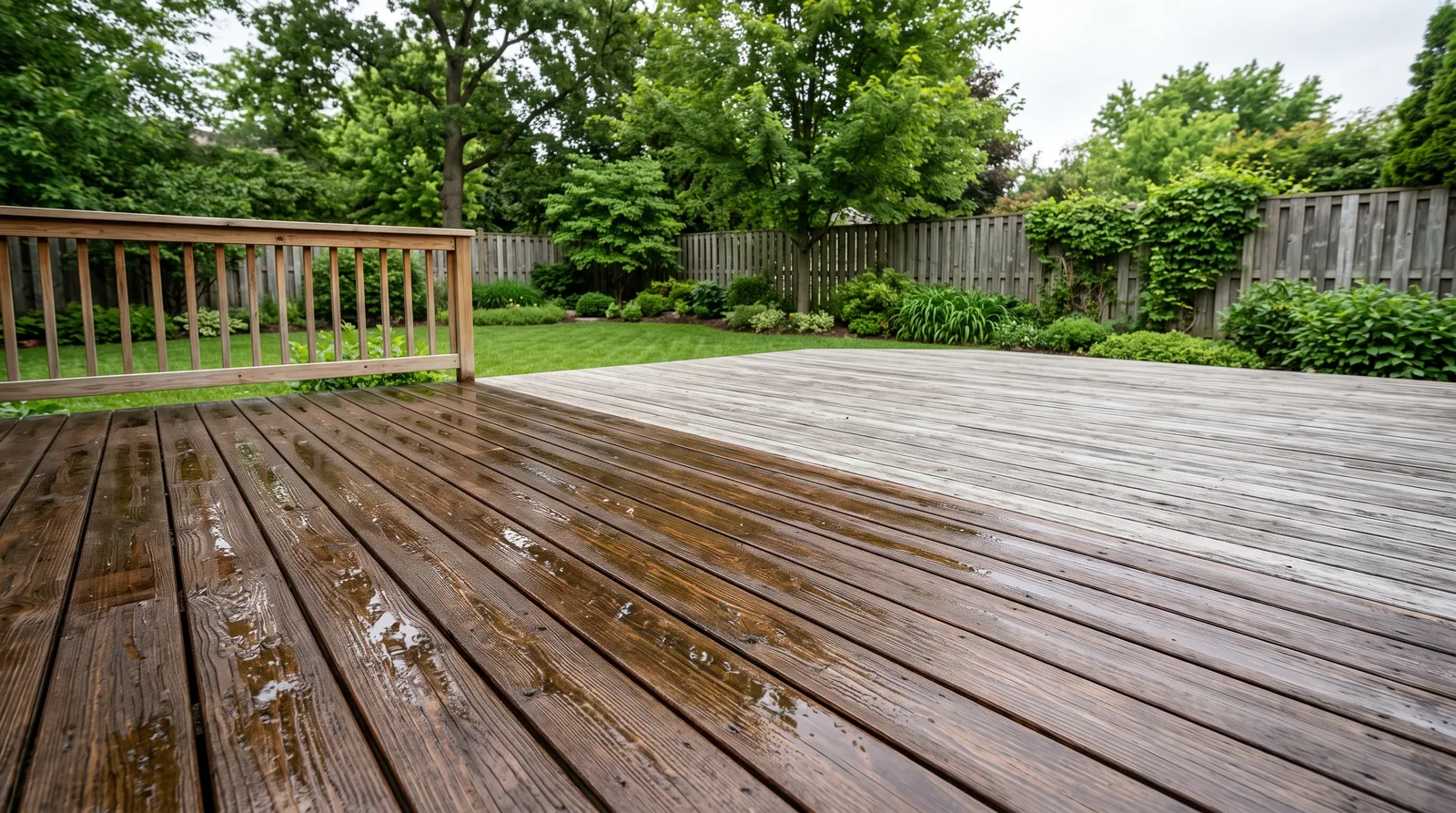
The 30-Second Answer
Both of these are clear water repellents. Neither one is a stain, and neither one stops gray. Thompson’s WaterSeal wins on decks: it holds a tighter bead through the first wet season, and the Advanced formula is rain-ready in about 15 minutes, which decides it when you get one dry Saturday in April. Olympic WaterGuard wins on fences, sheds, and dense old cedar. It costs less per gallon, it lays flatter on wood that won’t drink, and the tinted versions hold tone for the money.
At a Glance
| Thompson’s WaterSeal | Olympic WaterGuard | |
|---|---|---|
| Beading, season one, horizontal | 🟢 strongest | 🟡 fades sooner |
| Beading on vertical boards | 🟢 good | 🟢 good |
| Graying protection, clear | 🔴 none | 🔴 none |
| Graying protection, tinted | 🟡 fair | 🟢 holds tone better |
| Rain-ready window | 🟢 about 15 min (Advanced) | 🟡 a couple of hours |
| Look on dense wood | 🟡 can read shiny or blotchy | 🟢 flatter, more natural |
| Opacity range across the brand | 🟢 clear through solid | 🟡 clear plus a few tones |
| Price per gallon | 🟡 higher | 🟢 lower |
| Where you’ll find it | 🟢 HD, Lowe’s, Walmart, hardware | 🟡 mostly Lowe’s |
How to Tell What’s Already on Your Wood
Flick a cup of water across the boards and wait a minute. Beads that sit up round mean the last sealer is still working, and you don’t owe the deck anything this year. Water that soaks in and darkens the wood means the repellent is spent. Do this in four spots. Decks fail unevenly, and the boards under the grill and along the south rail always give up first.
To tell a repellent from a stain, drag a dry white rag hard across a board. A failing semi-transparent stain transfers pigment onto the rag. A clear repellent leaves it clean. If pigment shows up, you’re not choosing between these two products anymore, you’re stripping.
Water Repellency
This is the only job either product was built for. Both are water-based, both drive a wax-and-resin repellent into the top of the wood, and both bead on day one. Everything beads on day one.
Season one is where they split. Thompson’s WaterSeal Advanced holds a tighter bead longer on horizontal boards, which is the hardest test in the category. A deck takes standing water, foot traffic, sun straight down, and freeze-thaw working at the end grain. Olympic WaterGuard beads fine and starts letting water darken a walked deck sooner.
On vertical boards the gap closes to nothing. Rain hits a fence at an angle and runs off before it can soak, so the weaker repellent never really gets tested.
Winner: Thompson’s on horizontal wood. Tie on fences.
Graying and UV
Neither clear product stops graying. Say that out loud before you buy either one. Gray is UV breaking down lignin in the top few thousandths of the wood surface, and a clear coating with no pigment doesn’t block UV. Your deck goes silver in about eighteen months whether you sealed it or not. It’ll be a dry silver instead of a checked, splitting one, and that is the actual point of a repellent.
Pigment is the only thing that buys color years. Olympic’s tinted WaterGuard carries enough of it to hold a cedar or honey tone through a season and a half at a shelf price close to the clear. Thompson’s answers the same question with a different product, the Waterproofing Stain, which runs transparent through solid.
Clear against clear, both lose. Tinted against tinted at the same price, Olympic reads more like wood and less like a coating. The deck stain opacity guide covers how much pigment buys how many years, because that trade is the whole decision.
Winner: Olympic.
Application and the Rain Window
Thompson’s Advanced is rain-ready in about 15 minutes. People mock that claim, and it’s the one label claim in this category I’ll defend. It’s a thin penetrating repellent, not a film. Once it’s in the wood, a surprise shower doesn’t lift it. In the Midwest that’s the difference between sealing the deck in April and waiting for June.
Olympic WaterGuard wants a couple of hours before it can take rain and the rest of the day before you walk on it.
The method is the same for both. Pad, pump sprayer, or a synthetic brush, and back-roll or back-brush everything you spray. Spraying alone strands the repellent on top and misses the sides of the boards where water actually gets in. Back-brushing pushes it into the grain and finds the holidays. Feather the edge wherever you stop so you don’t leave a lap mark across the middle of a board. Work one full board at a time, end to end, and don’t quit halfway.
Prep is 80 percent of the result on either product, and a spent, fuzzy, over-washed deck ruins both. The pressure washer round-up for paint prep has the PSI and tip guidance.
Winner: Thompson’s, on the weather window alone.
Look on the Wood
Thompson’s Advanced can read shiny on dense wood. On old-growth cedar, on ipe, on anything that won’t drink, the excess sits on the surface and dries to a faint plastic sheen. It blotches too, wherever the board absorbs unevenly. Wipe the excess back within 10 minutes and the problem disappears. Almost nobody reads that line on the can.
Olympic WaterGuard goes on thinner and dries flatter. On dense wood it’s the safer pick because there’s less material available to strand on the surface.
On thirsty pressure-treated pine, neither one has the problem. The wood takes everything you give it and asks for more.
Winner: Olympic on dense hardwood and older cedar.
Recoat and Step-Up Path
Water repellents box you in. Once wax is in the wood, pigmented stain won’t grip it, and no amount of scrubbing changes that. You strip with a percarbonate deck stripper, neutralize with a brightener, let the boards dry three days, then stain.
Thompson’s makes that step-up easier in one narrow sense: the whole ladder is one brand. When clear stops satisfying you, the Waterproofing Stain line goes transparent, then semi-transparent, then solid, and the prep story never changes.
Recoating like-for-like is easy with either. Clean, dry, one hot coat over the old repellent while the wood is thirsty again. Don’t build mil thickness. These aren’t film-formers, and stacking coats leaves a tacky surface that grabs dirt and pollen all summer.
Winner: Thompson’s, for having somewhere to go next.
Cost, Coverage, and Availability
Olympic WaterGuard sits lower per gallon. Thompson’s Advanced runs a few dollars above it, and the 5-gallon pails narrow the gap on both. Coverage claims are identical on paper: 200 to 400 sq ft per gallon, with rough or weathered wood at the bottom of that range and smooth planed cedar at the top. Nobody hits the top number on a real deck. Budget 250 and buy the extra can.
Availability is the bigger split. Thompson’s is a Sherwin-Williams brand and sits on shelves at Home Depot, Lowe’s, Walmart, and most independent hardware stores. Olympic is PPG and is easiest to find at Lowe’s. If you’re standing in the wrong store at 7 a.m. on a Saturday with a clear forecast, that settles it.
Winner: Olympic on price. Thompson’s on availability.
Verdict by Use Case
- Pick Thompson’s WaterSeal if: horizontal deck boards, pressure-treated pine, and a forecast that gives you a few hours instead of a few days.
- Pick Olympic WaterGuard if: fence, shed siding, lattice, retaining wall. Big vertical square footage where price per board foot decides it. Also the pick on dense old cedar, where Thompson’s can strand on the surface.
- Pick the tinted version of either if: you care what the wood looks like in year two. Clear buys you nothing on color.
- It’s basically a tie when: the boards are new pressure-treated pine that shipped wet. Neither goes on until the wood dries out, and by then either one works.
- Skip both if: the deck is already gray and you want the color back. A clear repellent locks the gray in under a coating. Strip, brighten, and go semi-transparent.
Where to Shop Each Side
Most people who land on this comparison want more than a season out of the job. If that’s you, read the best deck stain round-up before you buy either can. A semi-transparent stain costs more and holds color three times as long.
Fence job? Start with paint vs stain on a fence. A clear repellent is the cheapest of the three routes and the shortest lived, and knowing that up front stops the disappointment.
Already thinking about full coverage? Solid stain vs paint on a deck is the other end of the same ladder, and it comes with peeling risk that repellents don’t have. Peeling exteriors have their own fix guide.
What’ll Bite You in Two Years
Two failures show up, and I see both every spring.
The first is the clear-sealed deck that’s silver by year two, with an owner who thinks the product failed. It didn’t fail. It was never pigmented. Repellents keep water out. They don’t keep sun off.
The second one costs real money. Someone keeps a deck on clear repellent for five or six years, gets tired of gray, and buys a semi-transparent stain. The wax in that wood rejects pigment in patches, the coat looks mottled going on, and it lifts in sheets by the following spring. Strip it properly or don’t start. That’s the bill for every easy Saturday you spent with a clear can.