Ready Seal vs Thompson's WaterSeal
Ready Seal vs Thompson's WaterSeal on decks and fences: which one lasts, which one peels, and which is worth the extra money. Jobsite verdict by use case.

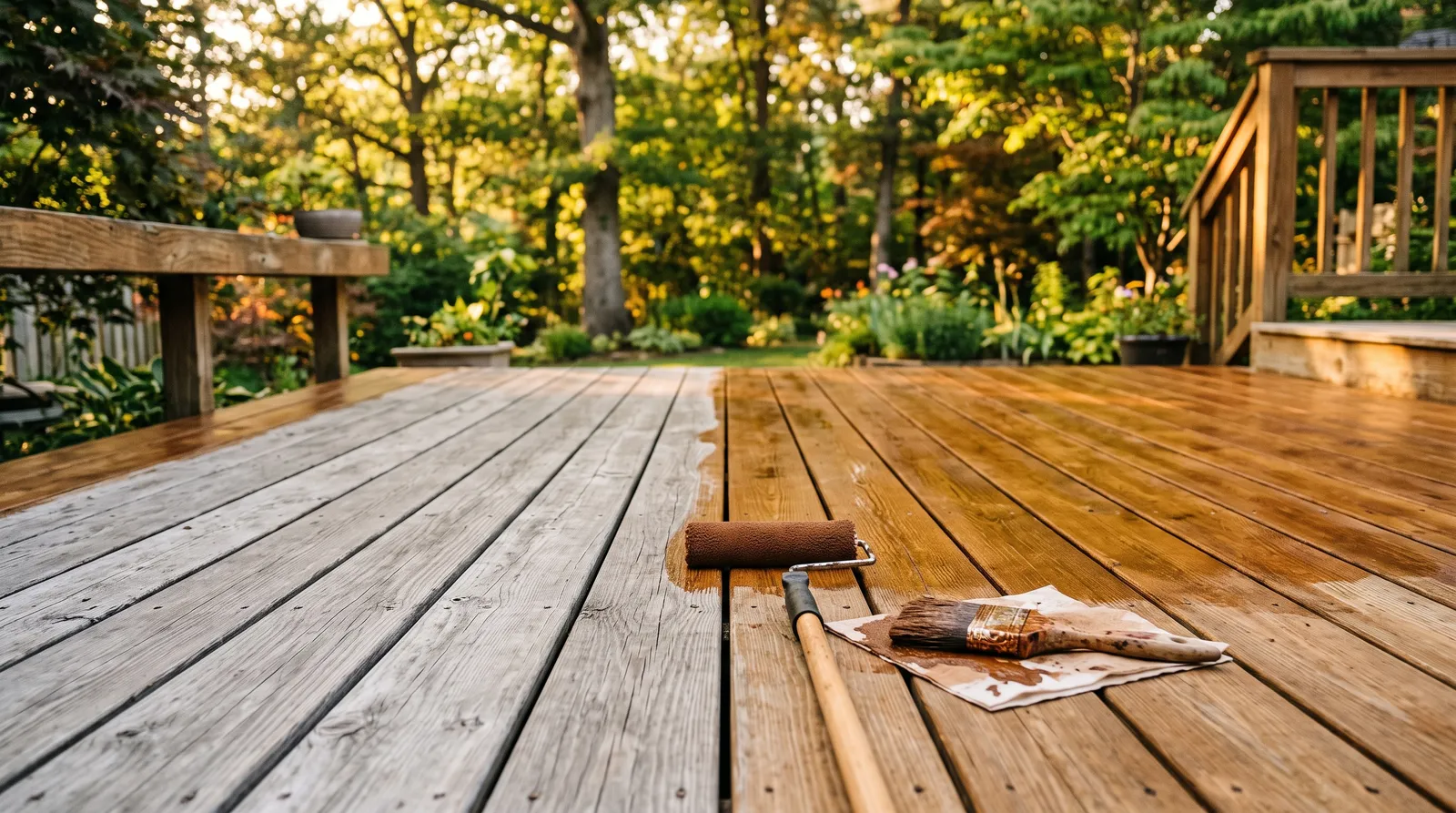
The 30-Second Answer
Ready Seal on anything you walk on. Thompson’s on the fence.
Ready Seal is a penetrating oil stain that never builds a film, so it can’t peel, and you recoat it in three years without stripping or sanding a thing. That ownership math is worth the extra $25 a gallon on deck boards. Thompson’s WaterSeal costs half as much, sits on every big-box shelf in the country, and sheds water off vertical wood just fine. On horizontal decking it quits in about two seasons.
At a Glance
| Ready Seal | Thompson’s WaterSeal | |
|---|---|---|
| Life on deck boards | 🟢 2–4 years | 🔴 1–2 years |
| Life on a fence | 🟢 4–5 years | 🟢 2–4 years |
| Lap marks / runs | 🟢 none, no wet line | 🟡 real on hot days |
| Day-one water beading | 🟡 good | 🟢 best in class |
| Recoat without stripping | 🟢 always | 🟡 clears yes, film stains no |
| Hides gray, beat-up wood | 🔴 no, semi-transparent only | 🟢 solid option available |
| Price per gallon | 🔴 $50–60 | 🟢 $25–40 |
| Availability | 🟡 lumberyards, online | 🟢 everywhere |
What Each One Actually Is
Ready Seal is an oil-based semi-transparent stain and sealer in one can, made in Texas, sold in a short color list that runs from Natural Cedar and Light Oak through Pecan, Mahogany, and Dark Walnut. No primer. No back-brushing. No wet line to chase. It soaks in, the excess doesn’t sit on top as a film, and the color trues up over about two weeks.
Thompson’s WaterSeal is a brand family, not a product. That trips people up. Under the same label you’ll find a clear Waterproofing Wood Sealer, the water-based Advanced Natural Wood Protector, a Penetrating Timber Oil, and Waterproofing Stains in transparent, semi-transparent, and solid. Most of the current line is waterborne. They behave differently from each other, and the solid stain has almost nothing in common with the clear sealer beyond the logo.
So when someone says “I used Thompson’s,” step one is asking which one.
How to Tell What Is Already on Your Wood
Sprinkle water on three spots: an open board in full sun, a board under the grill, and one along a shaded rail. Beading means the old finish still has life and neither product will penetrate. Soaking in dark means the wood is open and ready.
Then run a putty knife along an edge. If anything flakes or peels off in chips, you’re dealing with a film-forming coating (a solid stain, an old acrylic, or a deck restore product) and both of today’s contenders are off the table until it’s stripped. A penetrating finish doesn’t flake. It just fades and goes gray.
Longevity on Decking
This is the whole argument and Ready Seal takes it.
On a horizontal cedar or pine deck in zone 5, Ready Seal reads good for two to four years depending on sun exposure, and it fails politely. The color fades, the water stops beading, and that’s it. There’s no peeling, no cracking, no gray flakes stuck in the grain.
Thompson’s on the same boards is a one-to-two-season finish. The can numbers come from vertical testing where nothing pools, nothing gets walked on, and nothing bakes under overhead sun. Deck boards do all three. I see the same job every spring: a homeowner sealed the deck in May, the water was beading beautifully in July, and by the second August it’s dead flat and drinking rain.
Winner: Ready Seal.
Application Forgiveness
Ready Seal is the most forgiving exterior wood finish a homeowner can buy, and that’s not a small thing. There’s no wet line, so you can stop mid-board, take a call, and come back. No lap marks. No holidays showing up as darker stripes because you overlapped twice. Sprayer, roller, or brush all land the same. Work in direct sun if you want. Apply until the wood stops drinking and walk away.
Thompson’s needs a normal stain window: dry wood, 50 to 90 degrees, no rain for 24 to 48 hours. The waterborne stains flash fast on a hot deck, and if you’re brushing a long run of 16-foot boards in August you will see lap marks where the wet edge set up before you got back to it. Keep a wet edge and feather the edge into the next board.
Winner: Ready Seal, and it isn’t close.
Water Repellency
Thompson’s wins day one. That beading video on the box is not a lie. A fresh coat of WaterSeal makes rain stand up on the surface in fat little domes, and it does that better than Ready Seal does.
Ready Seal repels water the way oil repels water: the wood is saturated, so there’s no room for rain to get in. Beading is less dramatic. Protection is at least as good, and it stays that way longer.
By month 18 the comparison reverses. Ready Seal is still shedding. Thompson’s on a deck is usually done.
Winner: Thompson’s on day-one beading. Ready Seal on beading that’s still there next spring.
Color and Appearance
Ready Seal leaves a matte, in-the-wood look with visible grain and no plastic sheen. It also goes on alarmingly dark and stays that way for about two weeks. Every year somebody recoats on day three because they think it’s wrong, and now they’ve got a heavy, slow-drying film in the shaded corners.
Thompson’s owns the case Ready Seal can’t touch: wood that’s already ugly. A 15-year-old pressure-treated deck with mismatched replacement boards, mill glaze, and gray weathering does not look better under a semi-transparent oil. It looks like a gray deck with a tint on it. The solid Waterproofing Stain covers all of that. If you’re not sure which route your deck wants, the deck stain opacity guide walks through when to step up in opacity, and solid stain vs paint on a deck covers what happens after you go opaque.
Winner: Ready Seal on sound wood you want to see. Thompson’s on tired wood you want to hide.
Recoat and Maintenance
Ready Seal’s real selling point. Clean, dry, recoat. No stripping, no sanding, no chemical neutralizer, no scraping. Because there’s no film, coat four goes on the same as coat one, ten years later.
Thompson’s clear and transparent products recoat the same easy way. The semi-transparent and solid stains build enough mil thickness to fail as a film, and once a film starts letting go you’re into a stripper, a wire brush, and a weekend you didn’t plan on. The same failure pattern shows up on siding, which is covered in the peeling exterior paint fix.
Winner: Ready Seal.
Cost and Coverage
Ready Seal runs $50 to $60 a gallon, $190 to $240 for five. Coverage is 100 to 125 sq ft per gallon on rough-sawn lumber, up to about 175 on smooth, planed boards.
Thompson’s runs $25 to $40 a gallon, $110 to $150 for five, and claims 150 to 250 sq ft per gallon on smooth wood.
Run it on a 320 sq ft deck. Ready Seal: three gallons, roughly $165, once every three years. That’s $55 a year. Thompson’s: two gallons, roughly $70, but you’re back on your knees every 18 months, so call it $47 a year plus an extra prep-and-apply weekend in that span. Sticker price goes to Thompson’s. Cost per year is close enough to be a wash, and the labor difference decides it.
Winner: Thompson’s on price. Nobody on cost per year.
Verdict by Use Case
- Pick Ready Seal if: it’s a deck, a dock, a pergola, porch steps, or outdoor furniture. Horizontal wood, foot traffic, standing water, and you want to recoat in three years without a stripper.
- Pick Ready Seal if: you’re a first-timer working alone on long boards in July. The no-lap-mark behavior saves the job.
- Pick Thompson’s if: it’s 200 feet of fence, the budget is $150, and you need the material today from a store six minutes away.
- Pick Thompson’s if: the wood is gray, patched, and past pretty, and you need a solid stain to hide it.
- It’s basically a tie when: you’re sealing a shaded fence you’ll rebuild in five years anyway. Neither one gets stressed, and the cheaper can wins on math.
Top Picks by Side
Going penetrating oil? Ready Seal, Armstrong Clark, and TWP all live in the same category. The best deck stain round-up has the shortlist with sun-exposure notes.
Fence, not deck? Read paint vs stain for a fence before you buy anything. Painting a fence is a decision you can’t easily walk back.
Prepping first? Cleaning matters more than the stain you pick. See the pressure washers for paint prep round-up, and if you’re spraying the stain instead of rolling it, the airless sprayer picks cover which tips handle thin oil without spitting.
What’ll Bite You in Two Years
Two things. First, oily rags. Ready Seal is an oil finish, and a wadded pile of stain rags in a garbage bag can heat up and light itself on fire overnight. Lay them flat outside to dry or drop them in a metal can with water. Every year somebody loses a garage to this.
Second, the layering mistake. If you put Ready Seal over a Thompson’s solid stain that hadn’t fully failed yet, the oil sat on top instead of soaking in. It looked fine in September. Come the second spring you’ve got dark tacky patches where it pooled, gray bare wood where the old film let go, and no clean way to fix it short of stripping the whole deck back to raw. Test with a spray bottle before you buy the first gallon.