Minwax vs Varathane Polyurethane
Minwax vs Varathane polyurethane, judged on chemistry: film hardness, amber cast, open time, and recoat speed. A winner per dimension, plus who buys which.

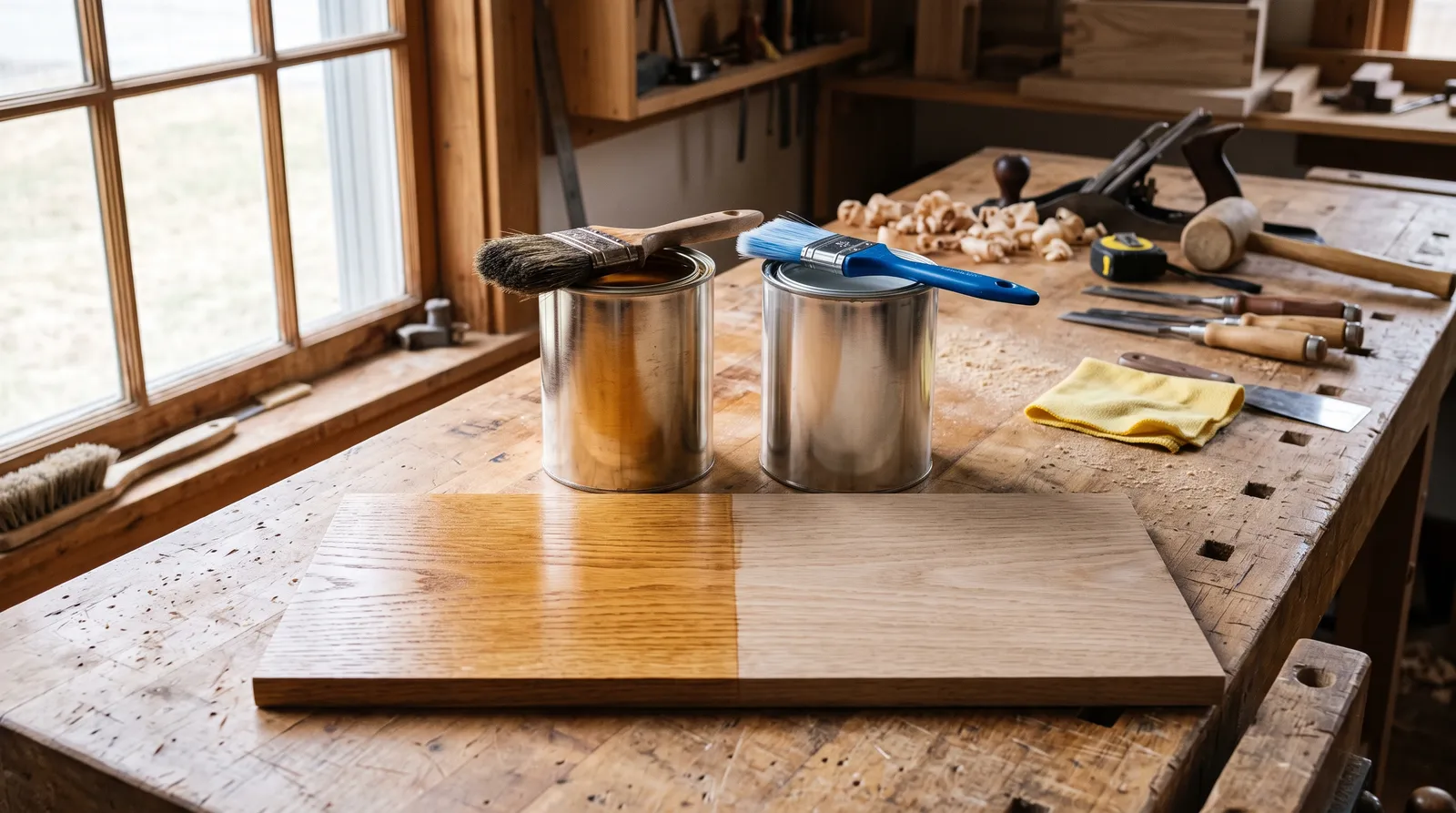
The 30-Second Answer
They sit two feet apart on the same shelf and the front labels say close to the same thing. The resins underneath do not match. Varathane runs a harder, higher-solids film that sets fast, and its Water-Based Ultimate is a genuine urethane dispersion rather than an acrylic hybrid. Minwax stays open longer under a brush, ambers warmly on oak and walnut, and comes with a stain lineup built to sit under it. Floors, tabletops, and white painted pieces: Varathane. Brushed clear over Minwax stain, or your first time with a topcoat: Minwax.
At a Glance
| Minwax | Varathane | |
|---|---|---|
| Film hardness and abrasion | 🟡 Good; Polycrylic is the soft one | 🟢 Harder, especially water-based |
| Clarity and yellowing | 🔴 Oil ambers warmly and keeps going | 🟢 Ultimate stays close to water-clear |
| Brushing behavior and open time | 🟢 Long open time, forgiving, self-levels | 🟡 Sets fast, brush marks lock in |
| Dry and recoat speed | 🟡 Oil recoat 4–6 h with a light sanding | 🟢 Oil recoat ~2 h, water-based ~2 h |
| Range, stain pairing, shelf presence | 🟢 Stains, wipe-on, spar, floor products | 🟡 Narrower, strongest at Home Depot |
| Price and coverage | 🟢 Roughly $16–22 a quart | 🟡 Roughly $20–30 a quart |
What Is Actually in the Two Cans
Neither product is polyurethane the way a chemist would use the word. Oil-based wood finish sold as polyurethane is a uralkyd: a soya or linseed alkyd with urethane linkages grafted onto the backbone. It cures by oxidative cross-linking, pulling oxygen out of the air with the help of metal driers, which is why the can warns you about rags and why a thick coat stays gummy underneath.
The ratio inside that resin decides everything. A longer-oil alkyd carries more drying oil, flows longer, ambers more, and cures softer. A shorter-oil alkyd with a higher urethane fraction sets faster and harder and gives you less time to fix a run. Minwax Fast-Drying Polyurethane sits toward the long-oil end. Varathane Premium sits toward the short-oil end and carries more solids per quart.
The water-based products are a different mechanism entirely. There is no oxidation. The binder arrives as particles suspended in water, the water leaves, and the particles coalesce into a continuous film. Minwax Polycrylic is acrylic-dominant with a urethane fraction blended in. Varathane Water-Based Ultimate is a polyurethane dispersion, urethane-dominant, and that composition is the whole reason the two feel different under a fingernail at day seven.
How to Tell What Is Already on the Wood
Find a hidden spot, a chair rail underside or the back edge of a shelf. Dab a cotton ball of denatured alcohol and hold it 30 seconds. Water-based finishes soften and go tacky. Oil-based poly ignores it. Then look at the color in raking light: an old oil poly over maple reads orange-honey, an old water-based reads pale and slightly gray.
If it still resists both tests and feels glassy and cold, you may have a conversion varnish or a factory catalyzed finish, and nothing in either brand’s lineup will bond to it without a full strip. The paint stripper round-up covers what actually cuts those.
Film Hardness and Abrasion
Varathane Premium’s higher solids and shorter oil length give it a denser film at the two-week mark. Push a fingernail into both at day ten and the Minwax gives first. By day thirty the two oil polys land close enough that a homeowner would not call it.
The water-based comparison is not close. Polycrylic’s acrylic-dominant binder is softer by design, which is part of why it brushes so easily, and it prints under a hot mug or a laptop within the first month. Varathane Water-Based Ultimate holds. On a kitchen table or a stair tread, that difference shows up in year one.
Winner: Varathane.
Clarity and Yellowing
Every oil poly ambers. The reason for that is the drying-oil fraction: as those chains oxidize and cross-link, they form conjugated structures that absorb blue light and read yellow. Minwax Fast-Drying ambers a little harder than Varathane Premium, and it keeps drifting warm for years, not months.
On red oak, walnut, cherry, and old-growth fir, that warmth is the reason people buy the stuff. On hard maple, birch, ash, or anything painted white, it is a defect. Varathane Water-Based Ultimate goes on faintly milky and dries close to water-clear, with none of the chromophore chemistry that ambers oil. Polycrylic stays clear too, but leaves a slightly cooler cast on dark stain.
Winner: Varathane.
Brushing Behavior and Open Time
Here Minwax earns its shelf space. The longer-oil alkyd keeps flowing after the brush leaves, so brush marks sink and level while you work the next section. On a six-foot tabletop that margin is the difference between a finish and a texture.
Varathane Premium starts skinning sooner. Go back into a section you laid down four minutes ago and you drag a half-set film into ridges that will still be there tomorrow. It is a fine finish, it just asks for a wet edge and no second-guessing.
Minwax Wipe-On Poly deserves its own line. It is thinned Fast-Drying Poly applied with a rag, and it removes the brush-mark problem by removing the brush. For a first-time refinisher it is the most forgiving product either brand sells. If you would rather brush, a good natural-bristle brush for oil matters more than the can does, and the paint brush round-up sorts the ones worth owning.
Winner: Minwax.
Dry and Recoat Speed
Published times, both brands, at 70°F and moderate humidity. Minwax Fast-Drying Polyurethane goes touch-dry around 2 hours and wants 4 to 6 hours plus a light 220-grit sanding before the next coat. Varathane Premium claims recoat at roughly 2 hours. Varathane Water-Based Ultimate is touch-dry in about 30 minutes and recoats at 2, which puts three coats inside a single day.
Humidity moves these numbers more than people expect. Oxidative cure slows in cold, damp air because the reaction itself is temperature-dependent, and water-based film formation stalls when the air is already saturated. In a 55°F garage in November, double everything on the label.
Winner: Varathane.
Range, Stain Pairing, and Shelf Presence
Minwax is a Sherwin-Williams brand and behaves like one. The stain deck, the gel stains, Wipe-On Poly, Polycrylic, Helmsman Spar Urethane for exterior doors, and two separate floor polyurethanes all live in the same system with cure schedules that assume each other. You can buy the whole stack at any hardware store in the country. More detail sits on the Minwax brand hub.
Varathane, part of Rust-Oleum, runs a tighter lineup with real standouts: Water-Based Ultimate, Triple Thick, and a well-regarded floor finish. Distribution is strongest at Home Depot and thinner at independents. Their stain line is good, and their Premium Fast Dry stain is the one product I would take over Minwax’s equivalent, but the ecosystem is smaller. See the Rust-Oleum brand hub and the wood stain round-up.
Winner: Minwax.
Price and Coverage
Minwax Fast-Drying Polyurethane runs roughly $16 to $22 a quart depending on region. Varathane Premium sits around $20 to $25, Water-Based Ultimate around $22 to $30, and Triple Thick can reach $34. Coverage is comparable at roughly 125 to 150 square feet per quart for a normal brushed coat.
The one place Varathane wins on cost is labor. Triple Thick’s high solids build a three-coat film in one pass, so a spindle railing that would eat a weekend in three brushed coats gets done in an afternoon. If you are spraying instead, thin according to the data sheet rather than by feel; see the notes on thinning paint and finishes and the HVLP sprayer round-up.
Winner: Minwax on the can. Varathane on total project time for complex shapes.
Verdict by Use Case
- Pick Minwax if: you are brushing oil poly over stained oak, walnut, or trim and want the warmth; you are new to topcoats and want Wipe-On Poly’s margin for error; you need an exterior door or a boat rail, where Helmsman Spar Urethane’s UV absorbers and flexible film beat anything Varathane stocks at retail.
- Pick Varathane if: the piece is painted white or finished on maple, birch, or ash and any amber shift would show; it is a floor, a stair tread, or a kitchen table; you need three coats in one day; the shape is spindles and turnings that Triple Thick can cover in one pass.
- It is close to a tie when: the project is a stained oak bookcase in a low-traffic room. Both oil polys land in the same place at thirty days and the choice comes down to whichever stain you already bought.
Top Picks by Side
Refinishing furniture either way? The furniture paint and finish round-up covers what goes under the clear coat, and the gel stain vs traditional stain comparison sorts the substrate question first.
Still deciding on the topcoat class rather than the brand? Read polyurethane vs polycrylic before you read either data sheet.
Buy the Varathane, sand between coats anyway. Fast recoat windows tempt people into skipping the 220-grit pass, and adhesion between coats of any urethane is largely mechanical.