How to Thin Paint Properly
Thin latex with water (10-15% max), oil with mineral spirits. When thinning helps, when it ruins the can, and why you should never thin Benjamin Moore Aura.

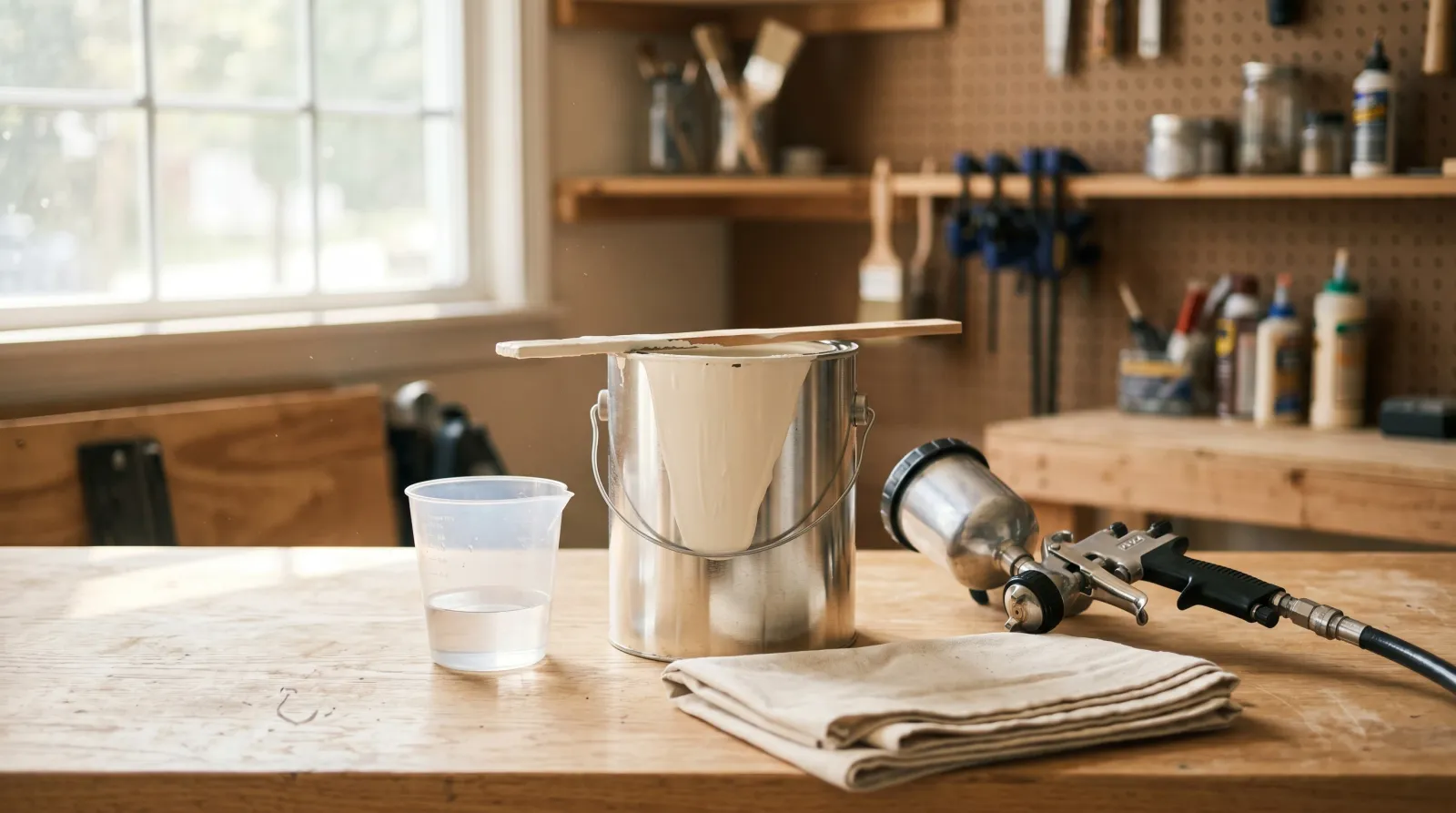
You crack open a half-used gallon of latex you bought last summer, give it a stir, and the paint coming off the stick looks more like pudding than paint. Or you load a new can into a spray gun and the tip spits and fingers instead of laying down a clean fan. Both problems point at the same thing: viscosity. The fix is thinning, and most people either skip it when they shouldn’t or overdo it when they should.
The reason for that is paint is a suspension engineered to a specific solids percentage. The binder, the pigment, the extenders, and the carrier (water or solvent) are balanced so the film forms cleanly at the label’s recommended application method. Move outside that window and the chemistry stops cooperating. Thin too much and the cured film loses hide and scrub resistance. Don’t thin enough for a sprayer and the atomization breaks down.
How to Thin Latex Paint
Stir the can for a full minute, then add clean room-temperature water a half cup at a time per gallon — about 3% — stirring and re-testing between additions until the paint runs off the stick in a smooth ribbon. Ten percent by volume (roughly 12 ounces per gallon) is the working ceiling for almost every latex, and 15% is the hard limit.
The reason to creep up on it instead of dumping water in is that you can always add more and you can never take it back out. Here’s the order that keeps you out of trouble:
- Stir before you judge. A can that sat all winter is thicker at the top than at the bottom. Stir a full minute with a stick or a drill paddle. Half the cans people thin didn’t need it — they needed mixing.
- Run the drip test. Lift the stick and watch. Paint that sheets off in a smooth ribbon and levels back into the surface is fine as-is. Paint that clings, falls in blobs, or leaves a ridge that just sits there needs thinning.
- Pour into a separate bucket. Thin a known volume, not the whole gallon. If you only need a quart for trim, thin a quart. This also leaves you an untouched can to fall back on if you overshoot.
- Add a half cup of water per gallon. That’s 4 ounces, roughly 3%, room temperature and clean. For a quart, use 1 ounce.
- Stir a full minute, then re-test. Funnel test if you have one: a cup of paint should drain through an ordinary plastic funnel in about 10 to 15 seconds. By eye, you’re looking for the consistency of heavy cream.
- Add an ounce at a time until it’s right. Re-stir and re-test after each addition. Stop at 10%. If the paint still isn’t behaving at 10%, the problem is the can, the temperature, or the tool — not the water.
- Test on scrap before the wall. A piece of cardboard or an offcut of the same substrate tells you whether hide survived the thinning. Two coats should still cover.
Because “10%” isn’t a number you can pour, here’s what each reduction actually measures out to:
| Reduction | Per gallon | Per quart | Per liter |
|---|---|---|---|
| 3% (starting point) | 4 oz / half cup | 1 oz | 30 ml |
| 5% | 6.4 oz | 1.6 oz | 50 ml |
| 10% (working ceiling) | 12.8 oz | 3.2 oz | 100 ml |
| 15% (hard limit) | 19.2 oz | 4.8 oz | 150 ml |
Measure it. A glug from the jug is somewhere between 2 and 6 ounces depending on the jug, and that spread is the difference between a can that sprays and a can that sags.
When to Thin Paint
Use it when:
- The paint sat in storage and partially skinned or thickened beyond a smooth pour
- You’re spraying with an HVLP, pneumatic, or fine-finish gun that needs lower viscosity to atomize
- Ambient temperature is in the 85-95°F range and the paint is flashing off the brush before it can level
- You’re brushing or rolling trim and need extra open time to avoid lap marks
- The label explicitly allows it (most general-purpose latex; almost all alkyd enamels)
Don’t use it when:
- The label says “do not thin” (Benjamin Moore Aura, most premium ceramic-loaded paints)
- The paint is fresh from the can and the label calls for direct application with the tool you’re using
- You’re trying to stretch coverage to save a gallon — thinning to extend the paint cuts hide and you’ll end up applying three coats instead of two
- You’re working in cold conditions below the binder’s minimum film-formation temperature; thinning makes it worse, not better
Which Solvent Goes With Which Paint
Match the carrier in the can. Water for waterborne, mineral spirits for oil. Cross them and the chemistry breaks.
| Paint type | Thinner | Maximum reduction |
|---|---|---|
| Latex / acrylic / vinyl-acrylic | Water (clean, room temperature) | 10-15% by volume |
| Alkyd / oil-based enamel | Mineral spirits or naphtha | 10% by volume |
| Waterborne alkyd | Water (check label first) | 5-10% by volume |
| Lacquer | Lacquer thinner | Per label |
| Shellac (BIN, Bulls Eye) | Denatured alcohol | 10-15% by volume |
Hot tap water is fine. Distilled water is overkill for almost every residential job. For oil, plain mineral spirits from the hardware store works. Skip the “low-odor” variant if you’re spraying — it has slower flash and can fish-eye on the second pass.
How Much to Add
Ten percent by volume is the safe ceiling for almost every latex. That’s about 12 ounces per gallon, or 3 ounces per quart. Start with half that, stir thoroughly for a full minute, and test on a scrap. If the paint still drags off the brush or spits at the gun tip, add another ounce or two and re-test. Past 15%, you’ve moved the paint out of the formula’s working pigment volume concentration. Hide drops, scrub resistance drops, and the cured film stops behaving like the paint on the label.
For sprayers, use a Ford #4 viscosity cup. HVLP wants 25 to 35 seconds; airless handles 70+ seconds and usually needs no reduction at all. The cup costs less than a roller cover and saves you from guessing. (More on what those numbers mean in paint viscosity explained.)
How to Thin Latex Paint for a Sprayer
How much you thin depends entirely on which gun you’re holding. An airless usually needs nothing; a turbine HVLP or a compressor gun almost always needs 10%. The pump does the work in an airless, so it can push full-bodied latex through a tip without help. Air-atomizing guns rely on the paint breaking into droplets on its own, and full-strength latex is too heavy for that.
| Sprayer type | Typical reduction | Notes |
|---|---|---|
| Airless (piston pump) | 0-10% | Most premium latex sprays straight from the can. Thin only if the fan tails or fingers; check the tip size first |
| Turbine HVLP | 10-15% | Or Floetrol. Target 25-35 seconds in a Ford #4 cup |
| Handheld / cup gun | 10% | Many ship with their own viscosity cup and a target time — use theirs over any general number |
| Compressor / conventional gun | 10-15% | Latex is at the edge of what these atomize well; consider a fine-finish tip instead of more water |
Two habits matter more than the exact percentage. First, strain the paint before it goes in the gun. Even a fresh can carries skin flakes and grit, and a clogged tip reads exactly like paint that’s too thick — you thin it, it still spits, and now you’ve got over-thinned paint and a clogged tip. A paper cone or a mesh paint strainer takes ten seconds. Second, test on cardboard, not the wall. Hold the gun the same distance you’ll hold it on the job and look at the edges of the fan. Coarse, sandy edges mean it’s still too thick; runs and heavy centers mean you went too far.
If the sprayed film dries with a stippled, pebbled surface, thinning is only one of the possible causes — see how to fix orange peel from spraying before you add more water.
The Floetrol Story
Floetrol is the additive most pros reach for instead of water. It’s an acrylic conditioner that extends the open time of latex paint and lowers viscosity slightly without diluting the binder concentration. You add water, you weaken the film. You add Floetrol, you keep the solids where the chemist put them and just give the paint a few extra minutes to flow and level before it sets up.
For cabinet doors, interior trim, or anywhere brush marks and lap marks would show, Floetrol is the right call. For sprayers, it cleans up atomization without thinning the paint past spec. For a hot-day exterior job where the paint is flashing before you can tip it off, Floetrol buys back the open time the heat took away. Cap is 16 ounces per gallon per the Flood Company spec, but you’ll rarely need more than 8.
There’s an oil-based equivalent called Penetrol from the same company. Same idea: extends open time on alkyd enamels without diluting the solvent ratio.
Why You Don’t Thin Aura
Benjamin Moore Aura is the paint people most often try to thin and the paint that punishes you for it. Aura uses Gennex colorant, a proprietary in-can tint system, and a waterborne resin loaded heavily with pigment. The formula was engineered to be applied straight from the can at full solids. Add water and three things happen in sequence: the Gennex colorant breaks suspension and you get streaks of pure tint, the matte chemistry that survives a wipe-down loses uniformity, and the high pigment volume concentration drops past the point where two coats cover.
The same rule applies to Aura Bath & Spa, Aura Exterior, and most ceramic-loaded premium paints (Behr Marquee, SW Emerald in some sheens). If the label says “do not thin,” the chemist meant it. Stir Aura, don’t dilute it. If it’s coming off the brush thick on a hot day, run a fan in the room or add a small amount of Floetrol — half what you’d add to a normal latex. Water is the wrong tool here.
Common Mistakes
- Thinning to stretch coverage. Adding water to get a sixth wall out of a gallon cuts hide. You apply three coats instead of two and end up using more paint, not less.
- Mixing water into oil-based. The paint seizes, separates into curds, and won’t lay down. Throw out the can; you can’t recover it.
- Skipping the stir before testing. A can that looks thick on the surface may have thinner paint underneath. Stir for a full minute (or box two gallons together — see boxing paint) before deciding whether it needs anything at all.
- Thinning Aura, Marquee, or any “do not thin” premium. Save the can or use Floetrol sparingly. Water ruins the film.
- Adding solvent by eye instead of by volume. A glug from the jug isn’t a measurement. Use a marked cup; the difference between 8% and 18% is the difference between a usable can and a wrecked one.
- Pouring leftover thinned paint back into the full-strength can. Now the whole gallon is off-spec and you have no reference batch. Keep thinned paint in its own labeled container, note the date and the percentage on the lid, and use it within a few months — extra water shortens the shelf life the preservative package was dosed for.
Where to Buy
Water is free. Mineral spirits, naphtha, and Floetrol are stocked at every hardware store and on Amazon. The viscosity cup, if you spray often enough to justify one, runs $15-25. For the deeper picture of why thinning works at all (what the binder is doing while you mix water in), see what is paint film formation and what is the binder in paint.
Ask a Question