What Is Boxing Paint? (And Why It Matters for Color Consistency)
Boxing paint means pouring multiple cans of the same color into a 5-gallon bucket and stirring them into one batch. Here's why it saves a job.

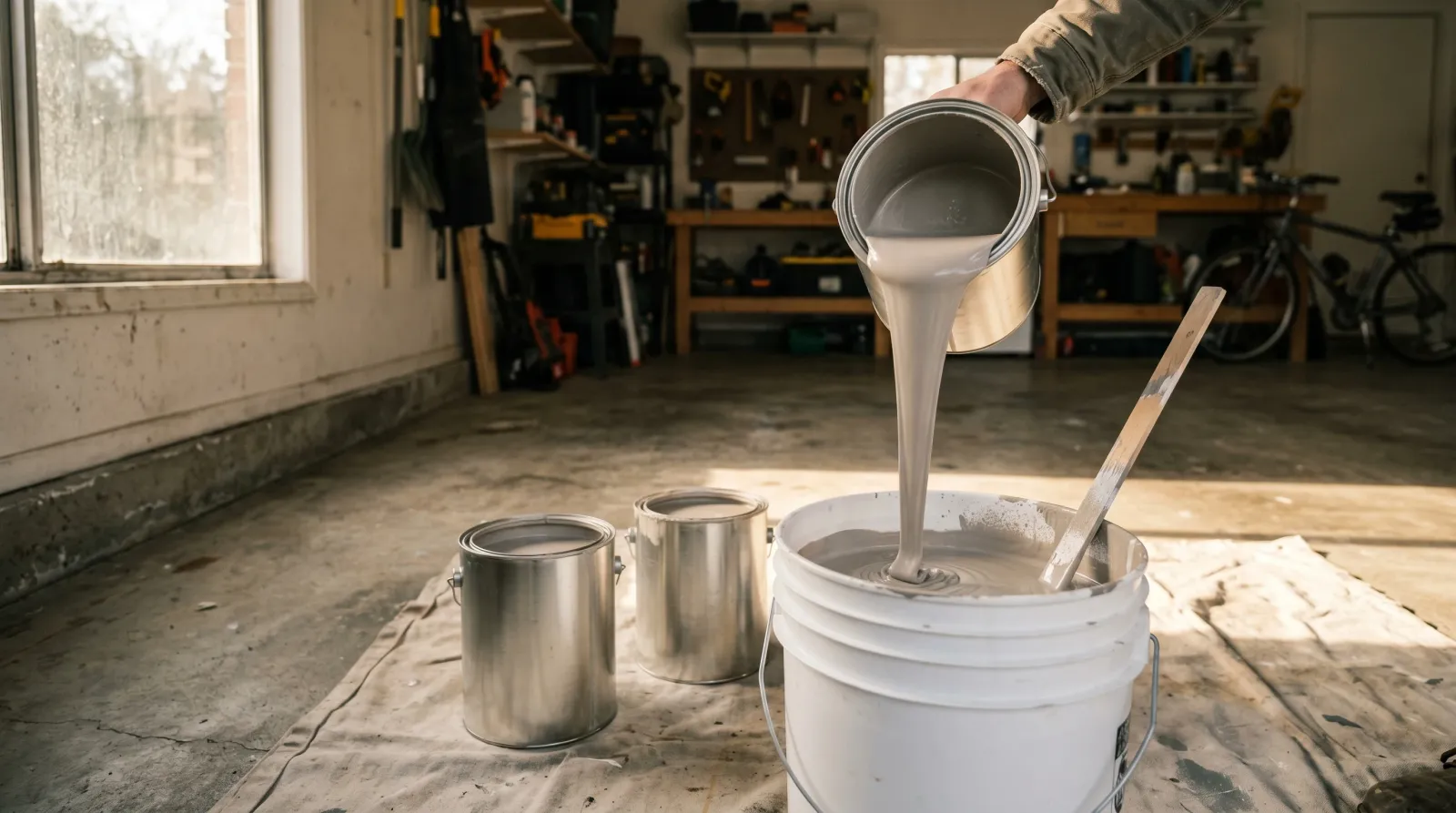
Boxing paint is pouring two or more cans of the same color into one larger container (usually a clean 5-gallon bucket) and stirring them into a single batch before you start rolling. The reason is simple. Two gallons of the same SKU tinted at the same store on the same day aren’t exactly the same color. Factory base varies by 1-3% between batches, the tinting machine dispenses colorant in fractions of an ounce, and the difference shows up on the wall under raking light. Boxing averages the variation out across the whole job so the seam between can one and can two doesn’t read as a stripe down your living room wall.
That’s the rule. Box every job over one gallon. Here’s why.
Why Factory Batches Vary
The white base in a gallon of paint is mixed in a factory tank that holds thousands of gallons. Each batch is within spec, but spec is a tolerance, not a target. Titanium dioxide loading, resin solids, and base whiteness shift slightly batch to batch. When the store’s machine adds 4 fluid ounces of colorant to two different gallons of base, you get the colorant on top of two slightly different starting points.
The tinting machine adds its own variance. Dispense heads wear, colorant cartridges run low, and a 1/128 oz dispense is the floor of the machine’s accuracy. On a saturated color, two consecutive gallons off the same machine can drift visibly. On a near-white, the drift hides. On a mid-tone gray or a saturated blue, the drift is the whole job.
Every brand has this. BM, SW, Behr, Kompozit, F&B. Same physics. The fix is on your end.
When You Box and When You Don’t
Box every time:
- Any wall or ceiling job using more than one gallon of the same color.
- Tinted primer when the color shows through (gray-scale tint under a saturated finish).
- Whole-house exteriors. The raking sun on siding is the worst possible light for seam reveal.
- Any deep or saturated color, even on a single wall. Two gallons of a deep navy show variation a near-white wouldn’t.
- Trim if it spans more than one can and the trim runs continuously across rooms.
Don’t bother:
- Single-gallon jobs. There’s no other can to box with.
- Touch-ups months later. The wall has already aged; boxing a fresh can into a leftover doesn’t help.
- Two cans going on two different walls separated by an inside corner. The corner breaks the eye. Variation can’t read as a seam if there’s no continuous surface.
How Boxing Compares to Just Stirring Each Can
| Box every can | Stir each can separately | Pour-and-go | |
|---|---|---|---|
| Color consistency wall to wall | tight | drifts gallon to gallon | drifts and visible seam |
| Time added | 10 minutes per batch | none | none |
| Equipment needed | 5-gal bucket, mixing stick | stir stick | nothing |
| Risk of mid-wall flash | low | medium | high under raking light |
| Used by pros on whole-house | always | never | hack work |
For the related rule on stopping mid-wall, see the cut-in technique guide. For the visible-seam problem boxing prevents, see what flashing is.
How to Actually Box Paint
Five minutes per batch. Worth every second on a job over two gallons.
Step 1 — Get a clean 5-gallon bucket. New is best. If reused, the bucket has to be paint-free and dust-free. A dried ring of old paint sheds into your fresh batch and you’ll find the chunks on the wall. A bucket grid for the roller can stay in the same bucket once you’re done boxing.
Step 2 — Stir each can individually first. The pigment settles in the can on the shelf, and the store’s shake doesn’t always recover a can that’s been sitting for a week. Open each can, give it 30 seconds with a stir stick, scrape the bottom corners. Pigment lives in the corners.
Step 3 — Pour all cans into the bucket. Slow ribbon, not a slop. Three gallons fits comfortably in a 5-gallon bucket with room to mix. If you’ve got six gallons, do it in two batches of three.
Step 4 — Mix the bucket. Three minutes with a stir stick, or 60 seconds with a drill-mounted paint mixer at low speed. High speed whips air into the paint and you’ll roll bubbles onto the wall. Scrape the bottom of the bucket. Pigment hides there too.
Step 5 — Pour the boxed paint back into the original cans, or work from the bucket. Pouring back lets you reseal between days. Working straight from the bucket is faster on a same-day job. Either way, the cans now all hold the same color.
Common Mistakes
- Boxing only two of three cans. You used can one, started losing track, opened can two without boxing it, and finished can three on its own. The seam shows up between can one’s section and can three’s section. Box at the start. All cans at once.
- Using a dirty bucket. Dust, drywall mud crumbs, or last week’s primer in the bottom corners ends up in your finish. Pros keep one bucket per finish category — one for whites, one for colors, one for primer. None for both.
- Whipping the mix with a high-speed drill. Air bubbles ride the roller onto the wall and pop into pinholes you’ll see for the life of the paint. Slow drill or hand stir.
- Skipping the box on tinted primer. The primer is what the finish coat sees. Uneven primer color flashes through one coat of finish on any saturated color. Box the primer too.
- Boxing across brands or stores. Two gallons of “Repose Gray” from two different SW stores aren’t the same. The colorants are blended differently, the bases come from different inventory. Boxing them makes a hybrid you can never reorder. One store, one trip, one batch.
What Boxed Paint Looks Like on the Wall
There’s nothing to photograph. That’s the point. A boxed job looks like one continuous color across every wall the same coat touches. An un-boxed job shows a faint vertical band wherever can one met can two. Visible the first morning the sun hits the wall through a side window, invisible at noon when the light is flat. The contractor’s term for the band is a flash. The homeowner’s term is “what’s wrong with that wall.”
Where to Buy the Bucket
Any paint store or home center sells empty 5-gallon plastic buckets for $4-7. Get a lid. A lid lets you reseal the boxed paint overnight without crusting the surface. A bucket grid for the roller adds another $5. For paint picks, see the interior paint round-up and the primer guide for tinted primer rules.
Related
One last thing that’ll bite you in two years: if you didn’t box and the seam showed up under raking light on a south-facing living-room wall, touch-up doesn’t fix it. The touch-up can is a fourth batch with its own variation, and now you’ve got three colors on one wall instead of two. The only fix is rolling the whole wall corner to corner with a new boxed batch — which means buying enough paint to recoat the wall, mixing it together, and starting over. Box the first time. Always.
Ask a Question