What Is Paint Flashing? Uneven Sheen Explained
Paint flashing is uneven sheen across one wall, caused by uneven substrate absorption while the latex film forms. Here is the chemistry, the four variants, the primer that prevents it, and the fix.

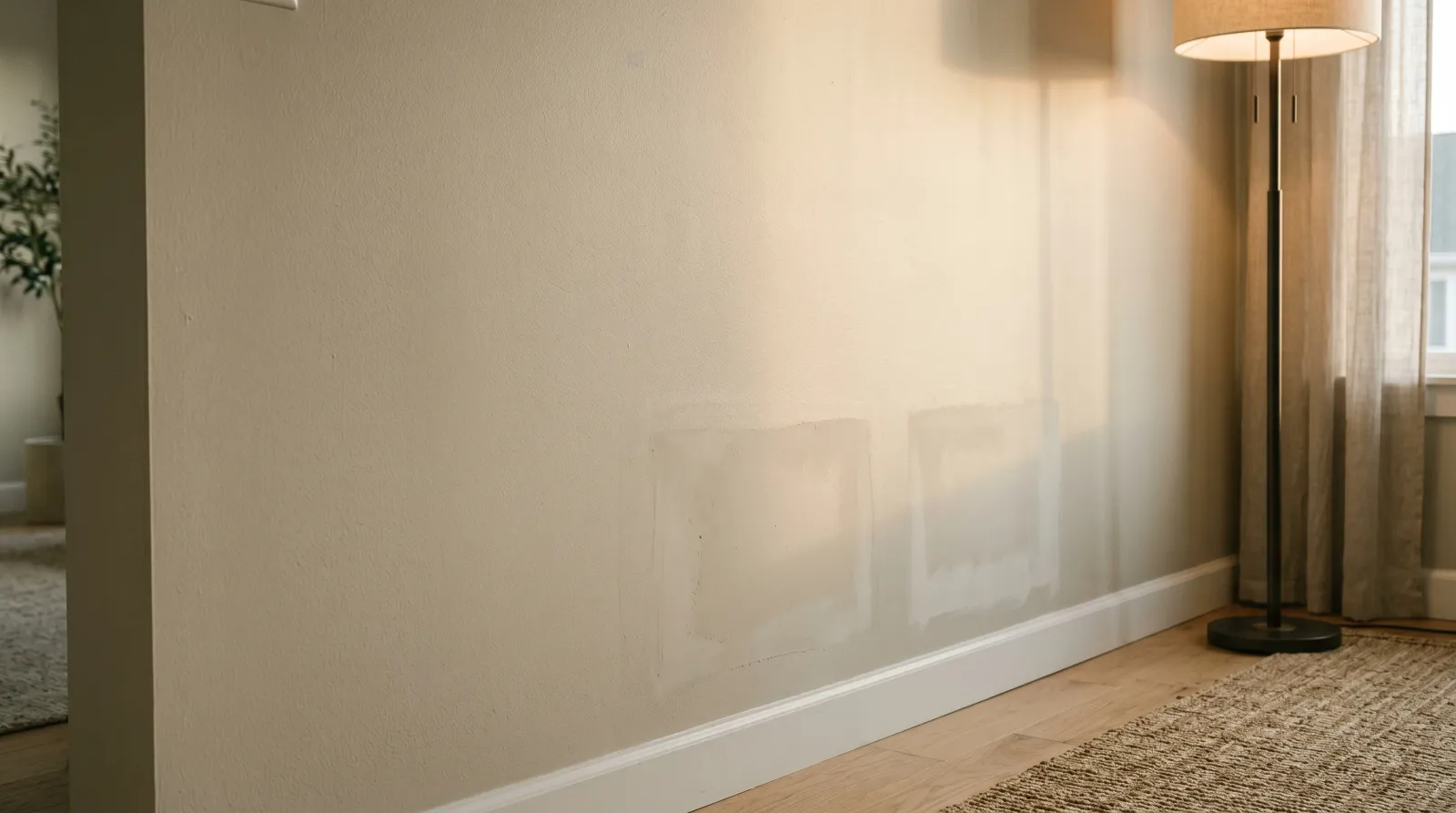
Most people notice it without naming it. You finish a wall, the room looks fine, then a floor lamp goes on at night and three duller rectangles stare back at you from a few feet away. That is paint flashing, and it is almost always a story about the substrate, not the paint. The technical definition is short: flashing is uneven sheen across a continuous painted surface caused by uneven absorption during film formation. A latex film loses about 60% of its water in the first hour. Where the wall drinks faster, the binder gets less time to coalesce, and the dry film reflects light differently from the rest.
The key thing to hold onto is that the paint above the flashed area and the paint above the rest of the wall are chemically identical. Same can, same roller, same color reading on a spectrophotometer. What differs is the optics of the cured film — micron-scale roughness from binder particles that did not fully fuse, scattering light at a different angle than the smoother film next to it. That is why flashing always shows up under raking light and disappears under flat overhead light. You are seeing surface texture, not pigment.
Why It Happens, in One Paragraph of Chemistry
Modern wall paint is a waterborne dispersion. Pigment, binder (usually an acrylic or vinyl-acrylic emulsion), extenders, and water. When you roll it on, two things happen in sequence: the water evaporates, and then the binder particles, now packed close together, soften and fuse into a continuous film. That second step is called coalescence, and it needs both time and a controlled drying rate. Pull the water out too fast and the binder particles freeze in place before they have flowed together. The film is still there. It is still the same color. But the surface is microscopically rougher, and rougher surfaces read duller. A porous patch in the wall is a sponge for that water. So the film over the patch coalesces less, and the sheen reads lower. That is the whole mechanism, and the film formation explainer walks the same two stages in more detail.
It helps to know why joint compound is such an aggressive sponge. Dried compound is almost entirely extender — calcium carbonate, mica, talc — with a tiny amount of binder holding it together. In coatings terms it sits far above its critical pigment volume concentration, which means the dry material is a network of packed particles with air gaps between them. Aged painted drywall next to it is a sealed acrylic film with essentially zero suction. You are asking one coat of paint to dry at the same rate over a sponge and over a plastic sheet. It cannot.
The Four Variants You Will Actually See
Flashing has the same chemistry every time, but it shows up in four flavors depending on what made the substrate non-uniform.
Primer flashing. The original sin. Someone spot-primed three drywall repairs instead of priming the whole wall, and the patched areas now read duller than the field. Joint compound is far more absorbent than aged painted drywall, so the topcoat dries unevenly across the seam. This is the most common variant on a repaint and the easiest to predict — anywhere fresh mud meets old paint without a unified primer underneath, you will see it.
Patch flashing. Adjacent to primer flashing but a step worse. The repair itself was primed, but the primer chosen was the wrong porosity match. A high-build drywall primer over old eggshell, or a thin sealer over fresh mud, still leaves a porosity gradient that the topcoat exposes. The substrate looks ready. It is not. If the patch also reads different in texture rather than only in sheen, you are looking at a second problem stacked on top — see texture mismatch after patching.
Water-stain flashing. Different mechanism, same outcome. A water stain, a degreaser ring around a switch, or a nicotine band along the ceiling line dissolves into the wet topcoat. The pigment in the stain migrates up through the film as it dries and re-deposits at the surface, where it scatters light differently than the unstained zone next to it. The paint coalesces normally. The optical surface is just contaminated. People often diagnose this as flashing and then add a second coat of finish paint, which makes it worse, because more solvent means more dissolution. The fix is a shellac or oil-based stain-blocker between the wall and the topcoat.
Application flashing. Nothing wrong with the wall at all — the film thickness is just uneven. Brushed cut-in lines around the ceiling and corners are thicker and smoother than the rolled field, so a band of extra sheen frames the wall. Painters call it picture framing. It is the same family as lap marks, where a roller passed over paint that had already started to set. Rolling the cut-in band while the brushed edge is still wet, and back-rolling anything sprayed, closes most of it.
Flashing vs the Things It Gets Confused With
| What you see | Real name | Root cause | Does more paint fix it? |
|---|---|---|---|
| Dull patches over repairs | Flashing | Uneven substrate porosity | Only after sealing |
| Shiny band at ceiling and corners | Picture framing | Thicker brushed film vs rolled field | Yes, one full rolled coat |
| Streaks along roller overlaps | Lap marks | Rolling into paint that had begun to set | Yes, one wet pass |
| Missed thin spots, visible only at an angle | Holiday spotting | Under-loaded roller | Yes |
| Shiny scuffs where furniture rubs | Burnishing | Low-binder flat polished by friction | No, needs a higher-binder paint |
Why Sheen Makes It Louder
Flat paint hides most flashing because flat paint is already scattering light in every direction. There is no gloss differential to catch. The numbers make this concrete. Measured at 60 degrees, a flat reads roughly 0–10 gloss units, eggshell 10–25, satin 25–35, and semi-gloss 35–70. Uneven coalescence over a porous patch can pull the local reading down by four or five gloss units. On a 5 GU flat that drop is invisible — there is nowhere to fall. On a 28 GU satin it is a visible dead rectangle from across the room, because the eye compares specular highlights, not absolute brightness.
That is the practical rule buried in the sheen guide: the higher the sheen you choose, the more prep the wall owes you. A bathroom or kitchen in satin is not just a paint decision, it is a substrate budget decision.
What This Means When You Actually Buy Paint
Here is where the chemistry turns into a shopping list.
Buy the primer as a sealer, not as an extra coat of paint. Those are different jobs, and the primer vs sealer comparison is worth five minutes if you have never separated them. A sealer’s entire purpose is to kill suction so the topcoat dries at one rate everywhere. Coverage numbers tell you which product is doing that job: a PVA drywall primer like KILZ PVA or Glidden PVA lists roughly 300–400 sq ft per gallon, and the spread drops toward the low end on fresh compound precisely because the compound is drinking it.
| Substrate you are covering | Primer type | What it does about flashing |
|---|---|---|
| New drywall, full skim coat | PVA drywall primer | Cheapest way to equalize suction across paper and mud; poor adhesion over gloss |
| Patched wall, mixed old paint and new mud | Multi-purpose acrylic (Zinsser Bulls Eye 1-2-3, Benjamin Moore Fresh Start, Behr Multi-Surface) | One porosity across the whole wall, sticks to both halves |
| Water, tannin, smoke, or grease stains | Shellac primer or an oil stain-blocker | Locks the stain so nothing migrates up through the topcoat |
| Torn drywall paper, chalky old surface | Penetrating problem-surface sealer | Binds the loose face and stops runaway absorption |
For stain-driven flashing specifically, the stain-blocking primer round-up and the BIN vs 1-2-3 comparison cover the choice between shellac and water-based, which is the decision people most often get backwards. The general primer round-up is the broader map.
Ignore “paint and primer in one” for this problem. The claim is real but narrow: enough binder to bond to a sound painted surface without a separate primer. It says nothing about sealing bare compound. Over patchwork it is still one coat of paint hitting two different porosities.
Buy enough paint to finish each wall in one wet pass. Most interior wall paint spreads 350–400 sq ft per gallon, which lands about 4 mils wet and roughly 1.5 mils dry at typical volume solids. Running out mid-wall and reloading twenty minutes later builds a visible seam. Buy the extra quart.
Keep the leftover from the same batch, and give the wall time. Latex keeps coalescing and hardening for two to four weeks after it stops feeling wet, which is the whole point of dry time vs cure time. A touch-up made a month later out of a fresh can rarely matches, even in the same color and sheen.
The Fix, in Plain Terms
Prime uniformly. That is the entire takeaway, and it is the thing that gets skipped on almost every flashing call.
If you are repainting a room with skim-coat repairs, do not spot-prime. Prime the whole wall, edge to edge, with a single product at a single porosity. A multi-purpose acrylic primer over drywall and old paint will give you a unified substrate the topcoat can land on without negotiating. If the wall has stain history, spot-prime the stained zones with a shellac primer first, then roll the wall in the multi-purpose product over the top so the porosity matches everywhere. Then a full topcoat in one wet pass, corner to corner, no spot-touching halfway through. Keep the room between 50°F and 85°F while it dries — below 50°F coalescence stalls and you will manufacture flashing out of temperature alone.
One more thing worth knowing before the drywall crew leaves. Level 4 finish leaves compound only at seams and screws; Level 5 adds a skim coat over the entire face so the whole wall is one material. If the room has big windows, long sightlines, or anything above eggshell on the walls, Level 5 is the cheapest flashing insurance there is, and it costs less than repainting.
For the symptom-side decision tree — what to do when you already have flashing on a wall — see how to fix flashing on walls. For the chemistry of why primer matters at all, the primer explainer is the next read. The shortest version of all of this is one sentence. Flashing is not a paint problem. It is the wall asking you to give the film something uniform to form on.
Ask a Question