Gel Stain vs Traditional Liquid Stain: Which Belongs on Your Project
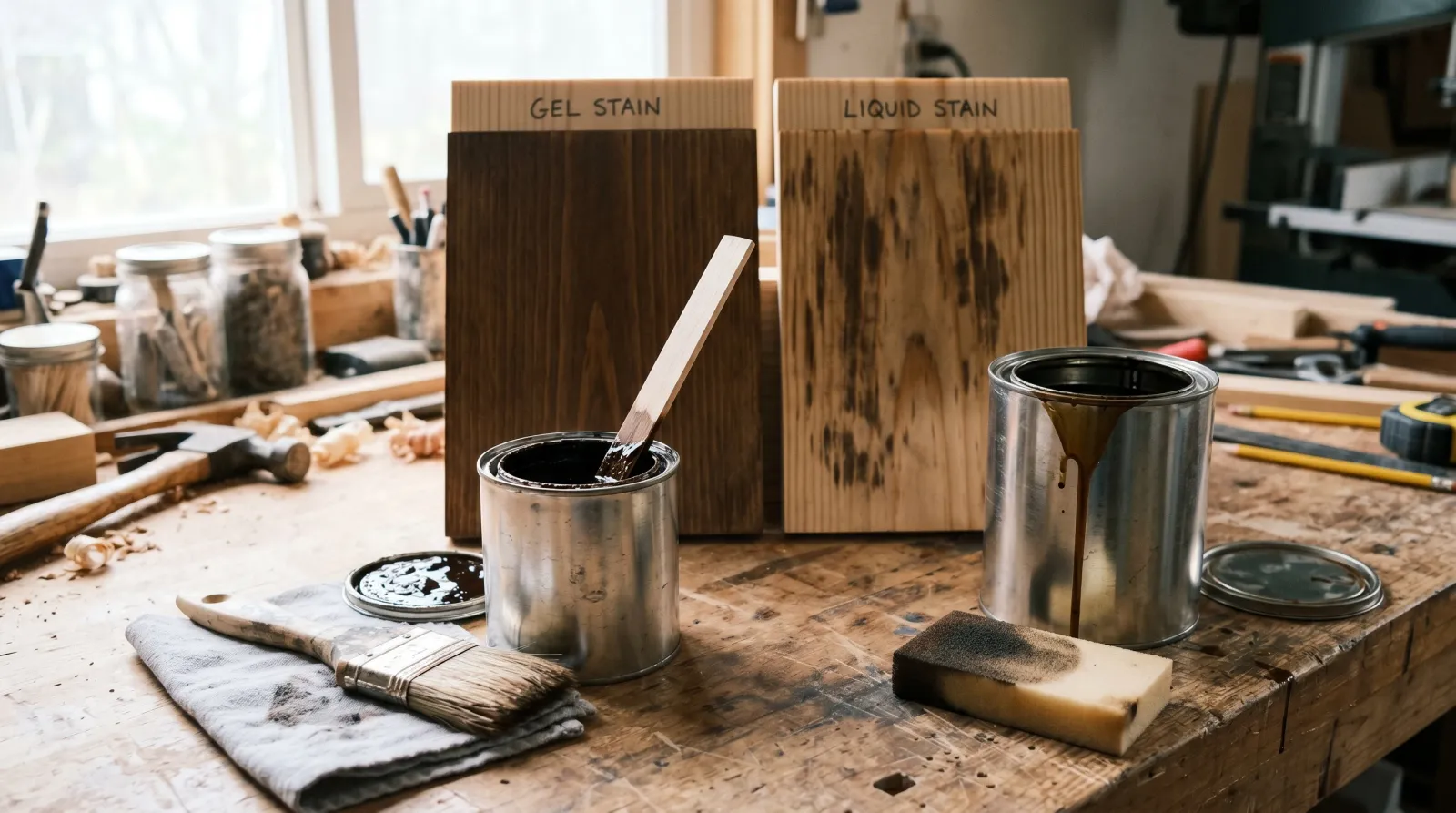
Gel sits on the surface and gives even color on blotch-prone softwoods. Liquid penetrates and reveals grain. The wood you're staining decides the winner.

The 30-Second Answer
Gel stain sits on the wood. Liquid stain soaks into it. That’s the whole comparison.
Pine, birch, maple, alder, and most cabinet doors built since 1995: use gel. Those woods drink stain unevenly and turn blotchy with liquid, no matter how careful you are. Gel doesn’t penetrate, so it can’t blotch.
Oak, walnut, cherry, mahogany, bare cedar: use liquid. Open-pore hardwoods reward penetration. Gel mutes the grain you actually paid for.
Restaining over an old finish without stripping: gel, every time. Liquid won’t bond.
At a Glance
| Gel stain | Liquid stain | |
|---|---|---|
| Consistency | Pudding-thick | Watery |
| Where it sits | On the surface | Inside the wood fiber |
| Penetration | None to ~1 mil | 4-8 mils on softwood |
| Blotch on pine | None | Almost guaranteed |
| Grain reveal on oak | Muted | Deep |
| Drip on vertical surfaces | None | Constant |
| Works over old finish | Yes | No |
| Touch-dry | 8-12 hours | 1-4 hours |
| Recoat | 24 hours | 2-4 hours |
| Coverage | 50-75 sq ft per pint | 125-175 sq ft per pint |
| Common example | General Finishes Gel Stain | Minwax Wood Finish |
How to Tell Which One You’ve Got in the Can
Open the lid and stir. If the stir stick stands up on its own, it’s gel. If the stick falls over and the stain runs off it like coffee, it’s liquid.
The can shape gives it away too. Gel ships in short squat half-pint or quart cans because it doesn’t pour. Liquid ships in tall slim quarts because it does.
Penetration vs Surface Coat
The mechanical difference drives everything else.
Liquid stain is a pigment-and-dye mix carried in mineral spirits or water with very low viscosity. Brush it on bare wood and capillary action pulls it 4-8 mils into the fiber. The pigment lands wherever the carrier went. On open-pore species the reach is even and deep. On softwoods with mixed soft early-wood and hard late-wood, the soft bands suck up two to three times more stain than the hard bands. That’s blotch.
Gel stain is the same pigment system suspended in a thickened urethane or alkyd binder. It has the viscosity of toothpaste. Wipe it on and almost nothing soaks in. It cures into a thin pigmented film that lives on top of the wood, not inside it. Pine can’t blotch because pine never gets to drink the stain.
Winner: Liquid on grain reveal. Winner: Gel on consistency across the surface.
Blotch Control on Softwoods
This is why gel exists.
Stain pine with Minwax Wood Finish straight from the can and the result is a streaky mess. Dark patches where the early-wood drank too much, pale patches where the late-wood resisted. Pre-stain conditioner from the same brand helps. So does washcoat-then-stain. Both add a step.
General Finishes Gel Stain on the same pine board reads as a uniform color from edge to edge. No conditioner, no washcoat, no test panel sweating. Wipe on with a rag, wipe off the excess, done.
The same logic applies to birch (cabinet plywood), maple (kitchen cabinets), alder (replacement doors), and any factory-finished cabinet door where you don’t actually know what’s under the topcoat.
Winner: Gel. Decisively.
Application
Liquid is faster and messier. Gel is slower and cleaner.
Liquid stain wants a foam applicator pad or a natural-bristle brush. Flood the surface, wait 3-5 minutes for the pigment to settle into the fiber, wipe off the excess with a clean rag. Stop letting it sit and you get hard streaks; let it sit too long and the excess sets up tacky. Vertical surfaces drip the whole time you’re working.
Gel goes on with a rag, a chip brush, or a foam pad. Apply a thin coat. Wipe off the excess with a clean rag. It doesn’t drip on vertical work because it doesn’t run. No timer to watch — the film thickness decides the color, not the dwell time. Want darker? Apply a second coat after 24 hours.
The trade-off: gel covers about half as much per pint. A pint of Minwax Wood Finish does a small dining table; a pint of General Finishes Gel Stain does the same table only if you stretch.
Winner: Gel on forgiveness. Winner: Liquid on speed and coverage.
Grain Reveal
The look you get from oil-based liquid stain on red oak is the reason people stain wood in the first place. The pigment sits inside the open pores; light hits the surface, refracts through the cell walls, bounces off pigment at varying depths. The grain reads three-dimensional under raking light. The wood looks alive.
Gel stain can’t do that. The pigment is in a film on top of the wood. The grain shows through because the film is thin, but the depth is muted. On closed-grain species (maple, cherry, birch) where neither finish gets into the wood much anyway, the gap closes. On open-pore oak and walnut, liquid wins clearly.
This is also why gel is the right answer for fiberglass doors, MDF profiled trim, and laminate cabinetry: those surfaces have no grain to reveal in the first place. Gel gives them the look of stained wood without needing real wood underneath.
Winner: Liquid on open-pore hardwoods. Tie on closed-grain and non-wood substrates.
Coverage and Cost
A pint of liquid stain runs $10-14 and covers 125-175 sq ft. A pint of gel runs $14-18 and covers 50-75 sq ft. Per square foot, gel costs roughly twice as much.
For a six-door kitchen cabinet refresh, that’s a quart of gel ($35-40) versus a half-pint of liquid ($8-10). Real money, but not project-killing money. The cost is bought with the steps you don’t have to do — no conditioner, no test board sweating, no fixing blotch after the fact.
Winner: Liquid on raw cost. Winner: Gel if you count the prep step it eliminates.
What’ll Bite You in Two Years
Gel stain over a glossy old finish without a scuff-sand will peel at the corners and the edges of doors within a year or two. Gel bonds to the underlying finish, but only if the underlying finish has tooth. Skip the 220-grit scuff and the bond fails right where the door gets touched the most.
Liquid stain on softwood without conditioner won’t peel, but the blotch you accept on day one gets worse-looking with age, not better. The dark patches darken further under any wipe-on topcoat. There’s no fix short of stripping back to bare wood and starting over.
Verdict by Use Case
- Pick gel stain if: the wood is pine, birch, maple, alder, or unknown; you’re restaining over an existing finish without stripping; the surface is fiberglass, MDF, or laminate; the work is vertical (doors in place, trim on the wall) where drips would ruin a liquid job.
- Pick liquid stain if: the wood is bare open-pore hardwood (oak, walnut, cherry, mahogany) or bare cedar; you want maximum grain depth under raking light; the project is horizontal (table tops, deck boards, floors) where penetration matters more than drip control.
- It’s basically a tie when: the substrate is closed-grain hardwood like maple or birch under a polyurethane topcoat. Either stain tints the wood; the topcoat does the protection. Pick the one you have on the shelf.
Top Picks by Side
Going with gel? General Finishes Gel Stain is the category default — oil-based, available in twenty-plus colors, the standard reference for cabinet refreshers and door projects. Old Masters Gel Stain is the other respected option.
Going with liquid? Minwax Wood Finish is the shelf standard for interior work — oil-based, every hardware store carries it, dries fast enough to topcoat the same day. For exterior wood the category split is different; see the best wood stain round-up for project-by-project verified picks.
Related
- Paint vs stain — when staining is the right call at all
- Water-based vs oil-based stain — the chemistry comparison underneath both gel and liquid
- Best wood stain — verified picks across species
- Bare interior wood — prep system for new wood
- Laminate furniture — the substrate where only gel works