General Finishes Milk Paint vs Traditional Milk Paint
GF milk vs real milk paint, tested on durability, finish, and cost. One is an acrylic in a milk-paint name; the other is a powder you mix. Here's which to buy.

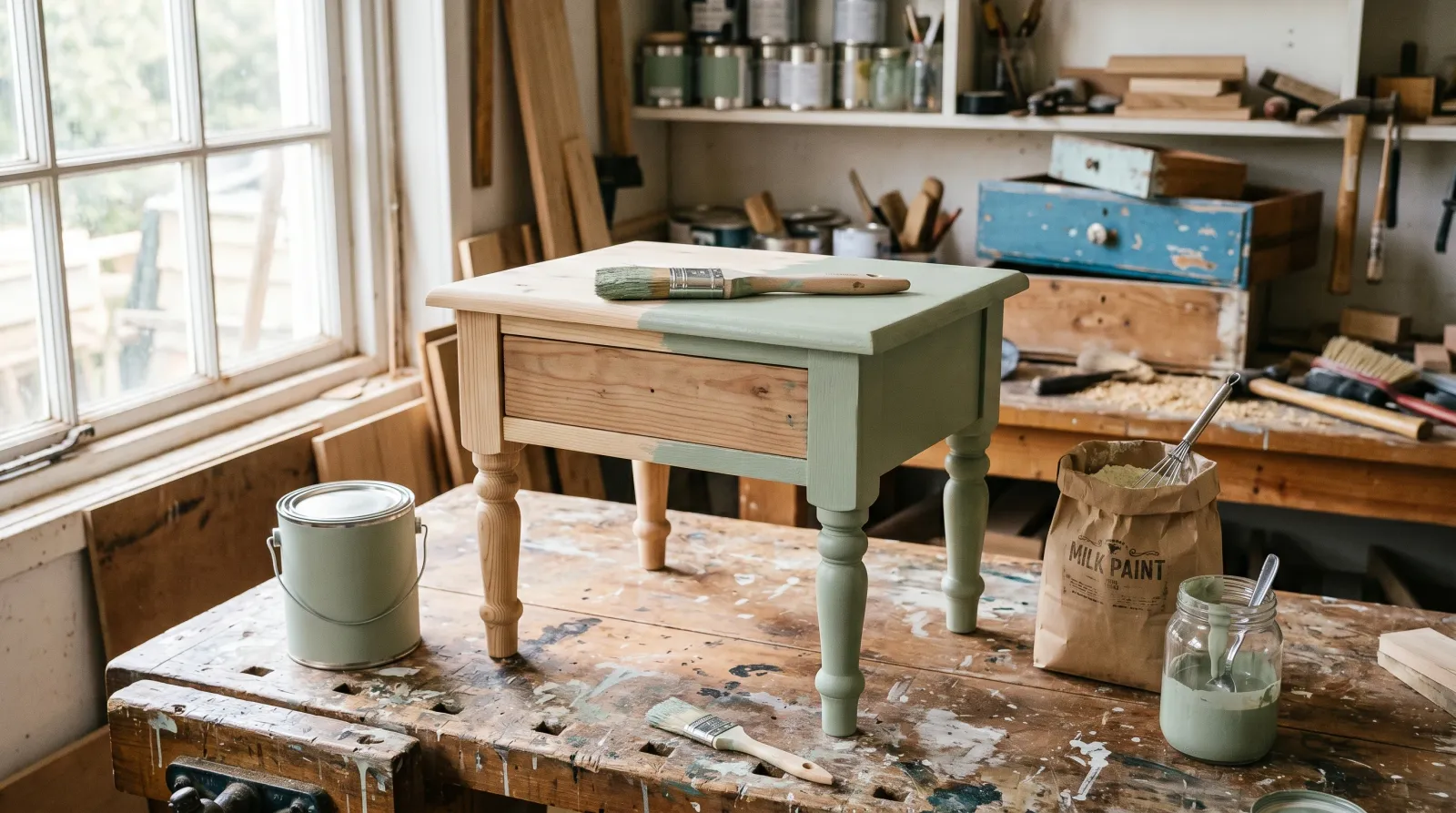
The 30-Second Answer
Buy General Finishes if you want an even, durable, no-fuss finish, and buy traditional milk paint if you want the chippy, authentic casein look. That’s the whole fork. General Finishes “Milk Paint” isn’t milk paint at all. It’s a pre-mixed water-based acrylic that pours ready to use, levels like a fine enamel, and sticks to most surfaces on its own. Traditional milk paint is the real recipe: a casein-protein powder you mix with water, that soaks into raw wood and chips on cue. One is convenience. The other is character. The job picks the winner, not the name.
At a Glance
| General Finishes Milk Paint | Traditional Milk Paint | |
|---|---|---|
| What it actually is | Water-based acrylic | Casein-protein powder |
| Form | Pre-mixed in a can | Dry powder you mix |
| Bonds on its own | Yes, most prepped surfaces | Only on raw porous wood |
| Finish | Smooth, low-luster satin | Chalky dead-matte |
| Chipping | No (that’s the point) | Yes (that’s the point) |
| Topcoat needed | Low-wear no, high-wear yes | Always |
| Pot life once mixed | ~1 year in can | 2-3 days, then it spoils |
| Color mixing | Buy the color | Buy or blend your own |
| Cost (per finished pint) | ~$13-16 | ~$8-12 |
| Cleanup | Soap and water | Soap and water |
How to Tell Which One You’re Looking At
People mix these up at the store, and it’s the label’s fault.
Pick up the container. If it’s a sealed can or jar of wet paint that pours, it’s General Finishes (or any “milk paint” that’s really an acrylic). If it’s a kraft bag or tub of dry powder that rattles, it’s the traditional casein kind. Read the ingredients next. Real milk paint lists casein, lime, clay, and natural pigment. General Finishes lists acrylic resin and water. The finish gives it away too, once it’s on wood: GF dries to a soft, even satin that wipes clean, while true milk paint dries to a porous chalky matte that water-spots until you seal it. Powder plus chalky equals the real thing. Can plus smooth equals the acrylic.
Durability
General Finishes wins this outright, and it isn’t close on high-wear pieces.
The acrylic resin cures to a hard, flexible film that takes daily handling. On a kitchen table sealed with GF High Performance Topcoat, I’ve seen the finish shrug off years of plates, elbows, and wipe-downs with no marking. It bonds to factory finishes after a scuff-sand and a bond coat, and it doesn’t chip unless you fight it. That’s the headline: it behaves like a furniture enamel, because chemically it is one.
Traditional milk paint splits into two outcomes. On raw porous wood it soaks in and grips like nothing else. The casein protein keys into the grain and the bond is mechanical and chemical at once. That’s why 200-year-old milk-painted furniture still holds its color. On a previously finished surface it can’t bite, so it chips, sometimes in big satisfying flakes. Restorers want that. Anyone painting a working surface does not. Add a bonding agent and it holds, but you’re now babysitting a finish that GF delivers straight from the can.
Winner: General Finishes. On raw wood with a bonder and a topcoat, real milk paint closes the gap, but it never pulls ahead on a surface that gets touched.
Finish
This is where traditional milk paint earns its keep, and where the acrylic can’t follow.
True milk paint dries to a dead-flat, chalky matte with a depth that reads as old, not new. Light sinks into it. The color sits slightly uneven, with a hand-mixed variability that looks like it grew on the piece. Distress it and the layers underneath show through. No acrylic fakes this look convincingly. I’ve watched people try to “milk-paint-finish” a GF piece with sanding and dark wax, and it always reads as a smooth paint roughed up, not a porous paint worn down.
General Finishes dries to a soft, even low-luster satin. It self-levels, so brushstrokes flatten out and the surface looks sprayed even when it’s brushed. Clean, modern, uniform. That’s exactly right for a crisp cabinet door and exactly wrong for a primitive farmhouse cupboard.
If you can’t decide between the two looks, the broader chalk paint vs milk paint comparison covers the third matte option that sits between them.
Winner: Traditional milk paint for authentic, chippy, aged character. General Finishes for clean and even.
Cost
Closer than the convenience gap suggests, with a twist on waste.
A quart of General Finishes runs about $26-32, which pencils out near $13-16 per finished pint of coverage. A bag of traditional milk paint powder costs less per finished pint, roughly $8-12 once mixed, because you’re buying dry pigment and adding the water yourself. On raw paper math, the powder is cheaper.
The twist is waste. Mixed milk paint spoils in two or three days. It’s real protein, so it sours like milk left out. Mix a cup for a small project, use half, and the rest goes in the trash. Mix too little and you’re matching a fresh batch mid-coat, which never matches perfectly. General Finishes in the can keeps for about a year, so leftovers carry to the next piece. On a single small project the powder wins on price. Across a year of furniture flips, the no-waste can often comes out even.
Winner: Traditional milk paint on raw cost. Closer than it looks once spoilage enters the math.
Ease of Use
General Finishes, by a wide margin, and this is the reason most people reach for it.
Open the can, stir, brush it on. No mixing ratios, no whisking out lumps, no waiting for the powder to slake. It levels itself, so a mediocre brush hand still gets a clean surface. Two coats, light scuff between, done. It sticks to most prepped surfaces without a separate primer, including the laminate and melamine pieces covered in the guide to painting laminate furniture.
Traditional milk paint asks more of you. Measure powder and water, mix to the right consistency, let it sit a few minutes, strain out the lumps, then work fast before it thickens. The first coat on raw wood often looks alarming, thin and streaky, and panic-buying a second coat too early makes it worse. It evens out by coat two or three, but the learning curve is real. Decide upfront whether you want chipping, because that decision changes whether you add a bonder to coat one.
Winner: General Finishes. The powder rewards practice; the can rewards nobody’s patience because it doesn’t test it.
Cleanup
A rare tie, and a genuine one.
Both clean up with plain soap and water while wet. Both are low-VOC and low-odor, safe to use in a spare bedroom with a window cracked. If you want the numbers behind that label, see the VOC explainer. Neither needs solvents, neither stinks up the house, and brushes wash out in a minute or two under the tap. The only edge is on dried spills: cured GF acrylic is tougher to scrape off a floor than dried casein, which powders off. That’s a footnote, not a deciding factor.
Winner: Tie. Soap, water, a window. Both are easy on this front.
Verdict by Use Case
- Pick General Finishes if: the piece gets used (tables, chairs, cabinets, dressers), you want an even sprayed-looking finish, you’re working over a previous finish or laminate, you don’t want to mix anything, or you need leftovers to keep for the next project.
- Pick traditional milk paint if: you want authentic chippy character, you’re restoring a period piece, you’re painting raw porous wood where casein grips hardest, you want to blend your own custom color from powder, or the aged chalky matte is the entire point of the project.
- It’s a tie when: you’re doing a small one-off decorative piece on raw wood that won’t see hard wear (a frame, a box, a primitive shelf). Both look great there. Pick on whether you want the chips.
Top Picks by Side
Going with General Finishes? It sits near the top of the best furniture paint round-up, which pits it against the other pre-mixed acrylics worth buying and covers the topcoats that make it last on high-wear pieces.
Going with traditional milk paint? The best milk paint round-up sorts the real casein brands by color range, bond-coat options, and how cleanly they chip, so you can match the powder to the look you’re after.
FAQ
Is General Finishes Milk Paint actually milk paint? No. It’s a water-based acrylic that borrowed the name. No casein, no lime. It pours ready to use and bonds on its own. Real milk paint is a casein-protein powder you mix with water. They share a label word and little else.
Can I get real milk paint to stop chipping? Yes. On raw porous wood it grips with no help. Over old finishes it chips because the casein can’t bite, so mix in a bonding agent on the first coat and it holds like normal paint. Skip the bonder if you want the chippy look.
Do I need a topcoat over General Finishes Milk Paint? For low-wear pieces, no. For anything touched or sat on, seal it with a wipeable topcoat or wax. Traditional milk paint always needs a sealer, since bare casein is porous and water-spots.
Related
- Chalk paint vs milk paint: the other furniture-paint fork
- What is milk paint: the casein explainer
- Best milk paint round-up: the real casein brands, sorted
- Best furniture paint: every option tested, including GF
- Painting laminate furniture: step by step on slick surfaces