EpoxyShield vs RockSolid: Garage Floor Kits Compared
EpoxyShield vs RockSolid on a real slab: pot life, cure to parking, coverage, hot-tire pickup, and which Rust-Oleum garage floor kit your concrete needs.

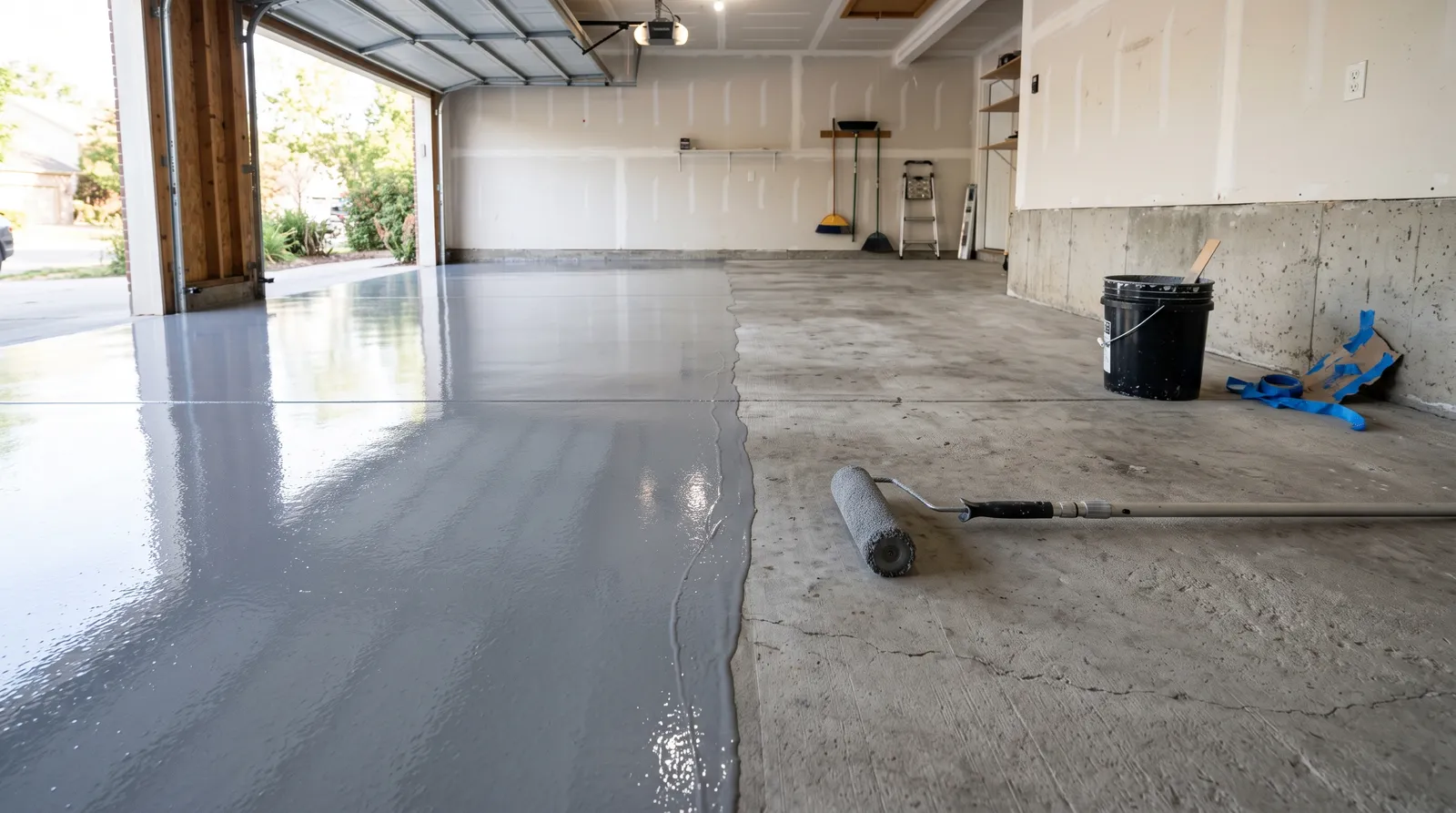
The 30-Second Answer
RockSolid is the tougher floor. EpoxyShield is the easier one. Park a daily driver on the slab and want it usable by Sunday night? Buy RockSolid Polycuramine and accept a twenty-minute working window per pouch. Coating a workshop bay, a basement, or a big slab on a budget, with no experience laying a floor? Buy EpoxyShield and give it the full three-day cure. Same brand, same aisle, two different jobs. Both fail identically when you skip the etch.
At a Glance
| EpoxyShield (2-part water-based epoxy) | RockSolid (Polycuramine pouch) | |
|---|---|---|
| Hot-tire resistance | 🟡 good with a full cure | 🟢 better, and more forgiving |
| Working time after mixing | 🟢 about 2 hours | 🔴 15–20 min in a warm garage |
| Cure to vehicle traffic | 🔴 3 days minimum at 70°F | 🟢 24–36 hours |
| Coverage | 🟢 up to 500 sq ft per 2.5-car kit | 🟡 rated 200–250 sq ft/pouch, budget 150 |
| Kit price | 🟢 $85–130 (2.5-car) | 🟡 $120 (1-car) / $200–230 (2.5-car) |
| Mixing error risk | 🟡 you measure and stir | 🟢 sealed pouch, no ratio to blow |
| Touch-up & recoat | 🟢 recoats cleanly | 🔴 patches flash a different gloss |
| VOC | 🟡 about 53 g/L | 🟢 0 g/L |
Which One Is Already on Your Slab
Half the people asking this question have a coating down already and don’t know what it is. Thirty-second test. Soak a rag in acetone, lay it on a hidden corner near the apron, wait a minute. Old latex or acrylic floor paint turns gummy and wipes off. Cured EpoxyShield dulls and softens a little. Polycuramine shrugs.
Then check the film at a saw-cut or the garage-door lip. Consumer epoxy builds about 3 to 4 mil thickness. That’s the edge of a business card. If you’re looking at something noticeably thicker with a chip broadcast frozen inside it, someone put a pro system down and you should be topcoating, not stripping.
Film Toughness and Hot Tires
Polycuramine wins this and it isn’t close on paper. EpoxyShield is a water-based two-part epoxy: Part A resin, Part B hardener, water carries it and evaporates out. The cured film runs 3 to 4 mils. RockSolid cures by chemical reaction with no water leaving the film, so it packs denser and lands harder. Brake fluid, gasoline drips, and de-icing salt wipe off Polycuramine without leaving a soft spot. On EpoxyShield those same fluids will etch a mark if they sit overnight.
Rust-Oleum markets RockSolid as twenty times stronger than epoxy. That number is one ASTM abrasion comparison against a basic one-part epoxy, not a service-life rating. Read it as “harder than the kit next to it,” not “lasts twenty times longer.” Both show gloss loss and scratching by year two on a slab that gets parked on every night.
Winner: RockSolid.
Working Time After You Mix
This is where EpoxyShield takes it back, and it matters more than most buyers expect.
EpoxyShield gives you roughly two hours of pot life at 70°F. That’s enough to cut in the perimeter with a brush, roll the field, broadcast chips, and still have time to go back and fix a holiday you missed near the door track.
RockSolid gives you the label’s stated hour and your actual twenty minutes. In a warm garage the resin thickens in fifteen to twenty minutes per pouch and starts dragging under the roller. Once it drags, that batch is finished whether you are or not. Mix one pouch, cut in fast, roll fast, mix the next. Never premix both pouches of a 2.5-car kit. I’ve seen more RockSolid floors ruined by a homeowner mixing everything up front than by any prep failure.
Winner: EpoxyShield, by a wide margin.
Cure to Parking
RockSolid takes foot traffic in 8 to 10 hours and vehicle traffic in 24 to 36. Start Saturday morning, park Sunday night.
EpoxyShield wants 12 to 16 hours for light foot traffic, 24 to 48 for heavy items, and three full days before a car touches it. Below 70°F that stretches. Below 50°F water-based epoxy doesn’t cure at all, and you’ve just wasted a kit.
For a single-bay garage that’s also the only place your car lives, that gap decides the whole purchase. Three days of street parking in January is not a small ask. If the difference between dry and cured is fuzzy to you, read the dry time vs cure time explainer before you plan the weekend.
Winner: RockSolid.
Coverage and What It Actually Costs
EpoxyShield’s 2.5-car kit runs $85 to $130 and covers up to 500 sq ft on a smooth slab. Most two-car garages measure 400 to 440. One kit, done, somewhere around $0.20 to $0.30 a square foot.
RockSolid sells a 1-car kit at about $120 and a 2.5-car at $200 to $230. Each pouch is rated 200 to 250 sq ft. On a properly etched, open-pore slab most floors take it closer to 150. Measure your bay, then buy one size up. A second kit ordered mid-job won’t match the first, and the seam where two batches meet reads as a line for the life of the floor.
Call it two to three times the material cost for the same garage. That’s the price of the harder film and the faster cure.
Winner: EpoxyShield.
Prep Tolerance and Touch-Up
Neither one forgives a dirty slab. Both are self-priming over bare concrete, both need the etch, both need a moisture test before you open anything. Tape a plastic square down for 24 hours. Beads on the underside mean the slab is pushing vapor, and vapor lifts coatings the same way it lifts peeling exterior paint off wet siding.
The split shows up afterward. EpoxyShield recoats. Scuff it, clean it, lay another coat, and the repair blends. RockSolid doesn’t. Patches flash a different gloss, and color can shift half a shade between two pouches out of the same box. The decorative chip broadcast exists partly to hide that.
Degreasing is the step people skip. Oil-stained concrete needs a real degreaser and a pressure washer before the etch, not a garden hose. Our pressure washer picks for paint prep cover the units with enough flow to strip a slab without gouging it.
Winner: EpoxyShield.
Finish and Gloss
EpoxyShield lays down high gloss, and only high gloss. Wet-look, reflective, shows every drip and every roller stop. On a clean slab it looks like a showroom. On a patched, cracked slab it advertises every repair.
RockSolid comes off satin to low-gloss with the chips broadcast in, with a separate clear topcoat sold if you want gloss. The lower sheen hides slab imperfections better and hides two years of scratching better. Also less slippery when wet, which matters if you track snow in.
Preference call, mostly. On a rough slab the satin finish is genuinely the smarter buy.
Winner: RockSolid on a beat-up slab. Tie on new concrete.
Verdict by Use Case
- Pick EpoxyShield if: the garage is a workshop, a storage bay, or a basement floor. You’ve never coated concrete before. The slab is over 450 sq ft and budget is the constraint. You can live without the car in there for three days.
- Pick RockSolid if: a daily driver parks on it every night, the floor sees road salt and dripped oil, and you need it parkable inside 36 hours. Also pick it if you know you’d blow the mix ratio on a bucket-and-drill product.
- It’s a tie when: the bay is under 250 sq ft and rarely parked in. At that size the price gap is $40 and either film will outlive your interest in it.
- Pick neither if: the slab fails the plastic-sheet moisture test, or there’s a sealed or painted coating on it you’re not willing to grind off.
Top Picks by Side
Both kits sit in the best garage floor coatings round-up with their test notes, alongside the one-part options worth considering for a low-traffic bay. For the long-form specs, we broke down EpoxyShield and RockSolid separately.
Whichever you buy, get a 1/2-inch nap roller cover rated for epoxy on an extension pole. A 3/8-inch cover starves the film and leaves you chasing holidays. The paint roller round-up has the covers that survive solvent-free resin without shedding lint into the floor.
What’ll Bite You in Two Years
Hot-tire pickup at the parking spot, and it will be your fault, not the coating’s. It looks like a dinner-plate-sized patch lifting where the front tire sits. The cause is almost always one of three things: the etch got skipped, the slab was damp when you coated it, or somebody parked before full cure. On EpoxyShield, parking on day two instead of day four is enough to do it.
The second one is the apron. That last three feet by the garage door gets sun, rain, freeze-thaw, and road salt. Coat it, then don’t lean on it. Plan to touch it up at year three, which is one more reason EpoxyShield’s clean recoat is worth something. On RockSolid, an apron touch-up flashes and you’ll see it every time you pull in.