Product review · Rust-Oleum · Updated August 7, 2026
RockSolid Polycuramine Garage Floor CoatingRust-Oleum paint review
7.0/10The best kit on a big-box shelf, held back by a working time that is a fraction of what the label implies.
The hardest film on the big-box shelf, sold in a burst pouch that removes the mixing error and replaces it with a clock. Two numbers on the box are optimistic: the pot life and the coverage.

Robert Vega · Commercial Coatings Editor · Updated August 7, 2026
Robert spent twelve years in facility engineering specifying floor systems for school districts and light industrial sites before moving to editorial. He judges a garage kit the way he judges a plant floor: prep, film build, and cure to service. About the testing process →
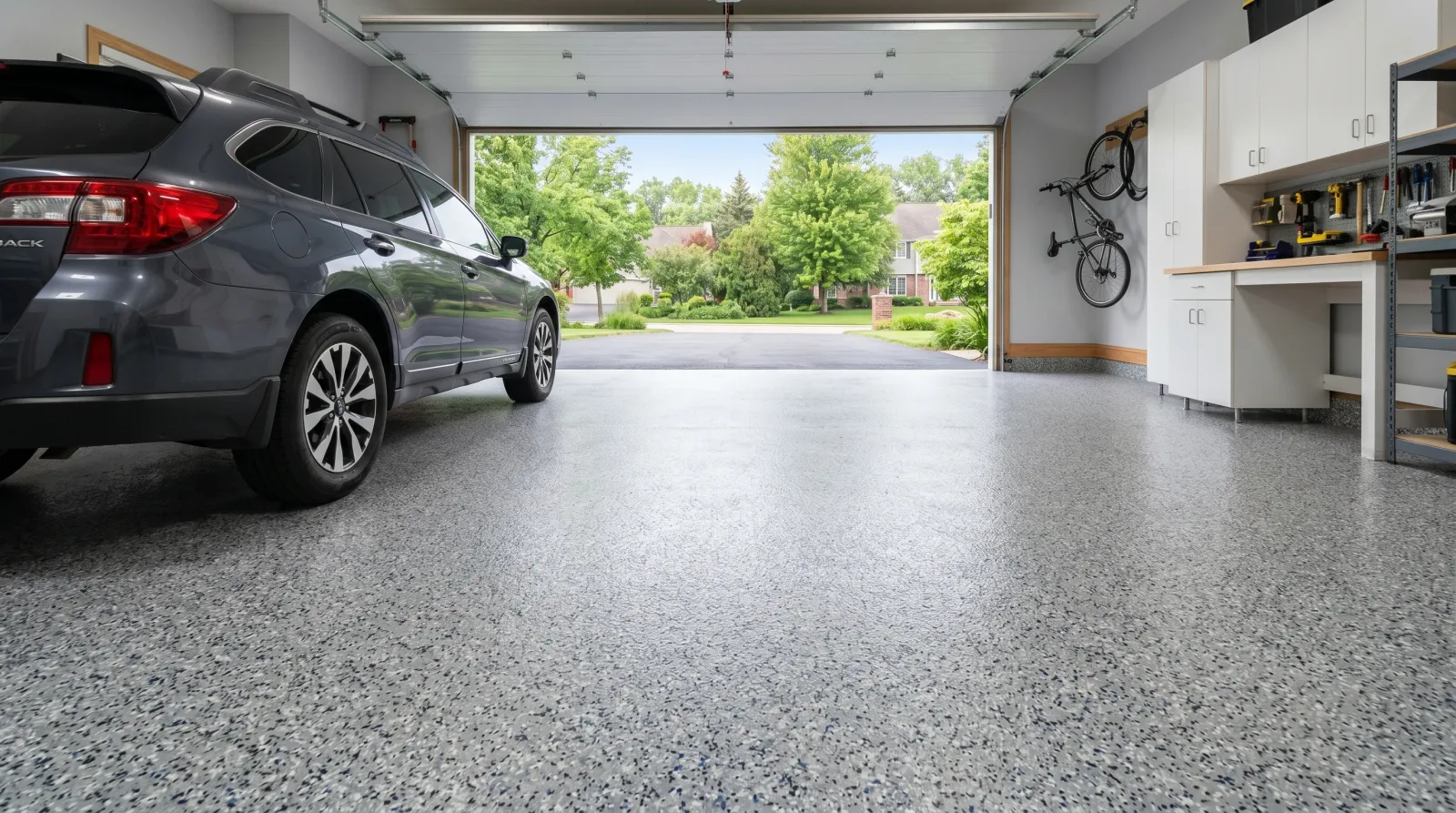
Rust-Oleum RockSolid Polycuramine Garage Floor Coating1 sheen
CoverageRated 200–250 sq ft per pouch
VOC0 g/L, low odor
Full chemical cureSeveral days
Sheens Satin to low-gloss film
Read this first
The Fast Verdict
For a one-weekend garage floor, yes. Nothing else on that shelf gives you a harder, more chemical-resistant film that takes foot traffic in 8 to 10 hours and vehicles in 24 to 36, and the burst pouch removes the mis-measured ratio that ruins most kit floors. It is the wrong product if the slab fails a moisture test or the floor has to still look new past year five — that is a contractor system, not a pouch. Whatever your slab math says, buy one kit size up.
Best for
One clean dry uncoated slab · Single-bay garages that need to be parkable fast · Attached garages where odor matters · Chemical and salt exposure · Applicators who can move fast once a pouch is mixed
Skip if
The slab fails a 24-hour moisture test · Previously sealed or painted floors you will not grind · You need a guaranteed 15-year floor · The garage cannot be held above 50F · You want an easy touch-up later
What it's good at
- Cure speed against the kit-epoxy field — foot traffic in 8 to 10 hours, vehicles in 24 to 36
- Chemical and stain resistance; brake fluid, motor oil, gasoline, and de-icing salt wipe off without etching the film
- Removing mixing error entirely, because the burst pouch means you never measure a ratio
- 0 g/L VOC and low odor, which matters in an attached garage sharing air with the house
- A film that is harder and denser than the one-part epoxy kits beside it on the shelf
- A residential warranty path when the slab was prepped to the label
- Hiding early wear under the decorative chip broadcast
What it's not good at
- Working time — 15 to 20 minutes per pouch in a warm garage, not the hour implied
- Coverage honesty; rated 200 to 250 sq ft per pouch, closer to 150 on a properly etched slab
- Color and gloss consistency between two pouches of the same kit
- Touch-ups, which flash a different gloss and cannot be blended once the resin sets
- Slabs with moisture-vapor emission — this is not a moisture fix
- Long service life; measurable gloss loss and scratching show up by year two on a daily-driver panel
- Cold garages, since the cure needs the space held above 50F
Same shelf, different cans
Which RockSolid Are You Buying?
Several products carry the RockSolid name and they are not interchangeable. This review covers the colored Polycuramine garage floor kit with the chip broadcast.
RockSolid Polycuramine Garage Floor Coating (this review)
BaseTwo-part Polycuramine burst pouch, solid color with decorative chips
SheensSatin to low-gloss with chip broadcast
Buy it if
You want a hard, fast-curing colored floor on a clean bare slab, in 1-car or 2.5-car kit sizes.
Avoid if
You want a show floor or a stain that shows the concrete. This is an opaque film.
RockSolid Metallic Floor Coating
BaseSame Polycuramine chemistry, pearlescent metallic
SheensMarbled pearlescent
Buy it if
The floor is meant to be looked at and you are willing to work for the effect.
Avoid if
This is your first floor. It is unforgiving of the same short pot life and demands an even hand.
RockSolid Polycuramine Clear Top Coat
BaseClear sealer over the colored base
SheensGlossy or textured
Buy it if
You want more gloss or a textured surface over a finished base coat.
Avoid if
You expected a finished floor in one can. This is an add-on, not a standalone coating.
RockSolid Concrete Stain
BaseSemi-transparent penetrating stain, no film build
SheensFlat
Buy it if
You want the concrete to show through with a natural mottled tone.
Avoid if
The floor needs abrasion and chemical resistance. A stain builds no protective film.
Numbers, not adjectives
Spec Sheet
- Resin
- Polycuramine hybrid, two-part burst pouch
- Coverage
- Rated 200–250 sq ft per pouch; budget about 150 on a porous slab
- Sheen
- Satin to low-gloss with chip broadcast; clear topcoat raises gloss
- Working time
- Label implies about an hour; plan for 15 to 20 minutes per pouch in a warm garage
- Foot traffic
- 8 to 10 hours at 70F
- Vehicle traffic
- 24 to 36 hours
- Full chemical cure
- Several days; longer in cool weather
- VOC
- 0 g/L, low odor
- Prep
- Acid etch on bare clean concrete; self-priming, no separate primer coat
- Surfaces
- Interior garage slabs and clean uncoated concrete; not a fix for moisture-vapor problems
- Sizes
- 1-car kit (90 oz, one pouch) and 2.5-car kit (180 oz, two pouches)
- Price
- $120 for the 1-car kit; $200–230 for the 2.5-car kit, per kit and not per gallon
Application Settings That Work
- Brush
- Cut the perimeter in with a brush immediately after the pouch is kneaded, then roll the field fast and in one direction. Do not premix both pouches of a 2.5-car kit. Broadcast the decorative chips into the wet film as you go — waiting until the bay is finished means the first section has already started to set.
- Primer
- No separate primer. The prep is an acid etch on bare, clean concrete, and that etch step is doing the priming work. Degrease first, etch until the surface feels open, rinse, and let it dry. A previously sealed or painted floor needs grinding, not etching. Run a 24-hour plastic-sheet moisture test before any of it.
Pot Life and Return to Service
Two clocks run on this product and only one of them is on the box. The pot life is the one that bites: the label implies about an hour, but in a warm garage the Polycuramine thickens in 15 to 20 minutes per pouch, and once it drags under the roller that batch is finished. Mix one pouch at a time, have the roller loaded and the perimeter cut plan settled before you snap the seal, and never premix both pouches of a 2.5-car kit. The return-to-service clock is the generous one. Foot traffic comes at 8 to 10 hours at 70F and vehicle traffic at 24 to 36, so a Saturday-morning start is parkable by Sunday night. Full chemical cure runs several days beyond that, and cool weather stretches all of it. Hold the garage above 50F through the whole cure.
Mid-project panic
When It Goes Wrong, and How to Fix It
The coating thickened and started dragging mid-floor
Why it happens. Pot life, not a bad pouch. The chemistry starts the moment the internal seal breaks, and heat shortens it fast. In a warm garage you have 15 to 20 minutes per pouch, not the hour the label suggests.
The fix. Mix one pouch at a time and treat the stated hour as a lab number. Stage the whole floor first — taped, cleared, roller loaded, chips within reach — then knead, cut in fast, and roll fast. When that batch drags, stop working it and mix the next pouch rather than fighting a resin that has already set.
Ran out of material and left a visible cold joint
Why it happens. The box rates a pouch at 200 to 250 sq ft. On a correctly etched, open-pore slab most floors absorb it closer to 150. A buyer who measures a 250 sq ft single bay and buys the 1-car kit runs out partway across, and the line where two batches meet stays visible for the life of the floor.
The fix. Measure the slab, then buy one kit size up — a 2.5-car bay means the 2.5-car kit plus a spare 1-car kit on the shelf. Ordering a second kit mid-job does not work, because the new batch will not match what is already down.
One section reads glossier or a half-shade off from the next
Why it happens. Two pouches in the same kit do not always lay down identical, and because the resin is on a clock you cannot stop to blend a wet edge that has already begun to set.
The fix. Work in one direction and keep a wet edge moving toward the door. Plan the pour so a pouch change lands at a natural break rather than mid-bay. Broadcast the decorative chips evenly, because they hide a real amount of this. Accept that later touch-ups will flash.
The film blisters or lets go across a whole area
Why it happens. Polycuramine sits on top of the slab. If the concrete has moisture vapor emission pushing up from below, no pouch coating stays bonded, and the same applies to a previously sealed floor that was coated without grinding.
The fix. Run a 24-hour plastic-sheet moisture test before you buy. A slab that fails needs a different system, not this kit. If the floor was previously sealed or painted, grind it back to bare, open concrete first — an acid etch alone will not cut through a coating.
Noticeable gloss loss and scratching by year two
Why it happens. This is a few mils of film on a daily-driver panel. Real-world floors show measurable gloss loss and surface scratching at the two-year mark, with some reports of roughly a fifth of the gloss gone.
The fix. There is no repair that hides it cleanly. Specify the chip broadcast, which exists partly for this reason, and add the clear top coat if appearance matters. If the floor has to still look new past year five, the honest answer is a professionally installed system, not a heavier hand with this one.
Side by side
RockSolid vs Kit Epoxy vs a Professional Polyaspartic Floor
The marketing line is that Polycuramine is twenty times stronger than epoxy. That number comes from a single abrasion comparison against a basic one-part epoxy, not from a service-life test against a contractor floor. Hold the comparison in the right frame and the product looks sensible.
| RockSolid Polycuramine | One-part kit epoxy | Professional polyaspartic | |
|---|---|---|---|
| Film build | A few mils, denser and harder than kit epoxy | Thin consumer build | 15 to 20 mils with a UV-stable topcoat |
| Back to vehicle traffic | 24 to 36 hours | About 72 hours | Single-day install by a crew |
| Chemical resistance | Strong. Oil, gas, brake fluid, and road salt wipe off | Softens or stains under the same fluids | Strongest of the three |
| Mixing risk | None — sealed pouch, timed knead | Bucket and ratio; the classic failure point | Handled by the crew |
| Working time | 15 to 20 minutes per pouch in a warm garage | Longer and more forgiving | Not your problem |
| Service life expectation | Gloss loss and scratching by year two on a daily-driver panel | Shorter still; scratches sooner and softens under hot tires | A decade-plus |
| Cost | $120 to $230 per kit, well under $2 per sq ft in materials | Roughly a third less per kit | $5 to $12 per sq ft installed |
Film build
RockSolid PolycuramineA few mils, denser and harder than kit epoxy
One-part kit epoxyThin consumer build
Professional polyaspartic15 to 20 mils with a UV-stable topcoat
Back to vehicle traffic
RockSolid Polycuramine24 to 36 hours
One-part kit epoxyAbout 72 hours
Professional polyasparticSingle-day install by a crew
Chemical resistance
RockSolid PolycuramineStrong. Oil, gas, brake fluid, and road salt wipe off
One-part kit epoxySoftens or stains under the same fluids
Professional polyasparticStrongest of the three
Mixing risk
RockSolid PolycuramineNone — sealed pouch, timed knead
One-part kit epoxyBucket and ratio; the classic failure point
Professional polyasparticHandled by the crew
Working time
RockSolid Polycuramine15 to 20 minutes per pouch in a warm garage
One-part kit epoxyLonger and more forgiving
Professional polyasparticNot your problem
Service life expectation
RockSolid PolycuramineGloss loss and scratching by year two on a daily-driver panel
One-part kit epoxyShorter still; scratches sooner and softens under hot tires
Professional polyasparticA decade-plus
Cost
RockSolid Polycuramine$120 to $230 per kit, well under $2 per sq ft in materials
One-part kit epoxyRoughly a third less per kit
Professional polyaspartic$5 to $12 per sq ft installed
Against the one-part kits on the same shelf, RockSolid wins cleanly on hardness, cure speed, and chemical resistance, and if those are your two options this is the upgrade. Against a professionally installed polyaspartic it is thinner and shorter-lived, and the price gap is honest rather than insulting — you are buying a different tier of floor, not a cheaper version of the same one. Decide which tier the floor actually needs before you read the kit price as either a bargain or a rip-off, and if you choose the kit, buy one size up.
If not this one
Honest Alternatives
RO
Rust-Oleum EpoxyShield Garage Floor Kit$65–90 / kit
Same brand, one tier down. A water-based one-part-style epoxy kit that goes on easier and costs roughly a third less, but cures slower, scratches sooner, and softens under hot tires faster. The right call for a low-traffic garage, a shop you rarely park in, or a budget that will not stretch.
PI
Professionally installed polyaspartic floor$5–12 / sq ft installed
The long-game answer. Ground and broadcast, UV-stable, installed in a single day by a crew, with a service life that doubles or triples this kit. You give up the price and book a contractor. Specify it when the floor has to still look new past year five.
RO
Rust-Oleum RockSolid Metallic Floor Coating$160–200 / kit
Same Polycuramine chemistry, different finish goal. The metallic kit lays a marbled pearlescent show floor instead of a solid color with chips. It demands more skill to apply evenly and is unforgiving of the same short pot life, so treat it as a deliberate aesthetic choice.
Questions people actually ask
RockSolid Polycuramine Garage Floor Coating Questions, Answered
Is Rust-Oleum RockSolid worth it?
For a one-weekend garage floor, yes. It is the best kit on a big-box shelf: the Polycuramine film is harder and more chemical-resistant than the one-part epoxy kits beside it, it takes foot traffic in 8 to 10 hours and vehicles in 24 to 36, and the burst pouch removes the mixing error that ruins most kit floor jobs. It is not worth it if your slab fails a moisture test or you need a 15-year floor. Budget one kit size up, because the rated coverage runs short.
Is RockSolid Polycuramine really stronger than epoxy?
The film is harder and more chemical-resistant than a standard one-part kit epoxy, and it cures faster. The twenty-times-stronger claim comes from a single ASTM abrasion comparison, not a service-life rating. Against a true two-part 100% solids epoxy laid by a contractor, RockSolid is thinner and shorter-lived. It beats the kit epoxy on the next shelf, not a pro floor.
How much working time do I actually get after mixing?
The label says about an hour. In a warm garage, plan for 15 to 20 minutes per pouch before the Polycuramine thickens and stops spreading. Mix one pouch at a time, have your roller loaded, and do not premix both pouches of a 2.5-car kit. Heat shortens the pot life fast.
Will the coverage really do my garage?
Read the kit size as optimistic. The box rates a pouch at 200 to 250 sq ft, but on a properly etched, porous slab most floors drink it closer to 150. Measure the slab, then buy one size up or add a second 1-car kit. Running short mid-coat is the most common way these jobs go wrong.
Does RockSolid hold up to hot tire pickup?
Better than bargain floor paint, not perfectly. Polycuramine resists hot-tire pickup far better than a one-part epoxy or a porch enamel, but parking a hot daily driver in the same spot can still lift the film at the edges over a few seasons if the slab was not etched and bone-dry. The decorative chip broadcast helps hide early wear.
Do I need a primer under RockSolid?
No. The kit is self-priming and the acid etch on bare clean concrete is the prep, not a primer step. What it will not do is bond to a previously sealed or painted floor. That needs mechanical grinding back to open concrete before the pouch comes out.
How do I know my slab can take it?
Tape a plastic sheet to the concrete for 24 hours and check underneath. Condensation means moisture vapor is coming up through the slab, and no topical pouch coating stays bonded over that. A floor that fails this test needs a different system. Also confirm the slab is uncoated and that the garage can be held above 50F through the cure.
Can I fix a scratch or a worn spot later?
Not invisibly. Patches flash a different gloss, and color can shift between pouches even inside the same kit, so a repair rarely disappears. This is the weakest part of living with the floor. Keep the chip broadcast even at application, since it hides more wear than any touch-up you will do later.
How long does the coating last?
It outlasts one-part epoxy by years, but be realistic. On daily-driver panels the film shows measurable gloss loss and surface scratching by the two-year mark. The chips hide much of that. If the floor has to look new past year five, a professionally installed two-part epoxy or polyaspartic is the honest answer, at three or four times the cost.
Which kit size should I buy?
One size larger than your slab math suggests. The rated coverage runs short, and a second kit ordered mid-job will not match the first. For a 2.5-car bay that means the 2.5-car kit plus a spare 1-car kit on the shelf, not the 2.5-car kit alone.
Keep exploring
More Rust-Oleum coatings reviewedBest garage floor coatings, rankedEpoxy vs acrylic, what the resins actually do
We may earn a commission when you buy through the retailer link above. It never changes the score or the verdict.
Ask a Question