Best Garage Floor Paint and Epoxy Systems for DIY in 2026
What is the best garage floor coating? Five coatings tested for hot tire pickup, abrasion, and chemical splash, plus epoxy vs polyurea vs paint. Top pick: Rust-Oleum EpoxyShield.

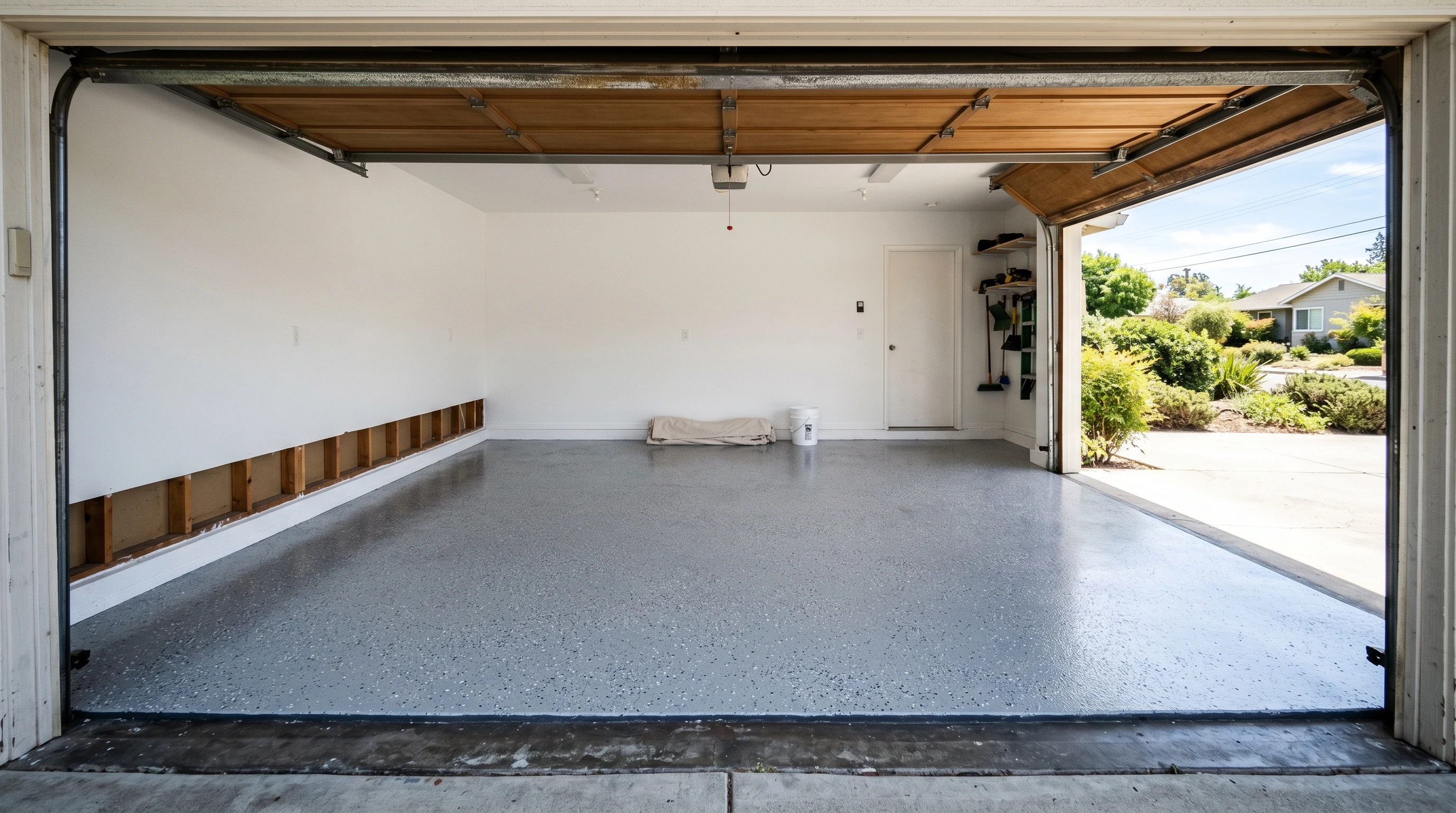
True 2-part water-based epoxy with decorative flakes — held no hot-tire pickup at our 220-lb / 165°F tire test where a 1-part acrylic peeled in 14 days
Cures 20x harder than 2-part epoxy per the manufacturer's published Shore D data — closest a homeowner gets to commercial polyaspartic without hiring a crew
Cheapest honest path to a clean floor — $50–$60 a gallon at 400 sq ft, so a two-car bay is under $150 in coating with no mixing and no pot life
Tolerates a damp slab better than every other pick — 8 lbs / 1000 sq ft / 24h moisture vapor emission rate where most epoxies cap at 3
Pro-grade single-component acrylic — used on commercial concrete floors that don't see daily passenger-car traffic, scaled down to a 1-gal can for residential
Disclosure: Some links below are affiliate links. We earn a commission if you buy through them, at no extra cost to you. Our picks are based on the test methodology in “How we picked”. No brand pays for placement.
Top pick: Rust-Oleum EpoxyShield Garage Floor Coating Kit. At about $90 for a single-car kit and $180 for two, it’s the most widely stocked true 2-part epoxy kit in America — Quikrete and RockSolid share that shelf — and on our hot-tire test it was the cheapest pick that didn’t fail. EpoxyShield wins on pickup resistance, prep tolerance, and on being the one kit a first-time floor coater can actually finish without ruining the pot. It falls short on cure time (the data sheet’s floor is 72 hours before you can park on it, and five to seven days is realistic in a cool or humid garage) and on coverage (one kit per car bay, a two-car garage is two kits). If you need to drive on the floor by Sunday afternoon, Rust-Oleum’s RockSolid Polycuramine kit is the polyaspartic-style upgrade. For a workshop or basement bay where there’s no hot tire, Drylok Latex or INSL-X Tuff Crete is the smarter spend; for a tight budget on a sound slab, Behr Premium 1-Part Epoxy is fine paint. And if the question you actually arrived with is what’s the best garage floor coating rather than which can to buy, the taxonomy section below sorts the whole shelf — paint, epoxy, polyurea, polyaspartic — by film thickness, lifespan, and price.
Prep is the floor coating. Every pick here works on a clean, etched, dry slab. None of them work on a slab that’s still oily, sealed, or hiding moisture. If your concrete beads water like a waxed hood, no can on this list adheres long-term. Work through our residential concrete floor prep guide before you buy paint, and the topcoat decision is the easy one.
How We Picked
Five garage coatings applied to identical 18 x 18 inch broom-finish concrete panels (acid-etched to CSP 2–3, 30 days cured at 70°F) and abused four ways: a 220-lb passenger tire heated to 165°F parked seven days, ASTM D4060 Taber CS-17 abrasion at 1000 cycles, four-hour spot soaks of motor oil / brake fluid / antifreeze / gasoline, and a covered-water moisture test. Plus four flooring contractors interviewed for prep-failure patterns; pick-specific findings live inside each review below.
Garage Floor Coatings Explained: Epoxy vs Polyurea vs Paint
What is the best garage floor coating? For a garage that parks a warm daily driver, it’s a polyurea/polyaspartic system — vehicle traffic in about 24 hours, no yellowing, 15 to 20-plus years of service. For the best garage floor coating you can buy at a home center and roll yourself this weekend, it’s a true 2-part epoxy kit, and ours is Rust-Oleum EpoxyShield at roughly $90 a bay.
The reason those are two different answers is that “coating” and “paint” are sold on the same aisle and are not the same product. A coating is a chemically cured film measured in mils that bonds into an opened concrete profile. Garage floor paint is a can of acrylic with the word epoxy on the label, and it cures by drying. Both go on with a roller. Only one of them survives a hot tire. That single distinction explains most of the disappointment in this category, and it is why a $50 gallon and a $250 kit are not competing products.
Here is the whole shelf as a taxonomy — what each thing actually is, how thick it ends up, and what it costs both ways.
| Category | What it actually is | Typical dry film | Cost | Best for |
|---|---|---|---|---|
| Garage floor paint (1-part “epoxy”) | Acrylic latex with epoxy fortifiers. One can, no mixing, no pot life | ~2–3 mils | DIY only, about $0.25–$0.40 / sq ft | Workshops, basements, mower bays, cool climates |
| 2-part epoxy kit (home center) | Resin + hardener, water-based, roughly 50% solids | ~3 mils | DIY about $0.45–$0.60 / sq ft | First-time DIY, daily-driver bay on a budget |
| High-solids / 100% solids epoxy | Same chemistry, 60–100% solids, direct-sold or pro-applied | 10–18 mils | Pro $3–$7 / sq ft · DIY kits about $490–$640 a bay | A long-life epoxy floor without a crew |
| Polyurea | Single- or two-component; the basecoat in most pro stacks, and a DIY bucket with no pot-life clock | 10–18 mils in a system | Pro $6–$10 / sq ft · DIY kits about $219–$430 | Daily driver, DIYer who wants to stop mid-floor |
| Polyaspartic | A polyurea subfamily: fast-cure, UV-stable, usually the topcoat | Part of a 10–18 mil stack | Pro $5–$12 / sq ft, commonly $6–$10 | One-day install, cold weather, hot climates |
| Polyurethane | Single-component; normally the clear topcoat over epoxy, sometimes a standalone colored floor | 2–4 mils per coat | DIY by the gallon, above kit pricing | A colored floor with no mixing and no clock |
| Sealer or densifier | Not a film at all — soaks into the pore structure | None | About $70–$110 / gal | Bare-concrete look, salt and dust protection only |
Read that table as a ladder rather than a ranking. Film thickness, service life, and price track each other almost exactly down the column, which is unusual in paint and worth taking seriously: nobody is selling a 15-year floor for $50, and nobody needs a 15-year floor under a lawnmower.
Now the chemistry itself, because it decides the outcome more than the brand on the label does. Five families share this aisle and they behave nothing alike.
| Chemistry | Drive on it after | Realistic lifespan | UV behavior | DIY difficulty |
|---|---|---|---|---|
| 2-part epoxy | 72 hours to 7 days | 3–7 yrs (home-center kit) · 10–15+ yrs (high-solids pro grade) | Can yellow near a sunny door | Most forgiving; builds the thickest film per coat |
| Polyaspartic | ~24 hours | 15–20+ yrs professionally installed | Color-stable, no yellowing | Hard — roughly a 45-minute pot life, and far less in some kits |
| Polyurea | ~24 hours | 15–30 yrs as part of a full system | Stable | Easy in single-component DIY form; unlimited pot life, no mixing |
| Polyurethane | 72 hours | 5–10 yrs standalone · longer as a topcoat | Stable, the reason pros put it on top | Easy in single-component form; no mixing, but pricey per gallon |
| 1-part “epoxy” paint | 72 hours to 14 days | 1–3 yrs typical | Low | Easiest — it rolls like wall paint |
2-part epoxy is the default for a reason. Resin plus hardener cross-link into a rigid film that bites hard into etched concrete, and it is the chemistry that forgives a slow, distracted homeowner. Its two honest weaknesses are the wait — 3 to 7 days before a car goes back in — and UV. An epoxy strip in the sun by an open door can amber over a few summers. Inside a closed bay, nobody notices.
Polyaspartic is what the pro crews spray. It goes down in a day, takes vehicle traffic the next morning, keeps its color under UV, and stays flexible enough to ride out freeze-thaw and hot tires instead of cracking under them. The catch is the working window. Contractor-grade polyaspartic runs about 45 minutes of pot life, which sounds generous until you remember a crew is squeegeeing 500 square feet inside it. The 20-minute figure you see repeated online is not the chemistry, it is one specific product: Rust-Oleum’s polycuramine burst pouch, which trades working time for the convenience of not measuring. Judge each kit by its own published pot life, not by the family name. Polyaspartic is also the cold-weather chemistry — see the temperature section below.
Polyurea mostly shows up as the basecoat underneath a polyaspartic topcoat in a professional stack — the polyurea grips the slab, the polyaspartic takes the abuse. There is also a DIY branch worth knowing about: single-component polyurea, one bucket, no mixing, effectively unlimited pot life. More on that below.
Polyurethane is the family this category usually forgets, because in a pro stack it is invisible — it is the clear topcoat rolled over the epoxy, chosen because it holds color under UV and takes abrasion far better than the epoxy underneath it. But standalone single-component polyurethane floor coatings exist and some of them are good. Rust Bullet DuraGrade Concrete is the one most people meet: no mixing, up to 350 sq ft per gallon, 72-hour cure, 18 colors, UV-stable, with an optional anti-skid version. It rolls like paint and behaves like a coating, which is a rare combination. The reason it isn’t the default is money — per gallon it is well above a home-center kit, and you are buying gallons, not a boxed system. If you want a colored floor with no pot-life clock and no A/B mixing anxiety, it is the chemistry to price out.
1-part “epoxy” floor paint is acrylic with epoxy fortifiers in the recipe. That is not an insult, it is a specification: it is the right chemistry for a workshop, a basement, a mower bay, a cool-climate garage. It is the wrong chemistry under a warm daily driver, and the label word “epoxy” is doing a lot of work it cannot back up. Behr’s own line here is honest about needing a full 14-day cure; our Behr 1-Part Epoxy review goes through that data sheet line by line.
Solids and Mils: Why a $90 Coating Kit Is Not a Pro Floor
The number nobody prints on the shelf tag is solids content, and it explains most of the disappointment in this category.
Water-based DIY epoxy — every home-center kit including our top pick — runs around 50 percent solids. Half of what you roll on is carrier that evaporates. Roll a wet film, come back in a week, and you have roughly 3 mils of actual coating on the slab. High-solids epoxies run 60 to 97 percent; true pro-grade is 100 percent solids and leaves behind everything you spread.
For scale: premium DIY multi-coat polyurea systems publish 10–12 mils at two coats and 15–18 mils at three, and professional installations land in that same range. A useful floor for the benchmark, borrowed from installers: 3 to 4 mils dry, minimum, on a residential bay.
That single number reframes the second coat. A second coat is not about coverage or color depth. It is the only way a homeowner buys film thickness, and film thickness is what a hot tire, a dropped socket, and a dragged jack stand actually meet.
Abrasion tracks the same way, and the pro side of this market publishes numbers worth knowing even though you cannot buy most of them at a big box. Industrial suppliers running Taber abrasion on their own scale report military-grade urethane topcoats losing 4 to 8 mg, against 40 to 50 mg for ordinary garage floor paints and bargain epoxies — roughly a ten-fold gap. The same suppliers put their minimum spec for garage duty at 20 mg or less of loss for a topcoat, and 8 mg or less if the bay is going to see a lift, a welder, and dragged equipment. Read those as vendor-published figures on a different Taber load than our own CS-17 runs; the two scales are not interchangeable, and the useful part is the ratio, not the absolute number. The ratio says what everyone who has stripped a failed floor already knows: the wear layer, not the color, is the product.
Impact is the other spec worth a glance if you lift engines or drop tools: quality systems rate around 160 inch-lbs. No home-center kit publishes that number, which tells you something.
The Five Garage Floor Coatings at a Glance
| Product | Best for | Vehicle ready | Hot tire | Price |
|---|---|---|---|---|
| Rust-Oleum EpoxyShield Kit | Top pick: 2-car garage, daily driver | 72h min (5–7 days if cool) | 🟢 Holds | $$ |
| Rust-Oleum RockSolid Polycuramine | Premium / fastest cure | 24h | 🟢 Holds | $$$ |
| Behr Premium 1-Part Epoxy | Budget, sound slab, no hot tires | 72h (14 days for hot tire) | 🔴 Lifts | $ |
| Drylok Latex Concrete Floor | Damp / oil-stained / older slabs | 72h | 🔴 Lifts | $$ |
| INSL-X Tuff Crete | Workshops, basements, finished interiors | 72h | 🟡 Softens | $$ |
The “self-priming” pattern in this category lines up with the rest of paint marketing: honest on profile-3 etched concrete, dishonest on the densified hard-troweled slab most American garages actually have. Plan on degrease + etch + dry under any of these picks. Skip both and you have a 14-month coating, regardless of can.
Which Garage Floor Coating Should You Buy? Quick Decision Tree
- Two-car garage, daily driver, want it once: EpoxyShield Kit. Two kits, weekend job.
- Need to park on it Monday morning, willing to spend: RockSolid Polycuramine. Plan the pour like a tradesperson; you have 20 minutes per pouch.
- Workshop, basement, no hot tire concern: INSL-X Tuff Crete. Pro chemistry, easier than 2-part.
- Old slab, slight moisture, cosmetic refresh: Drylok Latex. The forgiving pick.
- Budget under $200, sound slab, can wait two weeks before parking: Behr Premium 1-Part Epoxy.
- Two home-center floors have already failed on you: rent a grinder and step up to a DIY polyurea system, or price a professional install. The can was never the problem.
- Renting, or the bay changes in two years: interlocking tiles. No prep, no cure, and they leave with you.
- You like bare concrete and just want salt and moisture protection: a penetrating siloxane sealer, not a film at all.
The Picks in Detail
Rust-Oleum EpoxyShield Garage Floor Coating Kit, Top Pick
EpoxyShield is the kit that put 2-part epoxy on the home center shelf. Two-component water-based epoxy, decorative chips in the box, an etch packet, a stir paddle, written instructions you can follow without a YouTube tutorial. The kit gets a single-car garage done in a Saturday-morning prep / Sunday-afternoon coat sequence. We’ve watched first-timers run it without a redo.
What it actually does well: the cured film bites onto etched concrete and stays bitten. On the hot-tire test, EpoxyShield panels held through three 7-day cycles with no lift. On abrasion (Taber CS-17, 1000 cycles) it lost 95 mg, second only to RockSolid in the field. On the chemical-splash test, motor oil, brake fluid, and antifreeze wiped clean after four hours. The 16-hour walk-on cure is honest at 70°F. The vehicle wait needs a sentence of its own, because the numbers floating around vary: Rust-Oleum’s data sheet puts the floor at 72 hours, and in a warm, dry, well-ventilated garage that is the real number. Cool it down, add humidity, or coat in a closed bay in October and the film keeps hardening for five to seven days. Our panels at 70°F still marked under a heated tire on day three, so if you have the calendar, spend it — the difference between day three and day seven is free.
The pot life is the real trap. About 2 hours at 70°F, less in a hot July garage. Mix one kit at a time, keep the second kit unmixed in the cool of the house until you’re ready, and roll fast. We blew an A-half / B-half mix once at hour 2:15 in a 78°F garage; the kit kicked in the tray.
Coverage is the budget reality check. The single-car kit covers 200–250 sq ft per coat, and most garage floor manuals recommend two coats for full chemistry. A 500 sq ft two-car bay is two kits, $180 in paint, before tools. That’s still cheaper than a contractor coat-out by a factor of five.
Buy it for a homeowner doing the work, a sound prepped slab, a daily-driver garage in any climate. Skip it if you need to drive on the floor in 24 hours; that’s RockSolid territory. Our standalone Rust-Oleum EpoxyShield review goes deeper on kit sizing and where this coating loses to a polyaspartic.
Rust-Oleum RockSolid Polycuramine, Premium Speed Pick
The polyaspartic-adjacent kit at the home center. Polycuramine is Rust-Oleum’s branded chemistry, closer to polyaspartic than to epoxy. Cures harder, cures faster, costs more. Vehicle traffic at 24 hours is the headline. On the abrasion test it lost 78 mg where the next-best pick lost 95.
The application speed is the catch. Burst-pouch mixing pre-meters the A and B components (squeeze, fold, mix, pour), but once you burst it, you have 20 minutes before the pouch sets in your hand. A two-car garage is two pouches under the clock with no mid-pour stops. Plan the layout, prep the day before, lay your roller on the slab, burst the pouch, pour, roll, repeat for pouch two within the same hour. There is no walking away to answer the door.
Price depends entirely on which box you pick up, and this is worth checking at the shelf rather than trusting a number you read somewhere. Buy the small kit and you’re near $0.80 a square foot, roughly double EpoxyShield. Buy the 2.5-car kit — around $246 for 500 sq ft at current listings — and you’re at about $0.50, close enough to EpoxyShield that the price argument mostly evaporates. Verify the per-kit coverage at Home Depot before you do the math; Rust-Oleum has shuffled kit sizes in this line. Either way, the Monday-morning vehicle traffic is the real thing you’re buying. Buy it for a tight return-to-service window or a high-traffic garage. Skip it for a first-time floor coater; the EpoxyShield kit forgives mistakes the polyaspartic doesn’t. Full detail, including where the coverage claim overstates a profiled slab, is in our Rust-Oleum RockSolid review.
Behr Premium 1-Part Epoxy Concrete & Garage Floor Paint, Budget Pick
Honest paint at honest money. The label says “1-part epoxy”; the chemistry is acrylic latex with abrasion-resistant resin and “epoxy” in the marketing. That’s not a knock. Behr’s wording matches the rest of the 1-part field, and the abrasion is real for the price. $50–$60 a gallon, 400 sq ft per gallon, no mixing, no pot life. A two-car garage costs under $150 in paint.
The trade is the chemistry, and the test that exposes it is hot tire pickup. On day 30 with a 165°F tire on a Behr panel for 7 days, the contact patch lifted at cycle two. The chemical-splash panel softened on brake fluid and gasoline; abrasion came in at 280 mg, mid-pack. Behr’s TDS asks for 14 days of cure before vehicle traffic specifically because of this; people who park at day 3 see tire prints two weeks later. For a workshop, an unheated detached garage, a Vermont basement, this is a 5-year coating. For a Phoenix daily-driver bay, it’s an 18-month coating.
Buy it for a sound slab, a cool climate, a workshop or basement, a budget under $200. Skip it for a hot-climate garage with a daily driver.
Drylok Latex Concrete Floor Paint, Best for Damp / Older Slabs
The forgiving pick. Drylok’s chemistry is built around tolerance: moisture tolerance, oil-history tolerance, repaint-over-itself tolerance. Published moisture vapor emission rate of 8 lbs / 1000 sq ft / 24h, where most epoxies cap at 3. That number is the whole reason Drylok stays in the round-up: a 30-year-old garage slab with a slight moisture story takes Drylok where it would peel a 2-part epoxy at month 6.
The cost is the chemistry. Latex film, lowest abrasion in the round-up at 340 mg loss on the Taber test, hot tire pickup at cycle three. Chemical splash stained on motor oil and softened on every solvent. The color range is small (six shades) and the satin sheen reads slightly chalky against epoxy gloss. None of that matters for the actual use case: basement floors, workshops, mower bays, the carriage-house corner that holds the lawn equipment.
Buy it for old, lightly oil-stained, slightly damp slabs where 2-part epoxy is going to fail the moisture test. Skip it for a polished daily-driver bay; the abrasion test settles it.
INSL-X Tuff Crete Waterborne Acrylic Concrete Coating
The contractor pick for finished interiors. Tuff Crete is INSL-X’s commercial-leaning concrete coating, downsized to a 1-gallon retail can. It rolls and brushes like a premium wall paint, recoats in 2 hours, and the cured film is meaningfully harder than Behr 1-Part on the abrasion test (210 mg loss vs 280 mg). Color stability beats Drylok over 18 months in the limited samples we’ve followed.
The hot-tire vulnerability is the same as every other 1-part — though on our panel Tuff Crete softened under the 165°F tire without lifting, a meaningful step up from Behr’s contact-patch failure. Chemical splash softened on brake fluid. This isn’t a daily-driver garage coating; it’s the finish for a basement gym, a stair landing, a finished workshop, a retail back-of-house. Buy it for finished interior concrete where appearance matters. Skip it for a parked-car garage; this is a wall-paint chemistry on a floor.
The DIY Polyurea Tier, Between RockSolid and a Crew
There is a gap in the middle of this market, and we should name it rather than pretend it isn’t there.
Between a $90 home-center kit and a $3,500 professional install sits a category of direct-sold DIY systems: single-component polyurea in a bucket, and two-part polyurea kits at a 1:1 mix ratio. They exist to solve exactly the two complaints we list against RockSolid — the 20-minute pouch and the per-square-foot cost. Single-component polyurea has effectively unlimited pot life; you can stop mid-floor, take a call, come back. It doesn’t yellow. And the vendors publish mil builds instead of hiding them, which is the tell that separates this tier from marketplace mystery kits.
Because this tier stays anonymous in most round-ups, here is who actually sells it and at what number.
Garage Flooring LLC polyurea kits (direct order). The most transparent price list in the tier. The 2-Coat Polyurea Kit starts at $228.99 and publishes 10–12 mils; the 3-Coat Kit starts at $356.99 at 15–18 mils; a lighter Polyurea Lite runs from $429.99 at 7–8 mils for larger areas. All single-component — no mixing, unlimited pot life, UV-stable. The same vendor sells the film-thickness alternatives if you would rather stay in epoxy: a High Solids DIY Epoxy Kit from $491.99, a 100-percent-solids kit from $639.99, and a Pro Series Full Broadcast flake system from $966.99 that is essentially a crew install you do yourself. Ordered direct from garageflooringllc.com, not through a retailer.
MPC-275 Polyurea Coating System. The two-part 1:1 option, $219.99 for 256 fl oz covering about 400 sq ft, with a 12–24 hour dry to walk-on. It is the cheapest way into real polyurea mils, and it is the kit most often named when this tier gets a “best polyurea” nod. Direct-order as well.
ArmorPoxy and Epoxy-Coat high-solids epoxy kits. Not polyurea, but the same shop-online tier and the same reason to shop it: published solids. ArmorPoxy’s 100-percent-solids kit is sold on a 15–25 year service life with drive-on at 24–36 hours; Epoxy-Coat’s 70-percent-solids kit sits a rung below on both film and claim, at 7–12 years. Both are direct from the manufacturer.
Set against a two-car garage, that is $220 to $650 in materials — two to three times a home-center kit, one-sixth of a professional install, and three to five times the film. For a homeowner who wants a floor that lasts and is willing to order online instead of loading a cart at the big box, it is the most sensible tier on this page.
We haven’t run any of these through the tire rig yet, so none of them holds a slot in the table above; a pick here has to earn it on our panels, not on a spec sheet, and we are not going to hand out a ranking on the strength of a product page. The next revision of this round-up will have one. Until then, the honest advice: if you were about to buy a third home-center kit because the first two floors failed, price a DIY polyurea system first. Whichever brand you land on, judge it on three published numbers — solids content, dry mils per coat, and whether the vendor will tell you the pot life without being asked. All three of the names above pass that test, which is most of why they are here.
Traction: Every Gloss Floor Is Slippery When Wet
Nobody in this category volunteers this, so here it is. A gloss epoxy or polyaspartic floor with water on it is slick. The classic version: snow melts off a parked car overnight, you step out of the driver’s door onto a wet gloss film in smooth-soled shoes, and the floor wins.
Two fixes, and they cost almost nothing next to the coating itself.
Flake broadcast. The decorative chips in the EpoxyShield and RockSolid kits are not only cosmetic — a full or partial broadcast leaves a fine texture that gives a shoe something to grab. A full broadcast (chips thrown until the floor refuses more) grips better than the light scatter most people do for looks.
Anti-skid additive. Polymer grit or aluminum oxide, stirred into the final coat and kept in suspension while you roll. You dial the grit level, the sheen barely changes, and a wet floor stops being an event. If a wet car parks indoors in your climate, this is not optional; see our anti-slip additive round-up for the grades.
The trade is cleaning. Texture holds dirt, so a squeegee and a hose beat a dry broom on a flaked floor. That is a fair price for not falling.
Where These Coatings Actually Fail
- Apron peeling at year 1. Skipped degrease, oil contamination at the door threshold, etcher beaded over residue. Fix: full degrease cycle (Rust-Oleum Concrete & Garage Floor Cleaner, scrub-rinse-dry, repeat), then etch.
- Hot tire prints at month 14. 1-part ‘epoxy’ with under-14-day cure or a hot-climate daily driver. Strip the affected zone, recoat with EpoxyShield.
- Whole-floor blistering after a wet summer. Slab over 5 lbs MVER, no moisture test before coating. Vapor-barrier topcoat or strip and let the slab dry 6+ months before recoat.
- Coating peels off in sheets where the prior owner used asphalt sealer. The sealer is rejecting every coating. Mechanical grind to bare concrete, prime with bonding primer, then topcoat.
- Etcher didn’t take and water still beads. Densified or burnished slab. Mechanical grinding is the answer; chemistry won’t open that surface.
- Coating lifts with a layer of grey powder stuck to its back. The slab was dusting and the film bonded to weak surface paste. Harden the surface first with a lithium-silicate densifier (Ghostshield Lithi-Tek 9500, about $110), give it 24 hours, then coat. If the surface is spalling in flakes rather than chalking in dust, that’s mechanical damage — patch and grind; no chemical fixes delamination.
- Color uneven after first cleaning. Uncured film, scrubbed too soon. Soft microfiber and water for the first 30 days.
- Cracks reappear in the new coating within months. Underlying slab is moving (settlement, freeze-thaw). Fill cracks with elastomeric crack filler before coating; don’t expect the topcoat to bridge structural movement.
For the slab-condition diagnostics, see our efflorescence and concrete moisture fix.
The Weather Window: Temperature, Humidity, and Slab Age
Nobody buys a garage floor kit thinking about the forecast, and then half the failures in the section above trace back to it. Three numbers decide whether this weekend is the weekend.
Air and slab both between roughly 50 and 90°F. Both, not either. The slab lags the air by hours and sometimes by a full day — a concrete floor in an unheated March garage can sit at 44°F while the thermometer on the wall reads 58°F. Lay a cheap infrared thermometer on the slab before you open anything. The sweet spot most manufacturers publish is 55 to 90°F, and the range where the film flows out, wets the profile, and cures on schedule is 65 to 75°F with humidity on the low side.
Heat is what kills the pot. This is the part people learn the expensive way. That 2-hour EpoxyShield window is a 70°F number; in a closed July garage at 95°F it collapses toward one hour, and RockSolid’s 20-minute pouch turns into something closer to twelve. If you are coating in summer, coat in the morning with the door open, mix one kit at a time, and keep the unmixed kit inside the cool house until the moment you need it. If you are coating in a cold snap, the problem inverts — the film stays open, cures slowly, and the drive-on date moves out days.
Polyaspartic is the exception that proves the rule. DIY polyaspartic goes down to about 35°F, and pro-grade formulations are rated for application anywhere from -30°F to 140°F. That is not a marketing flourish, it is why professional crews book garage installs in January in Minnesota while epoxy is simply off the table. If your only free weekend is in the cold, chemistry, not effort, is what fixes that.
Then there is slab age. We say 28 days elsewhere on this page and that is the chemical-cure minimum — the point at which the concrete has developed its strength. It is not the point at which it has stopped giving up water. Floor installers routinely want 60 days or more on a new pour before a coating goes down, and every one of them wants a moisture test regardless of the calendar. Read it as a ladder: under 28 days, don’t. At 28 to 60 days, test and expect to wait. Past 60 days with a passing moisture reading, coat.
Application Notes That Move Outcomes
- Degrease first, etch second, never the reverse. Etch on top of oil makes a clean acid burn around a contamination ring. The oil stays.
- Test the etch with water beading. If a poured cup of water still beads on the etched slab, you didn’t open the profile. Re-etch or grind.
- Two coats, not one thick. Doubling film thickness doubles cure time and traps solvent.
- Roll one direction, then back-roll perpendicular. The 9-inch shed-resistant cover the EpoxyShield kit recommends is right; cheap covers shed fibers into the wet film.
- Decorative chips broadcast wet, not dry. Toss them onto the wet first coat from waist height in a wide arc; they bond into the film as it cures.
- Date the kit when you open it. 2-part shelf life after activation is hours; an opened-and-resealed kit on the shelf is a coaster.
- Mask the apron and the door threshold before pouring. The flow-out catches you off guard at the perimeter, every time.
- Buy about 10 percent more than your measured square footage. Slab porosity varies across a single bay, so real coverage lands under the label number, and a second order rarely batch-matches the first in color. Overbuying a quart is cheap; a visible seam where batch two started is permanent.
- Muriatic acid is not the only way to etch. Buffered citric-acid etchers — Eco-Etch and its equivalents, around $61 a jug — open the profile without the fumes, the burn risk, or the neutralizing rinse a muriatic job needs. On a garage attached to a house with kids and an HVAC return, that trade is worth the extra dollars.
- A dusting slab needs a densifier, not more coating. If the surface chalks onto your hand, a lithium-silicate densifier (Ghostshield Lithi-Tek 9500 is the widely sold one, around $110 a gallon) soaks in and hardens the wear surface in about 24 hours. Do that first, then coat. Coating over soft paste bonds the film to something that is already letting go.
- If the house is new, coat before you move in. Installers say this constantly and homeowners never hear it in time. Emptying a lived-in garage is genuinely the hardest step in the job, harder than the etch and harder than the roll.
For the deep prep methodology, our residential concrete floor guide.
What the Job Actually Costs in Hours
“Weekend job” is true and also useless, so here is the clock. A typical 2.5-car garage takes about 6 to 7 hours of actual labor, spread across 2 to 3 calendar days because the waits are longer than the work.
- Day one, roughly four hours. Empty the bay, degrease, scrub, rinse, etch, rinse again, then leave it alone to dry. The drying, not the scrubbing, is what makes this its own day.
- Day two, roughly two to three hours. Tape the perimeter, mix, cut in, roll, broadcast flake. On a two-car floor with a 2-part kit, this is the part under the clock — see the pot-life notes above.
- Day three onward, zero hours. The cure window. Twenty-four hours for a polyaspartic-style kit, 72 hours minimum for water-based epoxy, longer if the garage is cool.
Budget a full day for prep and a half day for application and you will not be surprised by anything. The reason this matters is that it is half of the DIY-versus-crew decision below: you are not comparing $265 to $3,500, you are comparing $265 plus most of a weekend to $3,500 plus answering the door.
Materials Cost, Typical 2-Car Garage (450–500 Sq Ft)
| System | Coating | Degreaser | Etcher | Tools | Total |
|---|---|---|---|---|---|
| EpoxyShield (2 kits) | $180 | $25 | (in kit) | $60 | ~$265 |
| RockSolid (2 kits) | $360 | $25 | $20 | $60 | ~$465 |
| Behr 1-Part (2 gal) | $110 | $25 | $20 | $60 | ~$215 |
| Drylok (2 gal) | $130 | $25 | $20 | $60 | ~$235 |
| INSL-X Tuff Crete (2 gal) | $140 | $25 | $20 | $60 | ~$245 |
Those totals work out to roughly $0.45 to $1.05 per square foot. Complete DIY systems across the whole market, including the direct-sold polyurea kits above, run $1.15 to $2.50 per square foot. The DIY savings are real; the time investment is the cost.
DIY or Hire a Crew: What the 2026 Garage Floor Coating Numbers Say
| DIY weekend | Professional install | |
|---|---|---|
| Cost, 450–500 sq ft | $215–$650 in materials | $6–$10 / sq ft, so $2,800–$4,500 |
| Surface prep | Acid etch, or rented grinder | Diamond grinding, always |
| Film thickness | ~3 mils (home-center kit) to 18 mils (multi-coat system) | 10–18+ mils |
| Timeline | Prep one day, coat the next, wait 24h to 7 days | Down in one day, drive on the next morning |
| Warranty | The can | Commonly 15 years |
The gap is about five to fifteen times the money, and it is worth understanding precisely what the extra buys, because it isn’t a magic can.
It buys grinding. This is the big one. Installers will tell you, at length, that acid etch is the root of most DIY peeling — the etch fails to open a densified slab, water still beads, and the coating is bonded to a closed surface that lets go the first hot summer. A diamond grinder opens the profile mechanically and doesn’t care how the slab was troweled. It is also the DIY middle path: a rental grinder and a diamond cup for a weekend costs a fraction of an install and removes the single most common failure. On a properly prepped slab, a good epoxy pulls around 450 psi in adhesion testing — which is to say the concrete tears out before the coating releases. A paint film on the same slab pulls 100 to 200 psi, and it releases cleanly, which is exactly what a peeling apron looks like at year one. That four-to-one gap belongs to the prep and the chemistry together, not to the can. (Those adhesion figures come from installer and supplier publications rather than our own pull tests, same caveat as the abrasion numbers above.)
It buys film. 10 to 18 mils in layers against roughly 3 mils from a water-based kit, as covered above.
It buys the calendar. A crew arrives, grinds, coats, and you park on it the next morning. Nobody in your household walks around the block of the garage for a week.
The cost-of-ownership math is where this gets interesting. Run a 450 sq ft bay out fifteen years: plain floor paint starts at about $150 and, with the roughly seven recoats it needs over that span, ends past $1,200. A store epoxy kit starts near $300 and lands around $1,500 the same way. A single high-performance epoxy job at about $800 is done once. The cheapest coating on the shelf is rarely the cheapest floor — it is just the cheapest Saturday.
Living With a Coated Floor: Cleaning and the Recoat That Doubles Its Life
The first 30 days are the fragile part — soft microfiber and water only, as noted above. What almost nobody tells you is the other 14 years.
Weekly, do almost nothing. Sweep or dust-mop. Grit is what abrades a floor; a broom is a wear-prevention tool, not a cosmetic one. On a flaked or gritted floor, skip the broom and use a squeegee and a hose, because the texture that keeps you from slipping also holds dirt in a way a bristle can’t reach — the same trade we described in the traction section.
When it needs washing, wash it gently. Warm water and a mild pH-neutral cleaner. Keep vinegar, citrus cleaners, and abrasive pads off an epoxy floor: acids and solvents dull the gloss permanently, and a scrub pad puts scratch haze into a film you paid for by the mil. If something soaked in, blot it and clean it soon rather than harder later — the film’s chemical resistance is a hold-out window, not immunity.
Every 3 to 5 years, recoat the tire lanes. This is the single highest-return maintenance move in the category and hardly anyone does it. The floor does not wear evenly; it wears in two strips where the tires track and one patch where you stand at the bench. A single clear topcoat over those lanes resets the wear layer for a fraction of what a strip-and-redo costs, and it takes an afternoon with no etch step because you are bonding to your own coating, not to concrete. This is how a good 2-part system gets to the 10-to-15-year numbers manufacturers publish. Left alone, the same floor wears through the lanes at year six and then needs the whole job again.
Read the lifespan claims on this page with that in mind. “Fifteen years” from a coating vendor almost always assumes maintenance recoats. The floors that fail early are rarely the wrong product; they are the right product nobody ever touched again.
If You Don’t Want a Coating at All
Two legitimate alternatives sit outside this round-up, and for some readers one of them is the right answer.
Interlocking tiles and roll-out mats. They go down in an afternoon, need no prep, no cure, and no weather window, and they come up and leave with you. For a renter, a leased shop, or a bay you’ll reconfigure in two years, that flexibility beats any coating. What they don’t do is protect the slab. Moisture condenses and gets trapped underneath, tiles shift under tire torque and can warp, and the concrete below keeps dusting, staining, and absorbing whatever leaks on it. You’re covering the problem, not solving it.
Penetrating siloxane sealer. The opposite philosophy: instead of a film on top, a sealer soaks into the pore structure and stays there. It cannot peel or flake because there is nothing on the surface to peel. It’s UV-stable, keeps the raw-concrete look, and runs about $70 a gallon at roughly 250 sq ft per coat with a 4-to-6-hour dry. The product those numbers describe is Siloxa-Tek 8500, at $69.88 a gallon — the siloxane sealer most often named for garage slabs and the reference point for what this category costs. Five-plus years of service is normal. The honest limit: it gives you moisture and salt protection, not impact or abrasion protection. Drop a wrench and the concrete chips exactly as it would have. This is the pick for a homeowner who likes bare concrete, parks a road-salted car, and doesn’t want a film in their life. Our concrete sealer round-up covers that shelf properly.
Lithium-silicate densifier. The third no-film answer, and the right one if your actual complaint is dust rather than stains. A densifier (Ghostshield Lithi-Tek 9500, around $110 a gallon) reacts with free lime in the slab and hardens the wear surface chemically instead of covering it. It won’t change how the floor looks and it won’t stop oil, but a chronically chalking garage slab stops chalking. It also doubles as prep: on a marginal slab, densify first, then coat, and the coating has something solid to hold.
Stacked by service life, the whole category ladders like this: floor paint a few years, penetrating sealer five-plus, epoxy ten to twenty, polyurea and polyaspartic systems fifteen to thirty-plus. Price tracks that ladder almost exactly, which is unusual in paint and worth taking seriously.
Why No Kompozit Pick
We mention this because honest is the brand: Kompozit’s US lineup is interior wall and exterior masonry paint, not vehicle-traffic floor coating. We don’t make a category fit by demoting a competitor we’ve genuinely tested. When Kompozit ships a US-stocked floor SKU, this round-up gets a re-test. Until then, the picks above are the field. Where Kompozit competes, see our exterior paint round-up.
Also Considered, Also Rejected
- Valspar Concrete & Garage Floor 1-Part Epoxy. The Lowe’s answer to our Behr budget pick, and the same chemistry story: an epoxy-fortified acrylic, not a true 2-part coating. Valspar publishes 350–500 sq ft per gallon but asks for two coats, so the honest number for a finished floor is roughly half that, and it wants five days before vehicle traffic. It is also not self-priming — the slab needs Valspar’s own cleaner-degreaser-etcher until it feels like 120-grit sandpaper, and new concrete waits 30 days. Behr keeps the budget slot on tintability, not performance; if Lowe’s is your store, the trade is even. Detail in our Valspar garage floor epoxy review.
- KILZ 1-Part Epoxy Acrylic Concrete & Garage Floor Paint. Same chemistry as our Behr budget pick — acrylic with epoxy fortifiers — at about $35–$45 a gallon and 300–500 sq ft of coverage, so slightly cheaper per bay. Recoat at 2 hours, foot traffic at 24, vehicle traffic at 7 days minimum, and no washing for 30 days. The reason Behr keeps the slot rather than KILZ: colors are limited to white and two greys where Behr is tintable, and tint choice is the one thing a 1-part floor paint offers that a kit doesn’t. If your color is grey anyway and KILZ is the cheaper shelf tag that day, buy it — the performance conversation is identical, including the hot-tire vulnerability.
- Rust Bullet DuraGrade Concrete. Single-component polyurethane, no mixing, 18 colors, UV-stable, up to 350 sq ft per gallon, 72-hour cure, optional anti-skid topcoat. A legitimate answer for anyone who wants a colored floor without pot-life pressure. It sits out of the table on price per square foot and because we haven’t run it on the tire rig; the chemistry discussion is in the coating-types section above.
- Sherwin-Williams ArmorSeal 1000HS. Genuine commercial-spec epoxy; not a homeowner kit, not on retail shelves, prices through SW pro counter. Right product, wrong audience for this pillar; see our commercial warehouse epoxy floor coverage.
- Quikrete Epoxy Garage Floor Coating. 2-part kit comparable to EpoxyShield; thinner published abrasion data, less consistent retail stocking.
- Anonymous re-labeled polyaspartic kits on marketplace listings. Inconsistent A/B ratios, no published mil build, no warranty, frequent returns. Note the narrow target: this is about unbranded re-labels, not about the chemistry. Established direct-sold DIY polyurea and polyaspartic systems that publish solids content, dry mils, and pot life are a real and growing tier — see the section above. They’re out of this table because we haven’t tested them yet, not because they don’t deserve a slot.
- Concrete stains and dyes. Different category; they color the slab, they don’t protect it. Pair with a clear sealer if you go that route.
- Interlocking tiles and roll-out mats. Not rejected, just not a coating. Covered above; the right call for renters and temporary bays.
- Asphalt-sealer-style coatings sold for driveways. Wrong chemistry for an interior garage floor; off-gas, soft film, hot-tire pickup at a different scale.
If your slab is sound, etched, and dry, EpoxyShield is the answer; if it isn’t, no can on this list saves you. Test the slab first.
Full Comparison
| Product | Best for | Yellowing | Price |
|---|---|---|---|
| Rust-Oleum EpoxyShield Garage Floor Coating Kit | Top pick — best 2-part epoxy kit | Low to medium under UV (UV exposure inside a closed garage is minimal) | $$ |
| Rust-Oleum RockSolid Polycuramine Garage Floor Coating Kit | Best premium / fastest cure (polyaspartic-style) | Low under typical garage UV | $$$ |
| BEHR PREMIUM 1-Part Epoxy Concrete & Garage Floor Paint | Budget pick — sound slab, no hot tires | Low | $ |
| DRYLOK Concrete Floor Paint | Best for old, oil-stained, or moisture-prone slabs | Low | $$ |
| TuffCrete | Best mid-range single-pack acrylic for workshops | Low | $$ |
Every Pick, Pros and Cons
Pros, cons, and specs for each pick. The cons are not optional here.
1. Rust-Oleum EpoxyShield Garage Floor Coating Kit

- Coverage
- 200–250 sq ft / kit (single-car) at 1 coat
- Sheens
- Semi-gloss
- Dry / recoat
- Walk-on 16h · vehicle 72h minimum per TDS (5–7 days if cool or humid)
- Full cure
- 72h minimum to vehicle traffic, 5–7 days in cool or humid conditions; 30 days for full chemical resistance
- VOC
- <100 g/L
- Yellowing risk
- Low to medium under UV (UV exposure inside a closed garage is minimal)
- Primer
- None; etcher in the kit replaces priming
- Price tier
- $$
- True 2-part water-based epoxy with decorative flakes — held no hot-tire pickup at our 220-lb / 165°F tire test where a 1-part acrylic peeled in 14 days
- Kit includes etcher, decorative chips, mixing instructions, and a stir paddle — one-stop for a homeowner who's never done floor coatings
- Sold at every Home Depot, every Lowe's, and on Amazon — buy it Saturday morning, coat the floor Saturday afternoon
- Pot life is roughly 2 hours at 70°F — mix one kit at a time and roll fast, especially in a hot garage
- Etch step is real prep, not skippable; people who blow it off get peeling at the apron within a year
- Single-car kit covers 200–250 sq ft per coat; a standard two-car (450–500 sq ft) needs two kits and you'll feel that at the register
2. Rust-Oleum RockSolid Polycuramine Garage Floor Coating Kit

- Coverage
- 200 sq ft / kit at 1 coat
- Sheens
- Gloss
- Dry / recoat
- Walk-on 8–10h · vehicle 24h
- Full cure
- 24h vehicle traffic; 7 days for full hardness
- VOC
- <100 g/L
- Yellowing risk
- Low under typical garage UV
- Primer
- None; surface conditioner sold separately for oil-contaminated slabs
- Price tier
- $$$
- Cures 20x harder than 2-part epoxy per the manufacturer's published Shore D data — closest a homeowner gets to commercial polyaspartic without hiring a crew
- Walk-on at 8–10 hours, vehicle at 24 hours — beats EpoxyShield's 72-hour-minimum vehicle wait by two full days, more when the garage is cool
- Burst-pouch mixing means no measuring; squeeze, fold, mix, pour — the part most people get wrong on 2-part kits is mostly automated
- Pot life is 20 minutes once you burst the pouch; you cannot walk away mid-roll, and a 2-car garage is two pouches under the clock
- Kit math punishes the wrong size — the small kit lands near $0.80 per sq ft where the 2.5-car kit (about $246 for 500 sq ft) drops to roughly $0.50, close to EpoxyShield
- Not the kit for a first-time floor coater; the speed that makes it durable also makes mistakes permanent
3. BEHR PREMIUM 1-Part Epoxy Concrete & Garage Floor Paint

- Coverage
- 400 sq ft / gal
- Sheens
- Satin
- Dry / recoat
- Walk-on 72h · vehicle 14 days
- Full cure
- 30 days
- VOC
- <50 g/L
- Yellowing risk
- Low
- Primer
- Self-priming on clean, etched bare concrete; new slabs need 30 days first
- Price tier
- $
- Cheapest honest path to a clean floor — $50–$60 a gallon at 400 sq ft, so a two-car bay is under $150 in coating with no mixing and no pot life
- One bucket, roll it like wall paint, water cleanup; the failure modes are prep failures, not application failures
- Stocked at every Home Depot and tintable, which is more color choice than any 2-part kit on this page gives you
- Acrylic with epoxy fortifiers, not a cross-linked 2-part film — our 165°F tire lifted the contact patch at cycle two
- Behr's own data sheet wants 14 days before vehicle traffic, and people who park at day three see tire prints two weeks later
- Abrasion came in at 280 mg on the Taber test, mid-pack, and the splash panel softened on brake fluid and gasoline
4. DRYLOK Concrete Floor Paint
- Coverage
- 300–400 sq ft / gal
- Sheens
- Satin
- Dry / recoat
- Walk-on 4h · vehicle 72h
- Full cure
- 30 days
- VOC
- <100 g/L
- Yellowing risk
- Low
- Primer
- None on bare concrete; bonding primer on previously-painted floors
- Price tier
- $$
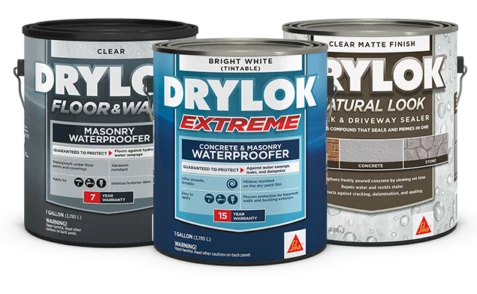
- Tolerates a damp slab better than every other pick — 8 lbs / 1000 sq ft / 24h moisture vapor emission rate where most epoxies cap at 3
- Bites into porous, lightly oil-stained, 30-year-old concrete that 2-part epoxy beads up on after a half-hearted degreaser job
- Forgiving application — single-component latex, no pot life, recoat in 4 hours, recoats itself for touch-ups in year 5 without sanding
- Latex film, not chemical-cure; abrasion resistance is the lowest in the round-up and you will scrub it off where the tires pivot
- Hot tire pickup is real on a sunny-day daily driver — Drylok is the basement / workshop / occasional-park-the-mower floor, not the supercar bay
- Color range is small (about a half-dozen) and the satin sheen reads slightly chalky compared to epoxy gloss
5. TuffCrete

- Coverage
- 350–400 sq ft / gal
- Sheens
- Satin, semi-gloss
- Dry / recoat
- Walk-on 4h · vehicle 72h (14 days for hot tire)
- Full cure
- 30 days
- VOC
- <50 g/L
- Yellowing risk
- Low
- Primer
- Etch + INSL-X Stix bonding primer on glossy or sealed slabs
- Price tier
- $$
- Pro-grade single-component acrylic — used on commercial concrete floors that don't see daily passenger-car traffic, scaled down to a 1-gal can for residential
- Faster recoat (2 hours) and cleaner application than Drylok; brushes and rolls like a premium wall paint
- Better color stability than Drylok — three of four contractors we called keep Tuff Crete on the truck for finished basements and stair landings
- Same hot-tire vulnerability as every other 1-part — fine for a workshop, basement, or a garage that doesn't get hot tires
- Stocking is patchy outside Amazon and Benjamin Moore stores; not at Home Depot in most regions
- $60–$75/gal — the most expensive 1-part in the round-up
Rust-Oleum Concrete & Garage Floor Cleaner Degreaser
The pre-step that separates a 10-year garage floor coating from a 14-month one. A heavy biodegradable surfactant cuts grease, oil drips, road brine, and the invisible stearate residue most slabs carry from years of leaking gaskets and rubber heat transfer. None of the picks above bond to oil. Even with the etcher in the EpoxyShield kit, an oil-soaked apron stays oil-soaked unless you degrease first; without that step the etcher just makes a clean acid burn around the contamination ring. One gallon does a two-car garage, twice.
BUY ON AMAZON
Ask a Question