Epoxy Floor Coatings for Warehouses: Specifier's Guide (2026)
Three multi-coat epoxy systems compared by DFT, service life, and zone use. ICRI CSP profiles, MVE limits, and the contractor path that won't fail inspection.

Disclosure: Affiliate links to retailers and manufacturer-direct programs. Recommendations are spec-driven, not commission-driven.
Use Case
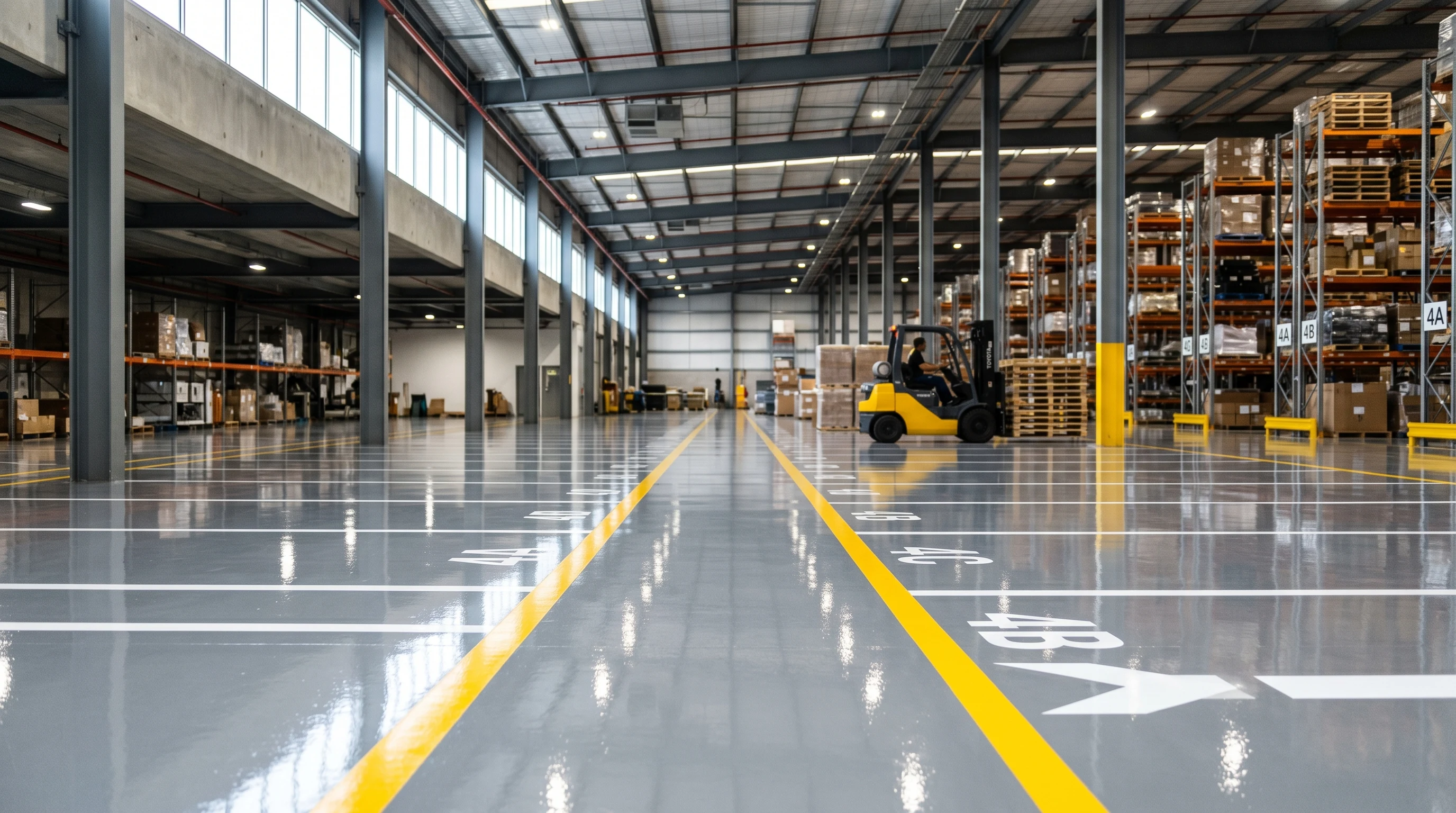
Warehouse epoxy floor coatings serve four primary functions: dust control on bare concrete, abrasion resistance under wheeled traffic, chemical protection from spills, and aisleway / safety striping that holds up to forklift wear. Specified across distribution centers, manufacturing floors, food-processing plants, automotive shops, and cold-storage facilities — though each environment requires a slightly different system.
Service life expectations: 5 years for budget single-coat builds, 7–10 years for the mid-tier two-coat systems, and 15+ years for high-build epoxy or polyaspartic systems with aggregate. Service life is dominated by surface preparation more than topcoat selection — skip the prep and even a premium product fails in 2 years.
Zoned Recommendation Matrix
Warehouses aren’t monolithic. The right system depends on what each zone sees:
| Zone | Recommended system | Why |
|---|---|---|
| Aisleway (forklift) | System B (mid-tier, aggregate broadcast) | Abrasion resistance + OSHA anti-slip |
| Loading dock | System A (premium, high DFT) | Hot-tire pickup, chloride from de-icing |
| Battery charging | System A + chemical-resistant topcoat | Sulfuric acid resistance |
| Cold storage / freezer | Specialty urethane cement, NOT standard epoxy | Sub-zero cure / thermal cycling |
| Restroom / breakroom | System C (budget, smooth finish) | Light traffic, ease of cleaning |
| Painted line striping | Sherwin Setfast or Rust-Oleum 2300 (separate guide) | DOT-grade traffic paint |
Spec Requirements
| Spec | Value |
|---|---|
| Dry film thickness (DFT) | 8–25 mils total, depending on tier |
| Coverage @ DFT | 80–200 sq ft / gal |
| VOC | <100 g/L per coat (CARB / OTC compliant) |
| Standards | ASTM D4060 (abrasion), ASTM F1869 (MVE ≤3 lb/1000sf/24h), ASTM C779 (wear), ASTM D7234 (adhesion) |
| Substrate prep | ICRI CSP 3 for shotblast (most common); CSP 4 if specifying high-build over rough or worn concrete |
| Surface prep | SSPC-SP1 solvent clean + SSPC-SP13 mechanical (shotblast) |
| Service temp | -20°F to +180°F (varies by system; cold storage requires urethane cement) |
| Cure to service | Foot traffic 24h · forklift 7 days · full chemical resistance 14 days |
| OSHA 1910.22 | Static COF ≥0.5 dry; aggregate broadcast required on forklift aisles |
System Chemistry Compared
Before picking specific products, choose the chemistry class for the use case:
| Class | Pot life | Recoat | Service temp | UV stable | $/sq ft installed | Best for |
|---|---|---|---|---|---|---|
| Epoxy (this guide) | 30–45 min | 8–24h | -20°F to 180°F | No (yellows in sun) | $4–9 | Indoor industrial floors |
| Polyaspartic | 15–30 min | 1–2h | -40°F to 200°F | Yes | $8–15 | Fast-turnaround floors, garages |
| Urethane cement | 30 min | 12h | -40°F to 250°F | Yes | $12–25 | Food processing, cold storage |
| MMA | 5–15 min | 1h | -40°F to 200°F | Yes | $14–28 | Continuous-shift facilities |
For a typical dry warehouse aisleway, epoxy is the right answer. For wet-environment food plants, urethane cement. For 24/7 facilities that can’t tolerate >24h downtime, polyaspartic or MMA.
Recommended Systems
System a — Premium, Long-Life
Service life: 12–15 years under forklift traffic. Total DFT 14–19 mils.
| Layer | Product | DFT |
|---|---|---|
| Primer | Sherwin-Williams ArmorSeal 1K HS | 2–3 mils |
| Build coat | Sherwin-Williams ArmorSeal 1000 HS Epoxy | 5–8 mils |
| Topcoat | Sherwin-Williams ArmorSeal 1000 HS (broadcast aggregate optional) | 5–8 mils |
Sherwin-Williams ProIndustrial product page →
System B — Mid-Tier, Value
Service life: 7–10 years under forklift traffic. Total DFT 8–12 mils.
| Layer | Product | DFT |
|---|---|---|
| Primer | Rust-Oleum EpoxyShield Concrete Primer | 2 mils |
| Topcoat | Rust-Oleum EpoxyShield Pro Floor Coating | 6–8 mils |
Rust-Oleum Industrial product page →
System C — Budget / Short-Cycle
Service life: 3–5 years light traffic only. Total DFT 6–8 mils. Acceptable for breakrooms, restrooms, low-traffic storage.
Systems Compared
| System | Total DFT | $/sq ft installed | Service life | Best for |
|---|---|---|---|---|
| A | 14–19 mils | $7–9 | 12–15 yrs | Dock zones, heavy forklift aisles |
| B | 8–12 mils | $4–6 | 7–10 yrs | General warehouse aisleways |
| C | 6–8 mils | $3–4 | 3–5 yrs | Low-traffic zones only |
Cost includes prep (shotblast), primer, build, topcoat, and contractor labor. DIY installation drops cost ~40% but increases failure risk significantly — see contractor path below.
Surface Preparation — Where 70% of the Result Is Decided
Industry data is consistent: an epoxy floor failure investigation almost always traces back to substrate prep, not topcoat selection. The hierarchy of prep methods, weakest to strongest:
| Method | ICRI CSP profile | Cost ($/sf) | Best for |
|---|---|---|---|
| Acid etch (DIY) | CSP 1 | $0.10 | Never specify for industrial — insufficient profile |
| Diamond grinding | CSP 2 | $0.50–$1.00 | Smooth concrete, residential garages |
| Shotblasting | CSP 3 | $0.75–$1.50 | Standard industrial spec — opens pore structure |
| Aggressive shotblast | CSP 4 | $1.00–$2.00 | High-build systems, badly worn floors |
| Scarification | CSP 5–6 | $1.50–$3.00 | Removing old coatings, severe restoration |
Shotblasting to ICRI CSP 3 is the spec for nearly every modern epoxy install. The shotblaster ejects steel shot at the floor, fractures the cement matrix, and exposes aggregate — giving the epoxy a mechanical key to grip. Anything less mechanical (chemical etch, hand-grinding) leaves a sealed concrete surface that the epoxy can only bond to chemically, which is dramatically weaker.
After shotblasting, vacuum twice with HEPA — the first pass for bulk, the second for fines. Solvent-clean per SSPC-SP1 (denatured alcohol or specified solvent — verify with the topcoat manufacturer’s data sheet). Do not pressure-wash; you’ll re-introduce moisture into the substrate and have to wait 48–72 hours for re-dry.
Moisture Testing Is Not Optional
Concrete moves moisture continuously. Epoxy is not vapor-permeable, so vapor that arrives at the underside of the cured coating has nowhere to go — it lifts the coating in disc-shaped blisters or peels at the edges. The two acceptable test methods:
- ASTM F1869 — calcium chloride dome. A pre-weighed dish of calcium chloride sealed to the floor under a plastic dome for 60–72 hours. Re-weigh; calculate MVE in lb/1000sf/24h. Pass: ≤3 lb. Most warehouse floors over 5 years old test 4–8 lb without intervention.
- ASTM F2170 — relative humidity probe. A sleeve drilled into the slab to 40% of slab depth, sealed, equilibrated 72h, then probed with an RH meter. Pass: ≤75% RH. More accurate but slower and more expensive.
If the test fails, install an MVE barrier primer (Sika MVE Stop, ArmorSeal 1K HS, Tnemec Series 218) before the epoxy system. Adds $1–$2/sf and 24h cure time but converts a failure-prone slab into a viable substrate.
Application & Contractor Path
This is not a DIY product class for a working warehouse. Specify a contractor with SSPC-QP1 certification (industrial coatings) or NACE Level 2 inspection credentials. Surface prep alone (shotblasting to ICRI CSP 3) requires equipment most facility crews don’t own. Manufacturer rep network: Sherwin-Williams ProIndustrial reps, Rust-Oleum Industrial distributors, and SSPC contractor lookup database.
For small DIY-scale installs (residential garage, light commercial under 500 sq ft), Rust-Oleum EpoxyShield is the right product class — but expect 3–5 year service life rather than the 7–15 a pro install delivers.
Downtime Planning — What to Tell Operations
Warehouses don’t close easily. Realistic schedule for a 5,000 sq ft section, working 16h shifts:
| Day | Activity | Section status |
|---|---|---|
| Day 0 | Clear section; relocate racking; degrease | Down |
| Day 1 | Shotblast, vacuum, profile inspection | Down (loud, dusty) |
| Day 2 | MVE primer (if needed); cure | Down |
| Day 3 | Build coat | Down |
| Day 4 | Topcoat with aggregate broadcast | Down |
| Day 5 | Light foot traffic OK at 24h post-final | Limited |
| Day 6 | Curing; pallet jacks acceptable at 48h | Limited |
| Day 7 | Forklift traffic acceptable | Operational |
| Day 14 | Full chemical resistance reached | Full |
Sectioning is the standard mitigation: divide a large warehouse into bays, work 5,000–10,000 sf at a time, keep operations running on the rest. Schedule the install for the lowest-volume week of the year (post-holiday for retail DCs, pre-harvest for ag-warehouses, end-of-fiscal-quarter for manufacturers).
Specifier’s Bid Language
Boilerplate language to drop into an RFP for a flooring contractor:
“Provide and install [System B / mid-tier two-coat epoxy] coating system per Sherwin-Williams ArmorSeal specification (or approved equal). Total DFT 8–12 mils. Substrate prep: shotblast to ICRI CSP 3 profile, HEPA-vacuum twice, solvent-clean per SSPC-SP1. ASTM F1869 moisture vapor emission test required prior to coating; if MVE >3 lb/1000sf/24h, install Sika MVE Stop or approved equal barrier primer. Aggregate broadcast in topcoat for OSHA 1910.22 compliance (static COF ≥0.5 dry) on all forklift aisles. Contractor to be SSPC-QP1 certified. Warranty: minimum 5 years on adhesion and wear.”
Adjust System tier and warranty terms per zone. Most reputable contractors will warrant a properly-prepped install for 5–7 years on adhesion (delamination), 3–5 years on wear (abrasion to substrate). Push back on bids that warranty wear at less than 3 years — that’s a tell that the contractor either expects to under-spec the prep or doesn’t trust the product.
Total Cost of Ownership — Beyond Installed Cost
The installed cost ($/sf) is half the picture. Over a 10-year horizon:
| System | Installed $/sf | Year 5 maintenance | Year 10 status | TCO (10yr) |
|---|---|---|---|---|
| A — Premium | $7–9 | Light wash, recoat aisle wear at $1/sf | Still serviceable | $9–11 |
| B — Mid-tier | $4–6 | Topcoat refresh at $2/sf in heavy zones | Aisles need recoat | $7–9 |
| C — Budget | $3–4 | Re-shotblast and recoat at year 4 ($4–5/sf) | Already replaced once | $9–12 |
The budget option costs more over a decade once you account for the failure-and-replacement cycle. Spec System A in zones that justify it (docks, battery rooms), System B for general aisles, System C only where genuinely low-traffic.
A practical reframe for facility managers building the capex case: a $4/sf System B install on 50,000 sf is $200,000. The same area replaced at year 4 because Year-1 prep was inadequate is $400,000+ in re-prep, downtime, and operational disruption. Insist on the prep specification at bid time — it’s where the savings actually live.
Failure Modes & How to Prevent Them
- Delamination from MVE. Concrete with high moisture vapor emission lifts the epoxy off in months. Prevention: ASTM F1869 calcium chloride test before install. If MVE >3 lb/1000sf/24h, install MVE barrier primer.
- Hot tire pickup. Tires lift the topcoat in the dock zone, leaving black rubber mark patterns. Prevention: specify Type II epoxy chemistry (chemical resistance) and avoid budget single-coat systems in tire-contact zones.
- Inadequate surface profile. ICRI CSP 1–2 (light grind) doesn’t give the topcoat enough mechanical bite. Prevention: specify CSP 3 for typical use, CSP 4 for high-build or worn-floor scenarios.
- Application below dew point. Moisture condenses between primer and topcoat, blistering the system. Prevention: dew point ≥5°F below substrate temperature during all coats. Tracked by the contractor’s QC log.
- Chemical attack. General-purpose epoxy fails under sulfuric acid (battery rooms), high-pH cleaners (food processing), or chlorinated chemistry (pool decks). Prevention: specify chemical-resistant topcoat (Carboline Carbozinc, Tnemec Series 240) for those zones.
Where to Buy / Spec
| Channel | Best for | Link |
|---|---|---|
| Manufacturer-direct (S-W Industrial, Rust-Oleum) | Spec’d projects, rep support, warranty | S-W ProIndustrial · Rust-Oleum Industrial |
| Industrial distributor (Sherwin Industrial, Rawlins US) | Bulk, contractor accounts | (regional) |
| Pro retail (Sherwin-Williams stores, BM Pro) | Smaller jobs, local pickup | (S-W store locator) |
| Amazon Business | Small jobs, fleet stocking | (search by manufacturer) |