Product review · Rust-Oleum · Updated August 7, 2026
EpoxyShield Garage Floor CoatingRust-Oleum paint review
7.6/10A genuine two-part epoxy at a consumer film build — worth it on a bare, dry, etched slab you can stay off for three days.
A real two-part epoxy in a box, at about 3 to 4 mils dry. The kit is fine. The slab under it is what decides whether the floor lasts.

Robert Vega · Commercial Coatings Editor · Updated August 7, 2026
Robert spent twelve years in facility engineering specifying floor systems for school districts and light industrial sites before moving to editorial. He judges a garage kit the way he judges a plant floor: prep, film build, and cure to service. About the testing process →
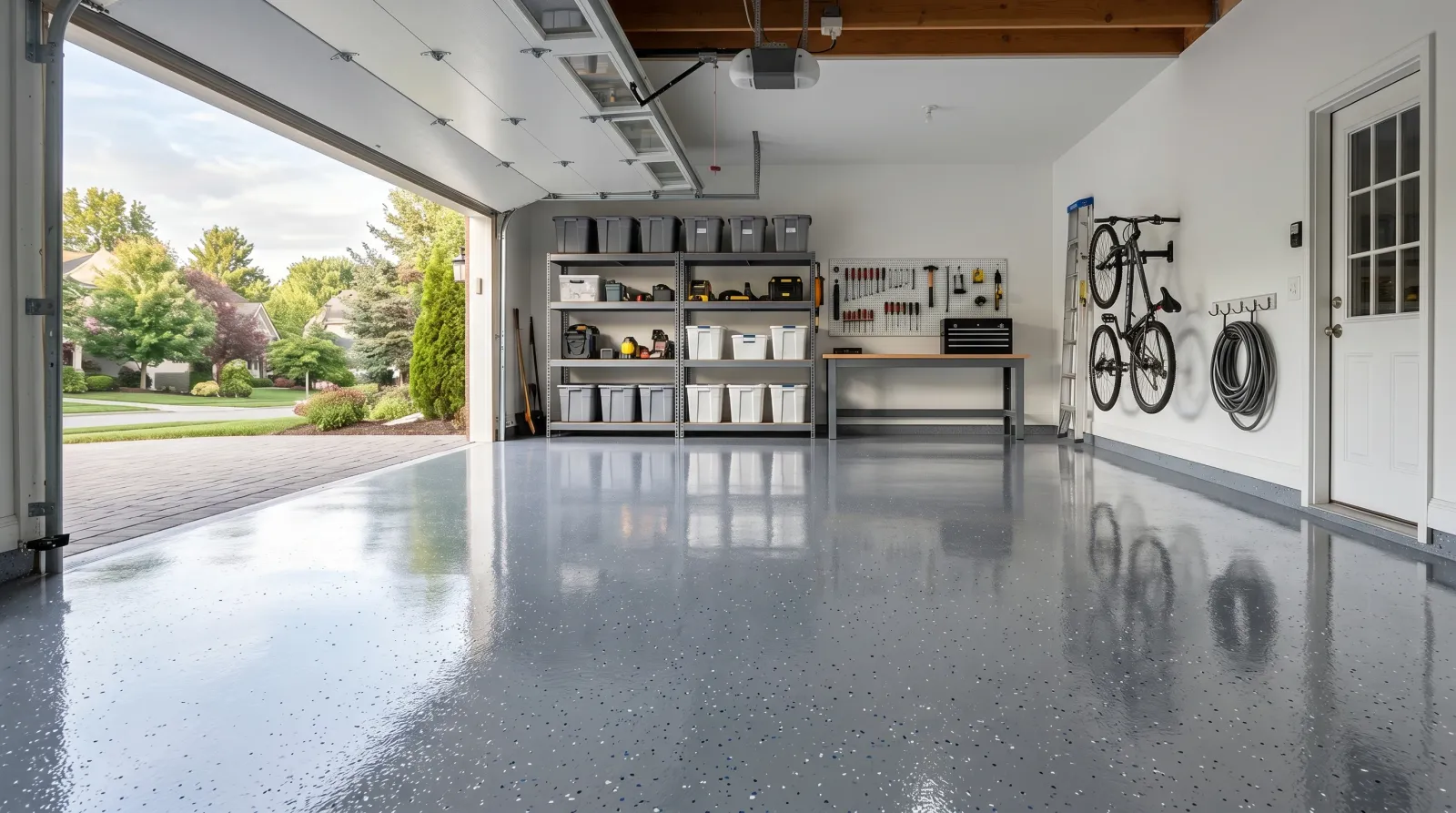
Rust-Oleum EpoxyShield Garage Floor Coating1 sheen
Coverage1-car kit about 250 sq ft
VOCAbout 53 g/L
Sheens High-gloss only
Read this first
The Fast Verdict
Buy it for a bare, uncoated, verified-dry garage slab you can surrender for three days. One 2.5-car kit at $85 to $130 covers a typical 400 to 440 sq ft two-car floor in a single coat, self-primes on etched concrete, and shrugs off oil, gas, antifreeze, and salt once cured. Skip it if the slab fogs a plastic sheet, if it is already sealed or coated, or if a daily driver parks on it hot all summer. The film is only 3 to 4 mils, and that is where it lets go.
Best for
Bare uncoated garage slabs · Basement floors · Verified-dry concrete · Two-car garages on a sub-$130 budget · First-time floor coaters
Skip if
The slab fails a moisture test · Previously sealed or coated concrete · You cannot give up the garage for three days · Daily-driver floors that run hot · Unheated space below 50F
What it's good at
- Self-priming on a properly etched bare slab with nothing extra to buy
- Real chemical resistance once cured — motor oil, gasoline, antifreeze, and road salt wipe up
- Covering a typical 400 to 440 sq ft two-car garage from one 2.5-car kit in a single coat
- Water cleanup and a livable smell at about 53 g/L, so the door only needs cracking
- Decorative flecks that hide roller texture and slab flaws a first-timer leaves behind
- A forgiving roll with a two-hour pot life, which is generous for a two-part product
- Price per square foot — roughly $0.20 to $0.30 for a glossy, oil-resistant floor
What it's not good at
- Hot-tire pickup on a daily-driver floor, where 3 to 4 mils is thin
- Slabs with moisture vapor emission — there is no vapor barrier in the film
- Previously sealed, coated, or burnished concrete that will not take the etch
- Schedule — three full days before a vehicle, longer in a cool garage
- Cold weather; below about 50F it does not cure at all
- Sheen choice, since high-gloss is the only option and it telegraphs every scuff
- Spot touch-ups, which flash a different gloss against the cured floor
Same shelf, different cans
Which EpoxyShield Kit Are You Buying?
The EpoxyShield name spans more than one box, and grabbing the wrong one is the common landing mistake. This review covers the standard two-part water-based garage floor coating kit. Match the box to the job before you match it to the price.
EpoxyShield Garage Floor Coating (this review)
Base2-part water-based epoxy, tan or gray, flecks included
Buy it if
Bare or uncoated interior concrete and you want one colored coat that covers the slab.
Avoid if
The floor is already sealed, coated, or holding moisture. Nothing in this box fixes that.
EpoxyShield Garage Floor Coating Tint Base
BaseSame kit, custom-tinted at the counter
Buy it if
You need a color outside the stock tan and gray.
Avoid if
Stock gray is fine, in which case you are paying for a tint step you do not need.
EpoxyShield Premium Clear Coating
BaseClear top-coat over the colored base
Buy it if
You want extra gloss and wear depth over a finished base coat.
Avoid if
You expected color. This is a top-coat, not a floor. It is sold separately and adds a day.
EpoxyShield Professional Floor Coating
BaseHigher-solids two-coat consumer-pro hybrid
Buy it if
You want thicker build than the standard kit and will spend the extra day on a second coat.
Avoid if
The schedule is tight. It is a longer job than the single-coat kit.
Rust-Oleum RockSolid
BasePolycuramine burst-pouch kit, not epoxy
Buy it if
You need a harder film and want to park in about 24 hours.
Avoid if
You want a forgiving roll and an easy recoat later. The pouch runs on a clock you cannot pause.
Numbers, not adjectives
Spec Sheet
- Type
- 2-part water-based epoxy, roughly 2-hour pot life
- Coverage
- 1-car kit about 250 sq ft; 2.5-car kit up to 500 sq ft, one coat
- Film build
- About 3 to 4 mils dry, single coat
- Sheen
- High-gloss only
- Foot traffic
- 12 to 16 hours
- Heavy items
- 24 to 48 hours
- Vehicle traffic
- 3 full days minimum at 70F
- VOC
- About 53 g/L; no GREENGUARD or CARB certification listed
- Primer
- Self-priming on etched, profiled bare concrete; no separate primer in the kit
- Surfaces
- Bare or uncoated interior concrete only
- Sizes
- 1-car, 2-car, and 2.5-car kits
- Price
- $85–130 per 2.5-car kit, roughly $0.20–0.30 per sq ft
Application Settings That Work
- Brush
- Roll it with a 3/8-inch nap roller and cut the perimeter in first with a brush, working one bay at a time so you keep a wet edge. Broadcast the decorative flecks into the coat while it is still wet. You have about two hours of pot life after mixing, so have the whole floor staged, taped, and clear before Part A meets Part B.
- Primer
- There is no separate primer, and none is needed on a properly etched slab. Degrease first, then etch with the citric-acid pack until the surface feels like fine sandpaper — a light ICRI CSP-1 to CSP-2 profile. Rinse and let it dry fully. If the concrete beads water, it is sealed and it is not ready. Run a 24-hour plastic-sheet moisture test before any of this.
Cure to Service: Three Days, Not Overnight
Plan the job around the cure, because this is where most EpoxyShield floors are lost. Light foot traffic returns at 12 to 16 hours. Heavy items go back at 24 to 48. Vehicle traffic waits three full days, and that number is measured at 70F. A cool spring garage stretches every stage, and below about 50F a water-based epoxy does not cure at all. The floor will feel hard long before it is. Parking on day two is the single most common way people ruin a bond that was otherwise fine, and the tire patches are where the failure shows up first.
Mid-project panic
When It Goes Wrong, and How to Fix It
Coating lifts at the tire contact patches
Why it happens. Hot-tire pickup on a 3 to 4 mil film. Hot summer tires soften the coating and peel it wherever adhesion was already marginal, which is almost always a spot that was not fully etched or was still passing moisture. The film does not fail on its own; it fails where the prep failed.
The fix. Etch the whole slab with the supplied citric-acid pack until the surface feels like fine sandpaper, rinse, and let it dry completely. Confirm the concrete is dry before you mix anything. Then give it the full three-plus days before a car touches it. If the garage parks a daily driver that runs hot all summer, specify RockSolid or a polyaspartic instead — they cure harder.
Bubbles, blisters, or wholesale delamination
Why it happens. Moisture vapor emission pushing up through the slab. EpoxyShield is a topical film with no vapor barrier in it, and no kit coating stays bonded over a slab that is still passing water from below. The box includes no moisture test, so nothing stops you from coating a bad candidate.
The fix. Tape a plastic sheet flat to the slab for 24 hours and check the underside for condensation. Dry plastic, proceed. Foggy plastic, stop — you have a vapor problem this kit will not solve, and the answer is a moisture-tolerant system, not a second coat.
Ran out of material partway across the floor
Why it happens. The kit ratings assume a smooth slab. Broom-finished or porous concrete drinks more, and there is no way to stretch a mixed batch once the pot life is running.
The fix. Measure the slab first. One 2.5-car kit covers up to 500 sq ft smooth, which fits most two-car garages at 400 to 440 sq ft. Over 450 sq ft, or a slab that reads thirsty, buy a second kit rather than spreading the first one thin. Thin coverage is a top failure mode, not a saving.
The floor stays soft or never hardens
Why it happens. Temperature. This is a water-based epoxy, and the cure schedule is written at 70F. An unheated garage in spring or fall stretches every stage, and below about 50F the chemistry stalls out entirely.
The fix. Coat inside the temperature window and hold the garage above 50F through the whole cure, not just during application. If you cannot heat the space, wait for the season. There is no additive that buys you a cold-weather cure on this product.
A touch-up patch reads glossier than the floor around it
Why it happens. High-gloss single-coat film. A spot repair lays down at a different thickness than the cured surface beside it, and the gloss flashes the difference under raking light.
The fix. Recoat to a natural break — a full bay, a full lane, wall to wall — rather than dabbing a spot. Accept that spot repairs on this floor are a compromise, and keep the touch-up for damage you can live with seeing.
Side by side
EpoxyShield vs RockSolid vs a Polyaspartic Kit
These three sit on the same shelf and answer the same question at different tiers. The deciding factors are film hardness and how long the garage stays out of service, not the color chart.
| EpoxyShield | RockSolid | Polyaspartic 1-Day Kit | |
|---|---|---|---|
| Chemistry | 2-part water-based epoxy, mixed in a bucket | Polycuramine in a two-part burst pouch | Polyaspartic, pro-DIY kit format |
| Film build | About 3 to 4 mils dry, single coat | Thicker and denser than the water-based epoxy | The toughest film of the three |
| Back to vehicle traffic | 3 full days at 70F, longer when cool | About 24 hours | Same evening |
| Hot-tire resistance | The weak point; lifts where adhesion was marginal | Better — the harder cure resists it | Best, and it handles UV and temperature swings too |
| Ease of application | Most forgiving. Two-hour pot life, water cleanup | Messier pouch mixing and a short working time; you commit to the whole floor at once | Demands the most precise prep and timing |
| Recoating later | Easiest of the three | Harder — patches flash | Hardest, and least forgiving of a mistake |
| Price | $85–130 per kit | $150–250 per kit | $200–400 per kit |
Chemistry
EpoxyShield2-part water-based epoxy, mixed in a bucket
RockSolidPolycuramine in a two-part burst pouch
Polyaspartic 1-Day KitPolyaspartic, pro-DIY kit format
Film build
EpoxyShieldAbout 3 to 4 mils dry, single coat
RockSolidThicker and denser than the water-based epoxy
Polyaspartic 1-Day KitThe toughest film of the three
Back to vehicle traffic
EpoxyShield3 full days at 70F, longer when cool
RockSolidAbout 24 hours
Polyaspartic 1-Day KitSame evening
Hot-tire resistance
EpoxyShieldThe weak point; lifts where adhesion was marginal
RockSolidBetter — the harder cure resists it
Polyaspartic 1-Day KitBest, and it handles UV and temperature swings too
Ease of application
EpoxyShieldMost forgiving. Two-hour pot life, water cleanup
RockSolidMessier pouch mixing and a short working time; you commit to the whole floor at once
Polyaspartic 1-Day KitDemands the most precise prep and timing
Recoating later
EpoxyShieldEasiest of the three
RockSolidHarder — patches flash
Polyaspartic 1-Day KitHardest, and least forgiving of a mistake
For a clean, dry, uncoated two-car garage where the budget matters more than the calendar, EpoxyShield is the right rung and the extra $100 buys you nothing you need. If a daily driver parks on that slab hot every summer day, step to RockSolid — the harder cure and the 24-hour return to service are worth the money on a floor that gets used. If downtime is the real constraint and the garage has to be back the same evening, the polyaspartic kit is the only one of the three that does it, and it demands the tightest prep discipline in exchange.
If not this one
Honest Alternatives
SP
Single-part garage floor paint$30–50 / gal
A one-part epoxy-fortified floor paint costs a third of the kit and skips the mixing entirely. You give up most of the chemical and tire resistance and all of the gloss depth. The right call for a low-traffic shed, basement, or workshop where appearance and oil resistance are not the goal.
RO
Rust-Oleum RockSolid Polycuramine$150–250 / kit
The upgrade inside the same brand. Cures harder and faster, parks in about 24 hours, and resists hot-tire pickup better. The burst-pouch mixing is messier and the working time is short, so you commit to the whole floor in one session.
Full review →P1
Polyaspartic 1-Day Kit$200–400 / kit
Cures fast enough to park the same evening, handles UV and temperature swings better, and builds a tougher film. It costs the most and demands the most precise prep and timing. Specify it when downtime is the constraint or the garage runs hot.
Questions people actually ask
EpoxyShield Garage Floor Coating Questions, Answered
Is EpoxyShield worth it?
On a bare, dry, properly etched slab you can stay off for three days, yes. An $85 to $130 kit covers a two-car garage and gives you a high-gloss floor that shrugs off oil, gas, antifreeze, and salt. It is not worth it if the slab has a moisture problem, if it is already sealed or coated, or if you park a daily driver on it through hot summers, because the 3 to 4 mil film is thin and hot tires lift it wherever adhesion was marginal.
Is EpoxyShield real epoxy or just floor paint?
It is a real two-part epoxy. You mix Part A resin with Part B hardener and get about a two-hour pot life. It is water-based, so it is milder and thinner than the solvent 100% solids epoxy a contractor sprays, and the cured film runs roughly 3 to 4 mils against 8 to 10 for a pro system. It is epoxy, just a thin consumer build that sits well above single-can floor paint.
Will EpoxyShield handle hot tire pickup?
With correct prep, yes. Hot-tire failures on this product trace almost entirely to a skipped etch or a damp or contaminated slab. Tires soften the bond and lift the coating where adhesion was marginal to begin with. Etch with the supplied citric-acid pack, confirm the slab is dry, and let it cure the full three-plus days before parking. Cut any corner and the tires will find it.
How many kits do I need for a two-car garage?
One 2.5-car kit covers up to 500 sq ft on a smooth slab, which fits most two-car garages at 400 to 440 sq ft. Porous or broom-finished concrete drinks more, so buy a second kit if your slab runs over 450 sq ft or looks thirsty. You cannot stretch a kit — thin coverage is a top failure mode.
How long before I can park on it?
Light foot traffic at 12 to 16 hours, heavy items at 24 to 48 hours, and vehicle traffic at three full days minimum, measured at 70F. Below 70F the cure slows, and a water-based epoxy will not cure at all below about 50F. Parking early is the most common way people ruin the bond.
How do I know if my slab is dry enough to coat?
Tape a plastic sheet flat to the concrete and leave it 24 hours. Lift it and look at the underside and the slab beneath. Dry means you can proceed. Condensation or a darkened patch means the slab is passing moisture vapor, and no topical coating stays bonded over that. The kit includes no moisture test, so this check is on you.
Can I use EpoxyShield over a sealed or previously painted floor?
No. This coating is specified for bare or uncoated interior concrete, and it needs an etched, open profile to key into. A sealed, painted, or burnished slab blocks that. If water beads on the surface instead of soaking in, the floor is not a candidate until it is mechanically ground or stripped back to bare concrete.
Does EpoxyShield work on a basement floor?
Yes, basement slabs are a listed surface and the low odor at about 53 g/L makes an enclosed space workable with modest ventilation. The moisture question matters more below grade than in a garage, though. Run the 24-hour plastic-sheet test, because a basement slab passing vapor is the single most likely reason the coating lets go.
EpoxyShield or RockSolid — which Rust-Oleum kit is better?
RockSolid is the polycuramine kit, sold in burst pouches, and it cures harder and faster. You park in about 24 hours and it resists hot tires better. EpoxyShield is cheaper, more forgiving to apply, and easier to recoat later. For a daily-driver two-car garage, RockSolid is the tougher pick. For budget and ease on a floor that mostly gets walked on, EpoxyShield.
Do I need the clear top-coat?
Not for the coating to work. The Premium Clear adds gloss and wear depth over the colored base, but it is sold separately and it adds a day to the schedule. Buy it if the floor is a showpiece or takes heavy foot traffic. Skip it if the budget and the calendar are the reason you chose this kit in the first place.
Keep exploring
Rust-Oleum brand hub and product line guideBest garage floor paint and coatings round-upDry time vs cure time explained
We may earn a commission when you buy through the retailer link above. It never changes the score or the verdict.
Ask a Question