Dixie Belle vs Annie Sloan Chalk Paint
Dixie Belle vs Annie Sloan chalk paint, tested on coverage, durability, sealing, and price. Which one wins for furniture, cabinets, and a tight budget.

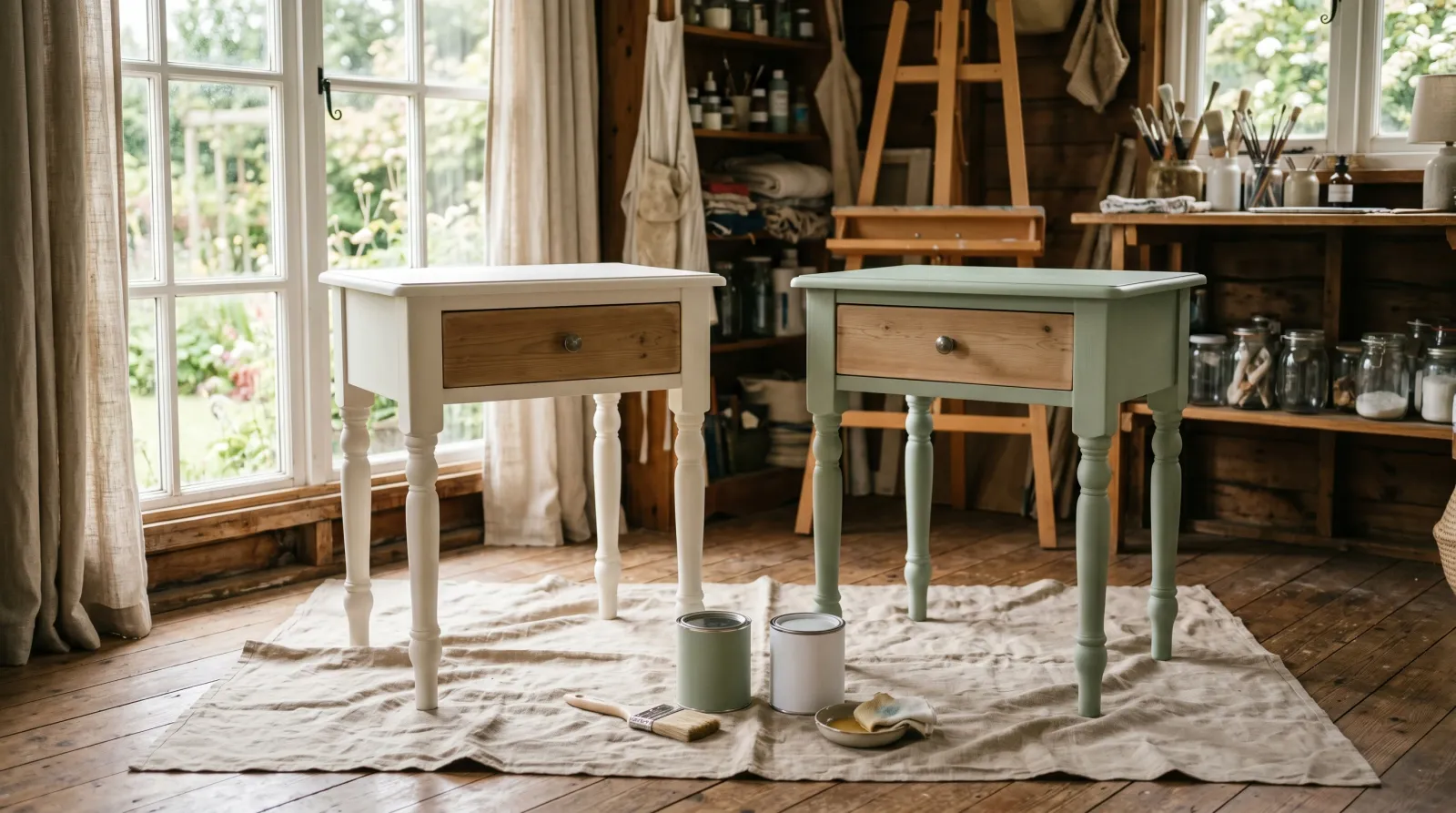
The 30-Second Answer
For most furniture flips, Dixie Belle. It covers in fewer coats, costs roughly half per quart, ships to your door, and its water-based topcoats hold up better on anything that gets wiped down. Annie Sloan wins when color depth and the original wax finish matter more than the bill. Its deep tones read richer, the Soft Wax is the better wax, and a stockist near you lets you see the real shade before you commit. The trade-off is price and access. On a $40 thrift dresser, Dixie Belle. On an heirloom you’ll keep for thirty years, Annie Sloan earns its premium.
At a Glance
| Dixie Belle | Annie Sloan | |
|---|---|---|
| Type | Chalk mineral paint | Original chalk paint |
| Coverage | ✓✓ (often 1–2 coats) | ✓ (usually 2 coats) |
| Color depth on deep tones | ✓ | ✓✓ |
| Self-sealing | ~ (lightly) | ✗ (needs wax/lacquer) |
| Topcoat options | Wax, clear coat, Gator Hide | Soft Wax, lacquer |
| Where to buy | Direct online, some retailers | Stockists, brand site |
| Price (quart / 32 oz) | ~$36 | ~$45 (chalk paint, 1 liter) |
| Best for | Budget flips, cabinets, big pieces | Heirlooms, color purists |
A note on sizing, because it trips up the price comparison. Dixie Belle sells a 32-oz quart for around $36. Annie Sloan sells a 1-liter tin, about 34 oz, for around $45. Close enough to compare quart to quart, but Annie Sloan runs about $9–12 more for a similar volume before you add wax.
How to Tell Which One You’re Looking At
Walk up to a painted piece and you can usually call it.
Annie Sloan reads chalkier and more matte out of the can, with a powdery hand-feel before it’s sealed. The deep colors, especially the blues and reds, have a depth that’s hard to fake. Dixie Belle dries a hair tighter and a touch less powdery because of its mineral binder. The tell is in the leftover can: Annie Sloan’s color names (Old White, Graphite, Florence) are distinctive, and Dixie Belle’s (Drop Cloth, Cotton, Caviar) are its own. If there’s no can, rub a damp cloth on a hidden edge. Raw chalk paint lifts pigment until it’s sealed, and both do this unsealed. A surface that resists the damp cloth already has a topcoat.
Coverage and Hide
This is where Dixie Belle earns its budget reputation.
Dixie Belle’s mineral formula carries a heavier pigment load than classic chalk paint, and it shows. On a mid-tone oak dresser going to Drop Cloth (a soft greige), I pulled solid coverage in two coats with no primer and no sanding, and the lighter areas were nearly there after one. White-over-dark is the hard test for any chalk paint, and Dixie Belle’s Cotton buried a walnut stain in two coats where I expected three.
Annie Sloan usually wants two coats for the same result, sometimes a third on the toughest white-over-dark jobs. Old White over a dark mahogany piece needed a full three coats to stop the wood reading through. The paint is thick and lays down well, but the hide per coat is a step behind Dixie Belle. On the deep colors the gap closes. Napoleonic Blue covers in two clean coats because the pigment is dense to begin with.
For a large piece, the coat count is money and time. A dining table or a tall armoire in Dixie Belle might save you a whole coat, which on a big surface is an hour of work and a chunk of the can.
Winner: Dixie Belle.
Finish and Color
Annie Sloan takes this one, and it’s not close on the deep tones.
The original chalk paint was built by a decorative artist, and the color development shows. Emperor’s Silk reads as a true, deep, slightly warm red without going pink or brick. Napoleonic Blue has a saturated navy depth that most competitors flatten out. Aubusson Blue, Graphite, and the off-whites are reference shades that other brands openly try to match. If your project lives or dies on getting a specific rich color exactly right, Annie Sloan’s deck is the safer bet, and the stockist model means you can see a hand-painted sample board before you buy.
Dixie Belle’s palette is large, modern, and well-curated, with strong neutrals and a deep range of its own. Caviar is a genuinely good near-black. The whites and greiges are excellent for the farmhouse and coastal looks most flippers are after. Where Dixie Belle lags is the very deepest jewel tones. Its richest reds and blues are good, not gallery-deep, and a side-by-side against Emperor’s Silk shows it.
Both dry to a flat, chalky matte. Sheen isn’t a differentiator here. If you want a less powdery look after sealing, that comes down to the topcoat, not the paint.
Winner: Annie Sloan.
Durability and Sealing
Chalk paint is porous and soft until it’s sealed, so this dimension is really about the topcoat system. That’s where Dixie Belle pulls ahead.
Dixie Belle is slightly self-sealing thanks to its mineral binder, and more important, its water-based topcoats are excellent. Gator Hide is a wipeable, water-resistant clear that turns a chalk-painted surface into something you can use on a kitchen table or a bathroom vanity without babying it. Its standard clear coat is also water-based, dries fast, and doesn’t yellow. For anything that gets daily contact, this system holds up.
Annie Sloan was designed around wax, and Soft Wax is the better wax of the two: it buffs to a soft sheen and deepens the color. The catch is that wax is a maintenance finish. It needs re-application over time, it can go soft in heat, and it struggles on high-use surfaces. Annie Sloan does sell a lacquer topcoat for high-wear pieces, which works well, but it’s a separate product at additional cost and less forgiving to apply than Gator Hide.
For a decorative accent piece you’ll wax and admire, Annie Sloan’s finish is the more beautiful one. For a cabinet, a tabletop, or a kid’s dresser that takes abuse, Dixie Belle’s sealing system wins on durability and on ease of getting it right. If you’re weighing the broader sealer question, the wax vs polycrylic topcoat comparison covers the durability gap in detail.
Winner: Dixie Belle on durable surfaces. Annie Sloan on a waxed showpiece.
Ease of Use
Both grip without sanding, both brush like a dream, and both forgive a beginner. The differences are at the edges.
Dixie Belle dries fast, sometimes too fast in a warm room, so you work in smaller sections and keep a wet edge. Its self-leveling is good, and brush marks soften as it dries. The water-based topcoats are beginner-friendly: brush or wipe Gator Hide on, let it cure, done. No buffing.
Annie Sloan is thicker and has a slightly longer open time, which makes it more forgiving for distressing and blending colors wet. The wax step is where beginners struggle. Applying wax evenly, wiping back the excess, and buffing to the right sheen takes practice, and an over-waxed surface stays tacky and streaky. For a first-timer who just wants a dresser sealed and done, the wax route adds a learning curve that Dixie Belle’s wipe-on clear coat skips.
If you’re distressing and layering colors for a vintage look, Annie Sloan’s longer working time is a real advantage. For a clean, modern, sealed-and-stop finish, Dixie Belle is the lower-effort path.
Winner: Dixie Belle for beginners. Annie Sloan for decorative technique.
Cost per Project
Run the real numbers on a single dresser and the gap is obvious.
A mid-size dresser takes roughly a quart with either paint. Dixie Belle: about $36 for the quart, plus around $30 for Gator Hide if you want a durable seal, so call it $66 fully sealed. Annie Sloan: about $45 for the liter, plus around $30 for a tin of Soft Wax, so roughly $75 waxed. Both topcoats do several pieces, so on the paint alone Dixie Belle saves about $9–12 per project.
Annie Sloan’s cost climbs with the sample-first habit the stockist model encourages. Buy a sample pot to test, then the full liter, then the wax, and a single project creeps toward $85–90. Dixie Belle’s direct-to-door pricing and frequent multipacks make stocking a range cheaper, which matters if you flip in volume.
The honest caveat is shipping. Dixie Belle is online-first, so a small order can carry a shipping charge that narrows the gap. If you have an Annie Sloan stockist in town and no Dixie Belle retailer nearby, the no-shipping math can tilt back toward Annie Sloan for a one-off piece.
Winner: Dixie Belle.
Verdict by Use Case
- Pick Dixie Belle if: you flip furniture on a budget, the piece is large and the coat count matters, you’re painting cabinets that need a wipeable seal, you want a beginner-friendly wipe-on topcoat instead of wax, or you’d rather order direct.
- Pick Annie Sloan if: the piece is an heirloom you’ll keep for decades, the project depends on a specific deep jewel tone, you love the buffed-wax finish, you’re distressing and want longer working time, or you have a stockist nearby and want to see the real color first.
- It’s basically a tie when: you’re painting a low-traffic decorative piece in a neutral color that you’ll wax and admire. Both look great, both grip without sanding, and the choice comes down to which can you can get faster.
Top Picks by Side
Going with Dixie Belle? It’s a regular winner in our furniture testing for exactly the reasons above: coverage, sealing, and price. See where it lands against the field in the best chalk paint round-up, and for the broader furniture-finish picture the best furniture paint guide covers it against milk paint, mineral paint, and cabinet enamels.
Going with Annie Sloan? If it’s the original chalk-paint romance you’re after, the best chalk paint round-up ranks it against Dixie Belle and the rest. If you’re drawn to the matte, time-worn look but want to weigh the older-school option, the best milk paint guide is the next read, and the chalk paint vs milk paint comparison sorts the two by project.
FAQ
Is Dixie Belle really chalk paint or chalk-style paint? It’s a chalk-style mineral paint, not the original Annie Sloan formula. In use it behaves like chalk paint: matte, thick, grips raw and slick surfaces with little to no sanding. The mineral binder makes it slightly more self-sealing. For a DIY dresser you won’t notice a category difference. You’ll notice fewer coats.
Can I use regular furniture wax over Dixie Belle? Yes, any quality clear furniture wax works. But Dixie Belle’s water-based topcoats beat wax on anything that gets wiped down, so on a table or cabinet, use Gator Hide instead. Annie Sloan’s Soft Wax is the better wax if wax is the look you want.
Why is Annie Sloan so much more expensive? The original formula is made in England and sold through a stockist network, which adds a margin layer Dixie Belle skips by selling direct. You’re also paying for color depth on the deep tones. Worth it on an heirloom, less so on a thrift-store flip.
Do I have to sand before either paint? Usually no. Both grip raw wood, old finishes, and most slick surfaces on a clean, degreased surface. Glossy laminate, previously waxed pieces, and high-gloss factory finishes still want a scuff or a bonding step. The deglosser vs sanding breakdown covers the prep call on a tricky piece.
Related
- Best chalk paint round-up: every brand tested, with Dixie Belle and Annie Sloan ranked
- Best milk paint for furniture: the older matte finish, compared
- What is chalk paint?: the matte furniture finish explained
- Chalk paint vs milk paint: which matte finish for which project
- Wax vs polycrylic topcoat: sealing chalk paint for durability