OSHA Safety Color Sign Paint: Specifier's Guide (2026)
OSHA safety colors and sign paint compared by ANSI Z535 spec, DFT, VOC, and substrate prep. Safety red, yellow, green, and blue matched to the right industrial enamel for steel, concrete, and pipe.

Disclosure: Affiliate links to retailers and manufacturer-direct programs. Recommendations are spec-driven, not commission-driven.
Use Case
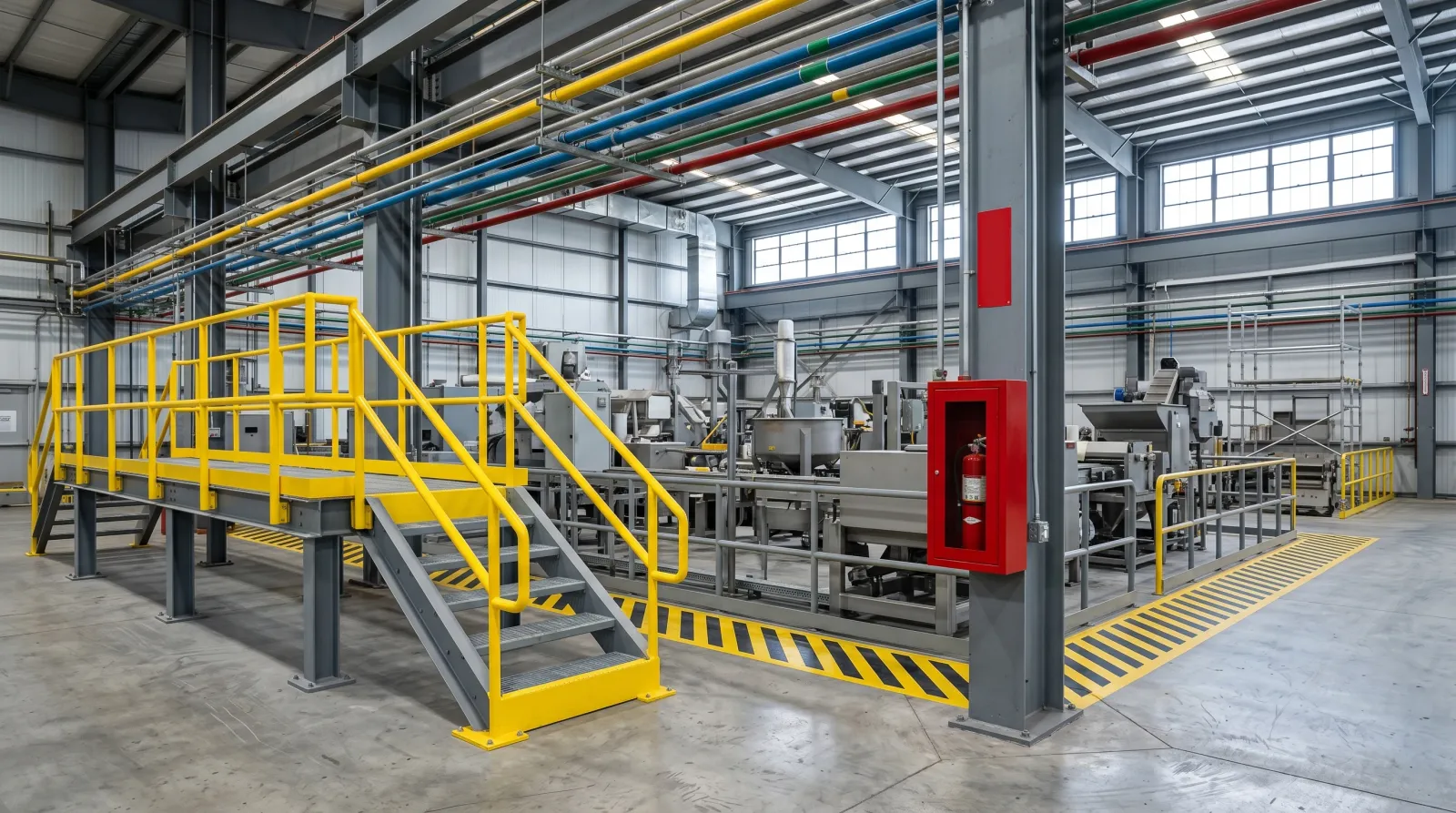
OSHA safety-color sign paint is the marking system that turns a federal color code into something a worker reads at a glance and an inspector measures with a chip. The work covers fire-equipment panels, guardrails and handrails, machine-guard edges, lockout points, first-aid stations, exposed hazards, and the color banding on process piping. The substrate is almost always steel, concrete, or masonry inside a manufacturing plant, warehouse, utility, or institutional facility. The authority is OSHA 1910.144 for the color code itself and OSHA 1910.145 for accident-prevention signs and tags, both of which reference the ANSI Z535.1 safety color standard and its Munsell notations.
This is not decorative paint. A red that drifts orange, a yellow that has faded to buff, or a hazard marking worn through to bare steel is a citation at the next OSHA walkaround and a finding at the next insurer loss-control visit. The spec writer’s job is to match each marking to its defined color, pick an enamel that holds that color against UV and abrasion for the service interval, and write the exact product and color name into the facility paint standard so that the touch-up done three years from now still matches.
Service life runs 7–12 years on interior conditioned steel with a two-coat direct-to-metal enamel. High-abrasion safety yellow (guardrails, stair edges, forklift-contact zones) wears in 3–5 years from mechanical contact rather than coating failure. Exterior and coastal markings need a UV-stable system and a salt-spray-rated primer, and they fade faster. The marking is not a walking-working surface, so OSHA 1910.22 anti-slip coefficient-of-friction requirements do not apply here; for painted floor walkways and stripes, that requirement governs and the chemistry changes.
Spec Requirements
The spec block earns the trust. The color target is the part most generalists miss.
| Spec | Value |
|---|---|
| Dry film thickness (DFT) | 2.5–5 mils dry per coat; 5–8 mils dry total in a two-coat enamel system |
| Coverage @ DFT | 250–350 sq ft/gal per coat (waterborne DTM); verify against the data sheet for the color |
| VOC | under 100 g/L waterborne DTM (CARB / SCAQMD / OTC compliant); 250–340 g/L solvent-borne alkyd under SCAQMD Rule 1113 industrial maintenance category |
| Color standard | ANSI Z535.1 Munsell notation per color; OSHA 1910.144 color code; ASTM D2244 color tolerance vs reference chip |
| Gloss | ANSI Z535.1 recommends matte to semi-gloss for signs to limit glare; ASTM D523 60-degree gloss verifies |
| Adhesion | ASTM D3359 tape (Class 4B–5B) or ASTM D4541 pull-off (≥200 psi on steel) |
| Substrate prep — maintenance steel | SSPC-SP2 hand tool or SSPC-SP3 power tool clean; remove loose rust, oil, mill scale |
| Substrate prep — new structural steel | SSPC-SP6 commercial blast for a primer-plus-color system |
| Substrate prep — concrete / masonry | ICRI CSP 2 profile minimum; clean, deglossed, no laitance or curing compound |
| Service temp (interior signage) | -20°F to 200°F dry service for standard DTM enamel |
| Ambient at application | 50°F to 90°F; relative humidity under 85% |
| Cure to service | Touch-dry 1–2 hours; recoat 4–6 hours waterborne, overnight for alkyd; full cure 7 days |
| Dew point margin | substrate at least 5°F above dew point during application and cure |
The color standard is the line item that separates a compliant marking from a citation waiting to happen. ANSI Z535.1 anchors each safety color to a Munsell notation: safety red sits near 7.5R 4/14, safety yellow near 5Y 8/12, safety green near 7.5G 4/8, safety blue near 2.5PB 4/10. A loss-control inspector or a safety auditor checks against the reference chip, not by eye. Specifying “red” gets you whatever red the painter had on the shelf, and hardware-store red drifts orange. Specify the manufacturer’s OSHA Safety color by name and require ASTM D2244 tolerance against the reference.
Substrate prep is the second number that decides whether the marking lasts. On maintenance steel that already carries a sound coating, SSPC-SP2 or SP3 to knock down loose rust and degloss the surface is enough for a direct-to-metal enamel. On bare new structural steel, SSPC-SP6 commercial blast plus a primer is the spec. On concrete and masonry, the ICRI CSP 2 profile and removal of laitance and curing compound is required, not optional; safety yellow painted over a slick troweled curing-compound surface peels in a season.
System Chemistry Compared
Pick the chemistry first, then the color line within it.
| Class | Recoat window | Service temp | UV stability | $/sq ft band | Best for |
|---|---|---|---|---|---|
| Waterborne DTM acrylic | 4–6 hr | -20°F to 200°F | Good | $0.35–0.65 | Interior steel signage, guardrails, in-house application |
| Solvent-borne alkyd DTM enamel | Overnight | -20°F to 250°F | Fair (chalks) | $0.30–0.55 | Maintenance steel where solvent ventilation is available |
| Two-component epoxy | 6–24 hr | -20°F to 250°F | Poor (ambers, needs topcoat) | $0.80–1.40 | Chemical exposure, immersion-adjacent, secondary containment |
| Aliphatic polyurethane topcoat | 6–12 hr | -40°F to 250°F | Excellent | $0.70–1.20 (over a primer/build) | Exterior and coastal color retention, color-critical UV exposure |
Waterborne DTM acrylic is the right answer for most interior facility marking. It ships under 100 g/L, applies by brush, roller, or small gun without solvent ventilation, holds the OSHA color well indoors, and recoats the same shift. Solvent-borne alkyd enamel still has a place on maintenance steel where the surface is greasy and the alkyd’s better wetting matters, but it chalks faster under UV and it runs into Rule 1113 limits in California and OTC states.
Two-component epoxy is over-spec for a wall sign and under-spec for UV. Epoxy ambers and chalks outdoors; it earns its place only where the marking also has to resist chemical splash or sits inside a secondary-containment area. For exterior and coastal color-critical work, the answer is a primer, the safety-color coat, and an aliphatic polyurethane clear or pigmented topcoat for UV color retention. That stack keeps safety red from going pink and safety yellow from going buff through a full inspection cycle.
Recommended Systems
Three systems at different price-performance points. System A is the waterborne interior default, System B is the solvent-borne maintenance enamel, System C is the low-VOC waterborne enamel for California and OTC work. Verify the exact OSHA color name against the manufacturer’s color card before order.
System a — Sherwin-Williams Pro Industrial DTM Acrylic (waterborne Interior Default)
The facility-marking standard. Direct-to-metal, under 100 g/L, holds the OSHA color indoors and recoats the same shift.
| Layer | Product | DFT |
|---|---|---|
| Surface prep | SSPC-SP2/SP3 clean on steel; degloss and clean on concrete | — |
| Primer (bare metal) | Pro Industrial Pro-Cryl Universal Primer | 2–4 mils |
| Color coat | Pro Industrial DTM Acrylic in OSHA Safety Red / Yellow / Green / Blue | 2.5–4 mils |
| Total | 5–8 mils |
Sherwin-Williams Pro Industrial DTM Acrylic product page · Search on Amazon
On a tight, sound, deglossed surface the DTM goes straight on without the separate primer. On bare or rusted steel the Pro-Cryl primer earns its coat; skip it and the color coat lifts at the first thermal cycle. Two color coats for full hide on safety red and safety yellow, which are the two hardest colors to cover in one pass.
System B — Rust-Oleum High Performance V7400 DTM Alkyd Enamel (solvent Maintenance)
Direct-to-metal alkyd for greasy maintenance steel where the alkyd’s wetting beats waterborne. Better one-coat hide, slower cure, higher VOC.
| Layer | Product | DFT |
|---|---|---|
| Surface prep | SSPC-SP6 blast (new steel) or SSPC-SP2/SP3 (maintenance) | — |
| Color coat 1 | V7400 DTM Alkyd Enamel in OSHA Safety color | 2.5–4 mils |
| Color coat 2 | V7400 DTM Alkyd Enamel, second pass | 2.5–4 mils |
| Total | 5–8 mils |
Rust-Oleum V7400 System product page · Search on Amazon
V7400 wets out an oily maintenance surface better than waterborne and gives strong single-coat hide. The cost is cure time (overnight recoat) and VOC. It chalks faster than the acrylic outdoors, which shows first on safety red. Specify it where solvent ventilation exists and the surface is too contaminated for a clean waterborne bond. Do not spec it for California or OTC state work; it exceeds Rule 1113 for many colors.
System C — PPG Pitt-Tech Plus DTM (low-VOC Waterborne, CARB/OTC)
Waterborne DTM enamel for compliance-restricted states and for facilities that have banned solvent from in-house application.
| Layer | Product | DFT |
|---|---|---|
| Surface prep | SSPC-SP2/SP3 maintenance clean; spot-prime bare rust | — |
| Color coat 1 | Pitt-Tech Plus DTM in OSHA Safety color | 2–3 mils |
| Color coat 2 | Pitt-Tech Plus DTM second pass | 2–3 mils |
| Total | 4–6 mils |
PPG Pitt-Tech Plus DTM product page · Search on Amazon
Pitt-Tech Plus is the budget-compliant waterborne, slightly thinner per coat than the Sherwin DTM so it leans on two coats for hide. It clears every VOC rule and applies without ventilation. PPG industrial distribution is thinner in the Mountain West, so verify local stock before a hard-deadline job.
Systems Compared
| System | Total DFT | $/sq ft installed | Service life | Best for |
|---|---|---|---|---|
| A — SW Pro Industrial DTM Acrylic | 5–8 mils | $0.45–0.80 | 7–12 yr interior | Default interior facility marking, in-house crews |
| B — Rust-Oleum V7400 Alkyd | 5–8 mils | $0.40–0.70 | 6–10 yr | Greasy maintenance steel, solvent OK |
| C — PPG Pitt-Tech Plus DTM | 4–6 mils | $0.40–0.70 | 6–10 yr interior | CARB / OTC compliance, no-solvent facilities |
Installed cost assumes brush, roller, or small-gun in-house application on accessible surfaces. Exterior color-critical work adds an aliphatic polyurethane topcoat at $0.70–1.20/sq ft and roughly doubles the system cost, which is the price of keeping the safety color on-reference through a full UV cycle.
Application & Contractor Path
Most interior OSHA color marking is in-house maintenance scope. A two-coat DTM enamel over a clean, deglossed surface is a brush, roller, or small-gun job for a trained facility crew. The discipline that matters is consistency: the same product and color, applied to the same DFT, so the touch-up done in year four matches the original. Write the exact product line and OSHA color name into the facility paint standard and hold a small reserve of each color for repairs.
Spec a coatings contractor when the work crosses into specialist territory:
- New or heavily corroded structural steel that needs an SSPC-SP6 commercial blast and a primer system before the color coat.
- Exterior and coastal exposure where salt-spray-rated primer (ASTM B117) and a UV-stable polyurethane topcoat are the spec.
- Pipe color-banding at height or in confined space, where OSHA 1910.146 confined-space and access requirements apply.
For contractor work, the relevant certification is SSPC-QP1 for industrial coatings or SSPC-QP2 for hazardous-coating removal if old lead-based safety paint is in scope. Pre-1978 facility safety markings often carry lead; test before disturbing red or yellow legacy paint. Sherwin-Williams, PPG, and Rust-Oleum all run an industrial rep network that will color-match a legacy marking to the current OSHA line and confirm the right primer for the substrate. Use the rep to lock the color match before the first gallon ships.
Failure Modes
The premature failures on OSHA color marking are color drift, adhesion loss, and abrasion wear. Each has a prevention written into the spec.
- Off-reference color (the audit failure). A generic red reads orange, or UV has shifted safety red toward pink and safety yellow toward buff. Cause is an unspecified color or a non-UV-stable coat in exterior service. Prevention is the ANSI Z535.1 Munsell target, the manufacturer’s named OSHA color line, ASTM D2244 tolerance on the spec, and a polyurethane topcoat outdoors.
- Peeling on concrete or masonry. Safety yellow lifts in sheets off a stair nosing or curb. Cause is curing compound, laitance, or a slick troweled surface left unprofiled. Prevention is ICRI CSP 2 profile, removal of curing compound, and a clean deglossed substrate before the color coat. The same prep logic governs painted cinder block and masonry surfaces.
- Adhesion loss on galvanized or new steel. Color coat sheets off bright galvanizing or mill-scaled steel. Cause is no etch and no compatible primer; zinc and mill scale both reject a direct enamel bond. Prevention is the right primer for the metal and the correct SSPC prep. See the galvanized steel painting guide for the wash-prime and DTM sequence.
- Rust bleed-through on maintenance steel. Brown staining ghosts through a fresh safety color within months. Cause is flash rust or loose oxide left under the coat. Prevention is SSPC-SP3 power-tool cleaning to sound steel and a rust-inhibitive primer on bare spots; the rusted metal prep guide covers the cut-back.
- Chalking and gloss loss outdoors. Exterior safety color goes powdery and dull, color reads weak under a finger swipe. Cause is UV breakdown of an interior-grade enamel used outside. Prevention is a UV-stable aliphatic polyurethane topcoat; the failure pattern and fix are the same one covered in the exterior chalking diagnosis.
- Abrasion wear on contact surfaces. Safety yellow on a guardrail top rail or forklift-contact edge wears to bare steel in 3–5 years. This is mechanical, not a coating defect. Prevention is a thicker build (two full color coats), a harder topcoat on the wear edge, and a scheduled touch-up cycle in the facility O&M plan rather than waiting for the audit.
Where to Buy / Spec
| Channel | Best for |
|---|---|
| Manufacturer-direct (SW Pro Industrial, PPG Pitt-Tech, Rust-Oleum V7400) | Spec’d color match, rep support, legacy-color matching, bulk pricing |
| Pro retail (Sherwin-Williams stores) | Local pickup, contractor pricing, on-shelf OSHA safety colors |
| Industrial distributor (Grainger, Fastenal, Motion) | In-house maintenance restocking, aerosol and quart units |
| Amazon Business | Aerosol touch-up, small-quantity color stocking |
For any facility standardizing a color across multiple buildings, manufacturer-direct is the channel. The rep locks the OSHA color to the ANSI Z535.1 reference, confirms the primer for each substrate, and keeps the match consistent across reorders so year-four touch-up matches year-one marking. Rust-Oleum’s industrial line and the Sherwin Pro Industrial line both carry the full OSHA safety palette as named colors.
FAQ
See the spec block above for the ANSI Z535.1 Munsell targets, VOC ceilings, and substrate prep grades that drive the color match and service life.