Fire Lane Paint: Specifier's Guide (2026)
Fire lane paint specified by color, DFT, and durability for asphalt and concrete curbs. IFC 503 red, OSHA 1910.144, NFPA stencil layout, and the salt-resistant systems that survive a year of plowing.

Disclosure: Affiliate links to retailers and manufacturer-direct programs. Recommendations are spec-driven, not commission-driven.
Use Case
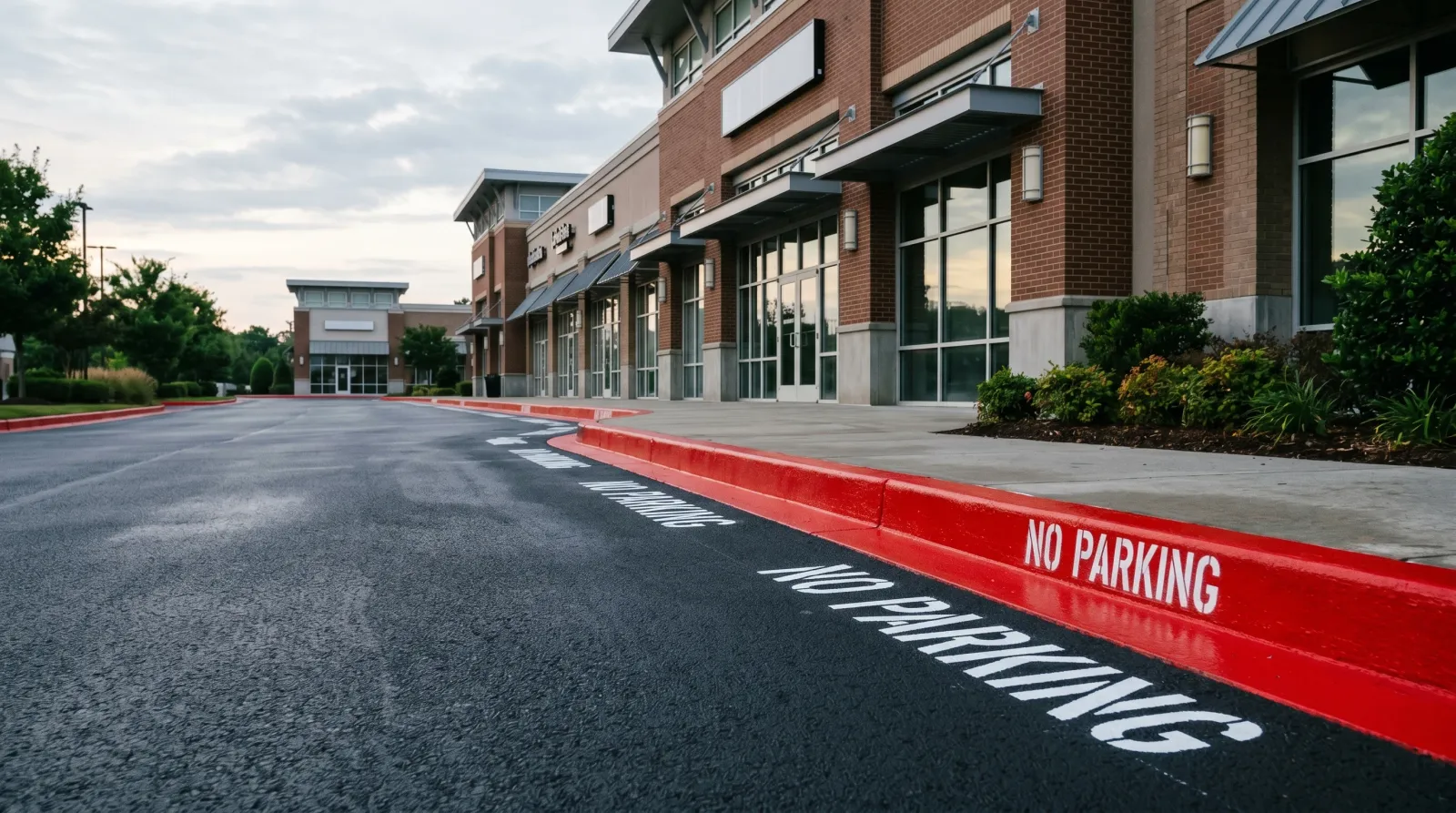
A fire lane marking has one job that owners underspecify: stay legible from the seat of a fire apparatus through a full year of UV, plow scrub, and chloride from de-icing salt, on a curb face and pavement edge that take more mechanical abuse than any other marking on the lot. The asset is the painted red curb plus the white stenciled FIRE LANE or NO PARKING legend along a fire apparatus access road. The environment is the harshest a traffic coating sees: tire scuff at the curb line, snowplow blades dragging the curb top, and salt brine wicking under the film all winter.
Service life runs 12 months on a plowed, salted northern lot, 24 months on a temperate commercial property, and 36 months on a southern lot without plows. The work is regulation-driven first and aesthetic never. The International Fire Code Section 503 requires fire apparatus access roads to be marked and kept clear, and OSHA 1910.144 fixes red as the safety color for fire equipment and emergency access. The local fire code official is the authority having jurisdiction, and they set the exact color, the legend wording, and the recoat interval. A property that lets fire-lane red fade to pink is exposed at the next fire-marshal inspection, and a blocked or unreadable lane is a citation with real teeth because it is a life-safety marking, not a convenience.
The spec writer’s job is narrow. Pick a chemistry that holds OSHA-red color through a salt season, meets the state VOC ceiling, bonds to both asphalt curb and concrete curb, and cures fast enough to reopen the lane inside a single closure window. The spec calls for durability over reflectivity here; a fire lane is read by daylight and apparatus floodlight, not by retroreflective return, so the bead question that dominates stall striping matters far less. Get the color, the bond, and the build right and the lane passes inspection for a year.
Spec Requirements
| Spec | Value |
|---|---|
| Dry film thickness (DFT) | 10–18 mils wet, 4–7 mils dry per coat (waterborne acrylic); two coats on plowed curb |
| Coverage @ DFT | 80–110 linear feet of 6-inch curb face per gallon; 250–300 sq ft per gallon flat zone marking |
| VOC | under 150 g/L waterborne (CARB / OTC compliant); under 450 g/L solvent-borne under SCAQMD Rule 1113 |
| Standards | ASTM D713 (road service), ASTM D2205 (specification), ASTM D2486 (scrub), AASHTO M-248 Type N |
| Color authority | OSHA 1910.144 safety red; legend white; verify exact spec with local AHJ per IFC 503 |
| Substrate prep (asphalt) | Pressure wash, degrease oil; new hot-mix off-gassed 30 days |
| Substrate prep (concrete) | Cure 28 days; ICRI CSP 2 by acid-etch or light abrasion; strip any cure-and-seal compound |
| Substrate temp at application | 50–95°F; air temp 50°F and rising |
| Humidity ceiling | 85% RH; dew point 5°F below substrate temp |
| Cure to traffic | 30–45 min no-track; 60–90 min vehicle (waterborne, 73°F, 50% RH) |
These specs are not interchangeable, and the two that get skipped on fire lanes are color compliance and the concrete prep grade. OSHA 1910.144 names red the safety color for fire equipment, but it does not publish a hex value, so the practical control is the manufacturer’s standard safety-red toner held to ASTM E1347 color measurement against a master. Off-spec consumer “red” oxidizes to pink in one summer and fails a color-legibility check long before it fails adhesion. ASTM D713 is the road-service test that screens for hot-tire pickup and chip loss at the curb line. ASTM D2205 governs the wet product in the pail. AASHTO M-248 Type N is the line item that forecloses cheap consumer-grade substitution on a bid sheet.
The concrete prep grade is the second sleeper. Most fire-lane curb in newer developments is poured concrete, not asphalt, and concrete curb almost always ships with a cure-and-seal compound that repels waterborne paint. Acid-etch or abrade to ICRI CSP 2 to break the laitance and pull the sealer, or the lane delaminates inside a season. On older asphalt curb the failure is the mirror image: green asphalt still off-gassing under a too-early coat. Hold 30 days on new hot-mix before the first red.
System Chemistry Compared
Pick the chemistry first, then the brand. The candidate classes for a fire lane are the same traffic chemistries used for stall striping, weighted toward durability because the curb takes more abuse than the field.
| Class | Cure to traffic | Service life on curb | $/lf installed | Best for |
|---|---|---|---|---|
| Waterborne acrylic | 30–90 min | 12–24 mo | $0.90–1.60 | Default fire-lane spec, asphalt and concrete |
| Solvent (chlorinated rubber, alkyd) | 20–40 min | 18–30 mo | $1.10–1.80 | Cold-weather curb in non-OTC states |
| Hot-applied thermoplastic | 5–10 min | 4–7 yr | $2.50–4.50 | High-abuse curb at airports, distribution yards |
| Epoxy / MMA cold plastic | 30–60 min | 4–6 yr | $3.00–5.00 | Industrial sites with forklift and tractor traffic |
Waterborne acrylic is the right answer for nearly every commercial fire lane. It holds OSHA red, meets the 150 g/L waterborne ceiling that CARB and the thirteen OTC states enforce, and bonds to both curb substrates once prepped. Solvent-borne dries faster in cold weather and resists salt slightly better, but SCAQMD Rule 1113 caps traffic paint at 150 g/L in the South Coast district and most northeastern states follow comparable rules. Spec solvent only where the state still permits it and only when a fall or early-spring curb has to cure below 50°F.
Thermoplastic and cold plastic earn their cost on a narrow set of sites. A distribution yard where loaded trucks scuff the curb daily, or an airport service road, can justify the $2.50-plus per foot because hot-applied material lasts four to seven years and shrugs off plow blades. On a strip-mall or office-park curb the math never closes; the lane gets restriped on an annual or biennial cycle before the durable chemistry’s longevity matters, and the capital and mobilization premium is dead money.
Recommended Systems
System A — Sherwin-Williams Setfast Acrylic Waterborne (Red)
The commercial standard for curb and zone marking. AASHTO M-248 Type N compliant, TT-P-1952F federal spec, ASTM D2205 conformance, available in OSHA safety red as a stock toner.
| Layer | Product | DFT |
|---|---|---|
| Surface prep | Pressure wash; degrease oil; off-gas new asphalt 30 days | — |
| Curb / zone coat 1 | Setfast Acrylic Waterborne, OSHA red | 10–14 mils wet / 4–6 mils dry |
| Curb / zone coat 2 (plowed lots) | Setfast Acrylic Waterborne, second pass | 10–14 mils wet / 4–6 mils dry |
| Total (high-wear) | 8–12 mils dry |
Sherwin-Williams Setfast product page · Search on Amazon
The two-coat call is what separates a fire lane from a stall stripe. A single 5-mil dry curb coat reads red on day one and washes to pink at the salt line by February. The second pass builds film where the plow rides the curb top. Setfast’s 30-minute no-pickup time assumes 73°F and 50% RH; on a shaded curb at 60°F and 75% RH, plan 90 to 120 minutes before you pull cones. Freeze recovery is the sharp edge on red toner specifically: the pigment loading is heavy, and a pail that takes a second freeze-thaw cycle breaks the emulsion and streaks the toner. Pails left on a March tailgate are scrap.
System B — Rust-Oleum Industrial Choice 2300 Inverted (Red)
Inverted-can aerosol for hand layout, short curb runs, and stencil legend work. Right for touch-ups, small lots under 300 linear feet of curb, and the FIRE LANE legend where rolling an airless is not justified.
| Layer | Product | DFT |
|---|---|---|
| Surface prep | Sweep and degrease; bonding primer on sealed concrete | — |
| Curb coat | Industrial Choice 2300 inverted aerosol, safety red | 8–10 mils wet / 3–4 mils dry |
Rust-Oleum Industrial Choice 2300 product page · Search on Amazon
The 2300 bites crews that push it past its scope. A 3-to-4-mil dry build will not survive a plowed winter on the curb top, and per-foot material cost runs double bulk waterborne once a crew burns ten cans an hour on a long run. Keep it to legend stencils, isolated curb sections, and landlord touch-ups between full restripes. Rust-Oleum’s broader industrial program is covered in our Rust-Oleum industrial line review.
System C — PPG Aexcel-Stripe Waterborne (Red)
Federal Spec TT-P-1952F compliant, AASHTO M-248 Type N, used on DOT and federal work. The spec-equal alternate to Setfast on Buy American and GSA-lease projects where a federal line item is mandatory.
| Layer | Product | DFT |
|---|---|---|
| Surface prep | Pressure wash; substrate temp 50–95°F | — |
| Zone / legend coat 1 | Aexcel-Stripe Waterborne, red | 15 mils wet / 6 mils dry |
| Zone / legend coat 2 (high-wear) | Aexcel-Stripe Waterborne, second pass | 15 mils wet / 6 mils dry |
| Total (high-wear) | 10–12 mils dry |
PPG Aexcel Pavement Markings page · Search on Amazon
Aexcel-Stripe tracks within a few percent of Setfast on published durability benchmarks. It earns its place on a fire lane at a federal distribution center, a postal facility, or a military base where the spec demands a TT-P-1952F line item. PPG’s industrial distribution is thinner outside the Midwest and Mid-Atlantic; verify pail supply on a Mountain West project before you write it into a bid with a hard occupancy date.
Systems Compared
| System | Total DFT | $/lf installed | Service life | Best for |
|---|---|---|---|---|
| A — SW Setfast (2-coat) | 8–12 mils dry | $1.10–1.80 | 18–24 mo | Default plowed commercial curb |
| B — Rust-Oleum 2300 | 3–4 mils dry | $0.90–1.50 | 8–14 mo | Legend stencils, short runs, touch-ups |
| C — PPG Aexcel (2-coat) | 10–12 mils dry | $1.10–1.80 | 18–24 mo | Federal and Buy American projects |
Installed cost on a fire lane runs higher than a stall stripe because curb work is hand-applied and the red toner carries a pigment premium. A two-color stencil legend doubles labor on the FIRE LANE callouts. Budget $1.20 to $1.80 per linear foot for red curb with a stenciled legend, against $0.18 to $0.35 for a plain white stall line.
Application & Contractor Path
A fire lane is not a DIY product in the residential sense, but it is one of the few commercial markings a competent in-house crew can handle on small scope. A facilities team with OSHA-red traffic paint, a curb brush or roller, a FIRE LANE stencil set, and a degreaser can restripe a short curb run that has to pass a recheck. The honest threshold is roughly 300 linear feet of curb or any job tied to a fire-marshal sign-off. Above that, the airless equipment, the stencil library, and the liability coverage of a striping contractor pay for themselves.
There is no specialty certification required to paint a fire lane the way SSPC-QP1 governs industrial steel or IICRC governs restoration. The contractor qualification that matters is a striping firm carrying $2M aggregate general liability, a documented track record on commercial lots, and a written 12-month minimum adhesion warranty. For the substrate decision on concrete curb, the relevant prep skill is concrete surface preparation, the same etch-and-profile work covered in our guide to prepping and painting concrete.
The manufacturer rep path is straightforward. Sherwin-Williams commercial reps and PPG Protective & Marine reps both service traffic-marking accounts and will pull a data sheet, confirm the OSHA-red toner is stocked locally, and verify the 5-gallon pail price against a contractor account. Use the rep to confirm color match to the local AHJ standard before the first coat; some jurisdictions hold a tighter red than the manufacturer’s stock toner, and catching that at the quote stage saves a repaint.
Failure Modes & How to Prevent Them
Red fading to pink within a season. The curb reads red on day one and washes to a chalky pink at the salt line by midwinter, failing a color-legibility check while still adhering. Cause is off-spec consumer “red” with a fugitive pigment, or a single thin coat that the salt brine bleaches. Prevention is the bid sheet: require AASHTO M-248 Type N or TT-P-1952F red by number, and spec two coats on any plowed lot.
Delamination off concrete curb. The film peels in sheets off a poured curb while the asphalt sections hold fine. Cause is waterborne paint applied over a cure-and-seal membrane that repels water. Prevention is the prep spec: acid-etch or abrade new concrete to ICRI CSP 2, strip the sealer, and confirm with a tape-pull before the first coat. The same release-layer failure shows up on sealed concrete floors in our peeling paint diagnosis.
Plow scrub on the curb top. The red survives on the vertical curb face but grinds off the horizontal top where the plow blade rides. Cause is normal winter maintenance against a single-coat build. Prevention is a second coat on the curb top specifically, or upgrading the highest-abuse runs to thermoplastic where the site justifies it.
Lifting on green asphalt. The line lifts along long ribbons from the ends inward, substrate clean, failure at the bond line. Cause is striping over hot-mix asphalt that is still off-gassing volatiles. Prevention is the 30-day off-gas window, or a sealcoat first with the red applied over the cured sealer at day 7.
Legend unreadable from the apparatus. The curb is red but the FIRE LANE stencil is faint or undersized and a fire marshal cannot read it from the apparatus seat. Cause is a worn stencil, a single thin legend coat, or letters too small for the AHJ standard. Prevention is to confirm legend height and spacing with the local fire-prevention bureau, restencil with a sharp template, and lay the legend in two passes for opacity.
Where to Buy / Spec
| Channel | Best for |
|---|---|
| Manufacturer-direct (SW Setfast, PPG Aexcel, Rust-Oleum 2300) | Spec’d portfolios, OSHA-red toner confirmation, rep support, bulk 5-gallon pricing |
| Industrial distributor (SealMaster, Pavement Supply, Brown Co) | Bulk red paint, stencils, curb brushes for striping contractors |
| Pro retail (Sherwin-Williams stores) | Local 5-gallon pickup, contractor pricing on red toner |
| Amazon Business | Aerosol-can stocking for hand layout and legend stencils |
Specifier’s Bid Language
“Provide and install AASHTO M-248 Type N waterborne acrylic traffic marking paint, OSHA 1910.144 safety red, per Sherwin-Williams Setfast specification (or approved equal: PPG Aexcel-Stripe). Two coats on all plowed curb; DFT 10–14 mils wet, 4–6 mils dry per coat. White stenciled legend FIRE LANE / NO PARKING per local AHJ standard and IFC 503. Concrete curb prepped to ICRI CSP 2 with cure-and-seal compound removed; asphalt curb off-gassed 30 days minimum. Substrate temp 50–95°F at application; air temp 50°F and rising; humidity 85% RH ceiling; dew point 5°F below substrate temp. Color and legend wording verified against the local fire-prevention bureau standard before first coat. Contractor carries $2M aggregate GL and warrants 12 months minimum adhesion and color retention.”
The 12-month warranty is the floor for a salted lot. On a temperate property with a properly prepped substrate, push for 18 to 24 months. Treat any bid that omits the AHJ color verification as incomplete; a fire lane that does not match the local standard fails inspection no matter how well it is applied.