Safety Yellow Paint for Floor Striping and Hazard Marking: Specifier's Guide (2026)
OSHA safety yellow paint compared by DFT, abrasion class, and dry-to-traffic time. ANSI Z535.1 yellow spec, 1910.22 anti-slip COF, ICRI CSP prep, and the contractor path for warehouse aisle striping.

Disclosure: Affiliate links to retailers and manufacturer-direct programs. Recommendations are spec-driven, not commission-driven.
Use Case
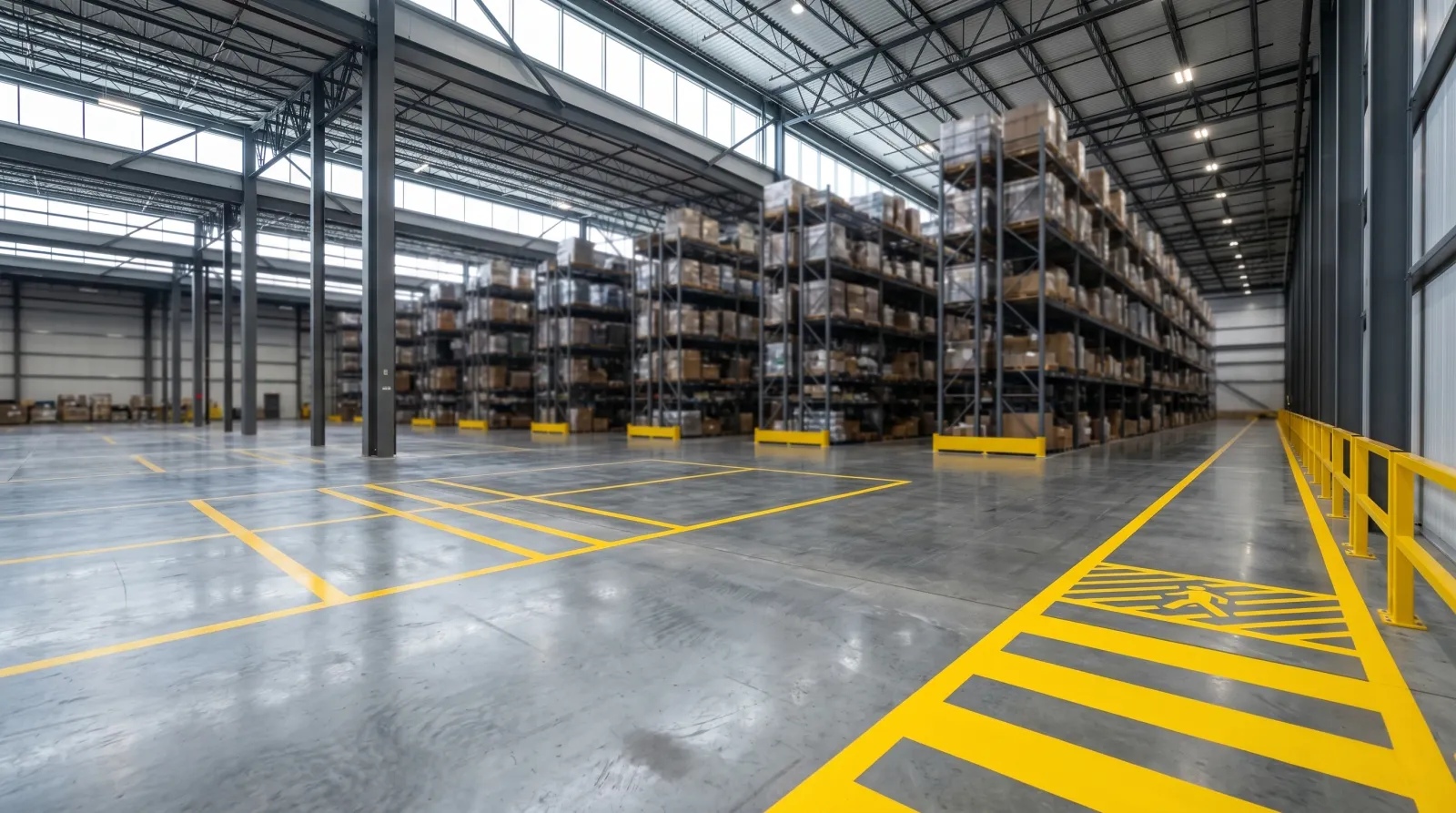
Safety yellow on a warehouse floor does one job: it tells a person on foot and a person on a forklift where each is allowed to be. OSHA 1910.144 assigns yellow to caution and physical-hazard marking, and OSHA 1910.22 requires the aisles those stripes define to stay clear and slip-resistant. The asset is interior concrete in a distribution center, manufacturing plant, food facility, or municipal shop. The environment is abrasive: steel forklift wheels, pallet-jack rollers, dropped freight, and the occasional cleaning crew running a ride-on scrubber over the same line a hundred times a month.
Service life is set by traffic, not by weather. A waterborne acrylic stripe in a pedestrian-only path holds color for 2 to 3 years. A two-component epoxy stripe in a forklift drive aisle runs 3 to 5 years before the yellow scuffs to buff and the edges chip. The line that crosses a dock door or a battery-charging bay wears fastest because that is where wheels turn under load.
The spec writer is buying compliance as much as paint. A faded aisle line is an OSHA 1910.22 walking-surface citation and a near-miss waiting to be logged. The color has to read as safety yellow under warehouse high-bay lighting, the film has to survive the scrubber, and the stripe has to stay put on a concrete floor that may be carrying moisture from below. Get the color reference, the prep profile, and the cure window right, and the rest of the spec follows.
A facility rarely has one zone. The line in a quiet office-warehouse mezzanine and the line through a high-throughput cross-dock are not the same product, and specifying one paint for the whole building over-builds the calm zones and under-builds the brutal ones.
Zoned Recommendation Matrix
| Zone | Traffic | Recommended system | Why |
|---|---|---|---|
| Pedestrian walkway | Foot only | System A (waterborne epoxy) + anti-slip aggregate | COF compliance matters more than abrasion; fast recoat |
| Forklift drive aisle | Loaded forklift, pallet jack | System B (two-component epoxy) | Abrasion and gouge resistance; 3–5 yr line |
| Dock door / charging bay | Turning wheels under load | System B with high-solids topcoat | Highest mechanical stress in the building |
| Hazard / caution borders | Foot + occasional cart | System A, yellow-and-black diagonal | Visibility over durability; ANSI Z535.1 yellow |
| 5S / temporary layout zones | Variable | Industrial floor tape (System C alt) or aerosol stripe | Layout changes; no cure window available |
Map the zones before you bid the floor. A 200,000 sq ft DC will run System B on the main grid, System A on the pedestrian spurs, and tape where the layout is still being tuned.
Spec Requirements
| Spec | Value |
|---|---|
| Dry film thickness (DFT) | 3–6 mils dry per coat waterborne acrylic; 8–12 mils dry total two-component epoxy |
| Coverage @ DFT | 80–120 linear ft of 4-in line per gallon at spec DFT |
| VOC | under 100 g/L waterborne acrylic (CARB / SCAQMD compliant); under 250 g/L high-solids epoxy under SCAQMD Rule 1113 industrial maintenance |
| Color reference | ANSI Z535.1 safety yellow; close to FS 595 33538, Pantone 116 C |
| Standards | ASTM D2486 (scrub), ASTM D4060 (Taber abrasion), ASTM D4541 / D7234 (pull-off), ASTM F1679 (COF) |
| Substrate prep (concrete) | ICRI CSP 2–3 by grind or shotblast; degrease per SSPC-SP1 |
| Moisture vapor emission ceiling | under 3 lb / 1,000 sq ft / 24 hr per ASTM F1869, or under 75% RH per ASTM F2170, before epoxy |
| Anti-slip | static COF ≥ 0.5 dry per ANSI/NFSI B101.1 on pedestrian lines; add aggregate to wet film |
| Service temp | floor surface 50–90°F at application; service to 140°F dry |
| Cure to service | foot traffic 4–8 hr; forklift traffic 24–72 hr (epoxy) at 70°F |
| Dew point / humidity | floor temp ≥5°F above dew point; ambient RH ≤85% during application |
| OSHA color code | 1910.144 — yellow for caution / physical hazard |
These specs are not interchangeable. ICRI CSP is the one most often skipped, and it is the one that decides whether the stripe lasts. CSP stands for Concrete Surface Profile; the International Concrete Repair Institute scale runs CSP 1 (a smooth acid-etch) to CSP 9 (an aggressive scarified texture). A stripe needs CSP 2 to 3, the profile of medium sandpaper, so the coating has tooth to grip. Paint a yellow line on a troweled, sealed slab at CSP 1 and the first scrubber pass takes the edge off; the whole line lifts inside a season.
Moisture vapor emission is the second silent killer. Concrete on grade wicks water from the soil below, and that vapor drives upward through the slab. If the moisture vapor emission rate exceeds 3 lb per 1,000 sq ft per 24 hours under an ASTM F1869 calcium chloride test, an epoxy stripe blisters and disbonds from underneath. Run the test before the epoxy goes down, not after the line fails. Waterborne acrylic tolerates higher moisture than epoxy, which is one reason it survives on older slabs where epoxy will not.
System Chemistry Compared
Pick the chemistry to match the traffic, then pick the brand.
| Class | Pot life | Recoat window | Cure to forklift | UV stability | $/lf installed | Best for |
|---|---|---|---|---|---|---|
| Waterborne acrylic | n/a (single component) | 1–2 hr | 24 hr | Good | $0.20–0.45 | Pedestrian lines, light traffic, fast turnaround |
| Waterborne / pre-cat epoxy | 2–4 hr | 4–8 hr | 24 hr | Good | $0.45–0.85 | Mixed pedestrian and light forklift zones |
| Two-component high-solids epoxy | 30–90 min | 8–24 hr | 24–72 hr | Fair (ambers, chalks) | $0.75–1.40 | Forklift drive aisles, dock zones |
| Polyaspartic / polyurea | 5–20 min | 1–4 hr | 4–12 hr | Excellent | $1.20–2.20 | Fast restripe, freezer floors, UV-exposed lines |
Waterborne acrylic is the right call for pedestrian walkways and any zone where the line gets restriped on a short cycle. It goes down with no mixing, recoats in two hours, and tolerates a damp slab. It will not survive a loaded forklift turning on it for five years; that is not its job.
Two-component epoxy is the workhorse for forklift aisles. It builds an 8 to 12 mil dry film that resists Taber abrasion and pallet-jack scrub, and it bonds hard to a CSP 2-3 profile. The trade is pot life: once the two parts are mixed, the crew has 30 to 90 minutes before the batch gels in the pail. Standard epoxy also ambers and chalks under skylights, so the high-bay daylight zones lose a little chroma over time. Polyaspartic fixes the UV problem and the cure speed at a real cost premium; spec it where a line has to reopen to traffic in hours or where it sees freezer service. The deep version of that math sits in the polyaspartic floor coatings guide.
Recommended Systems
System a — Sherwin-Williams Pro Industrial Waterborne Epoxy (Pedestrian and Mixed Zones)
A pre-catalyzed waterborne epoxy in OSHA safety yellow. Tolerant of higher slab moisture than solvent epoxy, low VOC, and a fast enough recoat to stripe and reopen pedestrian aisles in a single shift.
| Layer | Product | DFT |
|---|---|---|
| Surface prep | Shotblast or grind to ICRI CSP 2–3; degrease per SSPC-SP1 | — |
| Striping coat 1 | Pro Industrial Pre-Catalyzed Waterborne Epoxy, safety yellow | 3–4 mils dry |
| Striping coat 2 | Pro Industrial Pre-Catalyzed Waterborne Epoxy, second pass | 3–4 mils dry |
| Total | 6–8 mils dry |
Sherwin-Williams Pro Industrial waterborne epoxy page · Search on Amazon
For pedestrian lines, broadcast a fine aluminum-oxide aggregate into the second coat at 0.25 to 0.5 lb per gallon to hold the static COF above 0.5. Skip the aggregate on drive-aisle lines, where it just adds wear surface for tires to grind.
System B — Rust-Oleum Concrete Saver 7100 Two-Component Epoxy (Forklift Aisles)
The drive-aisle answer. A high-solids two-component epoxy that builds a hard, abrasion-resistant yellow line, with an optional high-solids clear or color-matched topcoat in the dock and charging zones where wheels turn under load.
| Layer | Product | DFT |
|---|---|---|
| Surface prep | Acid-etch or grind to ICRI CSP 2; verify MVE under 3 lb per ASTM F1869 | — |
| Striping coat | Concrete Saver 7100 two-component epoxy, safety yellow | 5–6 mils dry |
| Topcoat (high-traffic) | Concrete Saver 9100 high-solids epoxy, clear or color-matched | 4–6 mils dry |
| Total | 9–12 mils dry |
Rust-Oleum Concrete Saver page · Search on Amazon
Watch the pot life. At 80°F a mixed batch of 7100 gels faster than the published 90 minutes; size each batch to what a two-person crew can lay in 45 minutes and discard the kicked pail rather than dragging gelled epoxy across the line.
System C — Rust-Oleum Industrial Choice 2300 Inverted Aerosol (Touch-Up and Small Layouts)
Inverted-can aerosol for cart applicators, restripe touch-ups, and small layouts where mixing epoxy and closing an aisle for a day is not justified.
| Layer | Product | DFT |
|---|---|---|
| Surface prep | Sweep and degrease; new concrete cured 28 days | — |
| Striping coat | Industrial Choice 2300 inverted aerosol, safety yellow | 3–4 mils dry |
| Total | 3–4 mils dry |
Rust-Oleum Industrial Choice striping page · Search on Amazon
The 2300 is right for punch-list work and 5S touch-ups, wrong for a permanent forklift grid. A 3 to 4 mil aerosol film will not survive a year of loaded wheels in a main aisle. Use it where it belongs and it pays for itself in labor.
Systems Compared
| System | Total DFT | $/lf installed | Service life | Best for |
|---|---|---|---|---|
| A — SW Pro Industrial WB epoxy | 6–8 mils | $0.45–0.85 | 2–3 yr | Pedestrian walkways, mixed-traffic spurs |
| B — RO Concrete Saver 7100 | 9–12 mils | $0.75–1.40 | 3–5 yr | Forklift drive aisles, dock and charging zones |
| C — RO Industrial Choice 2300 | 3–4 mils | $0.20–0.50 | 8–18 mo | Touch-ups, 5S zones, small layouts |
The cost gap between A and B looks large per linear foot, but the total spend tracks zone area, not the unit rate. A typical DC runs 70% of its yellow footage on the System B grid and reserves A for the lighter pedestrian network. Over a five-year horizon, System B in the aisles costs less than restriping a waterborne line every 18 months under the same forklift load. Total cost of ownership favors the harder film wherever wheels turn.
Application & Contractor Path
Small layouts and touch-ups are within reach of an in-house maintenance crew running aerosol cans and a cart applicator. A full warehouse grid is not a DIY job. The work is gated on three things a facility team rarely owns: a shotblaster or planetary grinder to hit ICRI CSP 2-3, a calcium-chloride or RH probe kit to clear the moisture test, and the discipline to mix two-component epoxy in pot-life-sized batches.
Spec a contractor with concrete-coating experience and, where the floor coating itself is in scope, SSPC-QP1 certification for the surface-prep and application quality program. For the striping line item alone, the bar is a contractor who runs an airless or cart striper, owns the floor-grinding equipment, and warrants adhesion. Ask for a mockup: a 20-ft test stripe at spec DFT, pulled for adhesion at 24 hours per ASTM D7234, before the crew runs the building.
The manufacturer rep path is worth using. Sherwin-Williams Pro Industrial and Rust-Oleum Industrial both field reps who will spec the system to the slab condition, run the moisture math, and confirm the safety-yellow color reference against ANSI Z535.1. A rep-signed spec also protects the warranty. For the broader concrete-prep fundamentals, the concrete floor prep and paint guide covers profile and moisture testing in plain terms.
Failure Modes & How to Prevent Them
Peeling and delamination within months. The yellow line lifts at the edges and comes off in flakes under the scrubber, with clean concrete underneath. Cause is a prep failure: a slab left at CSP 1, a cure-and-seal compound never abraded off, or an oily floor that broke the bond. Prevention is the prep spec. Grind to CSP 2-3, degrease per SSPC-SP1, and pull a 24-hour test stripe before committing the building. This is the same bond-line story behind most peeling paint failures, just on a horizontal slab.
Blistering and disbonding from below. Small domed bubbles raise under the epoxy and pop to bare concrete, concentrated in low spots or near floor drains. Cause is moisture vapor driving up through an on-grade slab that never got a moisture test. Prevention is the ASTM F1869 calcium-chloride test before epoxy; if the slab reads over 3 lb, switch to a moisture-tolerant waterborne system or install a moisture-mitigation primer first.
Color fade to buff. Safety yellow reads dull and washed within a year, most visibly under skylights and high-bay daylight. Cause is UV chalking of standard epoxy plus abrasion from traffic and cleaning. Prevention is a UV-stable topcoat or a polyaspartic stripe in daylight-flooded zones, and a restripe budget tied to the ANSI Z535.1 reference so the new yellow matches the old.
Gouging and chipping in drive aisles. The line shows tire-width scars and chips along the forklift path while pedestrian spurs stay clean. Cause is reopening the aisle to loaded traffic before the epoxy reached cure-to-service, or under-building the DFT. Prevention is holding the 24 to 72 hour forklift cure window and specifying System B at 9 to 12 mils in the aisles, not a thin waterborne film.
Slip complaints on wet pedestrian lines. A glossy yellow walkway stripe gets slick when a scrubber leaves it damp, and a near-miss gets logged. Cause is an epoxy film with no anti-slip aggregate in a foot-traffic zone. Prevention is broadcasting aluminum-oxide or polymer beads into the wet film at 0.25 to 0.5 lb per gallon on every pedestrian line to hold static COF above 0.5 per ANSI/NFSI B101.1.
Where to Buy / Spec
| Channel | Best for |
|---|---|
| Manufacturer-direct (SW Pro Industrial, Rust-Oleum Concrete Saver) | Spec’d floor programs, rep support, color-match to ANSI Z535.1, bulk pricing |
| Industrial distributor (Grainger, Fastenal, coatings dealers) | Bulk epoxy, aggregate, and aerosol stocking for striping crews |
| Pro retail (Sherwin-Williams stores) | Local pickup, contractor pricing, small-batch tinting |
| Amazon Business | Aerosol-can stocking for cart-applicator and 5S touch-up work |