Polyaspartic Floor Coatings: Specifier's Guide (2026)
Polyaspartic systems compared by DFT, recoat window, and service life. ICRI CSP prep, ASTM specs, and where polyaspartic beats epoxy and urethane.

Disclosure: Affiliate links to retailers and manufacturer-direct programs. Recommendations are spec-driven, not commission-driven.
Use Case
Polyaspartic floor coatings get specified when downtime is the limiting cost. The chemistry is an aliphatic polyurea variant; the field advantage is a 2-to-4-hour cure to foot traffic and 24-hour cure to service, against the 5-to-7-day shutdown a standard high-build epoxy stack requires. That window decides the spec on a hospital corridor, an auto-dealer showroom, a quick-service restaurant kitchen, a veterinary clinic, an aircraft hangar, and the loading dock of any distribution center that runs 7 days a week.
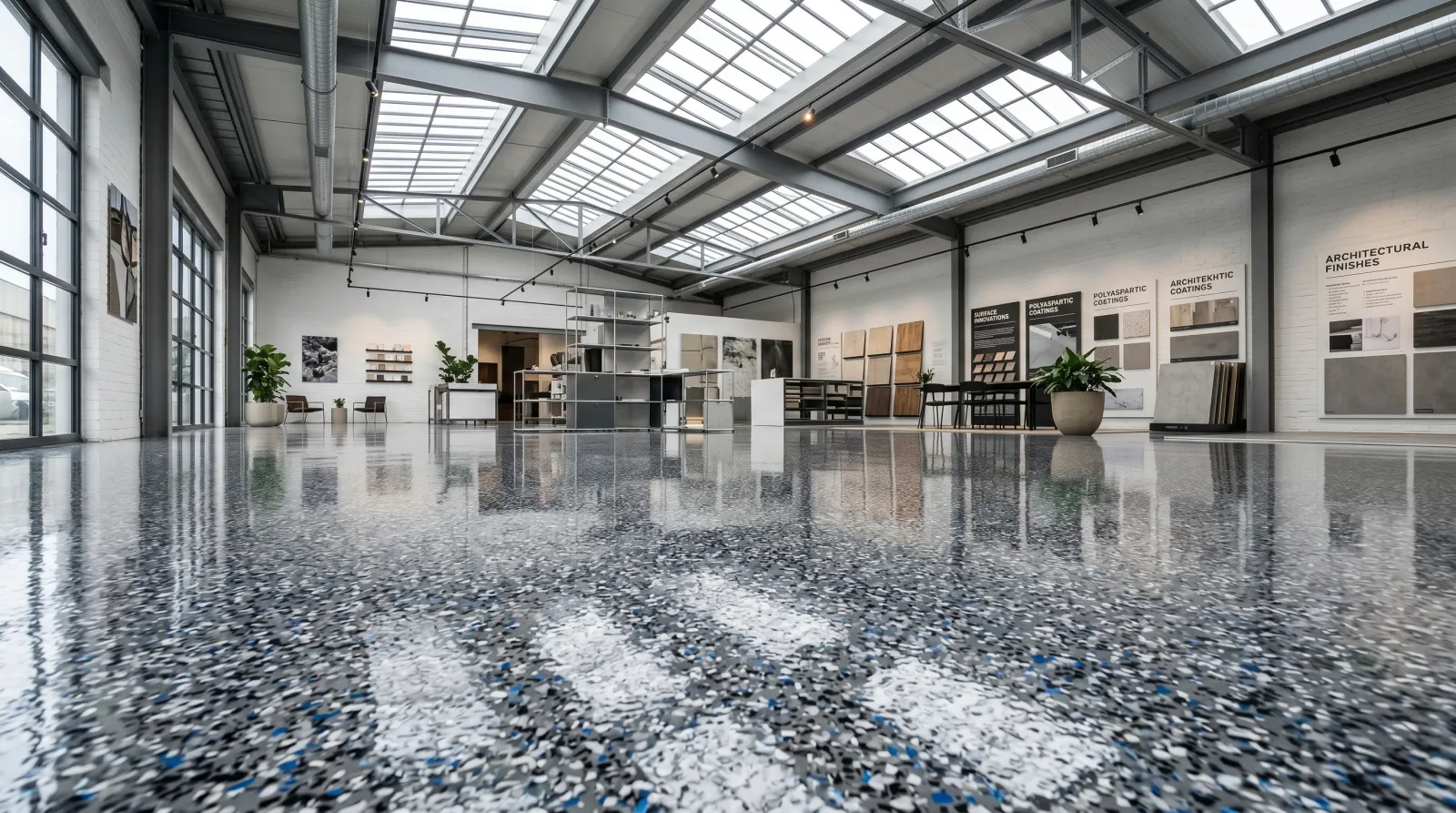
Service life expectations: 8–12 years on showroom and light-traffic commercial floors, 6–10 years on aisleways under pallet-jack traffic, 10–15 years on a properly broadcast multi-coat system with quartz aggregate. UV stability is the second advantage — polyaspartic does not amber under sunlight, where standard epoxy goes yellow inside 18 months in any space with skylights or south-facing glazing. Chemical resistance is mid-tier: solid against fuel, oil, salt, and most cleaning chemistries, weak against sustained acid immersion or solvent dwell over 4 hours.
Where polyaspartic loses the spec: sub-zero cure (urethane cement wins), full chemical immersion in tanks (epoxy or 100% solids urethane), potable-water linings (NSF/ANSI 61 is an epoxy category), and any floor where the install crew cannot honor a 30-minute-to-4-hour recoat window. The chemistry is unforgiving on application timing in a way epoxy is not.
Zoned Recommendation Matrix
Multi-zone commercial assets need different system tiers per zone. The spec for an automotive dealership campus:
| Zone | Recommended system | Why |
|---|---|---|
| Showroom / sales floor | System A (premium, full flake broadcast) | UV stability, visual finish, no yellowing under skylights |
| Service bays / lifts | System B (mid-tier with aluminum oxide aggregate) | Fuel + oil resistance, OSHA anti-slip under hydraulic fluid drips |
| Parts warehouse aisles | System B with double topcoat | Pallet jack abrasion, shelf-leg point loading |
| Wash bay / detail | Urethane cement, NOT polyaspartic | Sustained water + caustic dwell; polyaspartic fails at the joints |
| Office / customer waiting | System C (budget, single broadcast) | Light foot traffic only; lower DFT acceptable |
For a single-zone asset (a small warehouse, a clinic corridor), skip the matrix and pick one system across the slab.
Spec Requirements
The spec block, before recommending product:
| Spec | Value |
|---|---|
| Dry film thickness (DFT) — total system | 16–30 mils, including primer + base + topcoat |
| Coverage at spec’d DFT | 80–125 sq ft/gal per coat (varies by build coat formulation) |
| VOC limit | <100 g/L (SCAQMD Rule 1113 industrial maintenance); CARB SCM-compliant SKUs available |
| Cure to foot traffic | 2–4 hours at 70°F, 50% RH |
| Cure to full service | 24 hours; full chemical resistance at 7 days |
| Pot life | 20–45 minutes at 70°F (drops to 12 minutes at 90°F) |
| Recoat window | 30 minutes to 4 hours; miss it and intercoat adhesion fails |
| Service temperature (cured) | -40°F to 250°F continuous |
| Substrate prep — concrete | ICRI CSP 2 (showroom) to CSP 3 (aisles); shotblast or diamond-grind |
| Substrate prep — steel | SSPC-SP10 near-white blast for primer adhesion (rare on polyaspartic floors) |
| Moisture vapor emission ceiling | 3 lb/1000 sq ft/24h (ASTM F1869); above 3 lb requires MVE barrier primer |
| Ambient at application | 50°F to 90°F; humidity <85%; substrate ≥5°F above dew point |
| OSHA anti-slip COF | 0.5 dry minimum (1910.22); broadcast aggregate for wet zones |
Three numbers matter more than the rest: the recoat window, the substrate temperature relative to dew point, and the MVE rate. Miss any one and the system fails inspection.
System Chemistry Compared
Before naming systems, the chemistry-class comparison every specifier should run:
| Chemistry | Pot life | Recoat window | Service temp | UV stability | $/sq ft installed | Best for |
|---|---|---|---|---|---|---|
| Standard epoxy | 1–4 hr | 8–24 hr | up to 140°F | 🔴 ambers under UV | $3–6 | Warehouses, chemical zones, budget builds |
| Polyaspartic | 20–45 min | 30 min–4 hr | -40°F to 250°F | 🟢 UV-stable | $6–10 | Showrooms, dealerships, fast-cycle retail, hangars |
| Urethane cement | 30–90 min | 4–12 hr | -40°F to 250°F | ⚪ mid; some yellowing | $8–14 | Food processing, freezers, thermal-shock zones |
| MMA (methyl methacrylate) | 15–30 min | 1 hr | -40°F to 200°F | 🟢 UV-stable | $10–16 | Sub-zero install, 1-hour cure-to-service emergencies |
Polyaspartic sits in the middle of the price band and wins on cure speed plus UV. Epoxy is cheaper but yellows. Urethane cement is the chemical-resistance answer, not the cosmetic one. MMA wins only when you cannot shut down for 24 hours and have a crew certified to install it.
Recommended Systems
Three full multi-coat stacks at different price-performance points. All three reference the same ICRI CSP 3 prep and the same MVE ceiling.
System a — Sherwin-Williams ProIndustrial Polyaspartic 5500 (premium Showroom / Dealership)
| Layer | Product | DFT |
|---|---|---|
| Primer | ArmorSeal 1K HS Epoxy Sealer | 2–3 mils |
| Base / build coat | ArmorSeal Rexthane I | 5–8 mils |
| Topcoat | ProIndustrial Polyaspartic 5500 with vinyl flake broadcast | 8–12 mils |
| Total | 15–23 mils |
Service life 10–15 years on showroom traffic. The vinyl flake broadcast doubles as anti-slip aggregate and as the visual finish — the chip catalog covers automotive, retail, and healthcare palettes. Spec sheet at Sherwin-Williams Protective & Marine.
System B — Rust-Oleum Concrete Saver 5450 Polyaspartic (mid-Tier Industrial)
| Layer | Product | DFT |
|---|---|---|
| Primer | Concrete Saver 5400 Epoxy Primer | 3 mils |
| Topcoat (first pass) | Concrete Saver 5450 Polyaspartic | 5–7 mils |
| Topcoat (second pass with aggregate) | Concrete Saver 5450 + aluminum oxide broadcast | 5–7 mils |
| Total | 13–17 mils |
Service life 7–10 years under pallet-jack traffic. The 5450 ships in 2-gallon kits with measured catalyst; field-mix error is the single most common failure mode and Rust-Oleum’s pre-measured kit reduces it. Available at Rust-Oleum Industrial direct or through their distributor network.
System C — PPG PITTHANE Ultra 95 (budget Single-Coat Retrofit)
| Layer | Product | DFT |
|---|---|---|
| Primer | AMERLOCK 2/400 Epoxy | 4–6 mils |
| Topcoat | PITTHANE Ultra 95 | 4–8 mils |
| Total | 8–14 mils |
Service life 5–8 years on light commercial. This is the spec when the budget is fixed and the existing slab is sound — single polyaspartic topcoat over an epoxy primer, no broadcast. Skip on any floor that sees wheeled traffic above pallet-jack weight. PPG PMC product page.
Systems Compared
| System | Total DFT | $/sq ft installed | Service life | Best for |
|---|---|---|---|---|
| A — SW Polyaspartic 5500 | 15–23 mils | $8.50–11.00 | 10–15 years | Showrooms, dealerships, hospital corridors |
| B — RO Concrete Saver 5450 | 13–17 mils | $6.50–8.50 | 7–10 years | Warehouses, light industrial, parts rooms |
| C — PPG PITTHANE Ultra 95 | 8–14 mils | $4.50–6.50 | 5–8 years | Budget retrofit, light commercial |
Installed pricing assumes a 5,000+ sq ft scope through a manufacturer-rep contractor with shotblast prep included. Sub-1,000 sq ft jobs run 30–60% higher per foot on every system.
Application and Contractor Path
Polyaspartic is not a DIY product. The recoat window plus the pot-life math means a single applicator on a 2,000 sq ft floor will miss the window and produce intercoat delamination. Spec a contractor with SSPC-QP1 certification at minimum, and look for the manufacturer’s installer-certified list — Sherwin-Williams, Rust-Oleum Industrial, PPG, and Tnemec all maintain rep networks that publish certified-installer rosters by region.
Three contractor-qualifying questions before you sign:
- Has the crew applied this specific product line in the last 12 months? Polyaspartic chemistry varies enough across manufacturers that experience on Sherwin-Williams 5500 does not transfer to PPG PITTHANE without a calibration day.
- What is the dew-point protocol? The substrate must sit at least 5°F above dew point during application. A contractor who does not own a sling psychrometer or surface thermometer should not be on the bid list.
- How is MVE measured? ASTM F1869 calcium chloride test in three locations minimum on any slab older than 5 years. A contractor who skips this step will deliver a floor that delaminates from underneath inside the warranty period.
For sub-1,000 sq ft retrofits — a single bay, a small kitchen — the System C budget tier can sometimes be installed by a competent commercial painting crew without a polyaspartic-specific certification, provided they honor the recoat window. Above 1,000 sq ft, certification matters.
Failure Modes
Five failures account for nearly every polyaspartic warranty claim. Prevent these and the system delivers its rated service life.
- Intercoat delamination from a missed recoat window. Cause: ambient temperature higher than the spec assumed, pot life burned faster, crew did not adjust the recoat clock. Prevention: surface temperature monitored every 30 minutes during application; recoat clock keyed to substrate temperature not air temperature.
- Moisture-driven delamination from below. Cause: MVE rate above 3 lb/1000 sq ft/24h, no vapor barrier primer. Prevention: ASTM F1869 calcium chloride testing pre-bid; specify a moisture-tolerant epoxy primer (Sika MVE Stop, Sherwin-Williams ArmorSeal 1K HS) above 3 lb.
- Bubble / pinhole formation in the topcoat. Cause: substrate temperature rising during cure (afternoon sun on a slab, mid-day install), trapped air outgassing through the wet film. Prevention: install in temperature-falling windows (late afternoon, early morning) or under climate-controlled cover.
- Premature gloss loss under chemical attack. Cause: solvent dwell, sustained acid contact, aggressive caustic cleaners. Prevention: switch chemistries (urethane cement) in wet-chemical zones; do not specify polyaspartic where the floor sees a 4-hour-plus chemical dwell.
- Hot-tire pickup at parking-adjacent zones. Cause: undersized DFT on the topcoat, inadequate cure before vehicle return. Prevention: System A or System B with full 24-hour cure to service before vehicles re-enter; never System C in a hot-tire zone.
The first two failure modes — recoat window and MVE — produce roughly 70% of the field failure claims I see. Both are preventable in the specification phase, not the application phase.
Where to Buy / Spec
| Channel | Best for | Path |
|---|---|---|
| Sherwin-Williams Commercial / ProIndustrial rep | Spec’d projects above 2,000 sq ft, full system warranty | SW ProIndustrial rep locator |
| Rust-Oleum Industrial distributor | Mid-tier installs, pre-measured kits | RO Concrete Saver distributor |
| PPG PMC rep | PITTHANE-spec budget retrofits, federal facility work | PPG PMC product page |
| Local SW or BM Pro store | Contractor pricing, small-scope material pickup | Walk-in, account holder pricing |
Manufacturer-direct is the recommended channel above 2,000 sq ft. The rep network includes a free pre-bid site visit on most major manufacturers — use it. The site visit catches the MVE problem and the dew-point problem before the bid lands, which is worth more than any retail discount.
FAQ
Can I apply polyaspartic without a contractor? Above 1,000 sq ft, no. Pot life and recoat window math require a crew, not a single applicator. Below 1,000 sq ft on a sound slab, a competent commercial painting crew can install System C without polyaspartic-specific certification.
What’s the warranty? Manufacturer warranties on the product run 1–5 years; installer warranties through certified rep networks run 5–10 years on the installed system. The installed warranty is the one that matters for a facility manager — confirm it covers labor and material both.
Does this comply with SCAQMD Rule 1113? The major manufacturers (Sherwin-Williams ProIndustrial Polyaspartic 5500, Rust-Oleum Concrete Saver 5450, PPG PITTHANE Ultra 95) ship SCAQMD-compliant formulations under 100 g/L for industrial maintenance. Verify the SDS for the specific tint base before bidding a California job.
How do I test the cured film for holiday inspection? ASTM D5162 high-voltage holiday testing on metal substrates; on concrete, low-voltage wet sponge testing at 67.5 V per mil of DFT. Holiday inspection is standard practice on potable-water and chemical-containment linings; on a typical commercial polyaspartic floor it is rarely specified but should be required on any zone where coating failure means downtime cost.
What ICRI CSP profile is correct for a polyaspartic showroom floor? CSP 2 — diamond-grind, no shotblast. CSP 3 (shotblast) is correct for aisles and industrial. CSP 4 traps air at the interface and produces bubbles in the topcoat.
Related
Frequently asked questions
Polyaspartic vs epoxy — when does polyaspartic actually win?+
What ICRI CSP profile does polyaspartic need?+
Is polyaspartic NSF/ANSI 61 rated for potable water tanks?+
What's the recoat window on polyaspartic and why does it matter?+
Can I install polyaspartic over an existing epoxy floor?+
- Epoxy floor coatings for warehouses
- Warehouse floor coating system comparison
- Epoxy floor coverage calculator