Warehouse Floor Coatings: New-Build vs Recoat Specifier Framework (2026)
Four pro tiers — densifier, epoxy, polyaspartic, MMA — mapped to forklift load, MVP risk, and shutdown window. ASTM F1869, ICRI CSP 3, OSHA 1910.144 striping. Bid language included.

Disclosure: Affiliate links to retailers and manufacturer-direct programs. Recommendations are spec-driven, not commission-driven.
Use Case
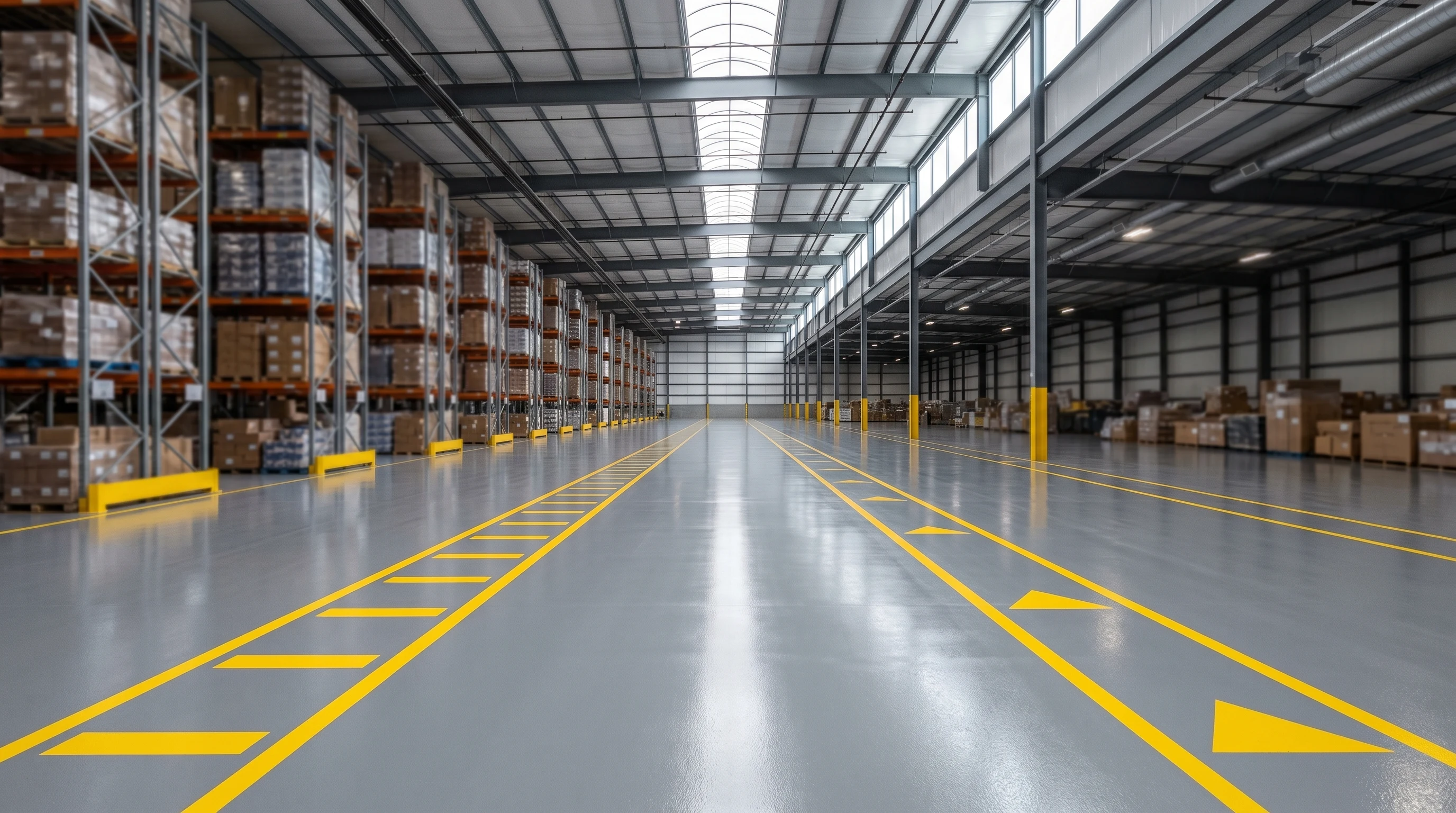
A warehouse floor sees a load profile no other commercial slab matches. Forklifts running 8,000–12,000 lb gross at 10 mph put pressure spikes at the drive wheel; pallet-jack point loads concentrate 2,500–3,500 lb on a 1-in² steel caster; hydraulic fluid and battery acid drip in the same aisle a wash-down crew hits with 1,500-psi cleaners on Saturday. Below the slab, vapor pressure from a slab-on-grade pour with no intact vapor barrier pushes against the underside of any film coating 24/7. The job of the coating is to spread the load, shrug off the chemistry, and let the slab breathe through controlled MVP without delaminating.
This is a different problem than an auto-shop floor. Auto shops see solvent and brake fluid but rarely point loads above 1,500 lb; a 6-mil garage epoxy survives there. The same product on a warehouse aisle de-laminates in 18 months. The right spec stack is not “industrial epoxy” as a category. It’s one of four tiers, picked against forklift duty cycle, MVP test result, and shutdown window.
This guide is the framework for picking that tier on either a new-build slab or a recoat over a worn floor. The companion piece on /commercial/epoxy-floor-warehouse covers the multi-coat stack details for the epoxy tier specifically.
The Four Pro Tiers
The decision tree starts here. Pick a tier first, brand second.
| Tier | Chemistry | $/sq ft installed | Service life | Cure to forklift | Best for |
|---|---|---|---|---|---|
| Tier 4 | Lithium silicate densifier + acrylic sealer | $0.40–0.80 | 10–15 yr (the slab itself) | 8 hours | New slab, low-traffic zones, cosmetic dust control |
| Tier 3 | 2-part epoxy (Tile-Clad HS, EpoxyShield Pro, ArmorSeal) | $2–4 | 5–7 yr | 5–7 days | General warehouse, ambient temp, 7-day window |
| Tier 2 | Polyaspartic (SW 5R, PPG HiPerformance) | $3–5 | 7–10 yr | 24 hours | Active facility, fast-turnaround recoat, UV exposure |
| Tier 1 | MMA (Sika Sikafloor, Stonhard Stonclad) | $5–9 | 10–15 yr | 1–2 hours | Cold storage, 24/7 facilities, sub-freezing installs |
Most distribution-center specs land on Tier 3 for general aisleways and Tier 2 for high-throughput zones. Tier 4 makes sense on a new build before racking goes in, when the operator wants dusting under control before deciding what to coat. Tier 1 is specialty.
Tier 4: Densifier + Sealer
Lithium and sodium silicate densifiers (L&M Lion Hard, Prosoco Ashford Formula, BASF MasterKure CC1315) react with free calcium hydroxide in cured concrete to form calcium silicate hydrate, the same binder that holds concrete together. The reaction hardens the top 1/8 inch of slab, increases abrasion resistance per ASTM D4060 by 20–40 percent, and locks fines so the floor stops dusting under traffic.
Saturate-and-let-stand application: two passes 24 hours apart, with sweeping or low-pressure rinse to remove residue. An acrylic sealer (Consolideck LS Guard, Ashford Sealer) adds 1–2 mils of film for stain resistance and modest gloss. Total install is 1–2 days and the slab takes foot traffic same-day.
Service life on the slab itself runs 10–15 years; the sealer wears in 2–4. Right scope: new build before tenant move-in, pick zones, rack-storage areas with no wheeled traffic, breakroom-and-restroom zones where the operator wants a clean look without the capital. Wrong scope: any aisle that sees a forklift, any zone with chemical exposure, any wash-down environment. Densifier-treated concrete is harder concrete; it is not a coating, and it does not protect against spills.
Tier 3: 2-Part Epoxy
Two-part amine-cured epoxy is the warehouse default and has been since the 1970s. The standard stack is an MVP-rated primer (ArmorSeal 1K HS, Sika Permacolor Primer), a high-build epoxy body coat (Sherwin Tile-Clad HS, Rust-Oleum EpoxyShield Pro, Sherwin ArmorSeal 650 SL), and an aliphatic urethane topcoat (Rexthane I) when UV stability matters at dock doors and skylight zones. Total DFT 12–18 mils. Cure to forklift 5–7 days. Service life 5–7 years on aisles, longer on storage zones.
Epoxy yellows under UV. Inside a windowless DC the topcoat issue is cosmetic and slow; under skylights or at open dock doors the yellowing is visible at 12 months. The Rexthane urethane topcoat solves that for $0.40–0.60/sq ft additional. The companion epoxy article details the per-zone DFT spec.
The single biggest reason a Tier 3 system fails at year 2 is not the epoxy. It’s the prep, the MVP test that didn’t happen, or both. More on each below.
Tier 2: Polyaspartic
Polyaspartic chemistry (a polyurea variant with aliphatic isocyanate) cures in 1–2 hours through a wide temperature band and holds UV stability the way epoxy doesn’t. The Sherwin Polyaspartic 5R, PPG HiPerformance Polyaspartic, and Tnemec 290 are the spec-grade products. Pot life is the catch at 15–30 minutes in the can. The body coat and topcoat go down on the same day, often the same shift.
The compelling case for polyaspartic is the cure schedule. A Tier 3 epoxy stack puts a section out for 5–7 days. A Tier 2 polyaspartic stack puts the same section back in service in 24 hours. On an active DC running 16-hour shifts, that delta is operationally enormous. The premium runs $1–2/sq ft over comparable Tier 3.
Polyaspartic is also the right answer when the substrate has been through one or two coating cycles already and the operator wants to break the recoat-and-fail loop. The faster cure schedule lets the contractor section the floor into smaller bays and work continuously instead of taking 5,000 sq ft offline for a week at a time.
Tier 1: MMA / Methyl Methacrylate
MMA (Sika Sikafloor, Stonhard Stonclad MMA, Florock 6500) cures by free-radical polymerization at temperatures down to -20°F and reaches forklift service in 60–120 minutes. Cost is $5–9/sq ft installed, service life 10–15 years. The smell during application is severe. MMA monomer carries a sharp acrylic odor that requires forced ventilation and an exclusion zone for the work shift.
Right scope: cold storage and freezer rooms (the only chemistry that cures sub-zero), 24/7 facilities where any downtime is unacceptable, food-processing floors with USDA-acceptable Sika or Stonhard formulations, and emergency-repair situations where a 1-hour cure is the difference between making the shift change or not.
Wrong scope: any ambient-temperature DC where a polyaspartic 24-hour cure is acceptable. Spec’ing MMA on a routine warehouse install is a contractor-driven upsell that doesn’t pay back.
Surface Prep Is Decisive
70 percent of failure investigations on warehouse coatings trace back to prep, not topcoat selection. The hierarchy:
| Method | ICRI CSP profile | $/sq ft | When to specify |
|---|---|---|---|
| Acid etch | CSP 1 | $0.10 | Never (insufficient for industrial) |
| Diamond grind | CSP 2 | $0.50–1.00 | Densifier (Tier 4) only |
| Shotblast | CSP 3 | $0.75–1.50 | Standard for Tier 2 and Tier 3 |
| Aggressive shotblast | CSP 4 | $1.00–2.00 | High-build, recoat over worn epoxy |
| Scarification | CSP 5–6 | $1.50–3.00 | Removing old coating, severe restoration |
ICRI CSP 3 is the spec for almost every Tier 3 epoxy and Tier 2 polyaspartic install. The shotblaster fires steel shot at the slab, fractures the cement matrix, and exposes aggregate; the result is the mechanical key the topcoat needs to grip. Anything less mechanical leaves a sealed surface that bonds chemically only, which fails at year 2 to 3 under forklift traffic.
After shotblast, HEPA-vacuum twice (bulk pass, fines pass), then SSPC-SP1 solvent clean per the topcoat manufacturer’s data sheet. Repair static cracks with urethane sealant; shave-and-fill moving cracks (any crack at an expansion joint or column line) with a polyurea or epoxy mortar. Skipping the joint detail is the second-most common failure mode after MVP.
MVP: Moisture Vapor Pressure
MVP is the killer. 80 percent of warehouse epoxy failures on slab-on-grade construction trace back to vapor migration from below grade through a slab with no intact polyethylene vapor barrier. Concrete moves moisture continuously; epoxy and polyaspartic are not vapor-permeable; vapor that arrives at the underside of the cured film has nowhere to go and lifts the coating in disc-shaped blisters.
Two ASTM-recognized test methods:
- ASTM F1869 (calcium chloride dome). Pre-weighed dish of anhydrous calcium chloride sealed under a plastic dome for 60–72 hours. Re-weigh, calculate moisture vapor emission rate in lb/1000sf/24h. Pass: ≤3 lb. Sample one test per 1,000 sq ft.
- ASTM F2170 (relative humidity probe). Sleeve drilled to 40 percent of slab depth, sealed, equilibrated 72h, probed with an RH meter. Pass: ≤75% RH. More accurate but slower.
Slabs older than 5 years on grade routinely test 4–8 lb F1869 without a vapor barrier. The fix is an MVP-rated primer before the topcoat goes down: ArmorSeal 1K HS, Sika MVE Stop, Tnemec Series 218, or Aquafin VB. Adds $1–2/sq ft and 24 hours of cure time. The math is straightforward. A $50,000 MVP primer add on a 50,000 sq ft DC against a $400,000+ tear-out and reinstall at year 2 makes the test the cheapest insurance on the project.
Run the F1869 test 72 hours before mobilization, after the slab has acclimated to conditioned-envelope temperature and humidity. Don’t accept a test taken before HVAC commissioning; the result will not represent operational conditions.
Anti-Slip and OSHA Compliance
OSHA 1910.22 sets a minimum static coefficient of friction of 0.5 dry / 0.42 wet for walking surfaces. Most cured epoxy and polyaspartic measure 0.3–0.4 smooth, which fails wet. The fix is aggregate broadcast in the topcoat: aluminum oxide (sharper, more aggressive) or quartz silica (rounder, lower bite) at 1–3 lb/100 sq ft.
ASTM E303 British Pendulum is the spec test for slip resistance; aim for BPN ≥45 wet. For NFPA 30 hazardous-area zones (battery-charging, flammable-liquid storage), broadcast quartz silica at the higher end of the range and require static-dissipative formulation if the zone houses Class I Division 1 or 2 equipment.
A single product class won’t cover a whole warehouse. Spec the aggressive aggregate in forklift aisles and dock zones; spec smooth or fine-aggregate in breakrooms and offices where slip risk is lower and ease of cleaning matters more.
Color and Striping Coordination
Stripe layout follows OSHA 1910.144 inside the four walls, the same color logic that governs exterior MUTCD work covered in /commercial/parking-lot-striping-paint.
| Marking | Color | Authority |
|---|---|---|
| Forklift aisle borders | Safety yellow | OSHA 1910.144 / 1910.176 |
| Hazard / caution zones | Yellow + black 4-in diagonal | OSHA 1910.144 |
| Fire-equipment access | Red | NFPA 1 / IFC §503 |
| Pedestrian path | Green or white | OSHA 1910.144 (advisory) |
| ADA accessible route | Blue | ADA §502 |
| Restricted / no-entry | Red | OSHA 1910.144 |
Stripe after the topcoat cures, not before. Sherwin-Williams Setfast and PPG Aexcel-Stripe waterborne acrylic adhere directly to cured polyaspartic and epoxy after a light scuff or solvent wipe; verify with a 24-hour test stripe and tape pull at a sun spot, a wash-down spot, and a low spot. Skipping the test stripe is how a contractor discovers at week 6 that the line stencil is lifting in sheets.
Specifier’s Bid Language
Boilerplate to drop into an RFP for general DC warehouse aisleways, Tier 3 epoxy spec:
“Provide and install two-coat epoxy floor system per Sherwin-Williams Tile-Clad HS or approved equal (Rust-Oleum EpoxyShield Pro, PPG Pitt-Glaze) over MVP-rated primer. Total DFT 12–16 mils. Substrate prep: shotblast to ICRI CSP 3, HEPA-vacuum twice, SSPC-SP1 solvent clean. ASTM F1869 calcium chloride moisture vapor test required at one test per 1,000 sq ft minimum 72 hours before mobilization; if any reading exceeds 3 lb/1000sf/24h, install Sika MVE Stop or approved equal vapor-mitigation primer. Aluminum oxide aggregate broadcast in topcoat at 2 lb/100 sq ft on all forklift aisles and dock zones; ASTM E303 BPN ≥45 wet required. Aisle striping per OSHA 1910.144 in safety yellow, applied minimum 24 hours after topcoat cure. Contractor SSPC-QP1 certified or NACE Level 2 inspector on site. Warranty: 5 years adhesion (delamination), 3 years wear (abrasion to substrate).”
For a Tier 2 polyaspartic spec, swap the chemistry and the cure window: 24-hour return-to-service against 7-day for epoxy. For a Tier 4 densifier scope, drop the MVP requirement (densifier is vapor-permeable) and reduce prep to CSP 2 diamond grind.
Most reputable contractors warrant 5–7 years adhesion on a properly-prepped Tier 3 install and 7–10 on Tier 2. Push back on bids that warranty wear at less than 3 years; that’s the tell that the contractor expects to under-spec the prep or doesn’t trust the product.
Failure Modes and How to Inspect
- Peeling at expansion joints. Joint movement breaks the bond at the discontinuity. Prevention is the joint detail: backer rod plus polyurethane sealant, finished flush with the floor surface, on every static and moving joint before topcoat. Inspection: walk the joints quarterly; a hairline crack in the sealant means resealing before water or oil migrates under the film.
- Disc-shaped blisters at random. Classic MVP signature. Vapor migrating through the slab pushes the coating off in 1–6 inch discs, often in clusters near the slab perimeter or at floor drains. Re-prime the affected zone with an MVP-rated primer after re-shotblasting; the blistered area always exceeds the visible area. If F1869 was skipped at install, the whole floor is at risk.
- Hot tire pickup at the dock. Tires lift the topcoat in matching tread strips along the truck-turn radius. Cause is thermal-mechanical stress and inadequate Type II epoxy chemistry. Fix is a chemical-resistant Type II epoxy (Carboline Carbozinc, Tnemec 240) in the dock zone, at higher DFT than the body of the warehouse.
- Oil staining through the coating. Old hydraulic oil that wasn’t fully encapsulated during prep migrates back through the film over 6–24 months. Prevention is the prep spec: degrease, encapsulate residual stains with a shellac-based sealer, and don’t paint over visible oil. Coating is not a substitute for cleaning.
- Loss of slip resistance. Aggregate wears down at year 3–4 in heavy aisles, BPN drops below 45 wet, the floor passes dry but fails wet. Fix is a maintenance recoat with re-broadcast aggregate every 4–5 years on Tier 3, every 6–8 on Tier 2.
The standard inspection cadence is quarterly walk-throughs by facility, annual third-party assessment for any zone under warranty, and a full F1869 retest before any major recoat. Document every reading; the warranty conversation goes differently when there’s a paper trail.
Where to Buy / Spec
| Channel | Best for |
|---|---|
| Manufacturer-direct (Sherwin-Williams ProIndustrial, Sika Industrial Flooring, Stonhard) | Spec’d projects, rep support, bulk pricing |
| Industrial distributor (Pavement Supply, Brown Co, Florock dealer network) | Bulk material, contractor accounts |
| Pro retail (Sherwin-Williams stores) | Smaller jobs, local pickup |
| Amazon Business | Densifier-tier products, small-batch primers, MVP test kits |
For Tier 1 MMA, the contractor path runs through manufacturer-trained applicators only. Sika and Stonhard both maintain certified-installer rosters and won’t honor warranty outside that network.
Ask a Question