Slate Blue
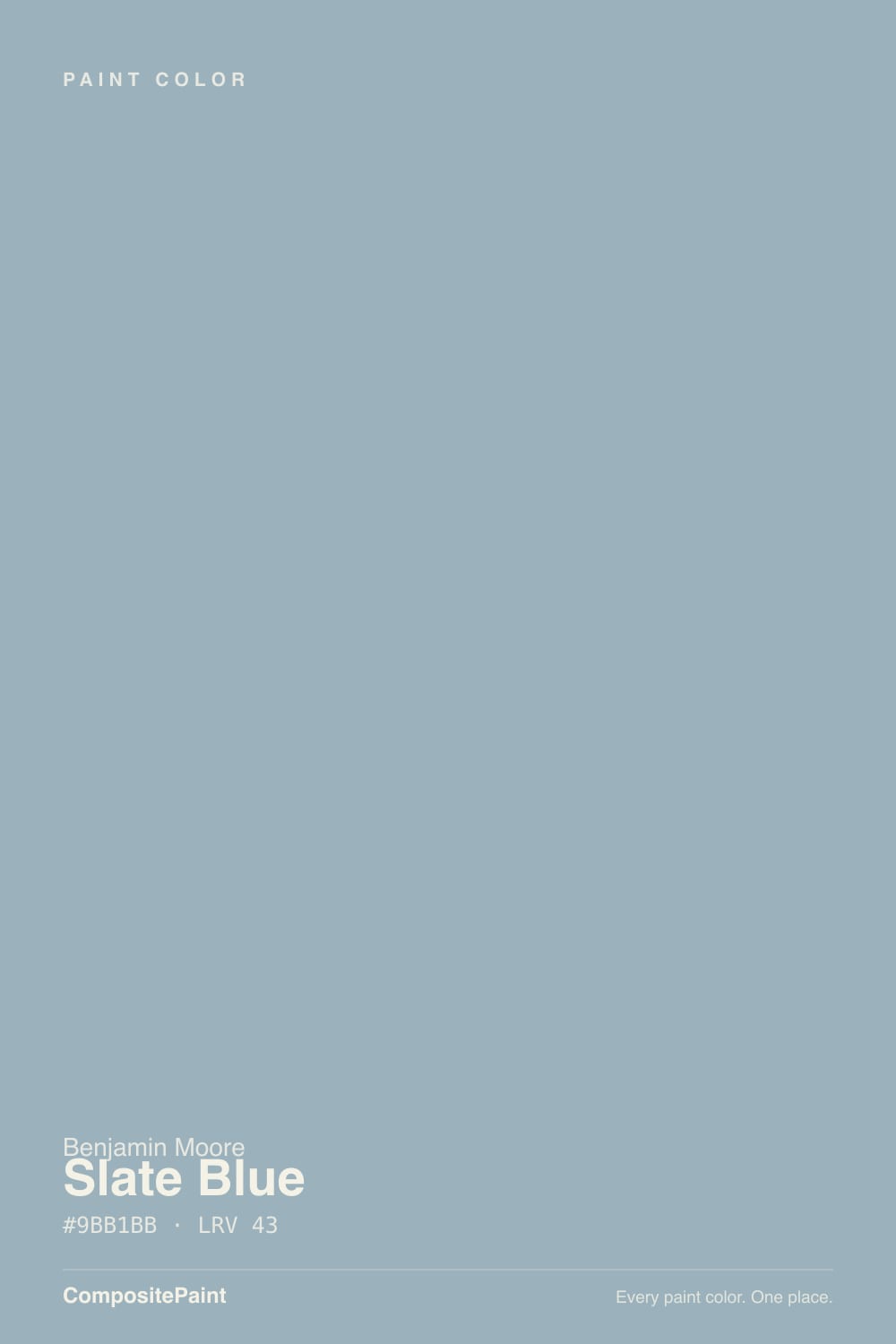
1648 · #9BB1BB · LRV 43 — cool blue-green tone, mid-tone — versatile but shifts visibly with light.
- 1Waterloo13
- 2Charcoal Blue19
- 3Slate Blue43
- 4Honolulu Blue62
- 5After Rain68
What Color Is Slate Blue, Really?
Slate Blue 1648 is a mid-tone gray-blue. Its hex value is #9BB1BB and its LRV is 43, which puts it squarely in the middle of the light scale. A wall in Slate Blue keeps real color and real weight, but it does not swallow the light the way a deep blue does. The undertone is a cool blue-green: the hue sits at 199 degrees with about 19 percent saturation, so this is a blue that has been quieted down with gray.
People choose it when they want blue that behaves. It is soft enough to live on every wall of a bedroom or bath without feeling like a statement, and grayed enough to sit next to existing neutrals without clashing. It gives a calm, slightly coastal, slightly weathered look rather than a bright or nautical one.
The thing to check before committing is how much of the green side you are getting. At 19 percent saturation the color has very little to hold onto, so cool north light can push it toward gray-green and dim rooms can flatten it to plain gray. Look at a big sample on the actual wall, not a chip.
Slate Blue sits at hue 199 with roughly 19 percent saturation, so it is a blue pulled well toward gray with a slight green push. The hex #9BB1BB says the same thing plainly: blue leads, but green is close behind and red is not far off either. That balance is why the color can read as a soft blue in one room and a weathered gray-green in another.
The undertone shows most next to clean white trim, where the blue steps forward clearly. Beside a true navy or a saturated blue tile, Slate Blue suddenly looks dusty and gray. Against warm beige, oak, or brass it reads cooler and more obviously blue.
Before you commit, hold a sample next to anything green already in the room, such as a countertop vein, a tile glaze, or a green-leaning gray floor. If those greens line up with the green hiding in Slate Blue, the wall will lean sea glass rather than blue. That is the shift most people do not expect.
Best Rooms and Uses for Slate Blue
With an LRV of 43, Slate Blue is a full-room wall color rather than an accent. Bedrooms take it well because the grayed blue reads restful. Bathrooms, powder rooms, laundry rooms, and mudrooms suit it too, since the color pairs easily with white fixtures and tile without looking cold.
It is a good cabinet and vanity color. On a bathroom vanity or a run of lower kitchen cabinets it gives depth against a light counter while staying quieter than a navy. Built-ins, bookcases, and interior doors work the same way.
Outside, gray-blues of this weight hold up as siding, shutter, or front-door colors, and the mid LRV means the color will not chalk out visually the way very pale exteriors do. What it is not is a trim color. At 43 it is far too dark to frame a room, so keep trim in a separate brighter white and let Slate Blue carry the wall or the cabinet face.
How Lighting Changes Slate Blue
At LRV 43 Slate Blue returns a moderate amount of light, so the room does not go dark, but the light source decides which side of the color you see. North-facing rooms get cool, flat daylight that strips out what little warmth is there. In that light the color reads grayer, greener, and a bit colder than the chip suggested.
South-facing rooms do the opposite. Warm, plentiful sun softens the gray and lets the blue look clearer and friendlier. East rooms feel fresh and cool in the morning, then settle flatter by afternoon. West rooms stay quiet early and pick up warmth late in the day.
Bulbs matter as much as windows here. Warm 2700K light takes the edge off the blue and can gray it out. Cooler 3500K to 4000K light sharpens the blue and can tip it toward cold. Because a mid-tone loses definition in dim light, look at your sample at night under your own fixtures before you decide.
Most complaints about Slate Blue are a light mismatch. Upload a photo of your actual room and see it on your walls — then ask for the same wall in north light or evening lamps before you buy a single sample.
Need It From Another Brand?
Any paint counter can custom-tint Benjamin Moore 1648 directly. If you would rather stay in one brand's own deck, these are the closest stock matches, measured as ΔE2000. Under 2 is a difference you will not see on the wall.
| Brand | Closest color | ΔE | LRV | |
|---|---|---|---|---|
| Sherwin-Williams | Dockside BlueSW 7601 · Sherwin-Williams | 1.2 | 43 | Color page → |
| Behr | Cloudless DayECC-32-1 · Behr | 1.7 | 42 | Color page → |
| Valspar | Hibernate8004-41C · Valspar | 2.5 | 43 | Color page → |
| PPG / Glidden | How Handsome1040-4 · PPG / Glidden | 3.0 | 41 | Color page → |
| Glidden | Soft Traditional Blue70BG 41/076 · Glidden | 2.5 | 41 | Color page → |
| Dutch Boy | Fogged In433-3DB · Dutch Boy | 2.8 | 41 | Color page → |
Similar Benjamin Moore Colors
The nearest shades to Slate Blue within Benjamin Moore's own range, ranked by perceptual color distance — useful when you want the same look a touch lighter, darker, or warmer.
WCAG 2.1: AA is 4.5 : 1 for normal text, 3 : 1 for large text, AAA is 7 : 1.
Slate Blue vs Similar Colors
Inside the same deck, Early Morning CC-818 carries the identical hex #9BB1BB and the same LRV of 43, so it is the same color living in a different collection. Ocean City Blue 718 at #97B2B7 and LRV 42 tips a little greener. Saratoga Springs 1669 at #93B1BC and LRV 42 is the clearer, bluer version, and Winter Lake 2129-50 at #9CADB7 and LRV 40 is the grayest and slightly deepest of the group.
Across brands, Dockside Blue SW 7601 at LRV 43 has a deltaE of 1.2 and Supernova N510-4 by Behr at LRV 42 comes in at 1.69, so both are visually identical to Slate Blue in normal room light. Hibernate 8004-41C by Valspar at LRV 43 and Kittiwake No. 307 by Farrow and Ball at LRV 40 are 2.45 and 2.61, very close but worth sampling first. Powder Mill DET566 by Dunn-Edwards, at 4.11, is close but visibly different side by side. Benjamin Moore sells through independent dealers, which matters if your nearest store carries a different line.
Colors That Go With Slate Blue
Trim is the easy part. A clean, brighter white on baseboards, casing, and ceilings gives the contrast Slate Blue needs, and a slightly warm white keeps the pairing from feeling clinical. Test both, since a cool white will emphasize the green in the wall.
For adjacent rooms or a second wall tone, stay inside the same quiet family. Winter Lake 2129-50 at LRV 40 and Little Falls 1621 at LRV 41 are a touch grayer and slightly deeper, so they step down without a jolt. French Toile CSP-595 at LRV 43 is the flattest and grayest of the neighbors, useful when you want the same brightness with less blue. Saratoga Springs 1669 at LRV 42 goes the other way and reads a little clearer and bluer.
Materials do the rest. Natural oak and walnut warm the color up, brushed nickel and chrome keep it crisp, and brass or aged bronze adds contrast. Black hardware and a dark door give it a hard edge if you want one.
Coordinated palette
Generated by hue-rotating #9BB1BB in HSL space. Pair Slate Blue with one accent and one neutral — the swatches below are starting points, not final picks.
Slate Blue FAQ
Is Slate Blue warm or cool?
Slate Blue is a cool color. Its hue sits at 199 degrees, which is the blue to blue-green part of the wheel, and there is no warm cast underneath it. The gray in the mix softens the coolness so it does not feel icy, but next to beige or oak it will always read as the cool element in the room.
What LRV is Slate Blue?
Slate Blue 1648 has an LRV of 43. LRV runs from 0 for black to 100 for pure white, so 43 is a true mid-tone. It reflects a moderate amount of light, which means a room painted in it keeps decent brightness during the day but will feel noticeably deeper at night or in a room with small windows.
Does Slate Blue work in a dark room?
It can, with a caveat. At LRV 43 the color still returns a fair amount of light, so it will not make a dim room feel cave-like. But low or cool light pulls the blue toward gray-green and flattens it, so the blue you liked on the chip may not show up. In a dark room, plan on good artificial lighting and sample at night.
Is Slate Blue actually blue or is it gray?
It is both, and the label depends on the light. The hex value #9BB1BB has blue leading with green close behind and only about 19 percent saturation, which is why it can read as a soft blue in sun and a weathered gray-green in cool north light. Think of it as a blue that behaves like a gray rather than a clear blue.
What white trim goes with Slate Blue?
A brighter white than the wall, which is any true trim white, since Slate Blue at LRV 43 leaves plenty of room for contrast. A slightly warm white keeps the pairing soft and stops the green undertone from being pushed forward. A cool, blue-based white will sharpen the contrast but can also make the wall look greener, so compare both against the wall before you buy.
Is Slate Blue good for cabinets or exteriors?
Yes to both. At LRV 43 it gives a vanity or lower cabinet run real depth against a light countertop without going as heavy as a navy. Outside, a grayed blue at this weight works as siding, shutters, or a front door, and its mid-range lightness means it holds its color rather than washing out in strong sun.
Have you painted with Slate Blue?
Rate it — one tap helps the next reader decide.
Ask a Question