Product review · Minwax · Updated August 7, 2026
Wood Finish Penetrating StainMinwax paint review
8.6/10The default oil stain for a reason. Budget the topcoat from day one, because the stain is the cheap half.
The 36 colors other stains get matched against, at $16 to $22 a quart. Just know what the name hides: this is color, not a finish, and it protects nothing on its own.

Mark Thompson · Pro Contractor & Field Editor · Updated August 7, 2026
22 years of residential repaints and finish carpentry. Mark has matched new trim to 30-year-old floors with Minwax more times than he can count, usually because the floor was Minwax to begin with. About the testing process →
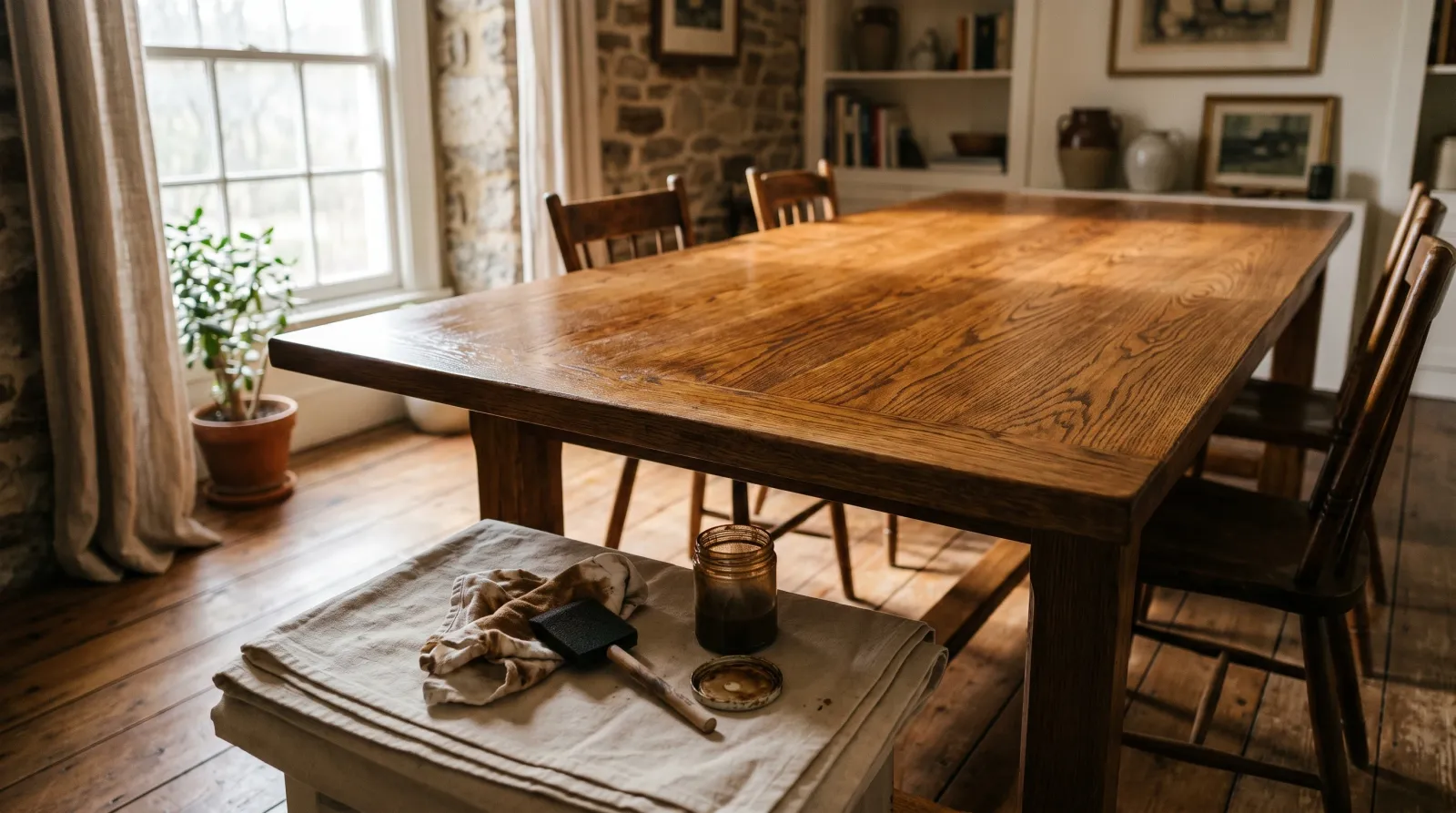
Minwax Wood Finish Penetrating Stain3 sheens
Coverage500–600 sq ft / gal, one coat
VOCAbout 550 g/L standard
Sheens A — penetrating stainno sheenyou topcoat it
Read this first
The Fast Verdict
Yes, for bare interior wood you are going to topcoat afterward. At $16 to $22 a quart it is cheap, it is stocked everywhere, and the 36 colors are the ones other stains get matched against. The oil sets slow enough to wipe an even tone, and one coat usually reads full on oak or walnut. No, if you wanted stain and seal in one can, because it protects nothing on its own. Condition pine and maple first or it blotches, and expect a real solvent smell.
Best for
Bare interior oak, walnut, mahogany, ash · Furniture and cabinets · Trim, molding, doors · Hardwood floors · Matching an existing stained floor · Half-pint jobs like a single frame
Skip if
You want stain and seal in one can · Pine or maple and you will not condition it first · Anything outdoors · You cannot ventilate the room · You will not stir the can as you go
What it's good at
- Color other stains get measured against — Special Walnut, Provincial, Early American, Jacobean
- Matching new trim to an old floor, because that floor was probably Minwax to begin with
- Working in slow enough to wipe the tone even on a tabletop or a door
- One coat reading full and rich on open-grain hardwood
- Being $16 to $22 a quart at every hardware store in America
- Half-pint sizes, so a single picture frame does not cost you most of a quart
What it's not good at
- Protecting anything — it is color only, and every job needs a topcoat over it
- Pine, maple, birch, alder, and cherry without the pre-stain conditioner
- Low-odor work; the standard formula runs about 550 g/L and the room reeks
- Staying consistent in the can, so the last board reads darker if you stop stirring
- Fast turnaround, since a proper topcoat wants 8 hours and often overnight
- Anything outdoors, where you want a stain built to flex and block UV
Same shelf, different cans
Which Minwax Wood Finish Are You Buying?
The Wood Finish name now spans more cans than it used to. This review is the original oil-based one. If you grabbed a water-based can expecting the slow, forgiving wipe of the oil, take it back — they handle nothing alike.
Wood Finish, oil-based (this review)
BasePenetrating oil stain, 36 colors, wipe-on
RecoatSecond coat 2–3 hr; ready for poly at about 8 hr
Buy it if
Bare interior hardwood you are going to seal afterward, and you want working time to wipe the color even. This is the color reference other stains get matched to.
Avoid if
Your state blocks the standard formula, or the smell is a dealbreaker in an occupied space. It runs about 550 g/L VOC.
Wood Finish 250 VOC
BaseReformulated oil stain
Buy it if
You live in California or the OTC region, where the standard can is not sold. Same look, legal formula.
Avoid if
Nothing, if it is what your state stocks — but do not special-order it elsewhere expecting a different result.
Wood Finish Water-Based Semi-Transparent
BaseWater-based, 200-plus tinted colors
Buy it if
Low-smell, fast-dry jobs in an occupied apartment, and you still want the grain to read through the color.
Avoid if
You are wiping a large surface. It sets before you have crossed the board, and the color reads flatter and cooler than the oil.
Wood Finish Water-Based Solid Color
BaseOpaque, paint-like
Buy it if
You want to hide the grain rather than show it — rough or mismatched wood where color uniformity beats figure.
Avoid if
The grain is the point. This one covers it.
Performance Series Tintable
BaseCounter-tinted to custom colors
Buy it if
Stock colors will not match an existing floor or trim run and you need the counter to mix to it.
Avoid if
One of the 36 stock colors already gets you there. You are paying for a service you do not need.
Numbers, not adjectives
Spec Sheet
- Coverage
- 500–600 sq ft / gal, one coat (less on thirsty wood)
- Type
- Penetrating oil stain — no film, no sheen
- Touch dry
- 1 hr
- Second coat
- 2–3 hr
- Ready for poly
- About 8 hr on most hardwoods; 24 hr on pine, fir, and oily woods
- VOC
- About 550 g/L standard; a 250 g/L SKU sells in restricted states
- Prep
- No primer. Pre-stain conditioner on pine, maple, birch, alder
- Surfaces
- Bare interior wood: furniture, cabinets, doors, trim, floors
- Sizes
- Half-pint, pint, quart, gallon
- Cleanup
- Mineral spirits — no soap and water
- Price
- $16–22 / qt, $45–60 / gal
Application Settings That Work
- Brush
- A rag or a foam brush, wiped on with the grain. Let it sit a few minutes, then wipe the excess off — the wipe is what evens the tone, and oil sets slow enough to give you a few minutes to work. One coat usually reads full on open-grain hardwood; a second deepens it. On a big floor, work with a partner to keep a wet edge. Stir the can constantly, and never shake it.
- Primer
- No primer. On pine, maple, birch, and alder use Minwax Pre-Stain Wood Conditioner first — brush it on, wait 15 minutes, and stain within two hours. Then plan the topcoat: poly, wipe-on poly, or hardwax oil, at least 8 hours after staining on hardwood and 24 on resinous wood.
When You Can Actually Topcoat It
Touch-dry runs about an hour and a second coat can go on at 2 to 3. Do not read those numbers as permission to poly. Give oil stain at least 8 hours on most hardwoods, and a full 24 on resinous or oily woods like pine, fir, and the rosewoods. Put polyurethane over stain that is still gassing off solvent and you get a soft, gummy film that never fully hardens — and the only fix is stripping both layers back off. When in doubt, wait the extra night. The other half of this is that the stain never cures into anything protective at all. Bare stained wood spots from a water glass and wears pale at the touch points, so the topcoat is not optional, it is the second half of the job.
Mid-project panic
When It Goes Wrong, and How to Fix It
Pine or maple came out blotchy
Why it happens. Pine, maple, birch, alder, and cherry drink stain unevenly. The soft early-wood grabs pigment and the dense late-wood rejects it, so you get a leopard-spot mess. It is the wood, not the can, and the label does not shout about it loudly enough.
The fix. Brush on Minwax Pre-Stain Wood Conditioner first, wait 15 minutes, then stain within two hours. It evens out the absorption. If you are already blotchy, you are sanding back to bare and starting over with the conditioner — so buy it in the same trip as the stain.
The polyurethane over it stayed soft and gummy
Why it happens. The poly went on too soon. The stain was still releasing solvent, and the topcoat sealed it in. On pine, fir, and the oily woods this happens even when the surface felt dry to the hand.
The fix. Wait at least 8 hours on hardwood and a full 24 on resinous wood before any topcoat. Where it has already gone gummy, strip it back — a film that never hardens will not fix itself, and adding another coat makes it worse.
Boards came out two different shades
Why it happens. Nobody stirred. The pigment drops to the bottom of the can fast, so the first board off a freshly stirred can and the last board off a settled can read like two different colors. I have seen a whole set of stair treads come out mismatched from one stir at the start and never again.
The fix. Stir, do not shake, and keep stirring as you go — every few minutes on a big job. If the shades are already off, a second coat on the light boards evens most of it out, but match on a scrap first.
The stained wood is water-spotting and wearing pale
Why it happens. It was left bare. Wood Finish is color, not a finish, no matter what the name says. There is no film on top, so water rings, scuffs, and grime in the grain all land straight on the wood.
The fix. Topcoat it. Two to three coats of polyurethane, wipe-on poly, or a hardwax oil. On floors and tabletops use an oil-based poly for the toughest film; on trim, doors, and most furniture a water-based or wipe-on poly is plenty and dries faster.
The room reeks and the rags worry you
Why it happens. The standard formula runs about 550 g/L VOC. It smells like solvent for a day, and oil-soaked rags can spontaneously combust if you ball them up wet.
The fix. Windows open and a fan running while you work. Lay used rags flat outside to dry before you throw them out. If you cannot ventilate — an occupied apartment, a basement with no window — the water-based version earns its keep, at the cost of working time and depth.
Side by side
Wood Finish Oil vs Water-Based vs General Finishes Gel Stain
People ask which one constantly. The short version is oil for looks, water for speed and smell, gel for wood that fights you. Here is the long version.
| Wood Finish (oil) | Wood Finish Water-Based | General Finishes Gel Stain | |
|---|---|---|---|
| Working time | Sets slow. Minutes to wipe the tone even. | Sets before you have crossed the board. | Thick and slow; wipe on, wipe off. |
| Color depth | Warm amber depth. The benchmark. | Flatter and cooler. | Deep and near-uniform, but it mutes the figure. |
| Blotch-prone pine and maple | Blotches unless you condition first. | Also wants conditioning, and it raises grain. | Near-uniform color with no conditioner. That is its whole pitch. |
| Over an existing finish | No. It has to soak into bare wood. | No. | Yes, over a scuff-sanded sound finish. |
| Odor and cleanup | About 550 g/L, real solvent smell, mineral spirits. | Low odor, soap and water. | Oil-based, so smell and solvent cleanup. |
| Price | $16–22 / qt | Similar shelf tier | $28–36 / qt |
Working time
Wood Finish (oil)Sets slow. Minutes to wipe the tone even.
Wood Finish Water-BasedSets before you have crossed the board.
General Finishes Gel StainThick and slow; wipe on, wipe off.
Color depth
Wood Finish (oil)Warm amber depth. The benchmark.
Wood Finish Water-BasedFlatter and cooler.
General Finishes Gel StainDeep and near-uniform, but it mutes the figure.
Blotch-prone pine and maple
Wood Finish (oil)Blotches unless you condition first.
Wood Finish Water-BasedAlso wants conditioning, and it raises grain.
General Finishes Gel StainNear-uniform color with no conditioner. That is its whole pitch.
Over an existing finish
Wood Finish (oil)No. It has to soak into bare wood.
Wood Finish Water-BasedNo.
General Finishes Gel StainYes, over a scuff-sanded sound finish.
Odor and cleanup
Wood Finish (oil)About 550 g/L, real solvent smell, mineral spirits.
Wood Finish Water-BasedLow odor, soap and water.
General Finishes Gel StainOil-based, so smell and solvent cleanup.
Price
Wood Finish (oil)$16–22 / qt
Wood Finish Water-BasedSimilar shelf tier
General Finishes Gel Stain$28–36 / qt
Furniture and floors in bare hardwood: the oil, and the depth is worth the overnight wait before topcoat. An occupied apartment with no ventilation: the water-based version earns its keep, and you accept flatter color and a faster set. Blotch-prone pine and maple, or a piece you are recoloring over an existing finish: a gel stain, which is roughly double the money and buys you uniformity a penetrating stain cannot give you on that wood.
If not this one
Honest Alternatives
VP
Varathane Premium Fast Dry Wood Stain$14–18 / qt
Rust-Oleum's oil stain, a couple of dollars under Minwax at the same big boxes. It dries faster — about an hour to recoat — and the color range is a touch richer in the reds. The catch is that the speed cuts your working time, so it is less forgiving when you are wiping a big surface even.
GF
General Finishes Gel Stain$28–36 / qt
Thick, pudding-consistency gel that sits more on the surface than it soaks in. That is the feature: near-uniform color on blotch-prone pine and maple without conditioner, and it is the go-to for staining over an existing finish where a penetrating stain cannot soak.
Full review →RM
Rubio Monocoat Oil Plus 2C$90+ per kit
A hardwax oil that colors and protects in one application — the actual stain-and-seal Minwax is not. One thin coat, no topcoat, low VOC, and a natural matte look. Expensive, cures over days, and the application is fussier.
Questions people actually ask
Wood Finish Penetrating Stain Questions, Answered
Is Minwax Wood Finish worth it?
Yes, for bare interior wood you are going to topcoat afterward. At $16 to $22 a quart it is cheap, it is stocked everywhere, and the 36 colors are the ones other stains get matched against — the oil sets slow enough to wipe an even tone, and one coat usually reads full on oak or walnut. No, if you wanted stain and seal in one can, because it protects nothing on its own. Condition pine and maple first or it blotches, and expect a real solvent smell.
Does Minwax Wood Finish need a topcoat?
Yes. It is a penetrating stain, not a finish — the name fools people. The color soaks into the grain but there is no protective film on top. Bare stained wood marks, water-spots, and wears through in months. Seal it with two to three coats of polyurethane, oil or water-based, or a wipe-on poly once the stain reads dry, usually overnight.
How long before I can put polyurethane over it?
Touch-dry in about an hour, but do not poly that fast. Give oil stain at least 8 hours on most hardwoods, and a full 24 on resinous or oily woods like pine, fir, and the rosewoods. If poly goes on while the stain is still gassing off solvent, you get a soft, gummy film that never fully hardens. When in doubt, wait the extra night.
Why does my pine come out blotchy with Minwax?
Pine, maple, birch, and alder drink stain unevenly — soft early-wood grabs pigment, dense late-wood rejects it, and you get a patchy mess. It is the wood, not the can. Brush on Minwax Pre-Stain Wood Conditioner first, wait 15 minutes, then stain within two hours. The conditioner evens out the absorption. Skip it on those woods and you will be sanding back.
Is the oil-based Minwax better than the water-based version?
For looks and forgiveness, yes. Oil works in longer before it sets, so you have time to wipe for even color, and it builds the warm amber depth people picture when they think of stained wood. Water-based dries fast, raises grain, and reads flatter and cooler. Oil wins on furniture and floors. Water-based wins where low odor and fast turnaround matter more than depth.
How many coats of stain do I need?
Usually one. On open-grain hardwood a single wipe-on coat reads full and rich, and that is what stretches a quart further than the can suggests. A second coat at 2 to 3 hours deepens the color if you want it darker, but on oak and walnut you rarely need it. Test on a scrap before you commit.
Why did my boards come out different shades?
The pigment settles to the bottom of the can fast. Do not shake it, stir it, and keep stirring as you work. The first board off a freshly stirred can and the last board off a settled can read like two different colors — that is how a whole set of stair treads ends up mismatched.
Can I use it outside?
No. This is a bare interior wood stain with no UV package and no flex, and it protects nothing on its own. For decks, fences, and exterior siding you want a stain built to move with the wood and block sun. Use an exterior or deck stain instead.
Keep exploring
Minwax brand guide and product lineupBest interior wood stain — full round-upWater-based vs oil stain — which to usePolyurethane vs polycrylic for the topcoat
We may earn a commission when you buy through the retailer link above. It never changes the score or the verdict.
Ask a Question