Best Wood Touch-Up Markers
Six wood touch-up markers tested on oak, walnut, and prefinished laminate scratches. Top pick: Minwax Wood Finish Stain Marker for stained interior wood.

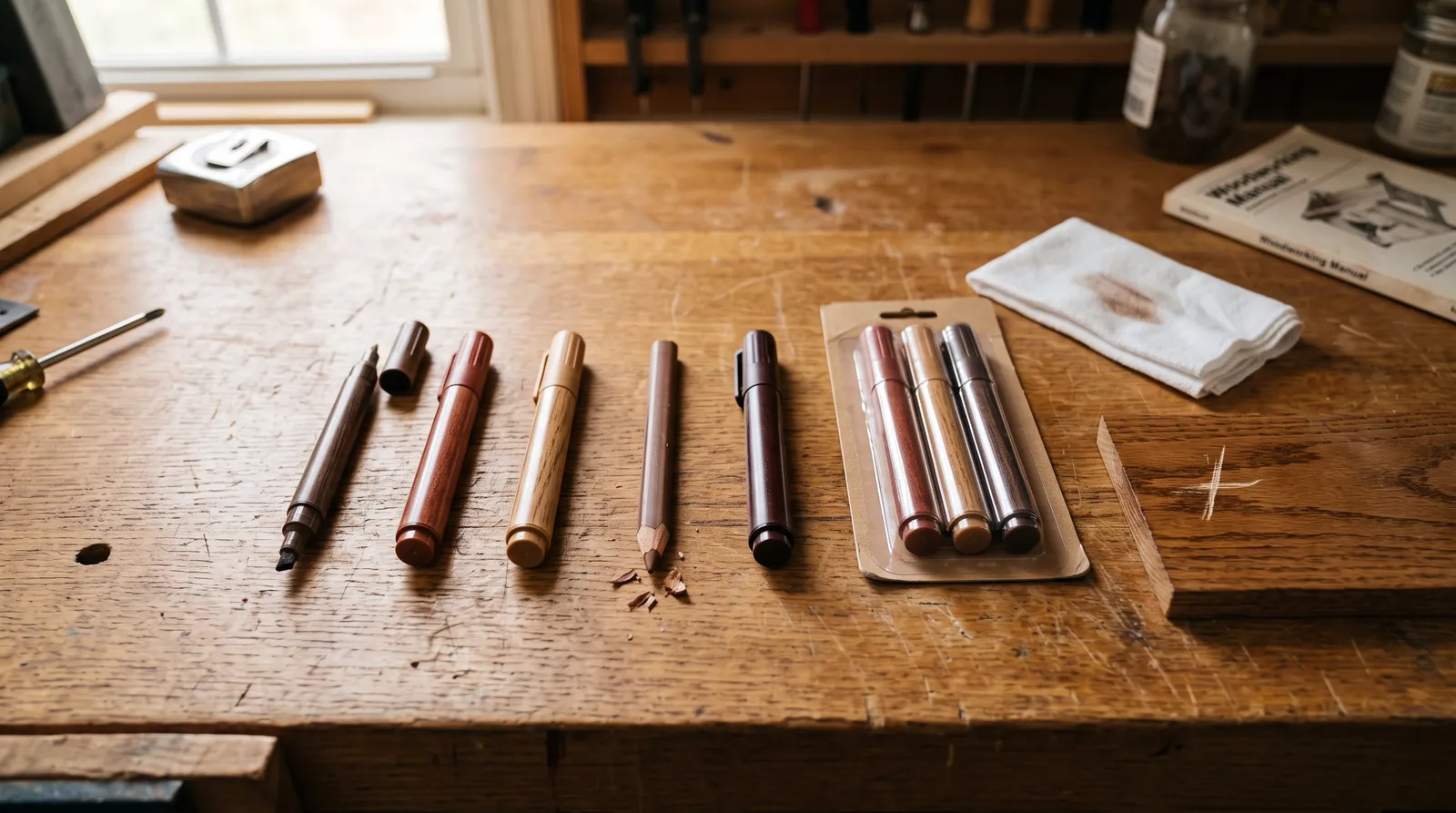
It is real oil-based Minwax Wood Finish stain in a marker body, so the colors line up with the same Dark Walnut, Golden Oak, and Special Walnut cans people already stained the furniture with
Over 50 individual colors plus 12-count and 36-count assortment packs, which is the only way to hit an odd factory finish like a fruitwood or a red-toned cordovan without mixing your own
15-minute dry and recoat window. You can build color in three passes inside an hour instead of waiting overnight between coats like the oil stain marker
Under 5 dollars for light, medium, and dark in one card. Start light, go darker, and you land close on most brown furniture without owning a color deck
Zero dry time. Work it into the hole, wipe the excess, and the trim is done before the caulk gun is back in the bag
Pigmented rather than dye-based, so it covers instead of tinting. This is the one that fixes a white cabinet door whose edge has worn back to bare MDF
Disclosure: Some links below are affiliate links. We earn a commission if you buy through them, at no extra cost to you. Picks are based on the criteria in How We Picked. No brand pays for placement.
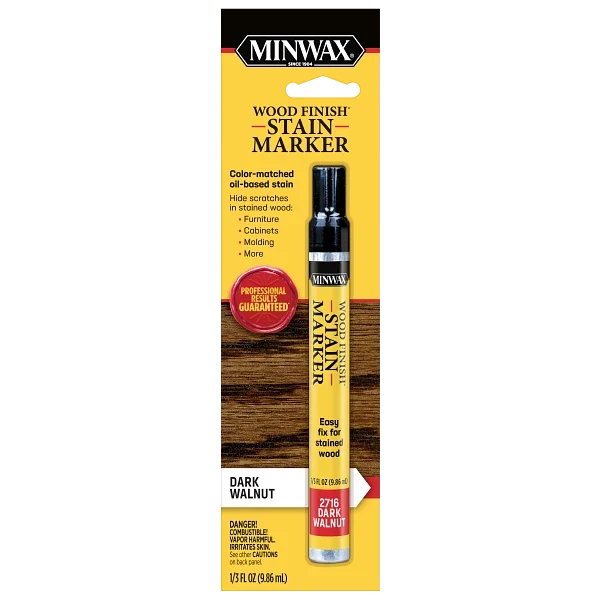
Top pick: the Minwax Wood Finish Stain Marker. It is real oil-based Minwax stain in a pen body, it costs about seven dollars, and on a scratch that went through the finish into stained oak or walnut it wins on color accuracy and on the thing nobody talks about, wipe-back. You get a long enough open time to lighten a pass that went too dark. Every dye marker I tested sets before you can fix it. Minwax falls short on dry time, at 4 to 6 hours before the surface is safe to touch, and it does nothing at all on a scuff that never reached bare wood. For that scuff, and for prefinished floors, buy Minwax Repair Markers instead.
Those two cover maybe eighty percent of household damage. The rest of this page is the other twenty percent.
The Two Chemistries Nobody Labels on the Package
Every marker in this category is one of two things, and the package almost never says which.
Dye and oil-stain markers carry transparent color that soaks into wood fiber. Minwax Wood Finish Stain Marker and Mohawk Pro-Mark live here. They keep grain visible, which is why a repair on quartersawn oak still reads as oak instead of as a stripe. They need raw fiber to work. Drag one across an intact polyurethane finish and it beads, smears, and comes off on the rag.
Pigment markers carry opaque color that sits on the surface and bonds to whatever is under it. Minwax Repair Markers, Mohawk Ultra Mark, and the Guardsman set are pigment. They work over an existing finish, over laminate, over paint. They hide grain, which on a scratch narrower than a pencil lead does not matter and on a wide worn edge very much does.
The failure I see most often on customer photos is a homeowner buying a stain marker for a finish-only scuff, wiping it off with the excess, and concluding the product is junk. The product is fine. The scratch never reached the wood.
There is a third thing on this list that is not a marker. The Blend-Fil Pencil is colored wax, and it fills volume. A nail hole in stained casing does not need tint, it needs something in the hole. Keep the categories separate in your head and the buying decision gets easy.
How We Picked
I cut matched scratch sets into four substrates: red oak stained Dark Walnut, hard maple stained Golden Oak, prefinished engineered hickory flooring, and the edge of a white-painted MDF cabinet door. Each panel carried three damage types cut with a utility knife and a chisel, a finish-only scuff, a scratch through to raw fiber, and a 1/8-inch gouge. Repairs went on at 70°F and 45% RH under 3000K work light, then got re-inspected the next day under 5000K daylight balance, which is where most touch-up jobs get exposed. Wipe-back windows were timed on a stopwatch at 10, 20, 45, and 90 seconds. Duplicate panels sat on a south-facing windowsill and got re-scored for fade at 30 and 90 days. Two furniture refinishers and a flooring installer looked at the panels and told me what actually comes back as a callback.
The Six at a Glance
| Product | Best for | Colorant | Dry time | Price |
|---|---|---|---|---|
| Minwax Wood Finish Stain Marker | Stained interior wood, scratch to bare fiber | 🟢 Oil stain, transparent | 🟡 4–6 hours | $ |
| Mohawk Pro-Mark | Exact match on odd factory colors | 🟢 Dye, transparent | 🟢 Minutes | $$ |
| Minwax Repair Markers | Prefinished floors, laminate, surface scuffs | ⚪ Pigment, semi-opaque | 🟢 15 minutes | $ |
| Guardsman Touch-Up Markers | Brown furniture, first-timers | ⚪ Pigment, semi-opaque | 🟢 Minutes | $ |
| Minwax Blend-Fil Pencil | Nail holes, gouges, filling volume | ⚪ Colored wax | 🟢 Instant | $ |
| Mohawk Ultra Mark | Worn edges, painted trim and cabinets | 🟡 Pigment, opaque | 🟢 Minutes | $$ |
Price tiers are per marker or per set, not per project. Nothing here costs more than eighteen dollars.
Match the Marker to the Damage
| What you are looking at | Buy this | Why |
|---|---|---|
| Scratch through the finish, bare wood showing | Minwax Wood Finish Stain Marker | Stain colors the exposed fiber and grain still reads |
| Hairline scuff, finish only, no bare wood | Minwax Repair Markers | Pigment bonds to the topcoat; stain would wipe off |
| Prefinished or laminate floor plank | Minwax Repair Markers | No wood fiber under the wear layer to stain |
| Nail hole, chip, or gouge with depth | Minwax Blend-Fil Pencil | Fills volume and colors in one motion |
| Worn white or gray painted edge | Mohawk Ultra Mark | Opaque pigment covers bare MDF |
| Unusual factory color you cannot name | Mohawk Pro-Mark | 50-plus colors and assortment packs to test against |
| Generic brown furniture, one-off repair | Guardsman set | Three shades under five dollars, blend to land close |
For anything deeper than a nail hole, color is the second step. See the wood filler round-up for the fill itself.
The Picks in Detail
Minwax Wood Finish Stain Marker, Top Pick
The reason this wins is boring and decisive: the color inside the marker is the same stain that is probably already on your furniture. Dark Walnut in the marker is Dark Walnut in the quart can. If a previous owner or a factory used a Minwax color, and an enormous amount of American furniture and trim did, the match is not a guess.
On the red oak panel I ran a scratch that went cleanly through the poly into fiber. One pass with Dark Walnut, twenty seconds, then a wipe with a folded lint-free cloth. The scratch went from a bright white line to invisible at four feet and still visible as a faint texture change at eight inches, which is the honest ceiling of what any marker does. On the maple panel with Golden Oak I got the more useful result: the first pass read too orange, I wiped at ten seconds, and the second lighter pass landed. That wipe-back window is the whole argument for oil-based over dye. Mohawk Pro-Mark on the same maple went in and stayed exactly where it landed.
The dry time is the real cost. 4 to 6 hours before it is safe to touch, and 24 before a clear coat. On a dining table you use every night, plan the repair for a Saturday morning, not an hour before guests. And it clogs. Store it lying down with the cap tight, or you will be soaking the tip in mineral spirits overnight like the label tells you to.
Buy it if the piece is stained interior wood and the scratch reached bare fiber. Skip this if you are working on a prefinished floor, laminate, or anything painted.
Mohawk Pro-Mark, Best Color Match
This is what a furniture refinisher pulls out of the truck. Over 50 individual colors, plus 12-count and 36-count assortment packs, and once you are holding an assortment the game changes completely. You stop hoping a Dark Walnut is close and start testing three candidates on the underside of the tabletop until one disappears.
The chemistry is a light-stable dye that seals, stains, and finishes in one pass, so a repair on raw fiber does not need a separate clear coat behind it. On our hickory and oak panels the flow was the best in the test, controlled and even, with almost no wicking along the open pores of red oak. Wicking is the specific failure that makes cheap dye markers double the width of a scratch, and Pro-Mark held its line.
The trade-off is permanence. Dye penetrates and does not lift. I put a Fruitwood pass on light maple deliberately heavy to see if I could pull it back, and at 10 seconds the cloth took almost nothing. Go one shade light and build, or plan on sanding.
Distribution is the other cost. Finishing distributors and Amazon, not Lowe’s. Buying one color blind is a coin flip; buying the 12-pack is 60 to 80 dollars and turns into a tool you keep for a decade.
Buy it if you have more than one piece to fix or a factory color you cannot name. Skip this if you need it tonight and the only store open is a home center.
Minwax Repair Markers, Best for Floors and Laminate
The workhorse most people should own alongside the stain marker.
Pigment on top of the finish is a different job from stain in the fiber, and this is the pick for the damage that is far more common in a lived-in house: shoe scuffs on engineered flooring, the gray line a chair leg leaves, a cart wheel mark in a laminate hallway. On the prefinished hickory panel, the oil stain marker did nothing at all, exactly as expected. The Repair Marker took hold on the first pass and darkened cleanly on the second.
The 15-minute dry and recoat window matters more than it sounds. Three passes inside an hour lets you sneak up on a color instead of committing. Two sizes ship, 0.13 fl oz and 0.78 fl oz, and if you are walking a whole hallway of traffic marks, the larger barrel is the buy.
What it gives up is permanence. Surface pigment is scrubbable, which is the point on laminate and the drawback on a floor that gets mopped. Expect to redo high-traffic spots yearly. The color range is also thinner than the stain marker line, so unusual factory floor tones can land close rather than exact.
Buy it if the surface is prefinished, laminate, or the scratch never got past the topcoat.
Guardsman Brown Wood Finish Touch-Up Markers, Budget Pick
Under five dollars for three markers, light through dark, and a genuinely sensible instruction on the card: start with the lightest and work darker until it disappears. That method is correct and most people would not arrive at it on their own.
Guardsman also puts UV absorbers in the formula, and it showed. At 90 days on the south-facing windowsill panel, the Guardsman repair held its tone better than any other pigment marker in the test. A no-name dye marker I threw in as a control had gone visibly pink by day 30.
Limits are exactly what three brown markers imply. No grays, no whites, no black lacquer, nothing red-toned enough for real cherry. Blend-to-match means approximate, and on dark walnut under a reading lamp the seam is findable. From four feet on a walk-past, it is gone.
Buy it if you have one brown dresser, one scratch, and no interest in owning a color library.
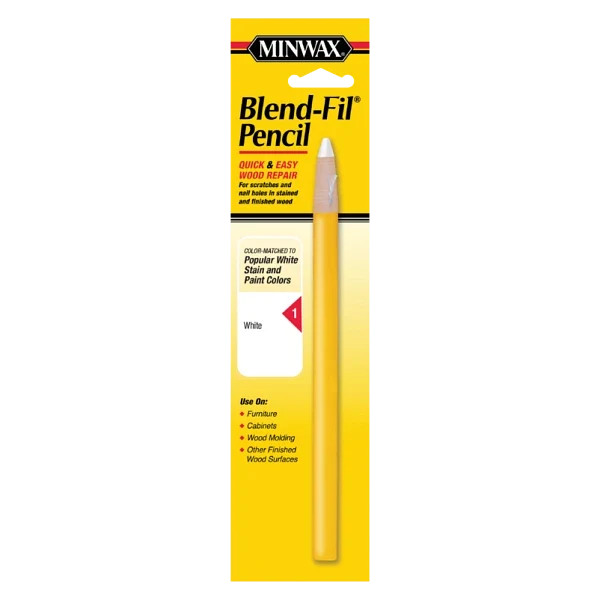
Minwax Blend-Fil Pencil, Best for Nail Holes
Not a marker. Colored wax in a pencil body, and the only thing on this page that adds volume.
Zero dry time is the headline. Work it into the nail hole, wipe the excess across the grain with a rag, and the trim is finished. On the stained pine casing I ran, ten nail holes took under three minutes total, which is why finish carpenters keep one in the pouch. Nine colors keyed to Minwax stain shades, and two pencils can be worked together on the surface to land a shade between them.
Two real limits. It is wax, so nothing clear-coats over it. Blend-Fil is always the last thing that touches the surface, after the poly, after everything. And it shrinks a little in a deep gouge, so anything more than a nail hole wants a second pass the next day.
Do not use it on a hairline scratch. Dragging wax across a fine line leaves a raised waxy streak that collects dust and looks worse than the scratch did. Deep and narrow is its job. For the wider stuff, real filler and then a marker over the patch. The furniture repaint project guide covers the full fill-sand-finish sequence if the piece is going to get refinished anyway.
Mohawk Ultra Mark, Best for Worn Edges and Painted Trim
The pick for damage that is not a scratch.
Cabinet door edges wear back to bare MDF. Painted trim gets vacuum-cleaner rash along the bottom. A table lip loses its color where forearms rest. That is a band of missing color, not a line, and a fine-point marker handles it badly. Ultra Mark is a valve-action chisel nib laying opaque pigment, and on the white-painted MDF panel it covered the worn edge in one pass where every dye marker in the test just tinted the exposed brown fiber a slightly different brown.
The color library runs past 200 SKUs including painted-furniture whites, grays, and blacks. Nothing else on this list carries those.
Two cautions from the panel work. Opaque pigment hides grain, so on open-pore red oak the repair reads as a painted stripe once light rakes across it. Use it where the finish is already opaque. And valve markers flood if you lean on them. Pump the nib on scrap card three or four times until color appears, then move to the work. I flooded one on the first attempt and spent longer cleaning it up than the repair took.
Buy it if the piece is painted or the damage is a worn edge rather than a line. Skip this if the surface is stained wood with visible grain.
Where Touch-Up Jobs Go Sideways
Most bad results are technique, not product.
- The repair looks right at night and wrong in the morning. You matched under warm 3000K light. Check every repair under daylight or a 5000K bulb before you call it done. This catches more mismatches than anything else.
- The scratch got wider. Marker wicked along open grain in oak or ash. Apply with the tip barely touching, stroke with the grain, and blot immediately.
- It went too dark and will not come back. Dye does not lift. Always start one shade lighter than you think and build in passes.
- The marker did nothing. Stain marker on an intact finish. Switch to a pigment repair marker.
- A waxy line collects dust. Blend-Fil dragged across a scratch instead of pressed into a hole. Wipe it off with mineral spirits and use a marker.
- The poly peeled over the repair. Clear coat went over wax. Nothing bonds to Blend-Fil. Wax last, always.
- The repair faded in a month. Direct sun on an interior-rated marker. Every product here is interior use; the Guardsman set with UV absorbers is the only one that held tone on a sunny sill.
If the trim itself has gone yellow rather than scratched, that is a different problem entirely. See the yellowing trim fix.
Technique That Moves the Result
- Clean first. A barely damp cloth, then dry. Marker over furniture polish beads and skips.
- Test underneath. Every piece has a hidden face. Two seconds of testing there saves an hour of regret on the top.
- Stroke with the grain, never across. Across-grain strokes read as a smear no matter how good the color is.
- Wipe back within 20 seconds on oil-based. Fold a lint-free cloth, wipe along the grain, and judge the color after it flashes off, not while it is wet. Wet always looks darker than dry.
- Build in thin passes. Two light coats beat one heavy one on every substrate we tested.
- Feather the edges. Carry the color a hair past the scratch and blend outward, so there is no hard border where the repair stops.
- Sand nothing. A 320-grit instinct on a finished surface burns through the topcoat and turns a two-minute fix into a refinishing job. If you truly need abrasive, our sandpaper picks cover the grits, but on touch-up work the answer is usually no sanding at all.
- Seal only if the scratch was deep. A wipe of paste wax or a dab of poly over a raw-fiber repair keeps it from re-absorbing moisture. For the choice between them, the wax vs poly sealer explainer lays it out.
Also Considered
- Katzco and the other 13-piece Amazon repair kits. Cheap, popular, and genuinely fine for a rental-deposit patch. The markers inside are unbranded dye pens with no published lightfastness data, and the wax sticks in the kit are softer than Blend-Fil. Buy one if you want everything in a box for twelve dollars; do not expect the color range to hold up.
- Mohawk Match-All Stain Marker. Strong product and close to Pro-Mark in performance. Pro-Mark’s larger color library and replaceable nibs edged it.
- Guardsman Wood Repair Filler Sticks. The five-color fill set is a legitimate Blend-Fil alternative and comes with a sharpener. Blend-Fil’s colors key directly to Minwax stains, which matters more in practice than the extra shade count.
- Old furniture-polish-and-iodine folk fixes. Walnut meat, tea bags, iodine on a cotton swab. They tint. They also keep tinting, unevenly, for weeks. Seven dollars buys a controlled result.
- Automotive paint pens. Wrong pigment load, wrong binder, wrong sheen. They stay glossy on a satin finish and the repair looks like a wet spot forever.
If the furniture is stained wood and the scratch is white, buy the Minwax Wood Finish Stain Marker in the closest color and a Blend-Fil pencil to sit beside it. That pair, about fourteen dollars together, handles almost everything a house throws at trim and furniture. Add Minwax Repair Markers when the floors start showing traffic, and only go to Mohawk when you have enough pieces to justify a color library.
Full Comparison
| Product | Best for | Yellowing | Price |
|---|---|---|---|
| Minwax Wood Finish Stain Marker | Top pick — best for stained interior wood | None; pigment suspended in oil | $ |
| Mohawk Pro-Mark Touch-Up Marker | Best color match — pro-grade dye marker | Low; light-stable dye package | $$ |
| Minwax Repair Markers | Best for wood floors and laminate | Low | $ |
| Guardsman Brown Wood Finish Touch-Up Markers | Budget pick — three-shade blend set | Low; UV absorbers included | $ |
| Minwax Blend-Fil Pencil | Best for nail holes and gouges | None | $ |
| Mohawk Ultra Mark Marker | Best for worn edges and painted trim | Low; light-fast pigments | $$ |
Every Pick, Pros and Cons
Pros, cons, and specs for each pick. The cons are not optional here.
1. Minwax Wood Finish Stain Marker
- Coverage
- 0.33 fl oz per marker; dozens of small scratches
- Sheens
- Matte stain color, no sheen of its own
- Dry / recoat
- 4–6 hours
- Full cure
- 24 hours before topcoating with poly
- VOC
- Oil-based alkyd stain; mineral spirits cleanup
- Yellowing risk
- None; pigment suspended in oil
- Primer
- None; works on bare or lightly scuffed wood
- Price tier
- $
- It is real oil-based Minwax Wood Finish stain in a marker body, so the colors line up with the same Dark Walnut, Golden Oak, and Special Walnut cans people already stained the furniture with
- The 4-to-6-hour dry window is long enough to wipe back. Apply, count to twenty, wipe with a cloth, and you control the depth instead of living with whatever the first pass gave you
- Cheapest honest fix in the category at roughly 6 to 9 dollars a marker, stocked at Lowe's, Ace, Menards, and Sherwin-Williams stores
- Oil-based stain colors bare fiber, not finish. On a scratch that only scuffed the topcoat and never reached wood, it sits on the surface and wipes off with the excess
- The 4-to-6-hour dry time means you cannot topcoat the same afternoon, and a hand landing on it at hour two smears the repair
- Tip clogs if you store it upright with the cap loose. Minwax's own fix is an overnight mineral-spirits soak, which tells you how often it happens
2. Mohawk Pro-Mark Touch-Up Marker

- Coverage
- Single marker; dozens of edge and scratch repairs
- Sheens
- Self-sealing dye, low sheen
- Dry / recoat
- Minutes to touch-dry
- Full cure
- 1 hour before handling
- VOC
- Solvent-carried dye; interior use with ventilation
- Yellowing risk
- Low; light-stable dye package
- Primer
- None
- Price tier
- $$
- Over 50 individual colors plus 12-count and 36-count assortment packs, which is the only way to hit an odd factory finish like a fruitwood or a red-toned cordovan without mixing your own
- Light-stable dyes that seal, stain, and finish in one pass, so a repair on a raw scratch does not need a separate clear coat over the top
- Capillary tip flows on demand and takes replacement chisel nibs (M267-9000), so a dried-out marker is a 30-second nib swap, not a trip to the store
- Dye penetrates and does not lift. Wipe-back barely works, so a too-dark first pass on light maple is a sanding job, not a wipe
- Sold through finishing distributors and Amazon rather than home centers. There is no Saturday-morning impulse buy here
- Buying blind means buying an assortment. A single wrong color is 10 dollars wasted and you still do not have the right one
3. Minwax Repair Markers
- Coverage
- 0.13 fl oz or 0.78 fl oz per marker
- Sheens
- Low sheen, blends into satin factory finishes
- Dry / recoat
- 15 minutes dry and recoat
- Full cure
- 24 hours
- VOC
- Waterborne pigment; interior only
- Yellowing risk
- Low
- Primer
- None; apply over the existing finish
- Price tier
- $
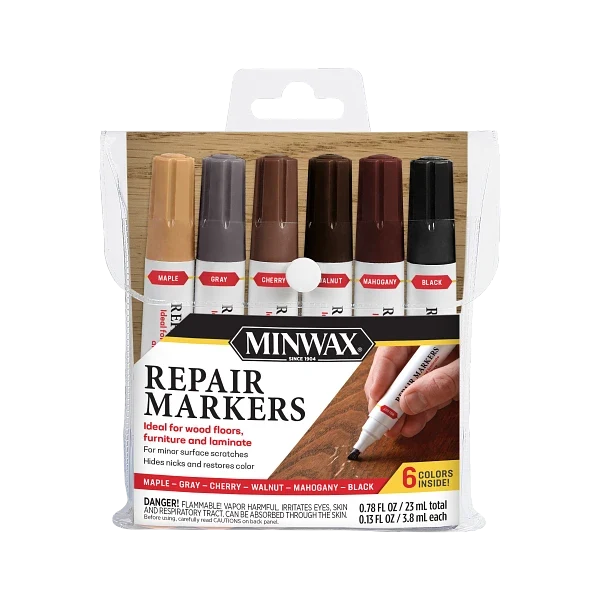
- 15-minute dry and recoat window. You can build color in three passes inside an hour instead of waiting overnight between coats like the oil stain marker
- Formulated to sit on top of a finish, which is why it works on prefinished engineered floors and laminate where an oil stain marker just wipes away
- Two sizes (0.13 fl oz and 0.78 fl oz). The larger barrel is the right buy for a whole hallway of traffic scuffs
- Pigment on top of the finish means it can be scrubbed off later. Expect to redo high-traffic floor spots on a yearly cycle
- Color range is narrower than the Wood Finish Stain Marker line, so exact matches on unusual factory floor colors are hit and miss
- Interior only. It has no UV package worth trusting on a threshold that gets direct afternoon sun
4. Guardsman Brown Wood Finish Touch-Up Markers
- Coverage
- 3 markers per set
- Sheens
- Low sheen
- Dry / recoat
- Minutes
- Full cure
- 1 hour
- VOC
- Interior furniture-care formula
- Yellowing risk
- Low; UV absorbers included
- Primer
- None
- Price tier
- $
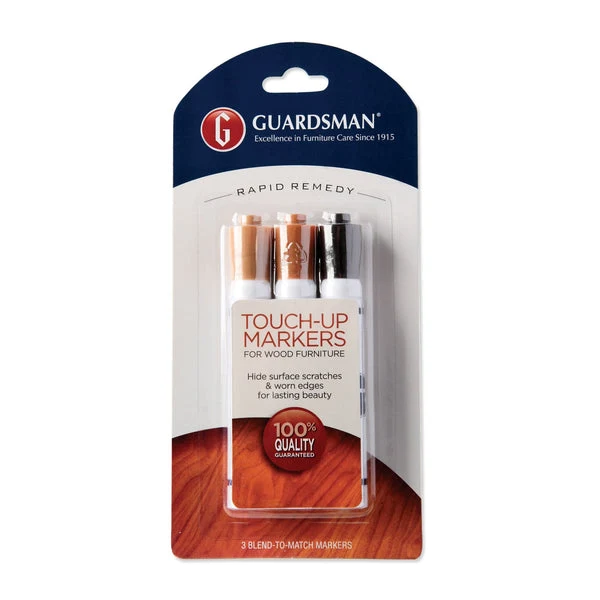
- Under 5 dollars for light, medium, and dark in one card. Start light, go darker, and you land close on most brown furniture without owning a color deck
- UV absorbers in the formula, which is the reason a Guardsman repair on a sun-facing dresser edge held its tone where a cheap dye marker went pink
- Dries fast and does not drip, so it is the marker to hand a nervous first-timer
- Brown only. Grays, whites, black lacquer, and red-toned cherry are outside what this set can reach
- Blend-to-match means approximate. On a 90-day walk-past it disappears; at reading distance under a lamp, the seam shows on dark walnut
- Three markers is three markers. Heavy use on a whole set of dining chairs runs one of them dry
5. Minwax Blend-Fil Pencil
- Coverage
- 0.05 lb pencil; roughly 40–60 nail holes
- Sheens
- Matte to low sheen
- Dry / recoat
- Instant; no dry time
- Full cure
- Immediate
- VOC
- Wax-based; mineral spirits cleanup
- Yellowing risk
- None
- Primer
- None; interior use only
- Price tier
- $
- Zero dry time. Work it into the hole, wipe the excess, and the trim is done before the caulk gun is back in the bag
- Fills and colors in one motion, which no marker on this list can do. A nail hole in stained pine casing needs volume, not tint
- Two colors can be worked together on the surface to hit a shade between them, so a 9-color range covers more ground than it reads on the shelf
- It is a wax-based fill. Polyurethane and most clear finishes will not bond over it, so this goes on last or not at all
- Shrinks slightly in a deep gouge and needs a second pass a day later
- Not a scratch tool. Dragging it across a hairline scratch leaves a waxy line that catches dust
6. Mohawk Ultra Mark Marker

- Coverage
- Single valve marker
- Sheens
- Low sheen to satin
- Dry / recoat
- Minutes to touch-dry
- Full cure
- 1 hour
- VOC
- Solvent-carried pigment; ventilate
- Yellowing risk
- Low; light-fast pigments
- Primer
- None
- Price tier
- $$
- Pigmented rather than dye-based, so it covers instead of tinting. This is the one that fixes a white cabinet door whose edge has worn back to bare MDF
- Valve-action chisel nib lays a controlled band down a door edge or a table lip, which is the exact damage pattern a fine-point marker handles badly
- The color library runs past 200 SKUs, including painted-furniture whites, grays, and blacks that no wood-tone marker line carries
- Opaque pigment hides grain. On an open-pore red oak scratch the repair reads as a painted stripe once light rakes across it
- Valve markers need a firm pump to start and can flood if you lean on them. Practice on scrap, not on the door
- Distributor pricing is opaque and the Amazon listings are single colors at 12 to 18 dollars, which is a real price for one marker
Ask a Question