Best Gel Stains
Five gel stains tested on oak, pine, maple, a fiberglass door, and factory-finished cabinet doors. Top pick: General Finishes Oil-Based Gel Stain for pigment depth.

Highest pigment load in the test. Java covered honey oak to a near-black brown in two wiped coats where the home center gels needed three
Stocked at Home Depot, Lowe's, Ace, and most hardware stores, in quarts and half-pints, which no other gel in this round-up can claim
Thickest body of the five. It hangs on a vertical surface at a heavy load without a single sag on our test rails
$14–$18 a quart at Home Depot, the cheapest per ounce in the test
Stain and polyurethane in one can, so a tired oak handrail or a set of stair balusters goes darker and protected in two coats and one afternoon
Disclosure: Some links below are affiliate links. We earn a commission if you buy through them, at no extra cost to you. Picks are based on the criteria in “How I Picked”. No brand pays for placement.
Top pick: General Finishes Oil-Based Gel Stain. A quart runs $28–$36 and carries more pigment per ounce than anything else in this test, which is the entire reason to reach for a gel instead of a liquid stain. General Finishes wins on color depth, on how flat it lays across a cabinet stile without sagging, and on a thirteen-color deck nobody else matches. It falls short on speed, needing 24 hours between coats and 72 before a waterborne topcoat. If you need it today from a store you can drive to, Minwax Gel Stain is the pick, and it is also the one to use on a fiberglass entry door. Budget and fast: Varathane Premium Gel Stain. Biggest flat panel: Old Masters, which stays wipeable longest.
Now the part nobody puts on the can.
Gel Stain Sits on the Surface. That Changes Everything.
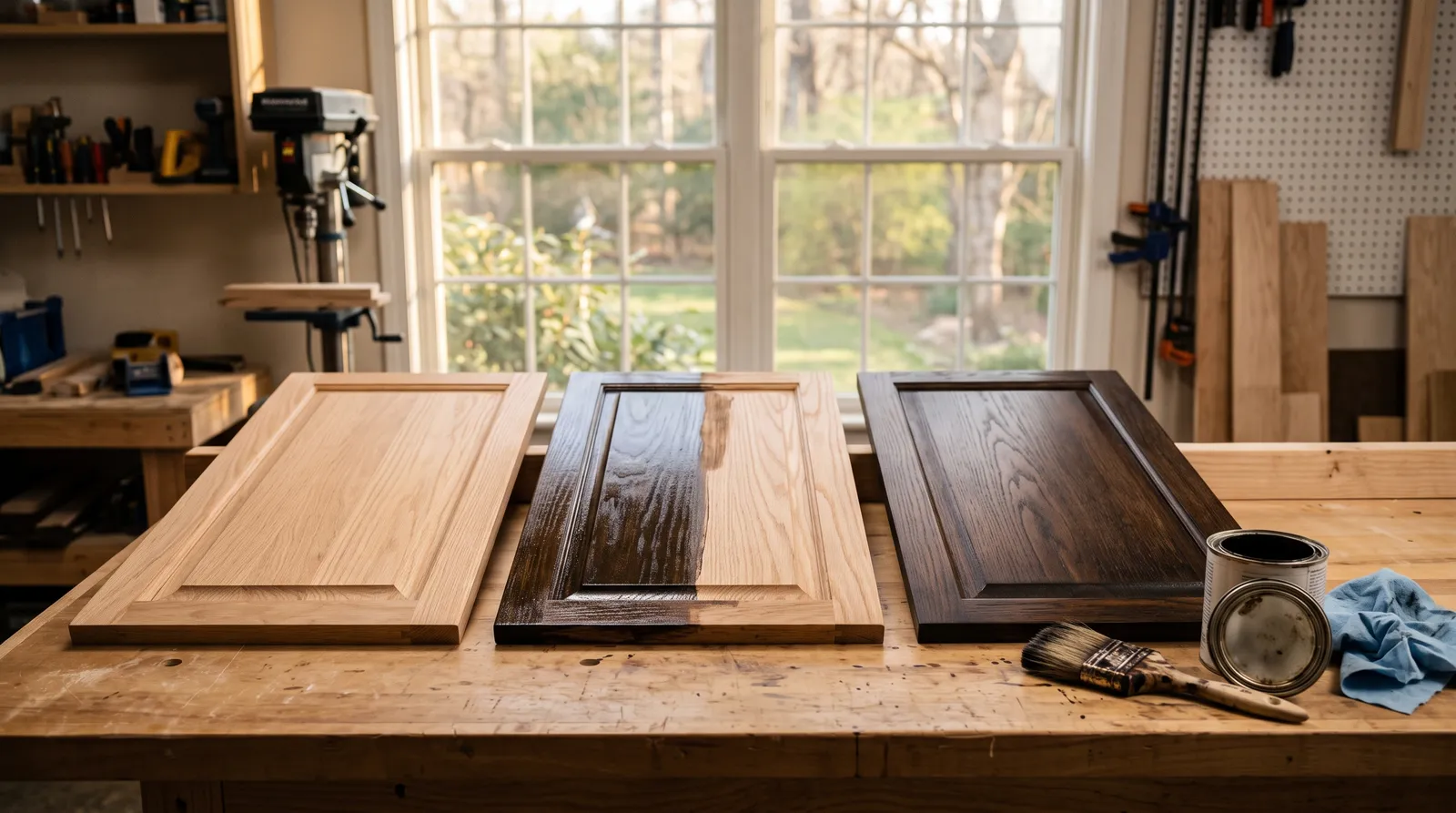
Liquid wood stain soaks in. Pigment and dye ride a thin solvent into open fiber, the excess gets wiped, and the color lives inside the wood. Gel stain does none of that. It is pigment suspended in a thixotropic alkyd or urethane binder, thick enough to hold its shape in the can, and it stays where you put it.
That one property is the whole category.
Because gel stain does not need open fiber, it colors surfaces liquid stain slides off: a fiberglass door skin, a factory-primed steel door, paper-thin veneer you cannot sand, and wood that already wears a clear finish. Because it does not soak in, it does not blotch on the species that always blotch. Pine, soft maple, birch, and cherry drink liquid stain unevenly because their density varies wildly across a single board. Gel stain lays a uniform pigment layer across all of it. On our white pine panel, a single wiped coat of Old Masters read even under raking light while a liquid oil stain on the sister panel went full leopard.
The cost is the same property flipped around. Pigment sitting on a surface has nothing holding it there but the binder, so gel stain without a topcoat wears off at every fingertip contact point. Every can in this round-up needs a clear coat over it. Nobody in the aisle tells you that.
How I Picked and What I Put Them Through
I ran five gel stains across seven substrates: red oak, white pine, soft maple, birch plywood, a set of factory-finished honey oak doors pulled from a 1998 kitchen, a fiberglass entry door skin, and a primed steel skin. Every panel got the manufacturer’s own prep, either a 220-grit scuff or a liquid deglosser, never both, and the shop stayed at 68–72°F and 40–50% RH for the whole run. I counted coats to hit a full espresso from honey oak, timed the wipeable open window with a stopwatch, hung vertical rails at a heavy brush load to watch for sags, and ran a crosshatch tape pull at 30 days on the two door skins. Three cabinet refinishers took my calls about where gel stain actually fails on paying jobs. Pick-specific findings live in each review below.
The Field at a Glance
| Product | Best for | Coats to espresso | Open time | Price |
|---|---|---|---|---|
| General Finishes Gel Stain | Cabinets, deep color changes | 🟢 2 | ⚪ 8–10 min | $$$ |
| Minwax Gel Stain | Buying it today, fiberglass doors | ⚪ 3 | ⚪ 6–8 min | $$ |
| Old Masters Gel Stain | Slab doors, tabletops, red tones | ⚪ 3 | 🟢 12 min | $$ |
| Varathane Premium Gel Stain | Budget, one-day turnaround | 🟡 4 | 🟡 5 min | $ |
| Minwax PolyShades | Handrails and trim, no topcoat step | ⚪ 3 | 🟡 5 min | $$ |
Coats-to-espresso measured on identical honey-oak cabinet doors. Open time is minutes before wiping leaves a visible lap line at 70°F. PolyShades is a stain-and-poly hybrid, not a true gel; see its review for why it still made the list.
The Short Version
- Refinishing oak or maple kitchen cabinets: General Finishes, Java or Brown Mahogany.
- Fiberglass or steel entry door: Minwax Gel Stain, Hickory or Aged Oak, spar urethane over it.
- Big flat surfaces you have to wipe in one pass: Old Masters.
- Small project, tight budget, want it done Saturday: Varathane Premium.
- Oak handrail or stair balusters going darker, no separate topcoat: Minwax PolyShades.
The Picks
General Finishes Oil-Based Gel Stain, Top Pick
The pigment is the reason. On matched honey oak doors, GF Java hit full espresso in two wiped coats. Minwax needed three to reach the same value, Old Masters three, Varathane four and it still read a half-step lighter. If you are making a large color change on wood that already has a finish, coats-to-target is the number that decides whether the job takes a weekend or eats two.
It also behaves on vertical surfaces, which sounds minor until you are staining face frames still hanging in the kitchen. Loaded heavy on a vertical rail, GF held without a sag and self-leveled the brush texture out inside a minute. Old Masters matched it. Minwax sagged at a heavy load, Varathane sagged and then flash-dried the sag in place.
The color deck is thirteen deep and includes tones nobody else sells. Java is the one that made this product famous on refinishing forums, and it deserves it. Georgian Cherry and Brown Mahogany do warm reds that Varathane’s brown-only lineup cannot approach. Winter White is the only whitewash gel in the category worth using.
Slow is the trade. GF wants 24 hours between coats, and in a humid shop it means 24, not 12. Then 72 hours of cure before a waterborne topcoat, or the water lifts uncured oil and the finish goes milky. I clouded one test door proving this so you do not have to. Plan a five-day calendar for a two-coat kitchen, most of which is waiting.
Distribution is the other cost. Woodcraft, Rockler, independent finish suppliers, and Amazon. Quarts run $28–$36, and a gallon is meaningfully cheaper per ounce if the job is a full kitchen; buy the gallon from a woodworking retailer and the quart from Amazon.
Buy it for a big color change on cabinets, doors, or furniture where the finish quality matters more than the schedule. Skip it if you need the job closed inside 48 hours.
Minwax Gel Stain, Best Off the Shelf and Best on Door Skins
Every Home Depot, every Lowe’s, most Ace stores, half-pints and quarts. That availability is worth real money on a project that stalls at 4 p.m. on a Sunday because you ran short.
The door-skin result is what earns Minwax a slot beyond convenience. At 30 days, the crosshatch tape pull on the fiberglass entry skin came off clean, zero pigment lift, and the primed steel matched it. General Finishes was close behind. Varathane lifted at two intersections. On a molded fiberglass door, where the fake grain does the heavy lifting and the stain just has to grip and read as wood, this is the whole job. Hickory and Aged Oak are the two colors all three refinishers I called named without being asked.
Pigment is a step below GF. Three coats to espresso on honey oak, and thin body means it sags on a vertical rail if you load the brush. Wipe more aggressively than feels right and add a coat instead.
Buying a whole kitchen in half-pints and quarts is the annoyance nobody mentions. Four quarts of the same color from the same store, checked for matching lot numbers, or you find out about the shift in tone on door eleven.
Buy it for an entry door, a partial kitchen, or any job where store proximity beats a two-day shipping window. Skip it if you are chasing the deepest possible espresso on oak; GF gets there with one less coat.
Old Masters Gel Stain, Longest Open Time
The thickest material in the test, and the one I would take to a slab door or a dining table.
Open time is the reason. Twelve minutes of wipeable window at 70°F and 45% RH, against 6–8 for Minwax and about 5 for Varathane. On a 30-inch by 80-inch flat door that is the difference between one continuous wipe and a lap line running down the middle of your work. I stained a solid slab door with Varathane and with Old Masters back to back on the same afternoon; the Varathane door needed a second person and still showed a faint lap seam at the hinge stile.
Its reds are the truest in the category. Cherry and Spanish Oak read as actual cherry rather than the orange-brown most brands call cherry.
Two real weaknesses. The body that stops sags drags badly under a foam applicator, so use natural bristle or a folded cotton rag. And the lid colors are not close enough to the real thing to buy blind. Get a sample can or a color card before committing to a kitchen.
Buy it for tabletops, slab doors, and anything where you need one continuous pass.
Varathane Premium Gel Stain, Budget Pick
$14–$18 a quart at Home Depot, cheapest per ounce here, and it recoats in two hours. A two-coat interior door can be stained and topcoated inside one long day, which no other can on this list will do.
The soy-based oil formula also cuts the odor noticeably. Working inside an occupied kitchen instead of a garage, that is not a small thing.
Pigment is where it pays for the price. Four coats to reach espresso on honey oak, and the fourth was still a half-step lighter than GF at two. The five-minute wipe window is tight enough that anything wider than a face frame wants two people.
Six colors, all brown to black. No reds.
Buy it for small projects, a tight budget, or a one-day turnaround on a modest color shift. Skip it if the job is a full kitchen; the coat count erases the price advantage in labor.
Minwax PolyShades, the Non-Gel That Earns a Slot
This is not a gel stain. Saying so up front because half the internet files it in this category and the physics are different: PolyShades is pigment carried in oil-based polyurethane, so color and film go on together and a deep scratch takes both.
It earns the slot on one job. An oak handrail, stair balusters, or a run of trim that has a sound clear finish and needs to go darker, where a separate stain-then-topcoat sequence means four evenings instead of two. Two coats of PolyShades Bombay Mahogany over an old satin poly handrail, scuff-sanded with 220 and wiped with mineral spirits, and the job closed in an afternoon.
Brush marks are the failure. It sets fast and any overwork after the first pass telegraphs into the cured film, which is exactly what happened on my first baluster before I switched to long single strokes and stopped fussing. The wipe-on version is more forgiving if you have never done this. For anything already gone wrong, see the guide on fixing brush marks.
It also ambers. Over browns that reads as warmth. Over anything pale, it reads yellow within two years, the same way clear oil poly does on white trim, which is its own yellowing problem.
Skip this if the surface takes real wear. A gel plus a proper topcoat outlasts it on cabinet doors.
What a Kitchen Actually Costs, and Where to Buy It
A standard 10-by-10 kitchen runs about 20 doors and 8 drawer fronts, call it 120 square feet of surface counting both sides. At two coats that is roughly a gallon of gel stain plus a quart of topcoat.
Buy General Finishes by the gallon from a woodworking retailer and you land around $110–$130, against $28–$36 a quart if you buy four quarts. That is a $30 swing for one decision. Amazon is the right link for a quart, because a quart ships well and arrives in two days; for a gallon, a woodworking store beats it on price often enough to check first.
Minwax and Varathane go the other way. Both are cheaper on the Home Depot shelf than shipped, usually by $3–$6 a quart, and gel stain is heavy for its volume so shipping eats the difference. The Amazon links here are for the people who want it on the porch Wednesday rather than in the cart Saturday. If you drive past a home center anyway, buy it there.
Full arithmetic on a whole kitchen: gel stain and topcoat land between $130 and $190 in materials. A cabinet paint job on the same boxes runs $250–$400 once you count primer, two finish coats, and the sanding to fill oak grain. Gel stain wins on materials and wins bigger on labor, and it only works if the wood underneath is worth keeping. On thermofoil or ugly grain, none of that math applies; see the cabinet refinishing kits round-up for the paint-side alternative, and the guide to going over already-finished wood for the prep either route needs.
The Topcoat Is the Half of the Job Nobody Buys
Gel stain takes no primer. It takes a clear coat over the top, and this is where most disappointing gel-stain jobs actually go wrong.
Wipe-on oil polyurethane is the low-skill answer. Three thin rag coats, two hours apart, no brush marks because there is no brush. Over espresso and walnut tones, the slight amber shift reads as depth. Over Winter White or any pale color, use a waterborne acrylic clear instead and give the gel a full 72 hours of cure first. Waterborne over uncured oil is how you get a milky finish that only strips out.
For horizontal surfaces that take abuse, tabletops and cabinet tops, go four coats and give it the full 30 days before anything heavy sits on it. Water rings on a nine-day-old finish are a curing problem, not a product problem.
Where Gel Stain Jobs Go Wrong
Most gel stain failures happen before the can opens.
- It never dries and stays tacky for weeks. Too much material left on the surface. Gel cures top-down by oxidation; a thick layer skins over and traps wet material underneath. Wipe it back with mineral spirits and start over thinner.
- Color came out blotchy on a previously finished door. Uneven degloss. Where the old finish is still slick, the gel skids; where it was sanded through, it grabs. Scuff uniformly with 220-grit and check under raking light before you stain.
- It rubbed off at the door pulls in four months. No topcoat, or a topcoat applied over an uncured stain. Both are fixable only by redoing the affected doors.
- The kitchen cabinets look right on the doors and wrong on the boxes. Different substrate. Solid wood doors and veneered plywood boxes take pigment at slightly different rates. Add a coat on the boxes, not on the doors.
- The whole job smells like a refinery for a week. Oil-based gels off-gas hard. Ventilate, and wear a real cartridge respirator rather than a dust mask; see our painting respirator picks.
- Rags spontaneously combusted in the trash. Oil-soaked rags generate heat as they oxidize. Lay them flat outside to dry or drop them in a bucket of water. This one is not theoretical and it burns down garages every year.
Application Notes That Change the Result
- Degloss, do not strip. A 220-grit scuff and a mineral-spirits wipe on a sound existing finish is the whole prep. Grease near a stove needs a degreaser first; a TSP substitute handles it.
- Wipe back further than feels right. Every coat should look slightly too light when you walk away. Depth comes from stacking thin coats, not from leaving one heavy one.
- Natural bristle or cotton, never foam. Foam drags in thick gel and leaves texture. A good natural-bristle brush plus folded cotton rags is the entire tool kit.
- Work top to bottom on a vertical, and finish with the grain. The last pass sets the direction the eye reads.
- Do the doors flat, off the hinges. Every refinisher I called said the same thing. Horizontal surfaces cannot sag.
- Test on the back of a door first. Lid colors lie, and gel stain over an existing finish reads darker than the same color on bare wood.
- Respect the topcoat cure window. 24–48 hours before oil, 72 before waterborne. The clouding failure is permanent.
For the full sequence on a kitchen, our cabinet painting project guide covers layout, hardware, and drying racks; for furniture, the furniture refinishing walkthrough.
Also Considered
- Rust-Oleum Ultimate Wood Stain. Excellent liquid stain, not a gel. Wrong tool for finished surfaces.
- Unicorn SPiT. A gel stain-and-glaze hybrid aimed at decorative and craft work. Fun material, not a cabinet product; it needs a topcoat and does not behave like the four true gels here.
- Dixie Belle No Pain Gel Stain. Water-based, low odor, and easier cleanup. Pigment load did not compete with General Finishes and distribution is direct plus small retailers.
- Sherwin-Williams Wood Classics interior gel stain. Solid pro-channel product. Store-only distribution and pro pricing put it outside what most readers of this page are buying.
- General Finishes Gel Topcoat. Not a stain. Worth knowing about as the brand-matched clear if you want everything from one line.
If your cabinets are sound oak and the goal is espresso, buy the General Finishes gallon and give yourself five days. If the goal is a fiberglass front door before the in-laws arrive, buy Minwax Hickory at Home Depot on the way home and topcoat it with spar urethane. Those two answers cover most of the reason anyone searches for this category.
Full Comparison
| Product | Best for | Yellowing | Price |
|---|---|---|---|
| Oil Based Gel Stain | Top pick — best pigment depth for cabinets and doors | Low as a stain; the topcoat you choose drives the amber shift | $$$ |
| Gel Stain | Best off-the-shelf pick and best on fiberglass or steel doors | Low; the oil topcoat ambers before the stain does | $$ |
| Gel Stain | Best open time for large flat panels | Low | $$ |
| Premium Gel Stain | Budget pick — fastest recoat, home center shelf | Low | $ |
| PolyShades Stain and Polyurethane | Best for darkening an existing finish without a separate topcoat | Medium. It is an oil polyurethane and it ambers over pale colors | $$ |
Every Pick, Pros and Cons
Pros, cons, and specs for each pick. The cons are not optional here.
1. Oil Based Gel Stain
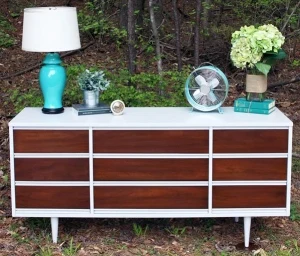
- Coverage
- Roughly 325–400 sq ft / gal as a wiped coat; about 100 sq ft per quart on cabinet doors
- Sheens
- Satin once topcoated; the stain itself dries to a low sheen
- Dry / recoat
- Touch dry 6–8h · recoat 24h
- Full cure
- 72h before a waterborne topcoat; 30 days for full hardness under film
- VOC
- Oil-based, roughly 450–550 g/L depending on color; check the can for restricted states
- Yellowing risk
- Low as a stain; the topcoat you choose drives the amber shift
- Primer
- None. Scuff-sand or deglosser, then stain. Topcoat required
- Price tier
- $$$
- Highest pigment load in the test. Java covered honey oak to a near-black brown in two wiped coats where the home center gels needed three
- Urethane-modified alkyd base levels itself on a vertical stile without running, which is the difference between a cabinet job that looks sprayed and one that looks wiped
- Thirteen colors including Java, Brown Mahogany, Georgian Cherry, and the Winter White that no other brand in the test offers
- Slow. A full 24 hours between coats in a humid shop, and 72 hours of cure before a waterborne topcoat goes on without cloudiness
- No big-box distribution. Woodcraft, Rockler, independent finish suppliers, and Amazon; you cannot buy it at 8 a.m. on the way to the job
- A quart is $28–$36, roughly double the Varathane per ounce
2. Gel Stain
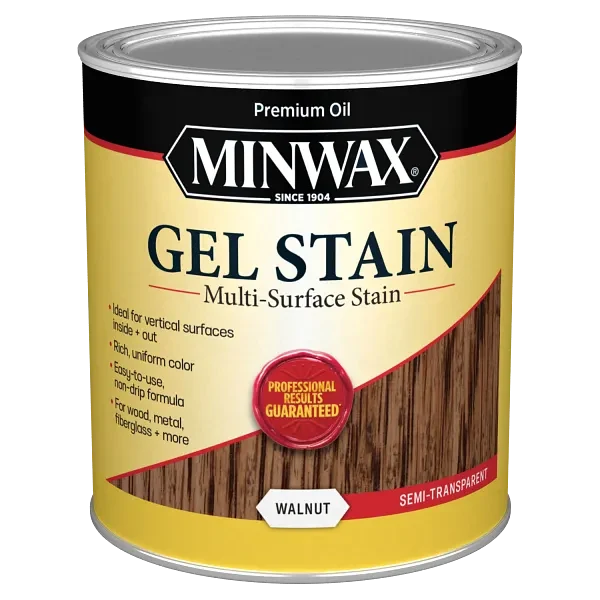
- Coverage
- About 100 sq ft per quart on cabinet doors; less on raw open-grain oak
- Sheens
- Low sheen; requires a topcoat for durability
- Dry / recoat
- Touch dry 3–4h · recoat 8–10h
- Full cure
- 24–48h before topcoat; 30 days under film
- VOC
- Oil-based; standard SKU is not compliant in some OTC states, verify the label
- Yellowing risk
- Low; the oil topcoat ambers before the stain does
- Primer
- None on wood. On fiberglass or steel, the factory primer is the substrate
- Price tier
- $$
- Stocked at Home Depot, Lowe's, Ace, and most hardware stores, in quarts and half-pints, which no other gel in this round-up can claim
- The most reliable grip on fiberglass and primed steel entry doors of anything tested; 90 days on a west-facing door with a spar urethane over it and no lift at the panel edges
- Eight colors that read like real wood species rather than paint, with Hickory and Aged Oak doing the best job of faking grain on a smooth door skin
- Pigment sits a step below General Finishes. Going from honey oak to espresso took three coats instead of two
- Thinner body than Old Masters, so it sags on a vertical rail if you load the brush
- Half-pint and quart only. A whole kitchen means buying four quarts and hoping the lot numbers match
3. Gel Stain

- Coverage
- Roughly 200–250 sq ft per quart on sealed or previously finished wood
- Sheens
- Low sheen; topcoat required
- Dry / recoat
- Touch dry 4–6h · recoat 8–12h
- Full cure
- 24h before oil topcoat, 72h before waterborne; 30 days under film
- VOC
- Oil-based, high VOC; a low-VOC compliant version exists for restricted states
- Yellowing risk
- Low
- Primer
- None. Clean, scuff-sanded, dry surface
- Price tier
- $$
- Thickest body of the five. It hangs on a vertical surface at a heavy load without a single sag on our test rails
- Longest working window. About 12 minutes of wipeable open time at 70°F and 45% RH, against 6–8 for Minwax, which is what saves you on a tabletop or a slab door
- Twelve colors, and the reds (Cherry, Spanish Oak) are the truest cherry tones anyone in this category sells
- Distribution is independent paint stores, Ace, and Amazon. No big box
- The body that stops sags also drags under a foam applicator; use a natural-bristle brush or a folded cotton rag, not foam
- Color names do not match the lid color closely enough to buy blind. Sample first
4. Premium Gel Stain

- Coverage
- About 110–150 sq ft per quart
- Sheens
- Low sheen; topcoat required
- Dry / recoat
- Touch dry 1h · recoat 2h
- Full cure
- 8h before topcoat; 30 days under film
- VOC
- Oil-based, soy-modified; lower odor than traditional alkyd gels
- Yellowing risk
- Low
- Primer
- None. Scuff-sand or deglosser first
- Price tier
- $
- $14–$18 a quart at Home Depot, the cheapest per ounce in the test
- Fast recoat, 2 hours in our 70°F shop, so a two-coat door can be done and topcoated in one long day
- Soy-based oil formula thins the odor noticeably against Old Masters and General Finishes, which matters if you are working inside the kitchen instead of a garage
- Weakest pigment of the four true gels. Honey oak to espresso ran to four coats and the fourth was still not as deep as GF at two
- Fast dry cuts the wipe window to roughly 5 minutes, so a slab door or a tabletop will show lap lines unless two people work it
- Six colors, all in the brown-to-black lane. No reds worth the name
5. PolyShades Stain and Polyurethane
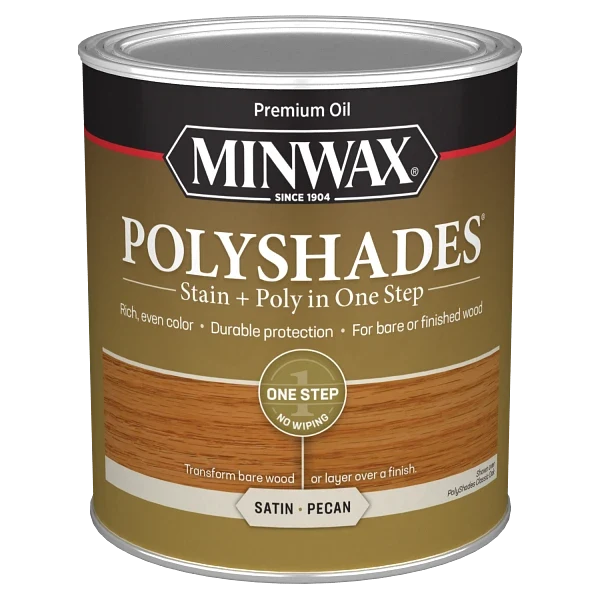
- Coverage
- 125–150 sq ft per quart
- Sheens
- Gloss, satin
- Dry / recoat
- Touch dry 2–3h · recoat 6h
- Full cure
- No separate topcoat needed; 30 days for full hardness
- VOC
- Oil-based polyurethane; restricted-state versions vary
- Yellowing risk
- Medium. It is an oil polyurethane and it ambers over pale colors
- Primer
- None. Clean and scuff-sand the existing finish
- Price tier
- $$
- Stain and polyurethane in one can, so a tired oak handrail or a set of stair balusters goes darker and protected in two coats and one afternoon
- Designed to go over an existing clear finish, which is the exact job most people are trying to do when they search for gel stain
- At every home center in gloss, satin, and a wipe-on version, $16–$22 a quart
- Not a gel stain. The body is thinner, the color rides in the film rather than in a separate pigment layer, and a scratch takes the color with it
- Brush marks are the failure mode. It sets fast and any overwork after the first pass telegraphs
- Color depth is fixed by film thickness, so a third coat gets darker and glossier at the same time whether you wanted that or not
Minwax Wipe-On Poly
Gel stain does not take a primer. It takes a topcoat, and skipping that step is the single most common reason a gel-stained cabinet door looks great in August and shows fingerprint wear by Thanksgiving. Gel stain is pigment in a thin binder sitting on the surface, not soaked into the fiber. Nothing protects it until you put a film over it. Minwax Wipe-On Poly is the low-skill answer: a folded cotton rag, three thin coats, two hours between them, no brush marks to sand out because there is no brush. It ambers slightly over time, which reads as warmth on brown and espresso gels and as yellow over Winter White. On pale gel colors, use a waterborne acrylic topcoat instead and give the stain a full 72 hours to cure first, or the water in the topcoat lifts the uncured oil and clouds. A quart covers a standard kitchen's worth of doors at three coats.
BUY ON AMAZON
Ask a Question