Best Brick and Masonry Sealers
Six brick sealers tested on clay brick, block, and mortar panels through a freeze-thaw winter. Top pick: Ghostshield Siloxa-Tek 8500 for breathable, invisible water repellency.

Water-based silane-siloxane that reacts inside the pore instead of filming over it; our treated clay-brick panel gained 0.4 percent moisture weight in a 24-hour soak against 6.1 percent bare
The repellent architects actually specify on brick veneer; predilute and ready to use, so there is no mixing error to make on a two-story wall
100 percent vapor permeable, the one spec that matters on a chimney where combustion moisture has to leave through the brick face
Guaranteed to stop water at up to 15 psi of hydrostatic pressure, backed by a 15-year warranty that transfers to the next owner
Deepens brick color the way a rain shower does and holds it, which is the actual reason most people search for a paver sealer
On every Home Depot and Lowe's masonry aisle for roughly a third of what the Ghostshield costs per gallon
Disclosure: Some links below are affiliate links. We earn a commission if you buy through them, at no extra cost to you. Picks are based on the criteria in “How I Narrowed the Field”. No brand pays for placement.
Top pick: Ghostshield Siloxa-Tek 8500. It is a water-based silane-siloxane that soaks into the pore, lines it, and leaves nothing on the surface. On our red clay brick panels the treated side gained 0.4 percent moisture weight in a 24-hour immersion soak against 6.1 percent for bare brick, and the colorimeter could not tell the treated half of the wall from the untreated half. It wins on absorption numbers, on invisibility, and on the concentrate that mixes five working gallons out of one purchase. It falls short on distribution, since there is no big-box shelf and no Sunday rescue trip.
For a whole house of brick veneer where you want the product a mason would spec, PROSOCO Sure Klean Weather Seal Siloxane PD. For a chimney, where combustion moisture has to leave through the brick, ChimneySaver Advanced Water Repellent and its 10-year vertical warranty. For an interior basement wall fighting hydrostatic pressure, DRYLOK Extreme. For a brick paver patio where you want the rained-on look to stay, DRYLOK WetLook. On a budget, Thompson’s WaterSeal Clear Masonry Protector off the Home Depot shelf.
One warning before any of that. Most brick does not need sealing at all.
Three Cans, Three Different Jobs
The word “sealer” is doing three jobs on the retail shelf and the labels barely distinguish them. Buy the wrong category and the wall gets worse, not better.
Penetrating water repellents are silane, siloxane, or a silane-siloxane blend carried in water or solvent. They react with the silica in masonry and line the inside of each pore with a hydrophobic layer. Liquid water beads and runs off. Water vapor still passes through in both directions. Nothing sits on the surface, so there is no film to peel, no sheen, and no color change. Siloxa-Tek 8500, Siloxane PD, and ChimneySaver Advanced are all in this family. This is the correct category for exterior house brick, chimneys, garden walls, and foundation skirts. It is the category most people searching for “brick sealer” actually want.
Film-forming sealers are acrylic, latex, or urethane. They lie on top of the brick, block liquid water from both directions, and change the look. DRYLOK WetLook is here. They belong on horizontal hardscape (paver patios, brick steps, walkways) where you want gloss and where the slab underneath is not trying to breathe through the brick.
Waterproofing coatings are the heavy end: opaque, pigmented, brushed into the pore, rated against hydrostatic pressure. DRYLOK Extreme is the category standard. These are interior, below-grade products for basement block and brick. Putting one on an exterior wall is the classic homeowner mistake, and I will come back to why.
Vapor Permeability Is the Whole Ball Game
Brick walls get wet. That is not a defect, it is the design. A brick veneer wall absorbs driving rain into the outer face, holds it briefly, and releases it back out as vapor when the sun comes around. The wall dries outward. Every masonry assembly built before about 1970 relies on this, and most veneer built since still does.
Put a vapor-impermeable film on the outside face and the water still gets in. It comes through a hairline crack in a mortar joint, up from the splash zone at grade, sideways from a leaking gutter, or outward from humid interior air. Now it cannot leave. In summer it sits. In winter it freezes, expands roughly 9 percent, and pushes the face off the brick in coin-sized flakes. That is spalling, it is permanent, and it is caused far more often by a sealed wall than by an unsealed one.
So the test that separated this field was a wet-cup assembly, weighed weekly for six weeks. The three penetrating repellents passed vapor at a rate statistically indistinguishable from bare brick. ChimneySaver publishes 100 percent vapor permeability and our cups agreed. DRYLOK Extreme sat under 1 perm, which is exactly what it claims and exactly why it stays inside.
If you take one thing off this page: exterior brick gets a penetrating repellent, never a film.
How I Narrowed the Field
Fourteen products across nine brands went on matched panels of red clay brick, buff brick, gray CMU, and Type N mortar, applied per each data sheet and cured 7 days. Six survived to the comparison. Every panel ran a 24-hour immersion soak weighed to 0.1 g, 40 accelerated freeze-thaw cycles, and 60 days over a saturated salt tray to force efflorescence, with colorimeter readings at day 7 and day 90 and wet-cup vapor testing across six weeks. A duplicate outdoor set went on a south-facing garden wall in a Mid-Atlantic freeze-thaw climate for a full winter. Two masonry restoration contractors and one chimney sweep supplied the failure patterns from real walls; the pick-specific findings sit inside each review below.
Six Picks, Side by Side
| Product | Best for | Breathable | Expected life | Price |
|---|---|---|---|---|
| Ghostshield Siloxa-Tek 8500 | Exterior house brick, block, stone | 🟢 Yes | 7–10 years | $$$ |
| PROSOCO Siloxane PD | Whole-house veneer, spec jobs | 🟢 Yes | Up to 10 years | $$$ |
| ChimneySaver Advanced | Chimneys, historic brick | 🟢 100% permeable | 10-year warranty | $$$$ |
| DRYLOK Extreme | Interior basement block and brick | 🟡 Under 1 perm | 15-year warranty | $$ |
| DRYLOK WetLook | Paver patios, steps, walkways | 🟡 Film | 1–3 years | $$ |
| Thompson’s Masonry Protector | Budget vertical brick, garden walls | ⚪ Partial | 2–4 years | $ |
None of these takes a primer. All of them take a clean, dry wall and a 3-day dry after washing. The two DRYLOK products share a brand and share nothing else; one is an opaque interior waterproofer, the other is a clear exterior gloss for hardscape.
On pricing: the DRYLOK and Thompson’s cans run a few dollars cheaper on the Home Depot and Lowe’s shelf than they do shipped from Amazon, and both jump to a much better cost per square foot in the 5-gallon pail. The Amazon links here are the right call for the 1-gallon size or when there is no store within a reasonable drive.
Match the Wall to the Can
- Exterior house brick, want it to look unchanged: Ghostshield Siloxa-Tek 8500.
- More than 1,500 sq ft of veneer, or a job you want spec-grade: PROSOCO Siloxane PD in 5-gallon.
- Chimney stack, or brick older than about 1940: ChimneySaver Advanced.
- Interior basement wall, damp, occasional seepage: DRYLOK Extreme.
- Brick paver patio or steps, want the wet look: DRYLOK WetLook.
- Garden wall, planter, low-stakes brick, tight budget: Thompson’s Clear Masonry Protector.
The Picks
Ghostshield Siloxa-Tek 8500, Top Pick
The absorption numbers made this easy. Our red clay panel treated with one flood coat gained 0.4 percent weight in a 24-hour full immersion; the untreated control gained 6.1 percent. Buff brick, which is more porous, ran 0.9 percent against 8.4. Those are the best numbers in the round-up and they held after 40 freeze-thaw cycles with no visible loss of bead.
In practice the application is forgiving in a way the pro-grade products are not. Water-based, no solvent smell, low-pressure pump sprayer, flood it on until the brick stops taking it. Ghostshield specs 4 to 6 hours to dry at 70F and 24 hours to traffic, with full repellency at 7 days. Our outdoor wall took a hard rain at day 9 and shed it in sheets.
The concentrate is the value story most buyers miss. A concentrate gallon mixes with four gallons of water to yield five working gallons, which covers a lot more brick than any single ready-to-use gallon on this page. If you are treating more than about 400 sq ft, buy the concentrate.
The invisibility cuts both ways. Colorimeter read a delta-E of 0.8 on red brick at day 90, which means you cannot see where you sprayed. Homeowners who wanted the wall to look better rather than to stop leaking are disappointed by that, every time. And coverage swings from 150 to 400 sq ft per gallon depending on how thirsty the brick is; soft handmade brick will drink twice what dense modern extruded brick takes.
Buy it for exterior house brick, block, stone, and stucco where the wall should look exactly as it does now. Skip it if you want the brick darkened or glossy, or you need the can today.
PROSOCO Sure Klean Weather Seal Siloxane PD, Best for Whole-House Jobs
This is the one the restoration contractors reach for. Both masons I called specify Siloxane PD by name on brick veneer, and neither had to look up the product number.
Predilute is the key word. It ships ready to use, so the mixing error that ruins a two-story wall is off the table. Under 30 g/L VOC means it is legal in every state including California with no separate compliant SKU. It bridges shrinkage cracks up to 0.02 inches, which covers the hairline mortar checking that lets driving rain through an otherwise sound wall. And it comes in 5-gallon and 55-gallon, so a 2,400 sq ft brick house is one purchase.
The performance sat within measurement noise of the Ghostshield on our panels: 0.5 percent soak gain on red brick, no bead loss through freeze-thaw. What separates them is the buying experience and the application discipline. Siloxane PD wants saturation to a 6 to 8 inch rundown below the spray line, worked bottom-up, wet on wet. Miss that and you get a striped wall that only shows itself in the first driving rain, when the untreated bands darken and the treated bands do not.
Coverage runs 50 to 200 sq ft per gallon. On porous brick you land near the bottom, which makes the material math worse than the sticker suggests. And you are buying from a masonry distributor with a will-call counter, not a retail aisle.
Buy it for whole-house veneer, chimneys on a spec job, or any wall where you want the product an architect wrote into the drawings. Skip it if the job is 200 sq ft and you would rather click once.
ChimneySaver Advanced Water Repellent, Best for Chimneys and Historic Brick
The chimney sweep I interviewed put it plainly: a chimney is the hardest masonry assembly on a house because it takes weather on five faces and it has combustion moisture pushing outward from the inside. Anything less than fully vapor permeable turns that stack into a freeze-thaw machine.
ChimneySaver Advanced is 100 percent vapor permeable, zero VOC, water-based polysiloxane, with a 10-year written warranty on vertical surfaces. That warranty is the longest here and it is the reason the product costs what it does. It also does something no other pick will: it goes over brick previously treated with a water-based or solvent-based repellent. On an old chimney that somebody already sprayed with something unknown, that compatibility is worth the price by itself.
Our test panel showed no efflorescence bloom at all after 60 days over the salt tray, the only product in the round-up with a clean sheet on that test. Repellency develops in 4 to 6 hours of UV and atmospheric moisture, so a morning application beats an afternoon storm.
The cost is genuinely steep. $86.65 a gallon at 90 to 150 sq ft of coverage is the most expensive square foot on this page by a wide margin, and distribution runs through chimney supply and hearth shops. Buy it for the flue stack and the 1920s wall. Do not buy it for the whole house.
DRYLOK Extreme, Best for Interior Basement Brick and Block
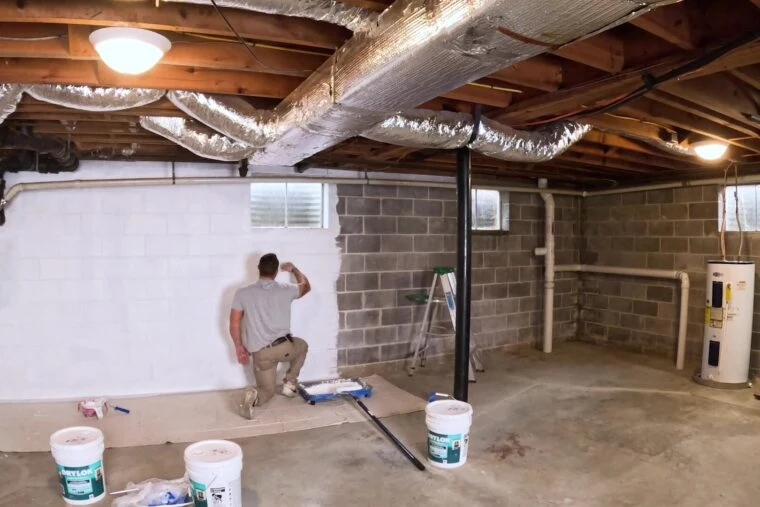
Different category, different physics. This is an opaque, pigmented waterproofing coating brushed into the pore, and it is guaranteed to stop water at up to 15 psi of hydrostatic pressure with a 15-year transferable warranty behind it.
On our damp-side block panel, where water was pushed through from behind, every penetrating repellent in the round-up let water through and DRYLOK Extreme did not. Penetrating repellents line a pore; they do not bridge one. When the water is coming from the wet side of the wall and the wall is below grade, you need a film with real build.
Two brushed coats is the warranty condition, and it is where people cut corners. Coverage is 75 to 100 sq ft per gallon per coat, so a 400 sq ft basement wall is roughly eight to ten gallons of material for the pair of coats. Rolling it fast instead of brushing it into the pore is the most common way homeowners void the warranty without ever knowing they did.
Under 1 perm. Say it out loud before you take this can outside. On an exterior wall that film traps the moisture the brick has to release, and one Mid-Atlantic winter later you are looking at spalled faces. Inside, on block, below grade, it is the right answer and there is no close second at the price. Fix the grading and the gutters first; a coating is not a drainage plan. See our damp walls diagnosis before you buy anything.
Buy it for interior basement and crawlspace masonry. Skip it for anything with sky above it.
DRYLOK WetLook, Best for Paver Patios and Steps
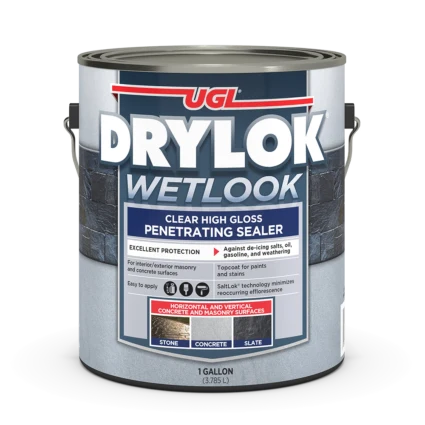
The honest reason most people search for a brick sealer is that they saw the patio right after a rain and wanted it to look like that all the time. WetLook does that, and it is the only pick here that does.
High-gloss clear latex, 200 to 400 sq ft per gallon, dry in an hour, recoat in two, maximum two coats. Our brick paver panel went about two shades deeper and stayed there through the winter set with no ambering, which is where the solvent-based acrylic paver sealers usually fall apart. The SaltLOK additive earned its keep on the salt-tray test: light haze at day 60 where an untreated paver had a visible bloom.
Slick is the trade-off. Glossy sealed brick with water on it is genuinely slippery, and on steps or a pool surround you want a polymer grit additive stirred into the second coat. And the refresh cycle is short. A walked-on patio wants a recoat every 1 to 3 years against 7 to 10 for the penetrating picks.
Keep it horizontal. It is a film, and on vertical house brick it blocks vapor and blisters the same way any film does.
Thompson’s WaterSeal Clear Masonry Protector, Budget Pick
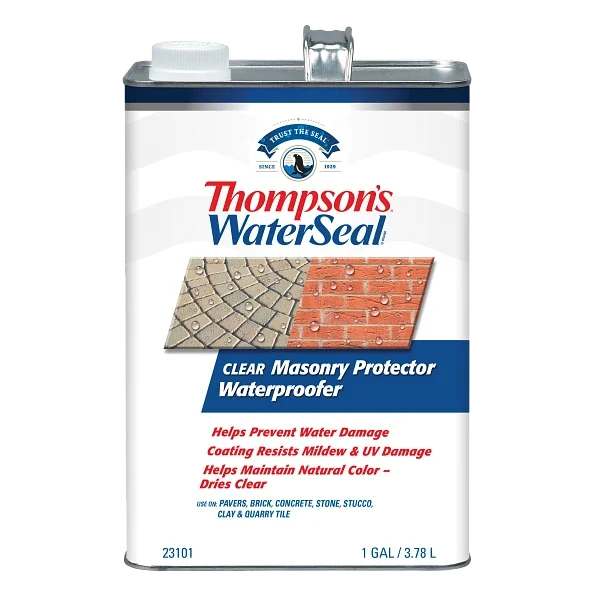
Roughly a third of the Ghostshield’s per-gallon price, sitting on every Home Depot and Lowe’s masonry aisle, and it works. On red clay brick it cut soak weight gain from 6.1 percent to 1.8. That is not top-pick performance, but it is a real result for a garden wall or a planter that nobody is going to relitigate in five years.
It goes on milky, which turns out to be a feature. You can see your wet edge on a big wall, and it dries clear. One light coat is the spec. Mildew and UV resistance are built into the film, which the bare silane repellents do not carry.
The dry time is the problem. 24 to 72 hours to dry and 72 hours before a recoat means you need a three-day clear-weather window, and in a Mid-Atlantic spring that window is rarer than the label implies. Coverage swings from 50 to 375 sq ft per gallon, so soft brick eats a gallon fast. And service life is the shortest here at 2 to 4 years on vertical brick.
Buy it for garden walls, planters, brick steps, and any job where the budget matters more than the reseal calendar. Skip it if you are treating the whole house and would rather do it once a decade.
Where Brick Sealing Jobs Go Sideways
Most sealer failures are wall failures wearing a sealer costume.
- Spalling faces after the first winter. A film-forming product went on an exterior wall. Water got in behind it through a joint or from grade, could not dry outward, and froze. There is no fix but replacing brick.
- Efflorescence came back through the sealer. The salts were there before you sprayed, or the water source is still active. Diagnose the direction of travel before you treat.
- Striped wall visible only in the rain. Uneven application. The repellent needs saturation and a 6 to 8 inch rundown, applied wet on wet, bottom-up.
- Repellent beaded for a year, then stopped. Applied on damp brick, or on mortar less than 28 days old. Alkalinity blocked the chemical bond.
- Sealed patio went cloudy in year two. Moisture trapped under an acrylic film, usually from a slab with no vapor break under the pavers.
- Paint will not stick to a wall you sealed last year. It will not, and there is no primer that fixes it. Repellent and paint are competing answers; pick one. The exterior brick paint round-up covers the other branch.
- Interior wall still damp after two coats of DRYLOK. The water is coming faster than 15 psi, or through the floor-wall joint. That is a drainage job, not a coating job.
Getting the Application Right
- Clean, then wait 3 days. Masonry cleaner, two rinses top-down, then dry. A wall that reads above 12 percent on a pin-type meter is not ready. Our moisture meter picks cover the tools that read masonry rather than wood.
- Rinse at low pressure. Do not hit brick with 2,000 psi. High pressure drives water deep into joints, erodes soft mortar, and feeds the next efflorescence bloom. Use a wide fan at low pressure or a stiff brush. The pressure washer round-up flags which machines throttle down far enough for masonry.
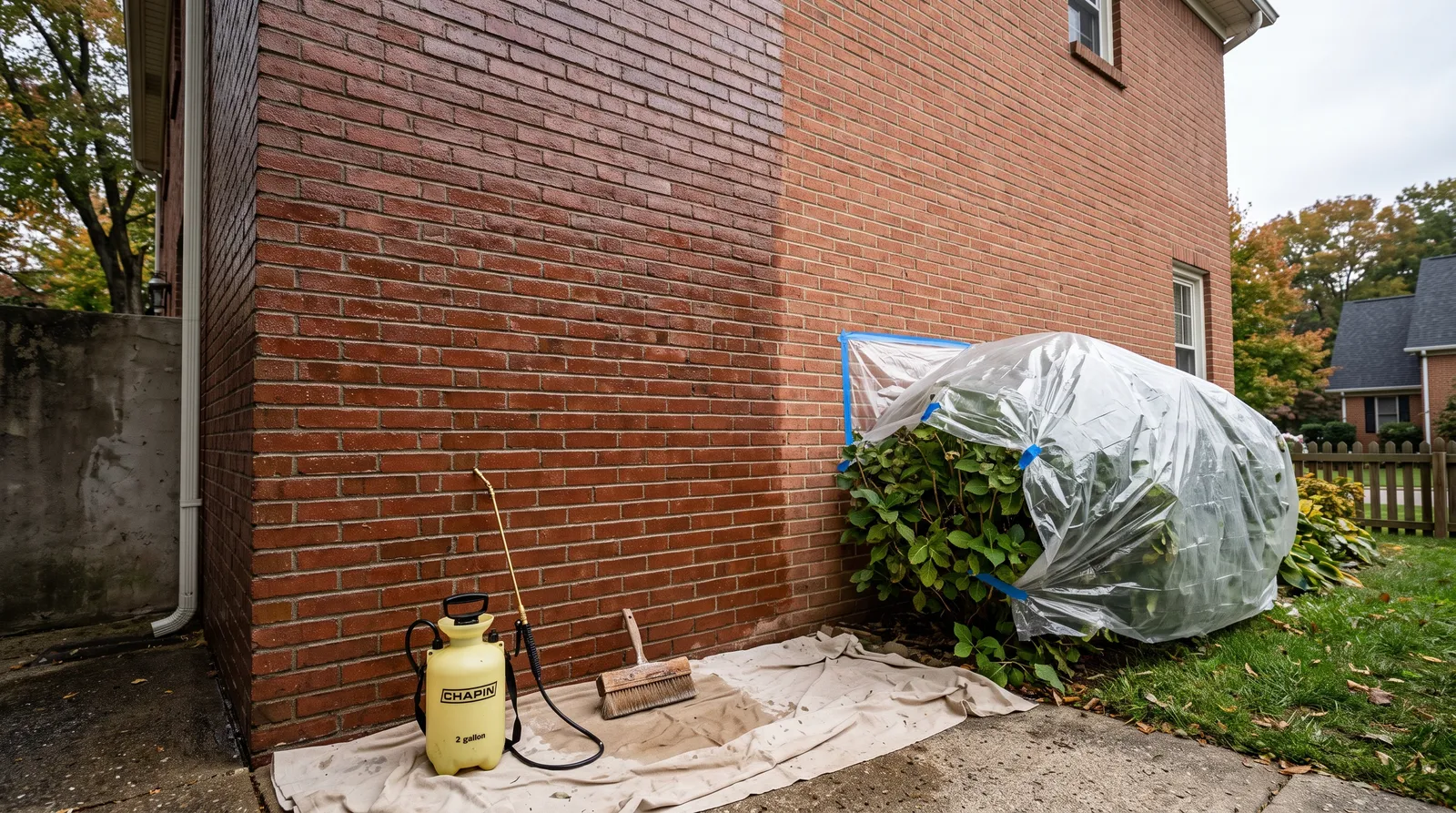
- Flood it, do not mist it. Low-pressure pump sprayer, brick saturated to visible rundown. Atomizing a penetrating repellent through an airless wastes most of the gallon.
- Work bottom-up, wet on wet. Bottom-up keeps runs from streaking dry brick below the line. Overlap while the previous pass is still wet.
- Watch the thermometer both ways. 40F to 90F surface temperature, no rain for 24 hours before or after. Below 40F the reaction stalls; see painting in cold weather for the same physics on the coating side.
- Mask the glass and the plants. Silane on glass etches. Tape and sheet the windows, and wet the shrubs down before and after.
- Wear a respirator. Even on the water-based products you are aerosolizing silane. An organic-vapor cartridge, not a dust mask. The respirator picks sort the cartridge types.
For stucco over masonry the prep sequence changes; the stucco guide has that version. For slabs, driveways, and garage floors, the concrete sealer round-up is the right page.
Close Calls That Missed the Cut
- PROSOCO SaltGuard WB. Excellent where de-icing salt is the enemy, and a genuine contender for coastal and northern walls. Siloxane PD beat it on plain rain performance and costs less.
- Behr Premium Wet-Look Sealer. Sold at every Home Depot and a reasonable alternative to the DRYLOK WetLook. Our panel showed slightly more haze after the salt-tray run.
- Foundation Armor SX5000 WB. Strong silane-siloxane chemistry with a big DIY following. Lost the slot to Ghostshield on published coverage economics and on how much clearer the Siloxa-Tek data sheet is about cure.
- Rust-Oleum Watertite. Interior waterproofer competing with DRYLOK Extreme. Comparable performance, shorter warranty.
- Any solvent-based acrylic “brick sealer” in a spray can. Films on vertical brick, ambers under UV, and peels. Skip the category.
If the wall is sound and you just want rain to stop soaking in, Siloxa-Tek 8500 and a $30 pump sprayer is the answer for most houses. If the wall is spalling, leaking, or blooming salt every spring, no can on this page is the first purchase. Fix the gutter, the flashing, or the grade, and then seal what is left.
Full Comparison
| Product | Best for | Yellowing | Price |
|---|---|---|---|
| Siloxa-Tek 8500 | Top pick — best breathable penetrating water repellent | None; no surface film to yellow | $$$ |
| Sure Klean Weather Seal Siloxane PD | Best for whole-house brick and pro-grade jobs | None; no film | $$$ |
| ChimneySaver Advanced Water Repellent | Best for chimneys and historic brick | None | $$$$ |
| DRYLOK Extreme Concrete & Masonry Waterproofer | Best for interior basement brick and block | Low; white base can dinge in a damp unvented basement | $$ |
| DRYLOK WetLook Clear High Gloss Penetrating Sealer | Best wet-look for brick pavers, patios, and steps | Non-yellowing per manufacturer | $$ |
| Thompson's WaterSeal Clear Masonry Protector Waterproofer | Budget pick — best home-center clear sealer | Low | $ |
Every Pick, Pros and Cons
Pros, cons, and specs for each pick. The cons are not optional here.
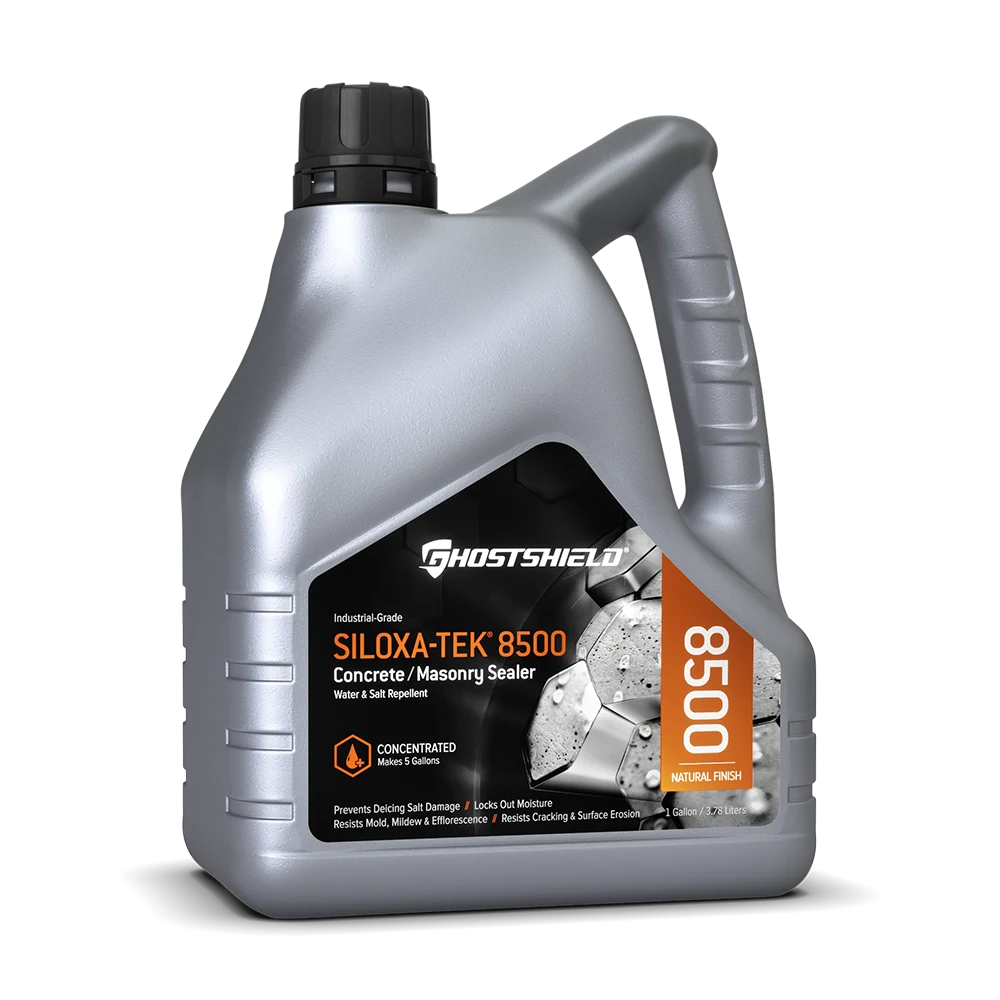
1. Siloxa-Tek 8500
- Coverage
- 150–400 sq ft / gal at 1 coat; ready-to-use up to 250 sq ft / gal per coat; concentrate up to 1,250 sq ft / gal
- Sheens
- None; dries invisible, no film
- Dry / recoat
- Dry 4–6h at 70F / 50% RH · foot and vehicle traffic 24h
- Full cure
- Full water repellency at 7 days
- VOC
- Water-based, low VOC
- Yellowing risk
- None; no surface film to yellow
- Primer
- None; clean dry masonry, 28 days minimum on new mortar
- Price tier
- $$$
- Water-based silane-siloxane that reacts inside the pore instead of filming over it; our treated clay-brick panel gained 0.4 percent moisture weight in a 24-hour soak against 6.1 percent bare
- Dries invisible on red clay brick, buff brick, and gray CMU with no darkening, no sheen, and no color shift we could read against the untreated half of the same wall
- The ultra-concentrate gallon mixes to five working gallons, which drops the per-square-foot cost below every pick here except the Thompson's
- Full traffic in 24 hours and full water repellency at 7 days, so a Saturday application is done being fussy by the following weekend
- No big-box shelf. Direct from Ghostshield or Amazon, which means shipping time and no Sunday-afternoon rescue trip
- The invisible finish is the point, and some buyers hate it. If you wanted the brick to look richer or darker, this is the wrong can
- Coverage swings hard with brick porosity (150 to 400 sq ft per gallon on one coat). Soft handmade brick can drink twice what a dense modern extruded brick takes
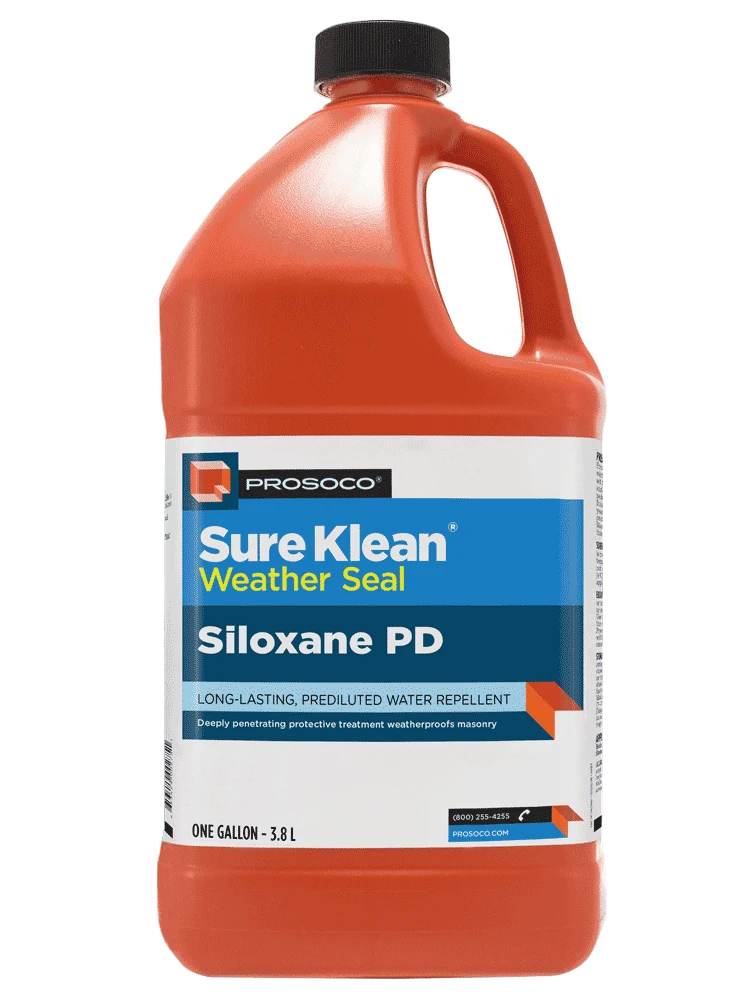
2. Sure Klean Weather Seal Siloxane PD
- Coverage
- 50–200 sq ft / gal depending on substrate
- Sheens
- None; penetrating, no film
- Dry / recoat
- Rain-resistant in 2–4h; surface dry same day
- Full cure
- Up to 10-year service life once cured
- VOC
- Under 30 g/L
- Yellowing risk
- None; no film
- Primer
- None; Sure Klean cleaner + 3-day dry before treatment
- Price tier
- $$$
- The repellent architects actually specify on brick veneer; predilute and ready to use, so there is no mixing error to make on a two-story wall
- Under 30 g/L VOC, legal everywhere in the US including California and the OTC states, with no separate compliant SKU to hunt for
- Bridges shrinkage cracks up to 0.02 inches, which covers the hairline mortar checking that lets driving rain into an otherwise sound wall
- Sold in 5-gallon and 55-gallon containers, the sizes that make a 2,400 sq ft brick house one purchase instead of six
- Masonry distributor channel, not retail. Expect a will-call counter, a lead time, and a salesperson who assumes you are a contractor
- Coverage on porous brick drops to 50 sq ft per gallon, so the material math is worse than the price tag suggests
- Spec-sheet application discipline is real: saturate to a 6 to 8 inch rundown below the spray line, wet-on-wet, or you get a striped wall that shows in the first rain
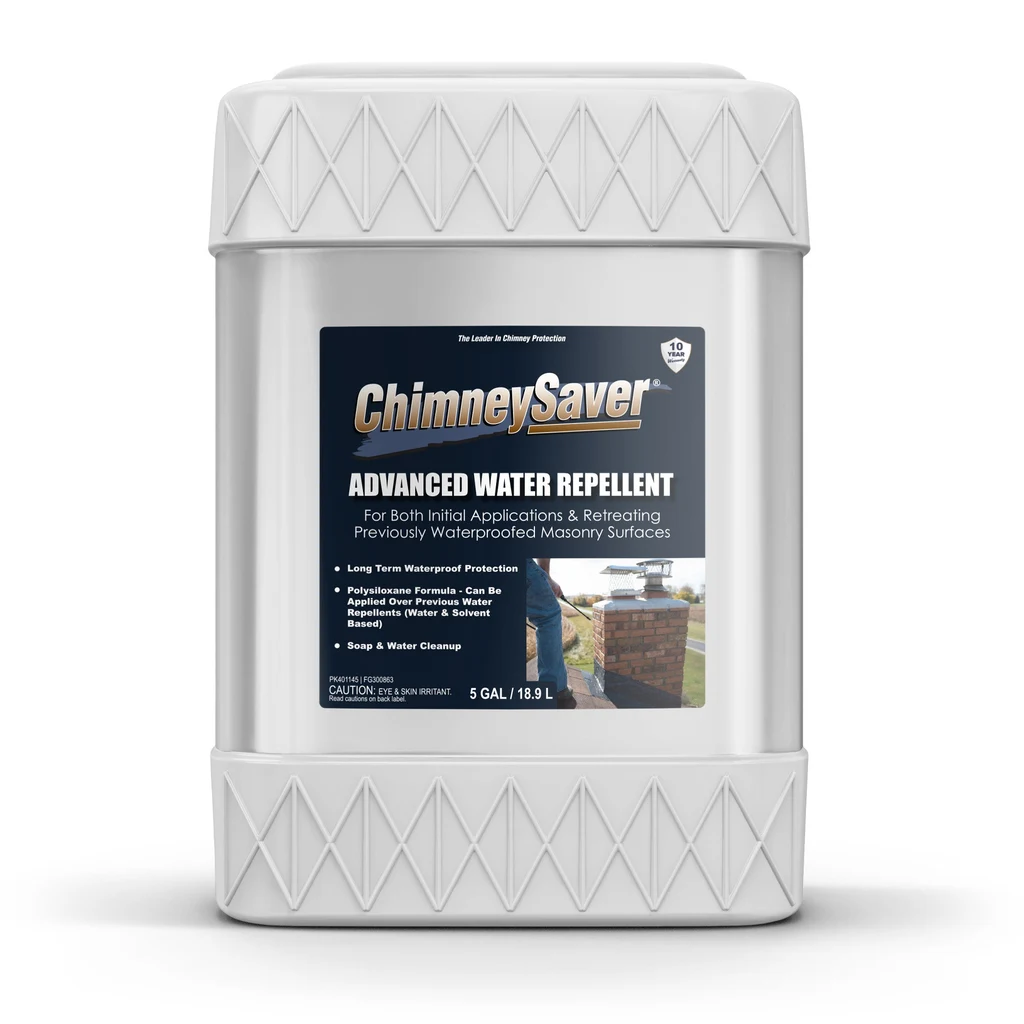
3. ChimneySaver Advanced Water Repellent
- Coverage
- 90–150 sq ft / gal
- Sheens
- None; dries clear and flat
- Dry / recoat
- Water repellency develops in 4–6h
- Full cure
- Full performance within 24–48h
- VOC
- Zero VOC, water-based
- Yellowing risk
- None
- Primer
- None; masonry must be clean, dry, and 24h rain-free
- Price tier
- $$$$
- 100 percent vapor permeable, the one spec that matters on a chimney where combustion moisture has to leave through the brick face
- 10-year warranty on vertical surfaces, the longest written warranty on any clear repellent in this round-up
- Zero VOC water-based polysiloxane that can go over brick previously treated with either a water-based or solvent-based repellent, which no other pick here will do
- Becomes repellent in 4 to 6 hours of UV and atmospheric moisture, so a morning application beats an afternoon storm
- $86.65 a gallon at 90 to 150 sq ft coverage. That is the most expensive square foot on this page by a wide margin
- Chimney supply and hearth-shop distribution; your local hardware store has never heard of it
- Overkill on a plain garden wall or a foundation skirt. Buy it for the flue stack and the historic wall, not the whole house
4. DRYLOK Extreme Concrete & Masonry Waterproofer
- Coverage
- 75–100 sq ft / gal per coat; 2 coats required
- Sheens
- Flat, opaque; tintable
- Dry / recoat
- Touch dry 45 min · recoat 2h
- Full cure
- Fully dry 2–3h per coat
- VOC
- Water-based latex; see PDS for state compliance
- Yellowing risk
- Low; white base can dinge in a damp unvented basement
- Primer
- None; bare clean masonry, no prior coating
- Price tier
- $$
- Guaranteed to stop water at up to 15 psi of hydrostatic pressure, backed by a 15-year warranty that transfers to the next owner
- Fills and bridges the pores on interior block and brick; two brushed coats sealed our damp-side test block where every penetrating repellent let water through
- Tintable, so a basement wall can be waterproofed and finished in the same two coats instead of waterproofing then painting
- Touch dry in 45 minutes and recoat in 2 hours, which puts a small basement wall inside one afternoon
- Under 1 perm. This is a semi-impermeable film, and on an exterior wall that film traps the moisture the brick needs to release
- 75 to 100 sq ft per gallon at two required coats. Material cost per wall is much higher than the coverage number on the front label implies
- Two coats brushed into the pore is the warranty condition, and rolling it fast is how people void the warranty without knowing
- Opaque. The brick disappears under it, so this is a utility wall product, not a curb-appeal one
5. DRYLOK WetLook Clear High Gloss Penetrating Sealer
- Coverage
- 200–400 sq ft / gal
- Sheens
- High gloss, clear
- Dry / recoat
- Dry 1h · recoat 2h · maximum 2 coats
- Full cure
- Light foot traffic 24h; 72h before furniture
- VOC
- Water-base latex; see PDS
- Yellowing risk
- Non-yellowing per manufacturer
- Primer
- None; clean, dry, efflorescence-free masonry
- Price tier
- $$
- Deepens brick color the way a rain shower does and holds it, which is the actual reason most people search for a paver sealer
- SaltLOK additive slows the white mineral leaching that turns sealed pavers cloudy in the second winter
- 200 to 400 sq ft per gallon with a 2-hour recoat, so a 300 sq ft patio is a single-gallon, single-morning job
- Non-yellowing water-base latex, unlike the solvent acrylic paver sealers that go amber on a south-facing patio
- It is a film. On vertical house brick it blocks vapor and can blister, so keep it on horizontal hardscape
- Gloss on wet brick pavers is slick. Add a slip additive on steps and pool surrounds or you will regret it in April
- 1 to 3 year refresh cycle on a walked-on patio, against 7 to 10 for the penetrating picks
6. Thompson's WaterSeal Clear Masonry Protector Waterproofer
- Coverage
- 50–375 sq ft / gal depending on porosity
- Sheens
- None; goes on milky, dries clear
- Dry / recoat
- Dry 24–72h · recoat 72h
- Full cure
- 72h
- VOC
- See label for state-restricted versions
- Yellowing risk
- Low
- Primer
- None; clean dry masonry, splash-test first
- Price tier
- $
- On every Home Depot and Lowe's masonry aisle for roughly a third of what the Ghostshield costs per gallon
- One light coat is the spec, and it goes on milky so you can see your wet edge, then dries clear
- Carries mildew and UV resistance in the film, which the bare-silane repellents do not
- Sized in 1-gallon, 1.2-gallon, and 5-gallon, so a garden wall and a whole chimney base both have a right-size can
- Dry time is 24 to 72 hours and recoat is 72 hours. Weather windows this long are the single biggest reason jobs stall
- Shortest service life in the round-up. Plan a refresh at 2 to 4 years on vertical brick, sooner on anything horizontal
- Coverage swings from 50 to 375 sq ft per gallon, and on soft brick you land at the bad end of that range
Sure Klean Vana Trol
Sealer takes no primer. It takes a clean, and the clean is where most brick jobs are lost. Vana Trol is the acidic masonry cleaner formulated for color-sensitive and metallic-stain-prone brick, and it removes efflorescence on new brick, block, and stone without the streaking and mortar burn that a hardware-store muriatic mix leaves behind. It rinses clean, it works with colored mortar, and it covers 500-plus sq ft per gallon at dilution. Pre-wet the wall, apply, dwell, scrub the joints, rinse twice top-down, then let the wall dry a full 3 days before any repellent goes on. Sealing over efflorescence locks the salt bloom under a repellent that is designed to last a decade, and the only fix at that point is stripping the treatment off. Skip the cleaner only when the brick is genuinely new, genuinely clean, and past its 28-day mortar cure.
BUY ON AMAZON
Ask a Question