How to Paint Stucco: Prep, Primer, and the Coatings That Hold
How to paint stucco — traditional three-coat vs. EIFS, alkali primer, masonry topcoats, and the regional climate calls that decide which paint actually holds.

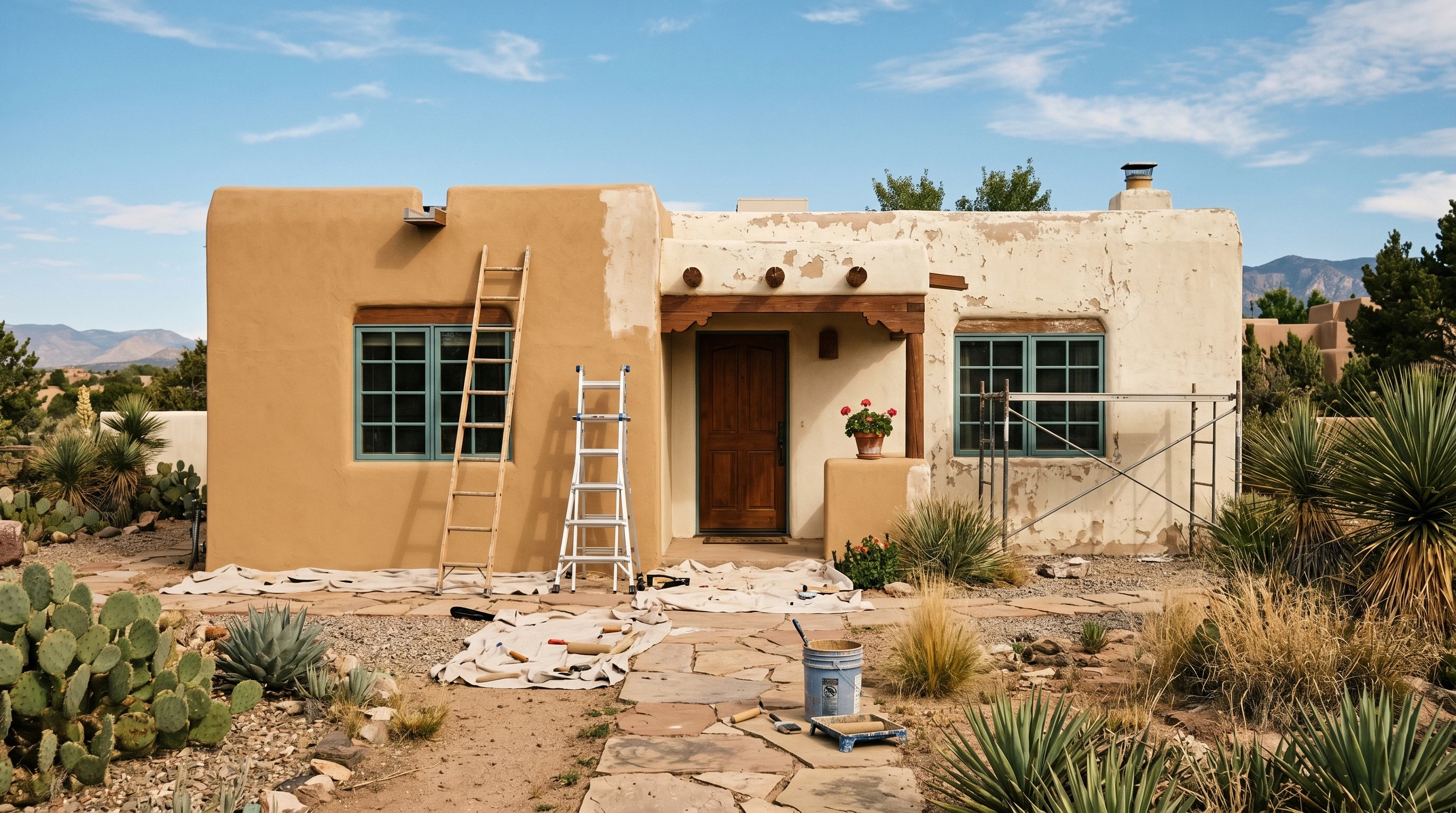
Stucco fails in three places. The prep. The primer. The coating picked for a climate it wasn’t built for. Get those right and the wall holds a decade. Skip any of them and you’re back on the same scaffold inside three summers.
TL;DR
- Identify the substrate: traditional 3-coat, EIFS, or synthetic. Each takes a different coating.
- Wash: pressure wash 1,500–2,000 PSI, then 48–72 hours dry
- Repair: elastomeric patch on hairlines, mesh + acrylic compound on spider cracks, pro on structural cracks
- Test: pH strip before primer. Below 10 to prime; above 10, wait or use high-alkalinity primer
- Primer: alkali-resistant masonry primer (Sherwin-Williams Loxon, Behr Concrete & Masonry Bonding)
- Paint: 100% acrylic masonry on sound walls; elastomeric where cracks move
- Method: brush the texture, roll the field with 3/4-inch nap, two coats minimum
- Cure: 30 days before pressure-washing or scrubbing the painted wall
- Skill: medium. Wrong primer and wrong coating-for-climate are the two killers
Identify Your Stucco First
Three substrates show up on residential walls and they don’t behave the same.
Traditional three-coat. Portland cement, sand, and lime, troweled in three layers (scratch, brown, finish) over expanded metal lath. Hard, heavy, breathes. Knock on it and it rings dull. Default on older homes in Texas, California, and the southwest. Alkaline. Wants masonry primer.
EIFS, exterior insulation finish system. Foam board on the sheathing, acrylic basecoat with fiberglass mesh embedded in it, textured acrylic finish on top. Light, soft, gives a little when you press on it. Knock and it sounds hollow. The assembly doesn’t breathe like cement stucco; moisture is managed by engineered venting at trim and penetrations. Surface chemistry is acrylic.
Synthetic stucco, acrylic-modified. Cement basecoat with acrylic resins added for flexibility, then an acrylic finish. Common on 1990s and 2000s homes. Treats like traditional for prep, like EIFS for finish coat compatibility.
Don’t know which you have? Find a cut edge at a window or control joint. Foam means EIFS, pure cement means traditional, cement with a polymer film on top means synthetic. When you can’t tell, prime it like masonry. Loxon over an acrylic surface won’t fail; an acrylic primer over fresh cement will.
Why Stucco Is Harder Than Wood Siding
Alkalinity. Fresh portland-cement stucco runs pH 12–13. Even decades-old walls hold alkaline pockets. Standard latex primer reacts with that alkalinity in a process called saponification. The binder breaks down, the primer turns soapy, the topcoat lets go in sheets. Use an alkali-resistant masonry primer. No substitutions on traditional or synthetic stucco.
Texture and mil build. Stucco has deep texture: dash, swirl, sand-finish, lace, knockdown. Paint has to fill the texture, not just coat the high spots. 3/4-inch nap roller minimum, 1-inch on heavy dash. Short nap leaves the recesses uncoated, and that’s where the next coat fails.
Movement. Stucco cracks. Hairline thermal cracks open and close with the seasons. Spider cracks spread from settlement. The paint film has to either bridge them (elastomeric) or release at the crack (acrylic) without lifting the field.
Climate exposure. Stucco shows up most in the sunbelt and southwest, where UV is brutal and thermal cycling on south walls hits 60°F daily swings. Cheap exterior paint chalks in three summers there. Coastal walls add salt fog. Freeze-thaw on stucco is rare in the northeast, but where it happens it spalls the face off in chunks.
Materials
- Alkali-resistant masonry primer (Sherwin-Williams Loxon or Behr Concrete & Masonry Bonding)
- Acrylic masonry topcoat (Loxon XP for sunbelt/coastal, Aura Exterior for color, Behr Marquee Exterior as the big-box pick)
- Elastomeric coating (Sherwin-Williams Conflex or Behr Elastomeric Masonry) for cracked walls
- Acrylic patching compound and fiberglass mesh; elastomeric crack filler for hairlines
- Sodium hypochlorite for mildew; TSP or masonry detergent
- pH test strips ($8 a pack at any pool supply)
- Urethane caulk rated for masonry (Sashco Through The Roof or OSI Quad Max)
Kompozit’s Acrylic Masonry topcoat slots next to Loxon XP if you want a partner-brand alternative. See the best exterior paint round-up for the full list.
Tools
- Pressure washer, 1,500–2,000 PSI, 25-degree tip
- 4-inch masonry brush (China bristle); 2.5-inch angled sash for cut-in
- 3/4-inch synthetic nap roller (1-inch for heavy dash)
- Extension pole, scaffolding or ladder rated for the wall height
- Airless sprayer with 517 tip (back-roll behind the spray)
- Hawk and trowel for patching; wire brush for chalk and efflorescence
- N95 minimum, P100 if you’re cutting or grinding stucco; eye pro always
Step 1: Pressure Wash and Dry the Wall
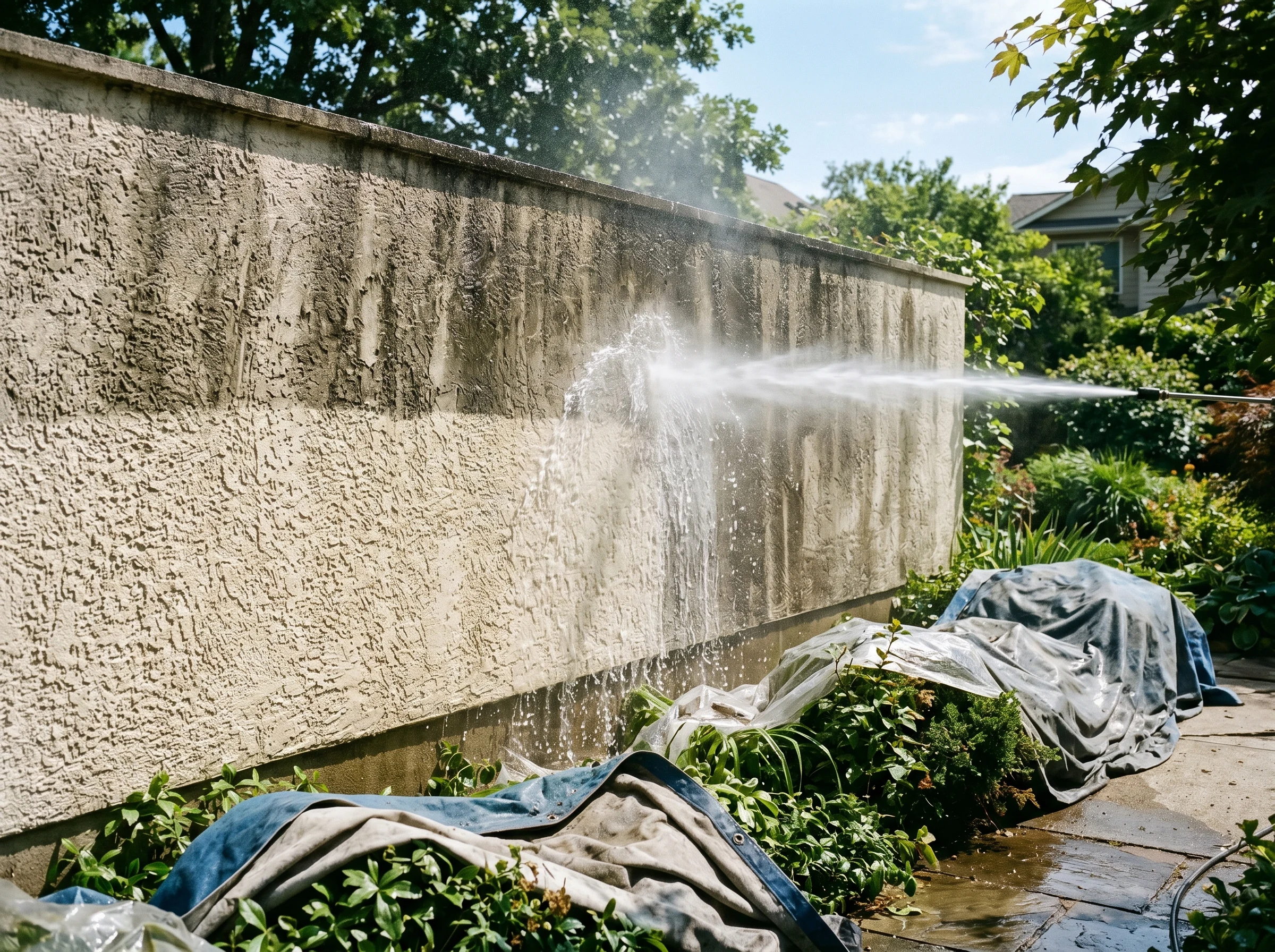
1,500–2,000 PSI on a 25-degree tip. Then 48–72 hours of dry weather before anything else touches the wall.
Cover plants. Mask windows and doors. Start at 1,500 PSI and work up only if the dirt isn’t moving. Stucco isn’t brick. Drive 3,000 PSI into a soft sand-finish wall and you’ll erode the texture and open new spider cracks.
Hold the wand 12–18 inches off the wall, work top down, angle across control joints rather than into them.
Mildew and algae get sodium hypochlorite: three parts water to one part bleach with a splash of dish soap. Brush on, dwell 15 minutes, rinse. White efflorescence bloom dissolves in a 1:10 muriatic acid wash, but on stucco I’d rather wire-brush it dry and find the moisture source than soak the wall in acid.
Then walk away for 48–72 hours of dry weather. Stucco that looks dry on the surface is still wet through the matrix. Primer over wet stucco blisters off in three weeks.
Step 2: Repair Cracks and Parge the Bad Spots
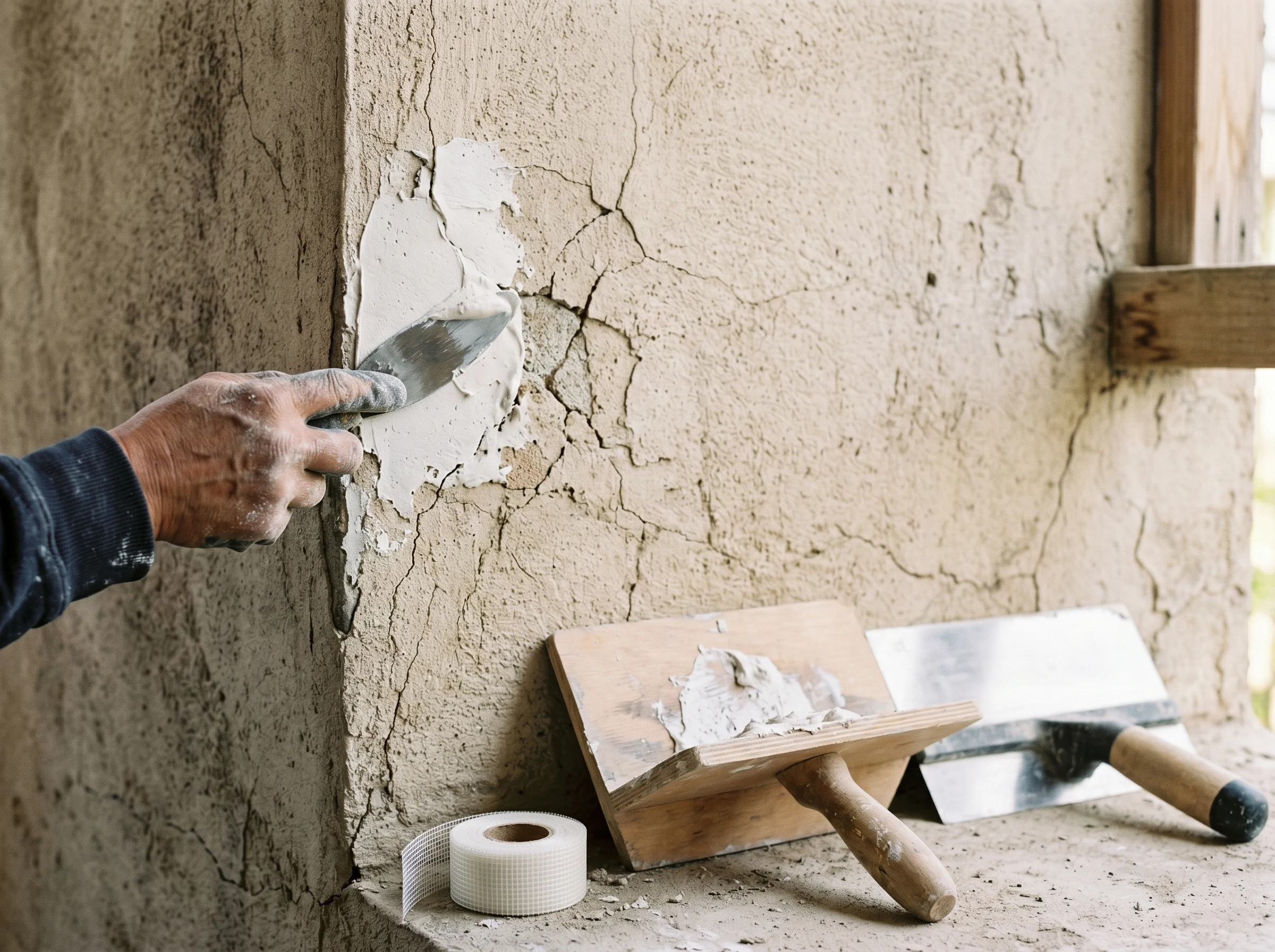
Hairline cracks get elastomeric patch. Spider cracks get fabric mesh and acrylic patching compound. Structural cracks call a pro.
Walk the wall. Sort the cracks by what you’re looking at.
Hairline cracks under a credit-card edge. Thermal movement, harmless on their own, ugly under paint. Elastomeric crack filler, tool flat, thin into the surrounding profile.
Spider cracks that branch. Brush out loose material, dampen, embed fiberglass mesh in acrylic patching compound, skim a second coat, feather the edge. Texture-match while the patch is wet. Sponge for sand finish, dash brush for dash, plastic float for knockdown.
Structural cracks wider than 1/8 inch, running through control joints, or stepping diagonally across a corner. Stop. That’s a foundation, framing, or settlement issue. Paint over it and the crack reopens through the new coat in a season. Get a structural opinion first.
EIFS-specific: every pipe, vent, light fixture, and hose bib coming through the wall has to stay sealed and vented per the system spec. Caulk failures around penetrations are the number-one EIFS moisture path. Replace failed sealant with urethane, not acrylic.
Fresh patches cure 28 days before primer.
Step 3: pH Test and Primer
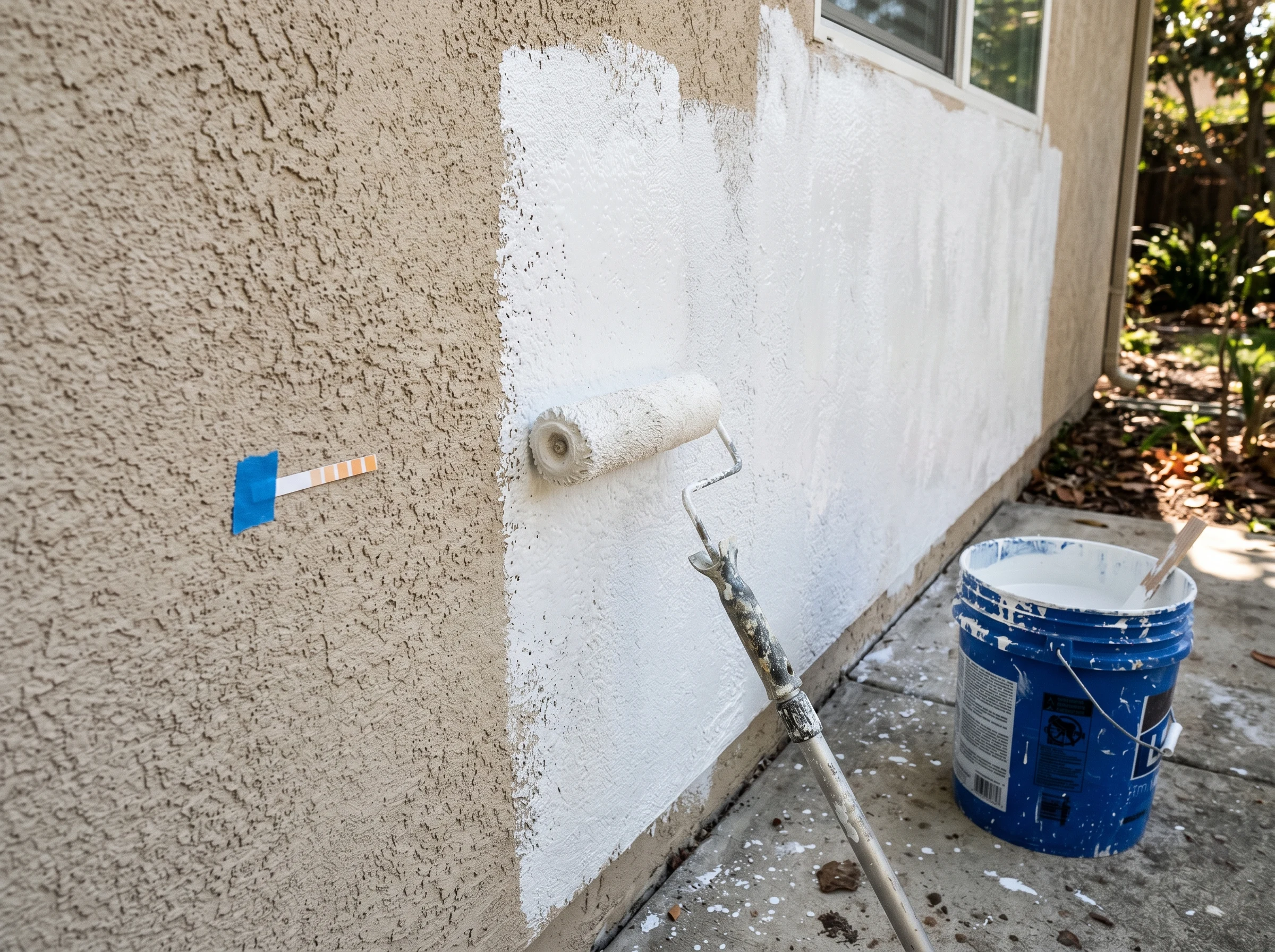
pH strip on a wet patch. Below 10, prime with masonry conditioner. Above 10, wait or use a high-alkalinity primer like Loxon.
Everyone skips this step and it’s the cheapest one on the job. Wet a small patch of bare stucco, press a pool-supply pH strip against it for 30 seconds, read the color.
pH below 10. Most masonry primers are rated. Loxon Concrete & Masonry Primer is the spec; Behr Concrete & Masonry Bonding Primer is the big-box equivalent.
pH 10 to 12. Loxon is rated up to pH 13 per the technical data sheet. Use it. Skip lower-spec masonry conditioners.
pH above 12. Wall hasn’t fully cured. Wait two more weeks. Re-test. Saponification on a $400-a-can topcoat is an expensive lesson.
Brush primer into the deep texture with a 4-inch masonry brush. Roll the field with 3/4-inch nap, 1-inch on heavy dash. Don’t worry about lap marks on primer; topcoat covers them.
One coat is enough on properly prepped traditional stucco. Heavy porous walls or chalky old paint want two thin coats. Cure per the can. Loxon is 4 hours touch-dry, 24 hours recoat in sunbelt conditions; longer in cold or humid weather.
Don’t use interior masonry primer outdoors. Same name on the can, different binder, fails inside a season under UV. The label has to say “exterior.”
Step 4: First Finish Coat
The topcoat is where climate decides for you.
Sunbelt south or west wall (Phoenix, Albuquerque, Tucson, central Texas). Sherwin-Williams Loxon XP. Waterproofing acrylic masonry coating built for thermal cycling and UV. Don’t argue with me on this one. Loxon XP and you’re set for ten years.
Coastal walls with salt fog and wind-driven rain. Loxon XP again. Waterproofing chemistry holds against salt intrusion better than standard acrylic.
Color-critical wall (saturated reds, deep blues, earth tones). Benjamin Moore Aura Exterior. The Color Lock binder holds saturation longer than any acrylic in the field. Pair it with a sound wall in a moderate climate.
Big-box budget pick. Behr Marquee Exterior. Closest Home Depot match to Aura on color and Loxon on durability. Fair tradeoff at half the price.
Open or moving cracks. Skip acrylic. Use elastomeric. Sherwin-Williams Conflex or Behr Elastomeric Masonry. Both stretch 400–600% and bridge cracks acrylic would split. Tradeoff is breathability; don’t roll elastomeric on a wall with rising damp.
Method is the same across all five. Brush the cut-in with a 2.5-inch angled sash, brush the texture with the masonry brush, roll the field with 3/4-inch nap. Or spray with a 517 tip and back-roll while wet. Spray-only leaves paint on the high spots; back-rolling drives it into the texture.
Watch temperature. 50°F minimum, 90°F maximum air, and that’s air, not surface. Stucco in direct sun on a south face at noon hits 130°F; acrylic flashes solvent before the film levels and you get a chalky coat. Sunbelt south face? Paint at 6 AM or 5 PM, never noon.
Sixteen hours between coats. Some cans say four. Don’t believe them on exterior masonry.
Step 5: Second Finish Coat
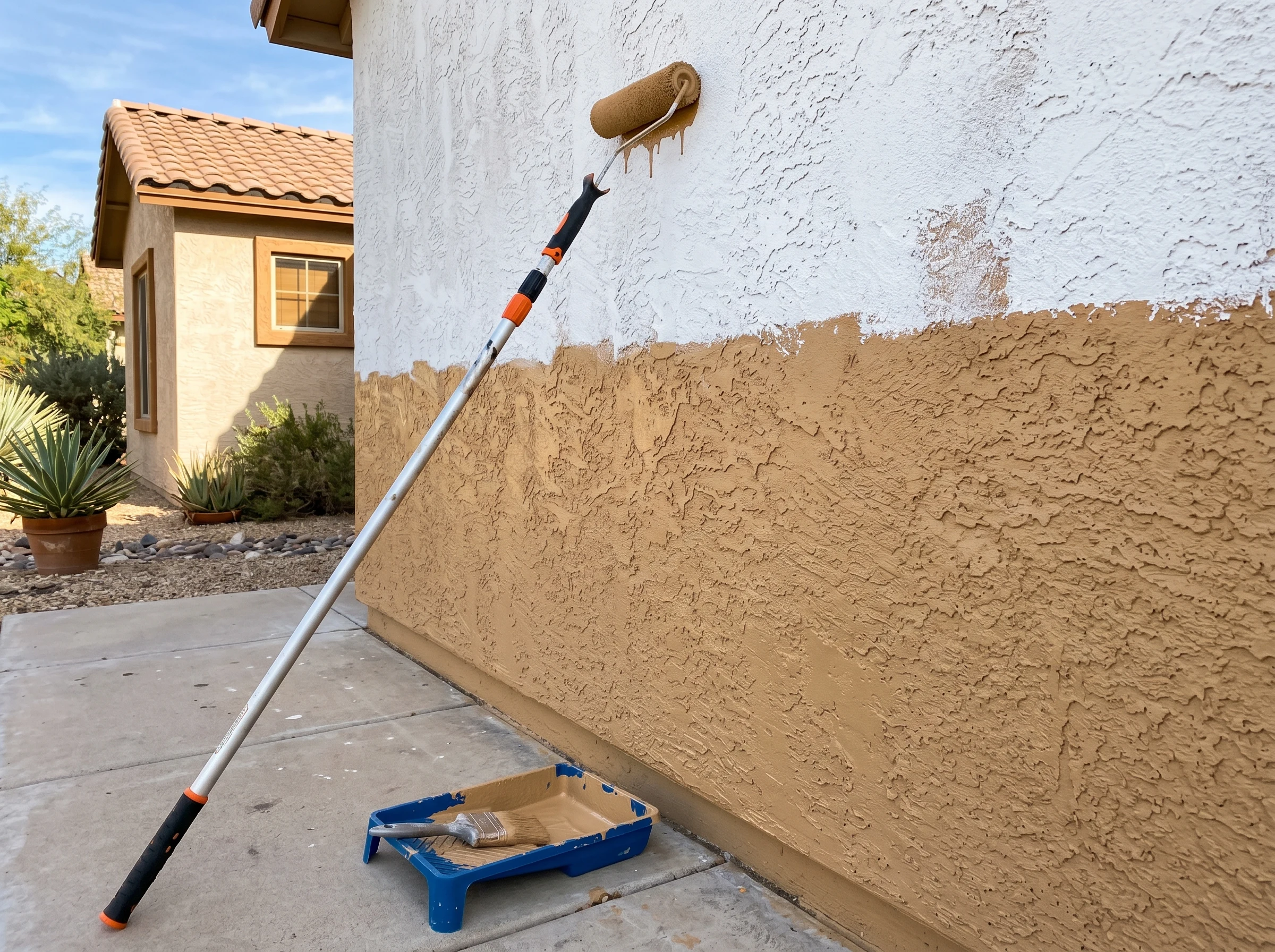
Two coats minimum. The second coat fills holidays from the first and brings the film to spec mil thickness.
Same brush-and-roll drill. The second coat fills holidays from the first and brings the dry film thickness to manufacturer spec, usually 6–8 wet mils and 2.5–3 dry per coat. Two coats lands you at 5–6 dry mils total, which is the durable mil build. One coat on stucco is half a paint job.
Look at the wall in raking morning sun before you call it done. That’s when missed spots show. Touch up with a brush from the same can.
Step 6: Cure
Touch-dry in 2–4 hours. Recoat-dry in 16–24. Full cure runs 30 days on acrylic masonry, 60 on elastomeric. During cure, don’t pressure-wash the wall, don’t run sprinklers onto it, don’t lean ladders against it. A soft film picks up dirt and damage that locks in permanently.
Common Mistakes
- Painting fresh stucco before the 28-day cure. Saponification, blistering, full repaint inside a year. Run a pH strip if you’re impatient.
- Skipping the alkali-resistant primer. Standard latex primer reacts with cement and the topcoat lets go in sheets. Loxon or Behr Concrete & Masonry Bonding, no substitutions.
- Using interior masonry primer outdoors. UV destroys the binder in one season.
- Acrylic over a wall with moving cracks. Cracks reopen through the new coat in 18 months. Use elastomeric where the wall actually moves.
- Elastomeric on a wall with rising damp. Trapped moisture spalls the stucco face off in two freeze-thaw cycles. Find the moisture path first.
- Capping EIFS penetrations with caulk instead of venting them. Wall blisters from inside.
- Spray-only on deep texture. Paint sits on the high spots and skips the recesses. Back-roll every coat.
- Painting south-facing stucco at noon. Surface temp 130°F, solvent flashes before the film levels, chalky under-bonded coat. 6 AM or 5 PM only.
- Short-nap roller. 3/8-inch nap doesn’t reach the recess. 3/4-inch minimum, 1-inch on heavy dash.
Failure Modes in Five Years If You Cut Corners
Chalking on south walls. Cheap acrylic, no UV-graded topcoat. Wipe a dark cloth on the wall; white powder means the binder oxidized. Peel Stop plus Loxon XP for the next round.
Efflorescence bloom returning. Moisture path inside the wall is still active. Failing flashing, blocked weep screed, sprinklers hitting the stucco. Find it. Fix it. Don’t paint the bloom back over.
Blistering from trapped moisture. Common on EIFS where penetrations were caulked closed instead of vented. Strip the failed area, rebuild the detail to spec, recoat.
Peeling at the bottom three feet. Ground moisture wicking up through the wall. Same fix as brick: address the source before any repaint will hold.
Maintenance and Longevity
A properly painted stucco wall lasts 8–12 years before a full repaint. Sunbelt south face on standard acrylic gets you 5–7. Loxon XP stretches that to 8–10. Elastomeric on a cracked wall holds 10–15 if the moisture management stays sound.
Wash annually with a soap injector and a soft pole brush. No pressure-washing the painted wall in the first year of cure. After year one, 1,000 PSI on a 40-degree tip is the ceiling. Touch up small failures with a brush from the same can. Systemic peeling at the base means the moisture path needs work before any recoat will hold.
What I’d Buy on My Own House
Sunbelt or southwest, any south or west wall: Loxon XP. Coastal Texas, Florida, Carolinas: Loxon XP again. Color-critical project in a moderate climate: Aura Exterior over Loxon primer. Big-box budget repaint: Marquee Exterior over Behr Concrete & Masonry Bonding. Active spider cracking: Conflex or Behr Elastomeric Masonry, after you’ve ruled out interior moisture.
Will it bite you in two years? Only if you painted before the cure, skipped the alkali primer, picked the wrong coating for the climate, or sealed an active moisture path. Get those four right and the wall holds a decade.
Ask a Question