Best Concrete Sealers for 2026
Five concrete sealers tested on driveway, patio, and garage slabs for water beading, salt resistance, oil hold-out, and blush. Top pick: Ghostshield Siloxa-Tek 8500.

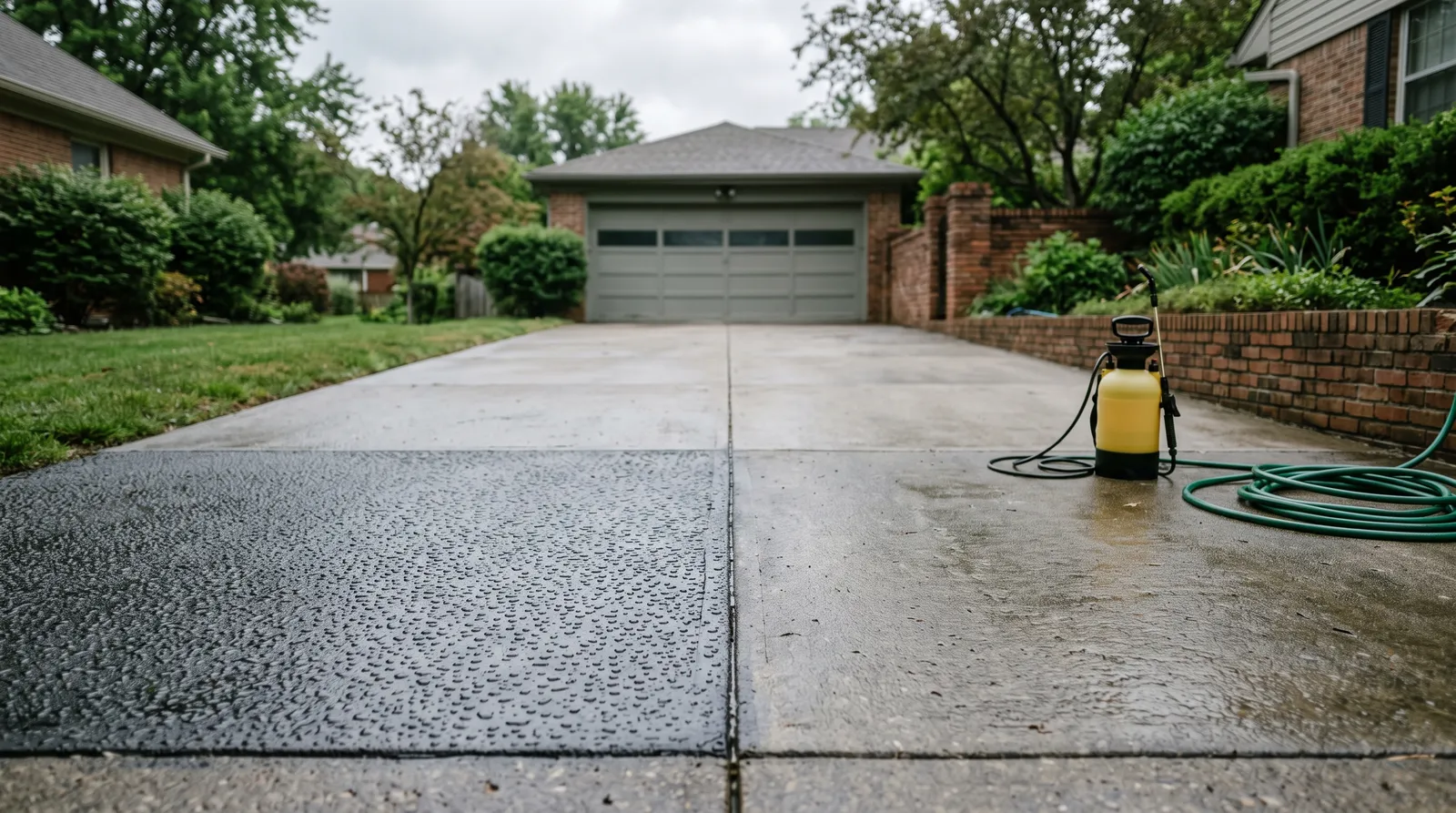
40 percent actives in a water-based silane/siloxane blend — the highest actives content of any water-based sealer a homeowner can buy off a big-box shelf
Deepens color the way water does when it hits a dry slab — the strongest color enhancement in the round-up, and the only pick that does anything visual
Oleophobic fluorocarbon chemistry on top of the silane/siloxane, so fresh motor oil sits up on the slab long enough to wipe instead of wicking into the pores
About $31 a gallon for a real silane/siloxane hybrid — the cheapest honest penetrating sealer in US retail
Rated to stop water at 15 psi of hydrostatic pressure with a 15-year warranty, which no penetrating sealer in this round-up will even claim
Disclosure: Some links below are affiliate links. We earn a commission if you buy through them, at no extra cost to you. Picks are based on the test protocol in “How I Ran This”. No brand pays for placement.
Top pick: Ghostshield Siloxa-Tek 8500. It costs about three times a gallon what the budget penetrating sealer costs, and on the two tests that decide whether a slab survives a winter, it was the only pick still winning at month 18. Siloxa-Tek 8500 wins on actives content, on chloride resistance, and on staying completely invisible. It falls short on price and on shelf availability, and it does nothing at all for how your patio looks. If you need the concrete to look richer, Foundation Armor’s AR350 is the wet-look answer. If the money is tight and the slab is not on a salt route, Eagle Natural Seal at around $31 a gallon does most of the job.
A sealer is not paint and it is not a coating. Most of what goes wrong in this category happens because somebody bought one expecting the other.
What a Sealer Is Actually Doing
Two chemistries, two jobs.
A penetrating sealer soaks in. Silane and siloxane molecules travel into the capillary pores of the concrete, react with the moisture and the alkalinity in there, and line the pore walls with something water will not wet. Nothing sits on the surface. The slab looks identical the day after. It cannot peel, blush, flake, or turn slippery, because there is no film. Three of my five picks work this way.
A topical sealer builds a film. Acrylic, usually, dissolved in solvent or carried in water, drying to a thin clear layer that sits on top. It stops surface staining, it darkens and enriches the concrete color, and it will wear off traffic lanes, whiten if moisture gets trapped underneath, and go slick when wet. The AR350 is here, and it earns its slot on looks.
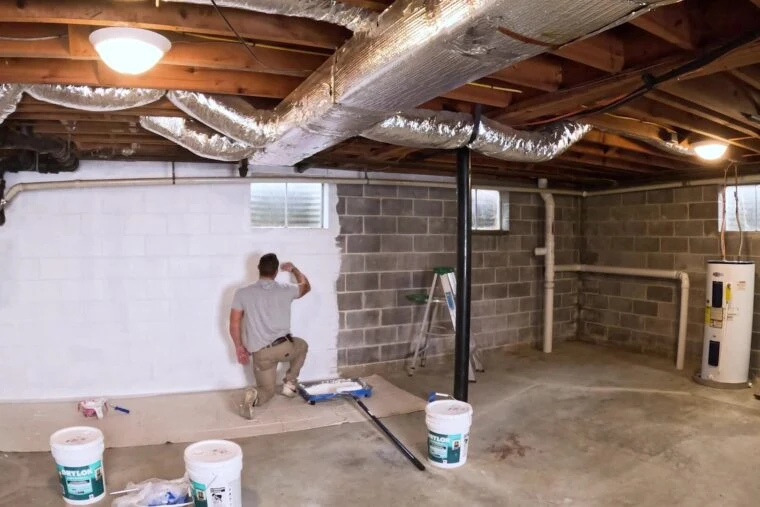
The DRYLOK pick is a third thing again, a pigmented waterproofing coating for vertical basement walls fighting water from the other side. I included it because half the people searching for concrete sealer are standing in a damp basement, and a silane/siloxane will not do anything for them.
How I Ran This
Five sealers on matched 18-inch broom-finish slabs, plus live sections of a 22-year-old driveway, a 6-year-old stamped patio, and an attached two-car garage floor, all in coastal Mid-Atlantic weather. Every slab got the same prep: acidic etch-clean, full rinse, 48 hours dry, application at 68 to 78°F under 60 percent humidity with a solvent-resistant pump sprayer. Hose-tested for beading at 30 days, 6 months, 12 months, and 18 months. Salt-ponded at 5 percent sodium chloride for 24 hours in a taped dam. Oiled with 30W for one hour and again for seven days. Then one full winter, 31 recorded frost cycles, and a look at every panel in April. Pick-specific findings sit inside each review below.
The Five, Side by Side
| Product | Best for | Beading at 18 mo | Appearance | Price |
|---|---|---|---|---|
| Ghostshield Siloxa-Tek 8500 | Top pick: driveways, patios, garages | 🟢 Still tight | Invisible | $$$ |
| Foundation Armor AR350 | Stamped concrete, pavers, looks | 🟡 Film worn in traffic lanes | Wet look, low gloss | $$ |
| Ghostshield Siloxa-Tek 8510 | Garage and shop floors, oil | 🟢 Still tight | Invisible | $$$$ |
| Eagle Natural Seal | Budget, low-salt climates | 🟡 Faded by month 12 | Invisible | $ |
| DRYLOK Extreme | Interior basement walls | ⚪ N/A (coating) | Flat white or tinted | $$ |
Salt is the divider in this category. On a slab that never sees deicer, a $31 gallon of Eagle does most of what a $100 gallon of Siloxa-Tek does, and I would not talk anyone out of it. On a driveway in a plow zone, the actives content is the whole product, and the cheap jug runs out of protection around the time you have forgotten you applied it.
Pick by the Problem, Not by the Price
- Driveway that gets salted or plowed: Siloxa-Tek 8500. Two coats, wet on wet.
- Stamped or colored patio that has gone dull: AR350. Accept the recoat cycle.
- Garage floor with oil history, no coating planned: Siloxa-Tek 8510. Degrease first or the money is wasted.
- Big square footage, mild climate, tight budget: Eagle Natural Seal, 5-gallon pail.
- Basement wall with water pushing through block: DRYLOK Extreme, and fix the grading outside while you are at it.
- Slab you intend to epoxy later: Buy nothing here. Sealing kills adhesion for the coating.
The Picks
Ghostshield Siloxa-Tek 8500, Top Pick
Forty percent actives in a water-based carrier. That number is the review. Most water-based silane/siloxane sealers sold to homeowners land between 5 and 20 percent actives, which is why they bead beautifully in June and stop beading by the following June. The 8500 has more chemistry per gallon to push into the pore structure, and the difference showed up exactly where you would expect it to, late.
At 30 days every penetrating pick beaded. At 6 months all three still did. At 12 months the Eagle panel had gone to a flat wet-out on the hose test while both Ghostshield panels held tight beads, and at 18 months the 8500 was still throwing water off the driveway section in beads I could photograph from standing height. The salt test was the bigger separation. After the 24-hour chloride pond and one winter, the untreated control had visible scaling at the dam ring, the Eagle panel had light surface dusting, and the 8500 panel was clean.
The application is unglamorous, which I like. Pump sprayer, flood the surface, keep it wet for a few minutes, do not let it puddle, come back with a second pass while the first is still damp on a porous slab. No back-rolling required on broom finish. No lap marks, because there is no film to lap. It dries invisible, and if you were hoping for a visible payoff, the only one you get is water behavior.
Two real costs. The first is money: this is roughly a hundred dollars a gallon, and a two-coat application on a 600 square foot driveway wants most of a 5-gallon pail. The second is that people expect a sealer to look like something. Your neighbor will not notice. Your slab will.
Buy it if your concrete sees road salt, plow blades, or hard freeze-thaw, and you want to do this once. Skip it if the slab is a covered porch in Georgia that never freezes; you are paying for chemistry you will never cash in.
Foundation Armor AR350, Best Wet Look
The only pick here that changes how concrete looks, and it changes it a lot. Solvent-based pure acrylic, low-gloss wet-look finish, 175 to 225 square feet per gallon. On the stamped patio section it pulled the color back out of six-year-old tan-and-slate concrete that had faded to a chalky version of itself. Photographed side by side, the sealed half looks like it just stopped raining there.
Service life is where the honesty lives. Foundation Armor publishes 1 to 3 years, and my traffic-lane observations lined up with the low end of that on the driveway apron and the high end on the patio where nobody drives. This is a maintenance product. You will recoat it, and the recoat is easy, which is the saving grace: clean, dry, apply a fresh coat, no stripping, no sanding, no bonding primer.
The failure mode to respect is blush. Solvent acrylic over a slab with moisture underneath goes milky white as the film cures and traps vapor. It happened on one of my test panels after I rushed the dry window during a humid stretch, and it was my fault, not the product’s. The fix is genuinely good though: wet the whitened area with xylene, the film re-dissolves, the trapped moisture escapes, and it re-levels clear. Try that with an epoxy.
Two more things. The 50 / 350 / 700 g/L VOC options mean you can actually buy this in California, Colorado, New York, and Ohio, which is more than a lot of the solvent-acrylic field can say. And the wet-look sheen is slick under water. If this is going on a pool deck or a shaded walkway, buy the non-slip additive and mix it into the final coat.
Buy it if the point of the project is appearance. Skip it if you want to seal the driveway and forget it for a decade.
Ghostshield Siloxa-Tek 8510, Best for Oil and Garage Floors
The expensive specialist. Ninety-four percent actives in a solvent carrier, with an oleophobic fluorocarbon component layered onto the standard silane/siloxane water repellency. Water beads and oil beads, at least for a while.
My oil test ran two ways. One hour of pooled 30W motor oil wiped off the 8510 panel with a dry rag and left nothing I could find under raking light. The same hour on the 8500 panel left a faint shadow, and on the untreated control it left a permanent one. Then I ran it for seven days, because that is what actually happens in a garage where a drip goes unnoticed under the car. At seven days the 8510 held a shadow too, lighter than the others, still visible. Oleophobic means the oil sits up long enough for you to catch it. It does not mean the slab is invincible.
The solvent carrier is the price of that performance. Real fumes, real ventilation requirements, xylene or mineral spirits for cleanup, and a respirator you should not skip. Check our respirator picks for painting before you spray this in a closed garage. It also drives deeper into a hard-troweled interior slab than any water-based product in the group, which is exactly why you would use it on a garage floor rather than a driveway.
Coverage math bites here. One gallon at 150 to 400 square feet is a single-car bay at one coat, and this is not a cheap gallon.
Buy it if you want a garage floor that resists stains without committing to an epoxy system. Skip it if the floor is going to get coated anyway, or if the slab has never seen a drop of oil.
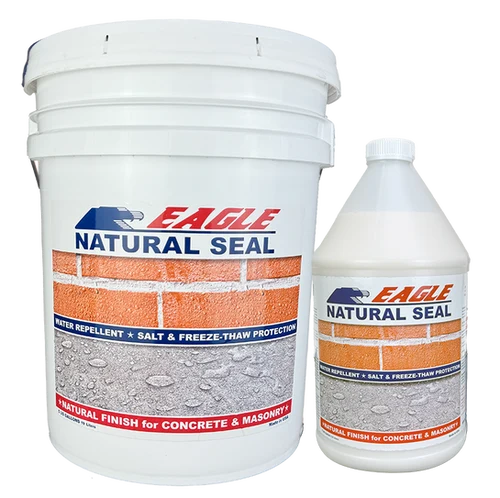
Eagle Natural Seal, Budget Pick
Around $31 a gallon for a genuine silane/siloxane hybrid, water-based, under 100 g/L VOC, one coat on most surfaces at roughly 200 square feet per gallon. That price is not a typo and this is not a fake sealer with a marketing name. It works.
It works for two to four years instead of seven to ten, and my beading data shows where the line is: tight at 6 months, flat wet-out on the hose by month 12, light surface dusting after the salt pond and one winter. Lower actives, shorter service life, exactly what the price predicts.
Where it earns the slot is square footage. Sealing 1,200 feet of driveway, walkway, and front steps with the top pick is a serious purchase. Sealing it with Eagle costs less than dinner out and gets you real protection through the next few winters. It also covers brick, block, mortar, and grout, so one jug handles the slab and the steps. Not for clay or terra cotta brick, not for polished stone, not for asphalt.
Vehicle traffic wants 48 hours, so plan the weekend around it.
Buy it if you have a lot of concrete, a mild climate, or a slab you expect to replace in a few years anyway.
DRYLOK Extreme, Best for Basement Walls
Different category, included on purpose. This is a pigmented latex waterproofing coating rated to hold back 15 psi of hydrostatic pressure with a 15-year warranty. No penetrating sealer on this page will make that claim, because none of them can.
Coverage is the shock: 75 to 100 square feet per gallon, roughly a quarter of what the penetrating picks deliver, because you are building a film thick enough to stop liquid water, not lining a pore. Two coats is the spec and the second one is not optional. Brush the first coat into the block, do not roll it; you are filling pinholes, and a roller skims them.
The disqualifier is prior paint. DRYLOK Extreme bonds to bare masonry and only bare masonry, and a large share of older basements have been painted at some point by somebody. If yours has, you are looking at a strip or a different approach entirely. Read our damp wall diagnosis before you buy anything, because a coating on the inside of a wall that is wet from the outside treats the symptom. Grading, gutters, and downspout extensions treat the cause.
On a floor slab or a driveway this is the wrong product. It is a wall coating.
The In-Store Price Conversation
Buy the 1-gallon size online if the job is small. Buy the pail locally if it is not.
Every sealer here prices the 5-gallon at roughly a 20 to 30 percent discount per gallon over singles, and unlike a two-part epoxy kit, unopened sealer keeps on a shelf for years. A 600 square foot driveway at two coats is not a gallon job. Home Depot and Lowe’s both stock the Ghostshield pails and DRYLOK in 5-gallon, and freight on a 45-pound pail is the thing that quietly ruins the online price advantage. Foundation Armor sells direct in pails and their per-gallon math beats retail on the big sizes.
For estimating how much you actually need, the arithmetic is the same as paint, and our coverage and gallons calculator handles it. Measure the slab, divide by the low end of the published coverage range, then add a coat for anything broom-finished or older than fifteen years. Old concrete is thirsty.
What a Typical Two-Car Driveway Costs
Six hundred square feet of 20-year-old broom-finish concrete, two coats where the spec asks for two, cleaner included, sprayer and roller not included because you probably own them.
| Sealer | Material needed | Approx. material cost | Expected life | Cost per year |
|---|---|---|---|---|
| Siloxa-Tek 8500 | 4–5 gal (2 coats) | $400–500 | 4–7 yr on a salted drive | ~$80 |
| Foundation Armor AR350 | 5–6 gal (2 coats) | $280–350 | 1–3 yr | ~$140 |
| Siloxa-Tek 8510 | 4–5 gal | $600+ | 5–8 yr | ~$95 |
| Eagle Natural Seal | 3 gal (1 coat) | ~$95 | 2–4 yr | ~$32 |
Run the cost-per-year column and the budget pick looks like the value winner, which it is on paper. In practice the labor is identical across all four rows, and the labor is the expensive part. Washing, etching, drying, masking, and spraying 600 square feet is a weekend either way. Paying $400 once every six years to do that weekend once beats paying $95 every three years to do it twice, unless you enjoy the weekend.
That calculus flips in one situation: a slab you know is coming out. If the driveway is cracked past repair and getting replaced within five years, buy the cheap sealer, slow the scaling, and spend nothing more.
Prep Is 80 Percent of the Result
- Wash, then clean, then dry. Pressure alone leaves the dust film. Follow it with a concrete cleaner or etcher and a full rinse.
- Give it 24 to 48 hours. Sealing a slab that is still damp in the pores is the number one cause of a disappointing job, and the number one cause of blush under an acrylic.
- Do the bead test on bare concrete. Splash water on the clean, dry slab. If it soaks in and darkens, you are ready. If it beads, something is still on the surface and no sealer will penetrate.
- Watch the forecast for 24 hours, not 4. Rain on a green penetrating sealer is a re-do.
- Mask the siding, the garage door, and anything with a finish on it. Solvent acrylic overspray does not wipe off vinyl.
- Use a solvent-resistant sprayer. A cheap garden sprayer’s seals swell and fail on xylene-carried product in about twenty minutes. The handheld sprayer picks note which models take solvents.
Where Sealer Jobs Go Wrong
- White haze across the whole slab. Over-application. Penetrating sealer that cannot soak in dries as residue on the surface. Scrub with the matching solvent and apply thinner next time.
- Beading gone in a year. Low-actives product, or a burnished slab that never let it in. Clean, etch, re-seal with something at higher actives.
- Milky patches under an acrylic. Trapped moisture. Xylene re-flow on solvent acrylics; water-based films usually need to come off.
- Peeling flakes in the driveway apron. Somebody used a film sealer where a penetrating one belonged, and tire scrub found the weak spot.
- New coating will not stick. The slab was sealed. Grind it. This is why sealing before epoxy is backwards.
- Efflorescence blooming through. Moisture is moving up through the slab from below. A breathable penetrating sealer tolerates that. A film does not, and it will keep lifting.
Also Considered, Also Passed Over
- Cure-and-seal compounds. Made for fresh concrete at the pour, not for a 20-year-old driveway. If your contractor used one, you have to remove it before any of these picks work.
- Big-box wet-look acrylics under $30 a gallon. Thin solids, short life, and the ones I have sampled whitened faster than the AR350. The category is real; the cheap end of it is not worth the labor you put into applying it.
- Sodium silicate densifiers. They harden and reduce dusting on interior floors. They are not water repellents, and they get sold as if they were.
- Polyurethane and epoxy clear coats. Genuine performance, wrong pillar. Those are coating systems with coating problems, covered in our garage floor round-up.
- Siloxane products sold only in 55-gallon drums. Better per-gallon pricing, no homeowner-scale package, and a drum of sealer in the garage is a hazard, not a bargain.
Clean the slab, prove it drinks water, then seal it. Skip that and the can you bought does not matter.
Full comparison
| Product | Best for | Yellowing | Price |
|---|---|---|---|
| 🥇Siloxa-Tek 8500 Concrete Sealer | Top pick — best penetrating sealer for driveways, patios, and garages | None — no surface film to yellow | $$$ |
| Armor AR350 Solvent Based Acrylic Wet Look Concrete Sealer | Best wet look for stamped concrete, pavers, and patios | Low (pure acrylic); blush and whitening are the real film risks, not yellowing | $$ |
| Siloxa-Tek 8510 Concrete Sealer | Best for garage floors, shop floors, and oil stains | None — no surface film to yellow | $$$$ |
| Natural Seal Penetrating Concrete Sealer | Budget pick — best value penetrating sealer | None — no surface film | $ |
| DRYLOK Extreme Masonry Waterproofer | Best for interior basement and foundation walls | N/A — pigmented white or tinted | $$ |
Reviews
Pros, cons, and specs for each pick.
1. Siloxa-Tek 8500 Concrete Sealer
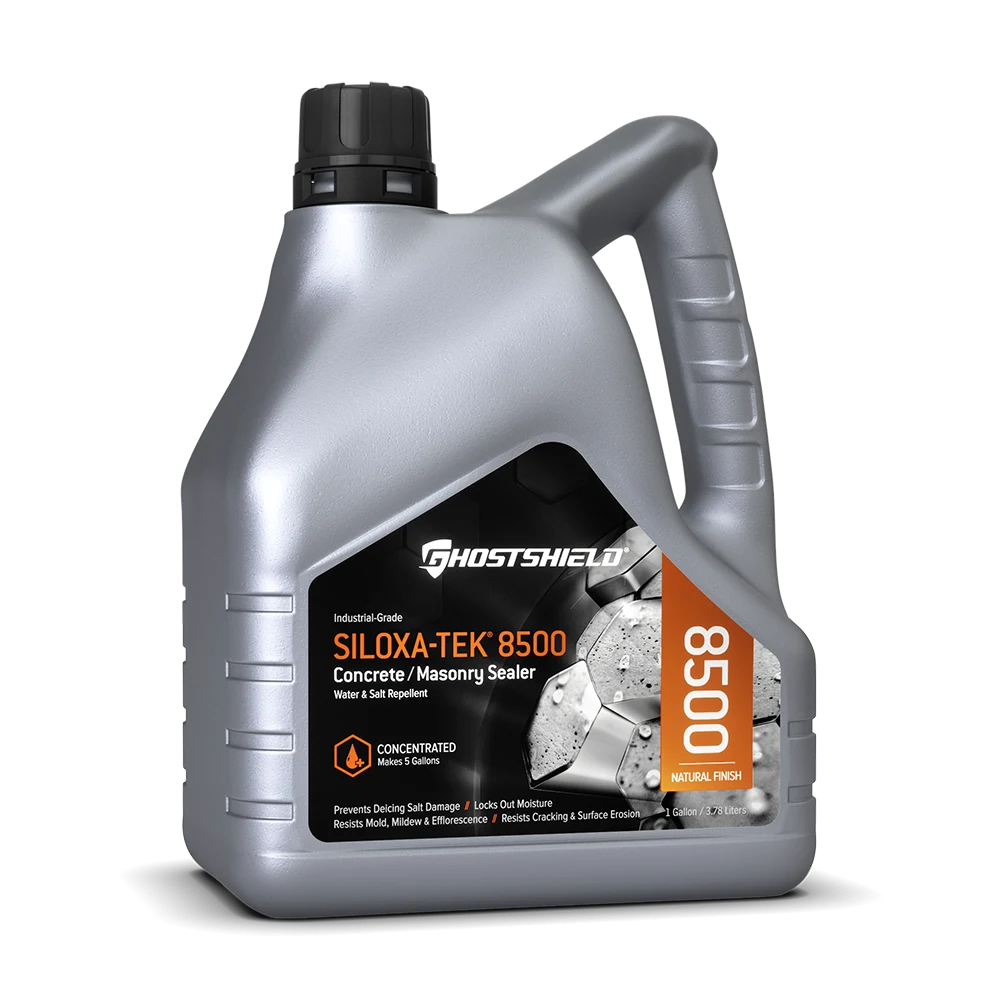
| Coverage | 150–400 sq ft / gal at 1 coat; 75–200 sq ft / gal at 2 coats |
|---|---|
| Sheens | None; dries invisible, no surface film |
| Dry / Recoat | Dry 4–6h at 70°F / 50% RH · foot and vehicle traffic 24h |
| Full cure | Full water repellency develops over 7 days |
| VOC | Water-based, low VOC; no state restrictions |
| Yellowing risk | None — no surface film to yellow |
| Primer | None; concrete must be cured 14–28 days and clean |
| Price tier | $$$ |
- 40 percent actives in a water-based silane/siloxane blend — the highest actives content of any water-based sealer a homeowner can buy off a big-box shelf
- Penetrates instead of filming, so it cannot peel, blush, or go slick when wet; the slab looks exactly like it did before you sealed it
- Beat every other pick on the chloride soak, which is the test that matters if your driveway sees road salt or a salted plow route
- Costs roughly three times per gallon what the budget penetrating pick costs, and it is not sitting on the shelf at every store
- Does nothing cosmetic. If you wanted the patio to look richer, this is the wrong bottle
- Two coats wet-on-wet is the honest spec on a porous slab, and that halves the coverage math people budget for
2. Armor AR350 Solvent Based Acrylic Wet Look Concrete Sealer
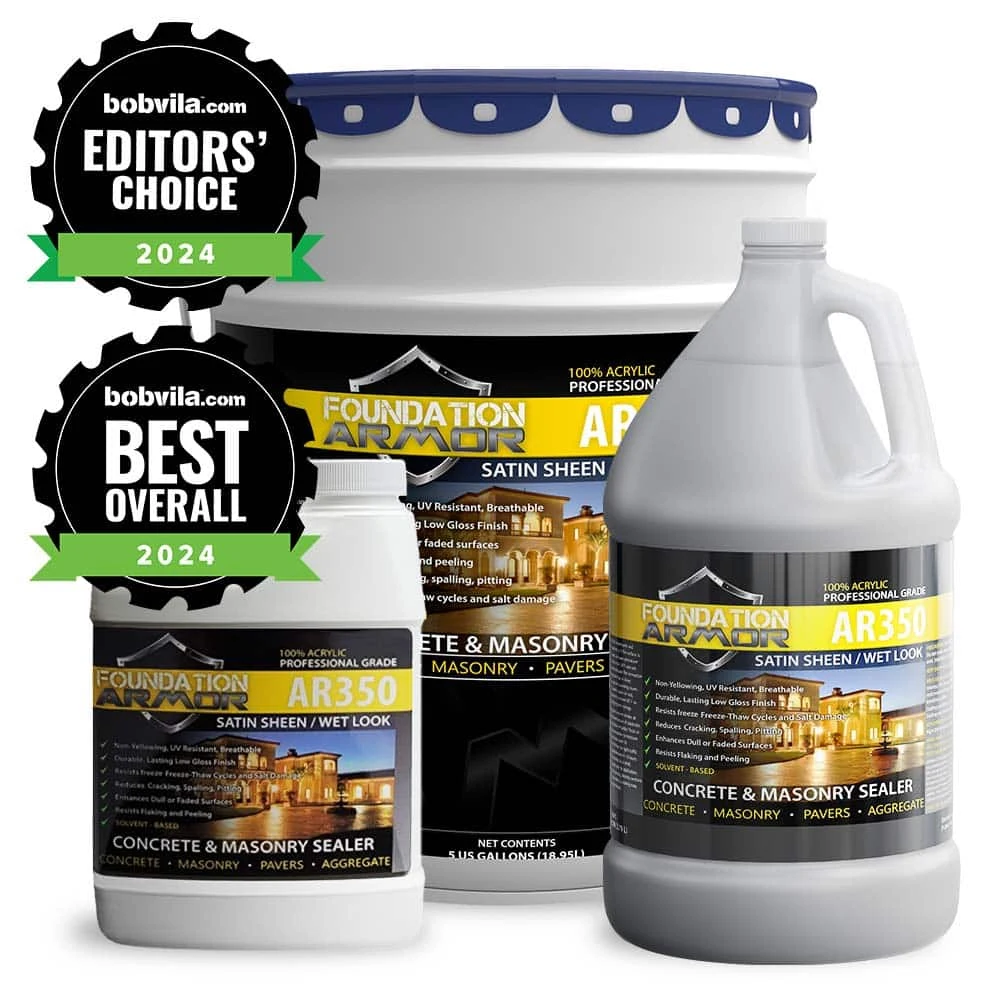
| Coverage | 175–225 sq ft / gal (two thin coats is the spec on most slabs) |
|---|---|
| Sheens | Low-gloss wet look |
| Dry / Recoat | Touch 1–4h · foot traffic 12h · vehicle 24–48h |
| Full cure | 1–3 years of service life before a maintenance recoat |
| VOC | 50 / 350 / 700 g/L versions; the 50 VOC ships to all 50 states |
| Yellowing risk | Low (pure acrylic); blush and whitening are the real film risks, not yellowing |
| Primer | None; clean, dry, profiled concrete |
| Price tier | $$ |
- Deepens color the way water does when it hits a dry slab — the strongest color enhancement in the round-up, and the only pick that does anything visual
- Sold in 50, 350, and 700 g/L VOC versions, so a California or Colorado buyer gets a legal can instead of a shipping refusal
- Repairable in place with xylene or the brand's blush repair; a whitened patch re-dissolves and re-levels instead of needing a strip
- Service life is 1–3 years, the shortest here. This is a recoat-forever product, not a seal-and-forget one
- Any trapped moisture under the film turns milky white, and on a slab over damp subgrade that happens the first humid week
- The wet-look sheen gets slippery under water; a pool deck or a north-facing walkway needs the non-slip additive mixed in
3. Siloxa-Tek 8510 Concrete Sealer
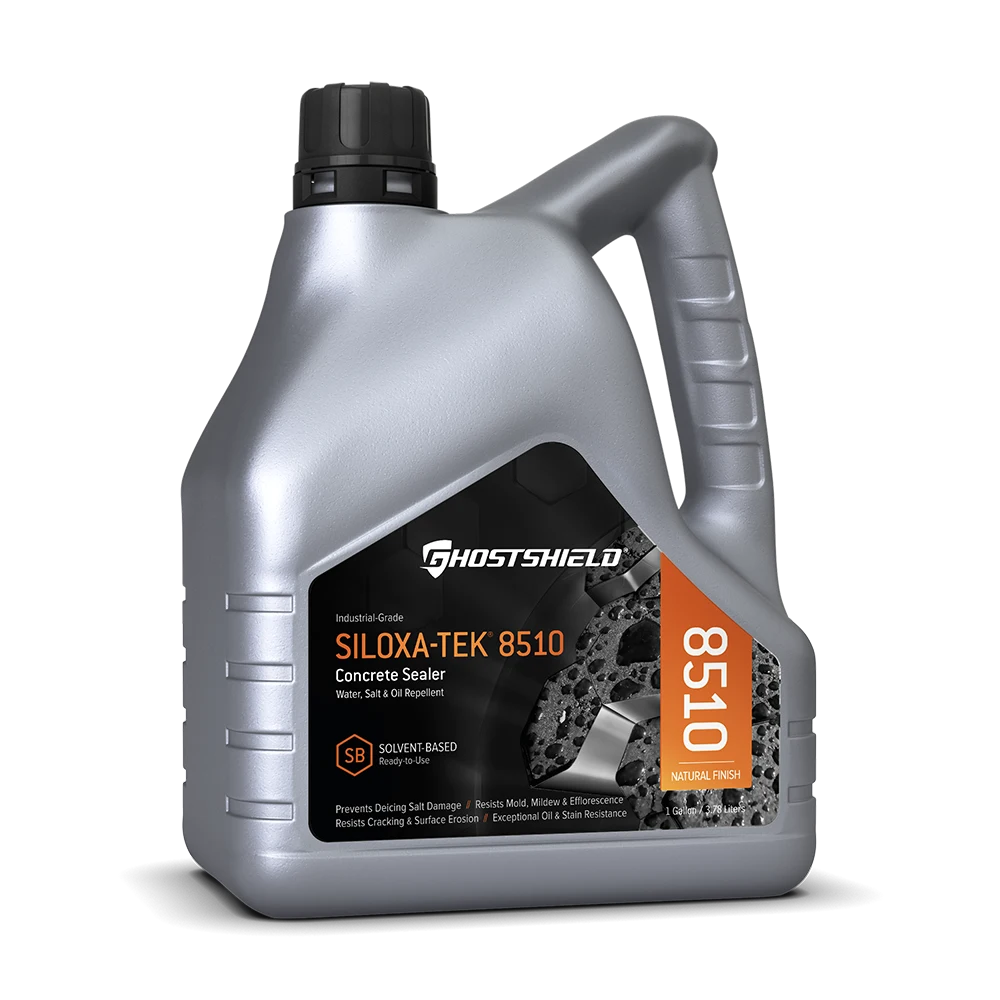
| Coverage | 150–400 sq ft / gal |
|---|---|
| Sheens | None; dries invisible, no surface film |
| Dry / Recoat | Dry 4–6h at 70°F / 50% RH · traffic 24h |
| Full cure | Repellency develops over 7 days |
| VOC | Solvent-based, 94% actives; xylene or mineral spirits cleanup |
| Yellowing risk | None — no surface film to yellow |
| Primer | None; degrease existing oil contamination first |
| Price tier | $$$$ |
- Oleophobic fluorocarbon chemistry on top of the silane/siloxane, so fresh motor oil sits up on the slab long enough to wipe instead of wicking into the pores
- 94 percent actives in a solvent carrier drives deeper into a hard-troweled garage slab than any water-based sealer in the group
- Still invisible when dry, so a garage floor gets stain resistance without the hot-tire and peeling problems a film coating brings
- The most expensive pick per gallon by a wide margin, and the 1-gallon size barely covers a single-car bay at two coats
- Solvent carrier means real fumes, xylene cleanup, and a respirator; this is not a windows-closed winter project
- Oil resistance is a head start, not a force field. Let a drip sit for a week and you still get a shadow
4. Natural Seal Penetrating Concrete Sealer
| Coverage | About 200 sq ft / gal, one coat on most surfaces |
|---|---|
| Sheens | None; natural dry look |
| Dry / Recoat | Touch 2–4h · foot traffic 4–6h · vehicle traffic 48h |
| Full cure | Repellency builds over about 7 days |
| VOC | <100 g/L |
| Yellowing risk | None — no surface film |
| Primer | None; clean, dry, cured concrete |
| Price tier | $ |
- About $31 a gallon for a real silane/siloxane hybrid — the cheapest honest penetrating sealer in US retail
- One coat, water-based, under 100 g/L VOC, no respirator, no state restrictions, cleans out of a pump sprayer with a hose
- Works on brick, block, mortar, and grout as well as slab concrete, so one jug covers a driveway and the front steps
- Lower actives than the Ghostshield picks; our beading test showed it fading by month 12 where 8500 was still tight at month 18
- Not for clay or terra cotta brick, polished stone, or asphalt, and the label is specific about that
- Vehicle traffic wants 48 hours, double what the top pick asks for
5. DRYLOK Extreme Masonry Waterproofer
| Coverage | 75–100 sq ft / gal depending on porosity |
|---|---|
| Sheens | Flat; bright white or tinted |
| Dry / Recoat | Touch 45 min · dry 2–3h · recoat 2h |
| Full cure | Wait 24h before backfilling a foundation wall |
| VOC | Latex base, low VOC |
| Yellowing risk | N/A — pigmented white or tinted |
| Primer | None; bare, unpainted, unsealed masonry |
| Price tier | $$ |
- Rated to stop water at 15 psi of hydrostatic pressure with a 15-year warranty, which no penetrating sealer in this round-up will even claim
- The right answer for below-grade block and poured foundation walls where water is pushing from the wet side
- Tintable, mildew-resistant, and it doubles as the finish surface in a utility basement
- Coverage is brutal at 75–100 sq ft per gallon, roughly a quarter of what the penetrating picks deliver
- Bare masonry only. It will not bond over previously painted or sealed walls, and that disqualifies a lot of older basements
- It is a coating, not a sealer in the trade sense; on a floor slab or a driveway it is the wrong product entirely
Eagle Etch and Clean Concrete Cleaner and Etcher
Sealers do not have a primer step. They have a cleaning step, and skipping it is the single most common reason a sealer job disappoints. A power-troweled slab is burnished nearly closed at the surface, so a penetrating sealer sits on top and evaporates instead of soaking in. An acidic etch-clean opens that surface and strips the film of dust, efflorescence, and lawn-chemical residue that a hose alone leaves behind. On a driveway, one gallon of concentrate treats several hundred square feet. Rinse it, let the slab dry a full 24 to 48 hours, then seal. If water still beads on the bare concrete after cleaning, the surface is not open and no sealer on this list will penetrate it.
BUY ON AMAZON