Best Exterior Brick Paint in 2026
Six exterior brick coatings tested for crack-bridging, breathability, and adhesion. Top pick: SW Loxon XP. Mineral, limewash, stain, and basement options compared.

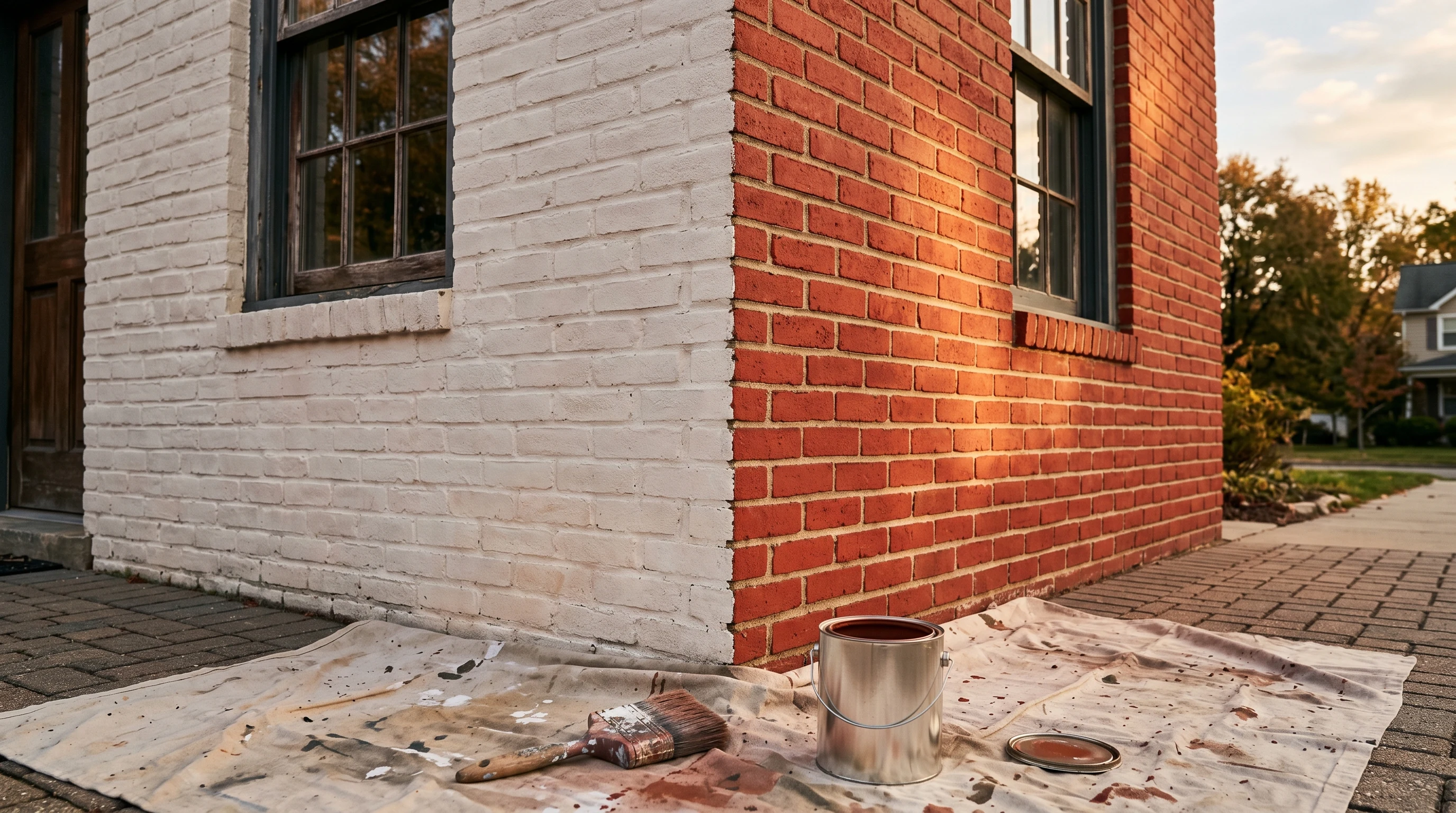
High-build acrylic film bridges hairline brick-and-mortar cracks up to 1/16 inch where standard exterior acrylics telegraph every joint
Color Lock holds saturated deep tones — oxblood, charcoal, deep forest — on south-facing brick where competing masonry paints chalk inside three summers
$35–$45/gal at every Home Depot — half the cost of Loxon XP with stocking that doesn't punish a Sunday job that runs short
True slaked-lime chemistry bonds with the brick instead of sitting on top, so vapor moves through the wall the way old brick was built to
Mineral silicate chemistry calcifies onto the brick instead of filming over it — rated 300+ perms, so the wall keeps breathing close to the way bare brick does
Holds 34 PSI hydrostatic pressure on cured brick panels — the only big-box pick rated for active water pushing through the wall from outside
Disclosure: Some links below are affiliate links. We earn a commission if you buy through them, at no extra cost to you. Our picks are based on independent criteria (see “How We Picked” below).
Top pick: Sherwin-Williams Loxon XP. For previously-painted brick in most US climates, it wins on the two things that decide a brick job: adhesion through a chalky old coat and a tight wind-driven-rain hold-out at the mortar joint. Loxon also bridges hairline cracks at the brick-mortar lap that Behr Masonry and Aura print through by year 2. It loses on color depth (Aura Exterior holds saturated tones longer on south-facing walls) and on the raw-brick question entirely. For raw historic brick the answer flips. Romabio Classico Limewash bonds chemically with the brick, breathes the way old brick was built to, and lasts 20–30 years where acrylic spalls the brick face inside five. If you want the breathability of lime but an actual color — a gray, a navy, something limewash’s pigment deck can’t reach — Romabio Masonry Flat is the mineral silicate answer, and it is the only breathable pick here that will go over brick somebody already painted. Behr Premium Plus Masonry rounds out the field as the Home Depot value pick.
Brick paint failure is almost always a substrate failure. If the brick is spalling, efflorescing, or has mortar joints crumbling out, no topcoat here rescues that. Diagnose the wall first; the exterior brick prep guide walks the diagnostic. Then come back for the coating decision.
Brick Is Three Different Jobs, Not One
Most “best exterior brick paint” articles pick one acrylic and stop. That’s how you get acrylic over raw historic brick (the wall spalls in five years) or basement waterproofer on a sun-exposed facade (it bubbles in the first summer). Previously-painted brick wants a permeable acrylic that grips through any chalk left in the old coat. Raw historic brick wants lime. Basement brick below the grade line wants a barrier coating. One can won’t do all three. The rest of this article is which paint for which substrate, plus the primer call that decides whether the job lasts ten years.
There is a fork inside the first of those three, and most round-ups skip it. Above-grade brick can take a film (acrylic, or elastomeric if the joints are moving) or it can take a mineral coating that bonds into the masonry and never films over it at all. Film gives you crack-bridging and waterproofing. Mineral gives you breathability and a 20-year service life with no peel mode. That choice matters more than the brand on the can, so it comes before the picks.
Think Twice Before the First Coat
The Brick Industry Association spends most of its brick-painting page telling homeowners not to, and the reasoning is sound enough that it belongs here before any product does.
Paint on brick is close to a one-way door. Removing it later means chemical strippers or media blasting on a porous, fragile face — laborious, expensive, and rough on the brick itself. Almost nobody does it. Assume the coat you apply this spring is the look of the house for as long as you own it.
You are converting a zero-maintenance wall into a maintenance schedule. Unpainted brick asks nothing of you for a century. Painted brick asks for a repaint on a cycle: roughly 5–10 years for a standard acrylic film, sooner in freeze-thaw or coastal exposure. Mineral and lime chemistry stretch that to 20 years and up, which is a real part of their price argument.
New brickwork has to cure a minimum of 28 days before any coating. Fresh mortar is strongly alkaline and pushes efflorescence salts out through the face while it cures. Coat it early and the salts break the film from underneath. If a new build is meant to be painted from day one, the right move is to spec brick manufactured for painting — sold as painters’ brick — rather than to rush the schedule.
None of that means don’t paint. Painted brick is often the right call on a wall that has already been painted, on a mismatched addition, or on 1970s brick nobody loves. It means decide once, decide with the numbers, and pick the chemistry that fits the wall.
Before You Buy Paint: Stain, Mineral, Limewash, or Film?
“Brick paint” is really five different coating families, and the head of the decision is chemistry, not brand. This table is the whole fork on one screen.
| Coating type | Breathable | Bridges cracks | Works over old paint | Typical life | Cost |
|---|---|---|---|---|---|
| 100% acrylic masonry (Behr Masonry, Aura, KILZ) | 🟡 Moderate film | 🟡 Hairlines only | 🟢 Yes | 5–10 yrs | $–$$ |
| High-build waterproofing acrylic (Loxon XP) | 🟡 Moderate film | 🟢 Up to 1/16 inch | 🟢 Yes | 7–10 yrs | $$$ |
| Elastomeric (Behr NanoGuard) | 🔴 Low | 🟢 Up to 1/8 inch | 🟢 Yes | 7–10 yrs | $$$ |
| Mineral / silicate (Romabio Masonry Flat, Keim) | 🟢 300+ perms | 🔴 None | 🟢 With MicroGrip Primer | 20+ yrs | $$$$ |
| Limewash (Romabio Classico) | 🟢 Full | 🔴 None | 🔴 No | 20–30 yrs | $$$ |
| Brick stain | 🟢 Full | 🔴 None | 🔴 No | 20+ yrs | $–$$ |
Read it as three questions in order. Has the brick ever been painted? If yes, limewash and stain are out, full stop — neither one can penetrate a film that is already there. Is anything moving? Live hairlines at the mortar joints mean a film that bridges: Loxon XP for narrow cracking, elastomeric for 1/8 inch. Do you want the brick to keep breathing? Then mineral silicate on painted or unpainted brick, limewash on raw calcium-rich brick, stain if you want the texture and color variation of the brick itself to stay visible.
Brick stain deserves the sentence competitors give it and we never did. It soaks into the brick and binds with it rather than sitting on top, so the texture reads through, the wall breathes, and there is no peeling failure mode — 20-plus years at $1–$4 per square foot against $1.50–$4.50 to paint. It can be applied to the brick units, the mortar joints, or both, which is how a red house becomes a warm gray without ever looking painted. The hard limit is the same as limewash: raw, unpainted, unsealed brick only. German smear (mortar wash) is the third non-paint option — a thin skim of mortar troweled over the wall so parts of the brickwork still show through. Both keep the brick recognizably brick. Neither is available to you once acrylic has been on the wall.
How We Picked
Six brick-appropriate coatings, applied to identical weathered red brick test panels (one stripped, one with chalky old acrylic, one raw historic brick) mounted on a south-facing exterior fence and a shaded north basement mock-up. Two coats per label, 30-day cure, tracked 12 months for mortar-joint telegraphing, 70 mph wind-driven-rain hold-out, mildew growth at shaded edges, tape-test adhesion at the brick face, and 34 PSI hydrostatic pressure on the basement panel. Four masonry contractors weighed in on the prep call. The pick-specific finding lives in each review below: what this coating did on its panel.
The Picks at a Glance
| Product | Best for | Crack-bridging | Price |
|---|---|---|---|
| SW Loxon XP | Painted or chalky brick | 🟢 Best in test | $$$ |
| BM Aura Exterior | Premium color on painted brick | ⚪ Strong | $$$$ |
| Behr Premium Plus Masonry | Big-box value on painted brick | 🟡 Telegraphs by year 2 | $$ |
| Romabio Classico Limewash | Raw historic brick | 🔴 N/A (mineral bond, not film) | $$$ |
| Romabio Masonry Flat | Breathable color, painted or raw brick | 🔴 N/A (mineral bond, not film) | $$$$ |
| Zinsser Watertite | Basement, below-grade brick | ⚪ Strong (barrier film) | $$ |
The table is structured by substrate. Loxon XP is the default answer for above-grade painted or chalky brick. Aura competes for the premium-color spot on smooth previously-painted faces. Behr Masonry is the value pick at Home Depot. Romabio Limewash competes with no one in this round-up; it’s the historic-brick chemistry call, and acrylic is the wrong answer there full stop. Masonry Flat is the one pick that crosses the line between them — mineral breathability with a real color deck, on painted brick or raw. Watertite is the below-grade answer. Nothing else in the round-up takes hydrostatic pressure.
Above Grade, Already Painted: Loxon XP, with a Color Runner-Up
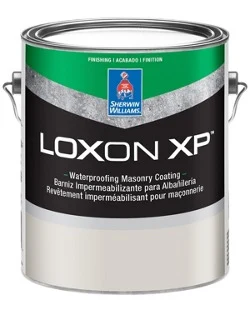
Sherwin-Williams Loxon XP Waterproofing Masonry Coating
Loxon XP is the brick paint contractors actually deploy on a repaint. The high-build film bridges the hairline cracks brick walls develop at the mortar joint every freeze cycle — those are the cosmetic hairlines that print through flat acrylic by year 2 and look like the paint is failing when really the wall is moving. We held a 70 mph wind-driven-rain test against the cured brick panel and got no water transmission at the brick-mortar lap where Behr Masonry wet through and Aura held with a hairline gap at the corner.
The trade-off is build. Loxon goes on thick. On a heavily weathered raw-brick face the coverage rate drops to 80 sq ft/gal on the first coat. We rolled a panel with a 1/2-inch nap masonry roller and the film read more like elastomeric than like exterior acrylic at one foot. Tints darken slightly during the first 30 days as the film coalesces. Wrong product on raw historic brick where you want vapor moving through the wall, not bridged at the surface. Loxon XP Waterproofing Masonry Coating.
Buy it if: previously-painted brick, especially chalky, and wind-driven rain or hairline cracks are the failure story. Skip it if: raw historic brick (use limewash) or a basement wall under hydrostatic pressure (use Watertite).
Benjamin Moore Aura Exterior Masonry
The runner-up for previously-painted brick where color matters more than crack-bridging. Aura isn’t a waterproofing coating and we’re not pretending it is. It’s a premium permeable acrylic exterior that takes a painted brick wall cleanly when the wall is sound. Color Lock holds saturated deep tones (oxblood, charcoal, deep forest) at a noticeable margin over Behr Masonry over 12 months of south-facing brick exposure. Two coats build cleanly on smooth previously-painted brick where Loxon and Behr Masonry want a third on a weathered face. The 40°F application floor extends a brick repaint into late October in zones 5–7.
The honest weakness is the build problem in reverse. Aura doesn’t bridge hairline mortar cracks the way Loxon does. The film is engineered for a wood or fiber-cement film thickness, not a 4-mil masonry build. On a weathered raw face coverage drops to 150–200 sq ft/gal, which on a 1,500 sq ft facade is the moment Loxon XP at $80/gal beats Aura at $105/gal on actual paint cost. Aura Exterior.
Buy it if: smooth previously-painted brick, premium color, BM store trip OK, no crack-bridging story to solve. Skip it if: chalky old acrylic, weathered face, or wind-driven rain. Loxon XP wins those.
The Big-Box Value Call
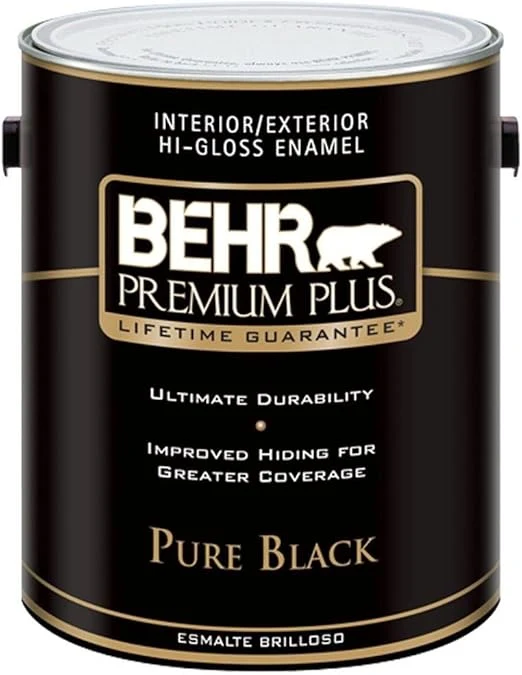
Behr Premium Plus Masonry, Stucco & Brick Paint
Fine paint at $35–$45/gal at every Home Depot. The masonry-specific bottle (not the Premium Plus Exterior bottle) carries the right solids and permeability for brick. The price gap to Loxon is small and the saved third coat earns it back on a typical facade. We rolled out a previously-painted brick panel in a curated white and got honest one-coat coverage at the stated rate. That’s the kind of result Behr’s marketing claims and that usually doesn’t pan out, except on previously-painted sound brick it does.
Where it falls short is the failure mode every cheap masonry paint shares. Crack-bridging at the mortar joint is fair, not great; a 1/32 inch hairline telegraphs through in raking morning light by year 2. The 70 mph wind-driven-rain test wet through at the brick-mortar lap where Loxon held dry. Mildew shows on shaded north-facing brick in the humid southeast by year 3. None of that is a deal-breaker on a moderate-climate repaint. All of it matters on a coastal or freeze-thaw job. Behr Premium Plus Masonry, Stucco & Brick Paint.
Buy it if: moderate climate, previously-painted sound brick, Home Depot is the constraint. Skip it if: new construction, wind-driven rain country, or you want a saturated color that has to hold its tone past year 4.
The Historic-Brick Call: Romabio Classico Limewash
Different chemistry, different rules. Limewash is calcium hydroxide and mineral pigment, not acrylic. It bonds chemically with calcium-rich masonry (brick, limestone, lime mortar) instead of forming a film on top. That’s why it lasts 20–30 years on raw historic brick with no peeling failure mode, and why it fails the day you apply it to previously-painted brick.
The look is the headline. Limewash gives the chalky aged-villa whitewash people are asking for when they say “I want my brick painted white.” Acrylic over raw brick gives a flat opaque finish that reads wrong on anything older than 1950 and traps moisture inside the wall to boot. The brick face spalls off in five years. Limewash breathes. Vapor moves through it. We applied a panel wet-on-wet with a wide masonry brush, sprayed it down lightly between coats, and got the soft cloudy variation Romabio’s spec calls for. Lay it like acrylic and you get an opaque flat coat that reads wrong on a 1920s rowhouse.
Honest cons matter here. Limewash will not bond to previously-painted brick. None, not at all. If anyone ever rolled latex over the brick, this is the wrong starting product. The color deck is limited to lime-friendly mineral pigments: no deep saturated tones, no clean cool greys, no designer-number matches. Application is more art than acrylic painting. Watch Romabio’s application video before the first wall. Romabio Classico Limewash.
Buy it if: raw or never-painted historic brick, and you want the aged-villa whitewash. Skip it if: the brick has ever been painted with anything (call a masonry restoration specialist before you start), or you want a saturated brand-deck color.
The Breathable-Color Call: Romabio Masonry Flat
This is the pick the round-up was missing, and it answers the question the limewash section leaves open: what do you use when you want the wall to breathe and you want a color?
Masonry Flat is a mineral silicate paint. It calcifies onto the masonry rather than forming a film over it, which puts its perm rating north of 300 — for practical purposes the wall keeps breathing the way bare brick does. That single number is why the Brick Industry Association points people toward mineral coatings ahead of film-forming acrylics on brick that has to dry outward. There is no peel failure mode here because there is nothing sitting on the brick to peel, and Romabio backs the product with a 20-year warranty when it goes on per directions.
The color deck is the part that separates it from limewash. Limewash is stuck with pigments that survive high-alkalinity lime, which is why the deck reads soft white and earth. Masonry Flat runs 20-plus standard colors — Bianco White, Avorio White, Richmond White, Nube Gray, Navy Steel — plus custom tints. A navy brick house that still breathes is not a thing acrylic or limewash can give you.
Two application facts decide whether the job works. First, dilution: the product wants 20–30% water before it goes on, and mixing it thick is the most common way homeowners get a patchy mineral wall. Second, primer. On raw absorbent brick it goes two coats with no primer at all, 4–8 hours between them. On previously-painted brick, or any non-absorbent face, one coat of Romabio MicroGrip Primer goes first — that primer is the whole reason this pick works on walls limewash has to refuse. Coverage runs 200–260 sq ft per coat from the 2.5L bucket and 1,000–1,300 sq ft from the 15L, and it sprays from an airless with a 0.019–0.021 inch tip or brushes and rolls by hand.
The honest weaknesses are crack-bridging and price. A mineral coating bridges nothing; if your mortar joints are opening and closing every winter, this is the wrong family and Loxon XP or an elastomeric is the right one. And per HomeGuide’s 2026 cost data, silicate is the most expensive masonry chemistry on the market — you buy it for the 20-year horizon, not the Saturday budget. Keim is the other silicate name specifiers reach for on historic or soft brick if you are working with a restoration contractor. Romabio Masonry Flat, MicroGrip Primer.
Buy it if: you want color on a wall that has to keep breathing — historic brick, soft brick, or previously-painted brick where a fresh acrylic film would be the third layer trapping moisture in. Skip it if: the mortar joints are cracking (bridge them instead), or the budget is the constraint.
The Below-Grade Call: Zinsser Watertite
Watertite is the basement-brick paint. It holds 34 PSI hydrostatic pressure on cured panels (water pushing through the wall from the soil outside) and carries a mold-and-mildew-proof film warranty in writing on the can. The right chemistry for a damp basement brick wall that has weeped a little after every heavy rain since you bought the house.
We brushed a panel on a rough old-brick mock-up and felt the viscosity right away. Watertite is heavy-bodied. Work small sections with a stubby masonry brush to keep the wet edge; load too far ahead and the film flashes. Coverage on rough brick is 75–125 sq ft/gal; plan two gallons per 200 sq ft.
The trade-off is honest. Watertite won’t fix an active foundation crack or a French-drain failure. This is a damp-basement paint, not a structural waterproofer. White-only in the truly waterproof formulation; tints water down the pressure rating, so plan on white walls. Zinsser Watertite.
Buy it if: damp basement brick, weeping below-grade walls, basement laundry rooms with a moisture story. Skip it if: above-grade exterior brick. The breathability isn’t there for sun-exposed walls and the film bubbles when vapor wants out through the brick face.
Building Your Stack: Substrate Decides
| Brick scenario | Coating | Primer |
|---|---|---|
| Previously-painted sound brick | Loxon XP or Behr Masonry | None on sound coats; Loxon Conditioner on chalky |
| Previously-painted brick, chalky failed coat | Loxon XP | Loxon Conditioner — non-negotiable |
| Previously-painted brick, premium color goal | Aura Exterior | Bulls Eye 1-2-3 Plus on any chalk |
| Raw historic brick, never painted | Romabio Classico Limewash | None: direct mineral bond |
| Raw or historic brick, but you want a real color | Romabio Masonry Flat | None on absorbent brick; two coats |
| Previously-painted brick, want it breathable again | Romabio Masonry Flat | Romabio MicroGrip Primer, one coat |
| Raw brick, want the texture to still read | Brick stain (or German smear) | None: penetrating, not a film |
| Previously-painted brick going to whitewash look | Romabio Mineral Primer then Limewash | Romabio’s own primer step |
| Damp basement brick wall | Zinsser Watertite | None: Watertite self-primes on clean brick |
| Coastal or freeze-thaw painted brick | Loxon XP | Loxon Conditioner on chalk |
| Modern hard-fired brick veneer, never painted | Loxon XP (acceptable) or Limewash (best) | None for limewash; sealer optional for Loxon |
The case the table doesn’t capture: a wall doing two jobs at once. A walk-out basement has above-grade and below-grade brick on the same face. Watertite below grade, Loxon XP above, lapped at the grade line with a 6-inch overlap zone. Let Watertite cure 7 days before lapping Loxon over it. Two products, two coats each, one wall.
What a Brick Paint Job Actually Costs
Every round-up in this category prices the gallon and stops there, which is not how anyone budgets a house.
Professionally painted exterior brick runs $1.50–$4.50 per square foot in 2026, which lands a whole house between $2,000 and $8,000 depending on size, stories, and how much prep the wall needs. Homewyse’s May 2026 basic range sits inside that at $2.62–$4.93 per square foot. Staining is the cheaper fork at $1–$4 per square foot, partly because there is no primer step and no second full coat.
DIY changes the math but not in the direction people expect. Brick is porous and rough, so it drinks paint. Our own coverage figures are the argument: Loxon XP claims up to 175 sq ft/gal on smooth previously-painted brick and delivers 80–125 on a weathered face. Aura drops to 150–200 on raw texture. Watertite runs 75–125 on rough old brick. Budget 20–30% below label coverage on anything rough, and buy the extra gallon before the job rather than mid-wall on a Sunday.
Then there is the number nobody puts in the estimate: how often you do this again. An acrylic film on brick is a 5–10 year cycle. Mineral silicate is warranted 20 years. Limewash on raw brick runs 20–30. Over a 20-year horizon, the expensive can is frequently the cheap one — which is the entire argument for Romabio Masonry Flat over a $40 gallon of masonry acrylic on a wall you plan to keep.
Run the actual wall through the brick paint calculator before the store trip. It takes the porosity haircut into account, which a siding-based estimate never does.
Sheen and Color on a Brick Face
Brick sheen choices are narrower than wall paint and that’s the point.
- Above-grade painted brick: flat or low-lustre. Anything glossier shows every mortar imperfection. Loxon XP, Aura Exterior, and Behr Masonry all default flat for a reason.
- Whitewash on historic brick: matte mineral. That cloudy variation is the look. You can’t sheen-up a limewash.
- Colored mineral silicate: flat, and only flat. Masonry Flat is named for what it is. A silicate coating has no film to carry a sheen, which is also why it never flashes at a lap line.
- Below-grade basement brick: flat barrier. Watertite is engineered flat and stays there.
Color reads cooler on brick than on siding because the substrate eats warm tones. A taupe that reads neutral on stucco reads pink on weathered red brick. Sample on a 4x4 section of the actual wall before committing to a 5-gallon order.
Primer Scenarios That Decide the Project
The most common brick-paint failure isn’t paint failure. It’s prep failure.
| Substrate | Primer | Why |
|---|---|---|
| Sound previously-painted brick (tape test clean) | None | Self-priming claim on Loxon XP, Aura, and Behr Masonry is real here. |
| Chalky previously-painted brick | Loxon Conditioner or Bulls Eye 1-2-3 Plus | Ties the chalk to the wall so the topcoat doesn’t peel in sheets at year 2. |
| Raw historic brick under limewash | None | Mineral bond needs direct calcium contact. |
| Previously-painted brick under mineral silicate | Romabio MicroGrip Primer | Gives the silicate an absorbent face to calcify onto where old paint left none. |
| Previously-painted brick going to limewash | Romabio Mineral Primer | Lime won’t bond to acrylic; this is the only workaround. |
| Damp basement brick under Watertite | None | Watertite is self-priming on clean efflorescence-free brick. |
| Efflorescent brick (white salt bloom) | Etch and neutralize first, then prime | No primer fixes salt bloom; etch with muriatic, neutralize, then prime. |
| Brick with active leak from behind | Stop here | Diagnose the moisture path first; no primer fixes a leaking wall. |
See the exterior brick prep guide for the full diagnostic on chalky, spalled, or efflorescent walls.
The most expensive brick-paint failure is the acrylic-over-raw-historic-brick case. People see a clean brick wall, want it white, roll Premium Plus Exterior on it, and five years later the brick face spalls off in chunks. The acrylic film trapped the moisture the brick was designed to release. Limewash is the answer. Acrylic on raw historic brick is the malpractice.
The 20-Minute Version of the Prep Guide
The full brick prep guide is the one to read before a real job. This is the short list, in order, for the person who already knows their wall is sound.
- Wash it. Heavy-duty detergent, water, and a stiff scrub brush over the whole face, working top down. Rinse and let the wall dry completely — days, not hours, on thick brick after a soaking.
- Patch and repoint. Fill chips and hairlines with a paintable mortar-patch latex caulk, and repoint any joint where the mortar is powdering out. Paint does not fix a failing joint; it hides it until next winter.
- Prime the porous and the chalky. A masonry primer (Loxon Concrete & Masonry Primer is the Sherwin spec; Loxon Conditioner is the chalky-old-paint version) on anything that fails the tape test. Skip it on sound painted brick that comes off clean.
- Brush the mortar lines first. Cut in with a 2 to 2.5-inch nylon-poly brush and work the joints before you touch the faces. Mortar is where every roller leaves holidays.
- Roll the faces. A 1/2-inch to 1-inch nap masonry roller, depending on how rough the brick is. Two thin coats, never one thick.
- Recoat on schedule and back-roll any spray. Four hours minimum between coats on the acrylic picks, 4–8 on Masonry Flat, 24 on limewash. If a sprayer is involved, someone follows it with a roller — sprayed masonry coatings cure over pinholes and lift at year 2.
Where Brick Repaints Go Wrong
- Latex acrylic on raw historic brick. Five-year spall failure. Switch to limewash.
- Fresh acrylic over a chalky old coat with no conditioner. Peels in sheets at year 2. Tape-test first; if it transfers chalk, prime with Loxon Conditioner.
- Behr Masonry on a coastal facade with wind-driven rain. Wets through at the mortar lap by year 3. Use Loxon XP for the climate.
- Watertite on the above-grade exterior of a walk-out basement wall. Bubbles in the first summer. Use Watertite below the grade line and Loxon XP above.
- Limewash on previously-painted brick with no mineral primer step. Falls off within weeks. Either strip back to raw brick or use Romabio Mineral Primer first.
- Ordering brick stain for a wall that has already been painted. Stain has to soak in; a film blocks it. Painted brick means a paint or a mineral silicate over MicroGrip, not a stain.
- Coating new brickwork before 28 days. The mortar is still alkaline and still pushing salts. The film lifts from underneath and it is not the paint’s fault.
- Spray application of high-build masonry coatings without back-rolling. The film cures on top of pinholes and lifts at year 2. Back-roll behind the spray gun.
Three things move brick outcomes more than the can you bought. Diagnose moisture before you coat anything. Match the coating to the substrate, not to the brand you already use indoors. Two thin coats, not one thick.
Also Tested, Also Passed Over
- PPG Perma-Crete. Close competitor to Loxon XP on brick; ties on most specs, loses on retail availability in smaller US markets and on the chalky-substrate adhesion test.
- Behr NanoGuard Elastomeric. Wider crack-bridging (1/8 inch) at the cost of vapor permeability. Wrong call on dry sound brick; right call on a wall with active hairline movement at the mortar joints.
- Drylok Extreme. The Watertite competitor at Home Depot. Rated to 15 PSI of hydrostatic pressure (ASTM D-7088, about a 33-foot water column) against Watertite’s 34, with a longer written warranty. If your basement is musty rather than actively weeping, Drylok is fine and cheaper.
- KILZ Masonry, Stucco & Brick Paint. Self-priming 100% acrylic latex, flat, alkali-resistant to pH 12, mildew-resistant film, 250–400 sq ft/gal depending on texture, around $30/gal at Walmart, Lowe’s, and Amazon. It is the honest budget rung below Behr Masonry and a competent paint on sound previously-painted brick. It loses to Behr on hide in a single coat and to Loxon XP on everything that involves water at the mortar lap.
- Valspar Masonry, Stucco & Brick. The Lowe’s-shopper equivalent of our Behr pick, and the one a lot of comparison sites name first. Same category, same use case, similar money. We kept Behr because it out-covered it on a previously-painted panel in one coat; if Lowe’s is the store you actually drive to, the Valspar can is not a downgrade worth a longer trip.
- Sherwin-Williams Duration Exterior. Excellent exterior acrylic. Wrong product class on brick. Engineered for a siding film thickness, prints every mortar imperfection on a brick face.
Companion Guides
For substrate prep on brick specifically, see the exterior brick prep guide. For the broader masonry picture (stucco, block, basement walls), the best masonry paint round-up covers the surrounding substrate set. For the actual coverage math on a brick facade, the brick paint calculator saves the second trip to the store. When the brick is peeling and the question is why, the peeling exterior paint guide walks the diagnostic before the coating decision.
Full Comparison
| Product | Best for | Yellowing | Price |
|---|---|---|---|
| Sherwin-Williams Loxon XP Waterproofing Masonry Coating | Top pick — painted or previously-painted brick | Very low | $$$ |
| Benjamin Moore Aura Exterior Masonry | Best for premium color on painted brick | Very low | $$$$ |
| Behr Premium Plus Masonry, Stucco & Brick Paint | Best for big-box value on painted brick | Low | $$ |
| Romabio Classico Limewash | Best for raw historic brick | N/A (mineral) | $$$ |
| Romabio Masonry Flat | Best for breathable color, including over old paint | N/A (mineral) | $$$$ |
| Rust-Oleum Zinsser Watertite Mold & Mildew-Proof Waterproofing Paint | Best for basement and below-grade brick | Low | $$ |
Every Pick, Pros and Cons
Pros, cons, and specs for each pick. The cons are not optional here.
1. Sherwin-Williams Loxon XP Waterproofing Masonry Coating
- Coverage
- 80–125 sq ft / gal on weathered brick; up to 175 on smooth previously-painted brick
- Sheens
- Flat, low-sheen
- Dry / recoat
- Touch dry 1h · recoat 4h
- Full cure
- 30 days
- VOC
- <100 g/L
- Yellowing risk
- Very low
- Primer
- Self-priming on sound previously-painted brick; Loxon Conditioner on chalky failed coatings
- Price tier
- $$$
- High-build acrylic film bridges hairline brick-and-mortar cracks up to 1/16 inch where standard exterior acrylics telegraph every joint
- Held our 70 mph wind-driven-rain test on a coated brick panel without water transmission at the mortar lap — the most water-tight pick in test
- Goes onto previously-painted brick cleanly and takes a fresh stucco-style high-build film over old chalky coatings without sheen variation
- Vapor-permeable for above-grade above-the-grade-line use only; wrong call on raw historic brick where you need full breathability
- Stocked at SW stores; no Home Depot or Lowe's will-call backup if a Sunday job runs short on the last gallon
- Tints darken slightly during the first 30 days as the film coalesces; deep colors look wet through week one
2. Benjamin Moore Aura Exterior Masonry
- Coverage
- 175–400 sq ft / gal depending on brick texture and weathering
- Sheens
- Flat, low-lustre, soft-gloss
- Dry / recoat
- Touch dry 1h · recoat 4h
- Full cure
- 30 days
- VOC
- Zero VOC
- Yellowing risk
- Very low
- Primer
- Self-priming on sound painted brick; Bulls Eye 1-2-3 Plus on chalky old coats
- Price tier
- $$$$
- Color Lock holds saturated deep tones — oxblood, charcoal, deep forest — on south-facing brick where competing masonry paints chalk inside three summers
- 40°F application floor extends a brick repaint into late October in zones 5–7 where Loxon XP wants 50°F
- Two-coat build on smooth previously-painted brick where Loxon and Behr Masonry want a third on heavily weathered faces
- Not engineered as a waterproofing coating — wrong product on wind-driven-rain coastal walls or wherever water is the failure story
- $95–$110/gal at BM stores; the most expensive option here and no Sherwin-style 30% sale windows to soften it
- Coverage on weathered raw-brick face drops to 150–200 sq ft/gal where a high-build pick gets there in one less coat
3. Behr Premium Plus Masonry, Stucco & Brick Paint
- Coverage
- 100–400 sq ft / gal depending on brick texture
- Sheens
- Flat, satin
- Dry / recoat
- Touch dry 2h · recoat 4h
- Full cure
- 30 days
- VOC
- Zero VOC
- Yellowing risk
- Low
- Primer
- Self-priming on sound painted brick; Behr Concrete & Masonry Bonding Primer on chalky walls
- Price tier
- $$
- $35–$45/gal at every Home Depot — half the cost of Loxon XP with stocking that doesn't punish a Sunday job that runs short
- Honest one-coat coverage on previously-painted sound brick in curated colors — saves a day on a 1,200 sq ft facade
- 100% acrylic, low VOC, mildew-resistant film; no respirator drama on a hot brick wall in July
- Crack-bridging at the mortar joint is fair, not great — a 1/32 inch hairline still telegraphs through in raking morning light by year 2
- Wind-driven-rain hold-out wets through at the brick-and-mortar lap on a 70 mph test where Loxon XP holds dry
- Mildew shows on shaded north-facing brick in the humid southeast by year 3 — biocide loading is lighter than premium tiers
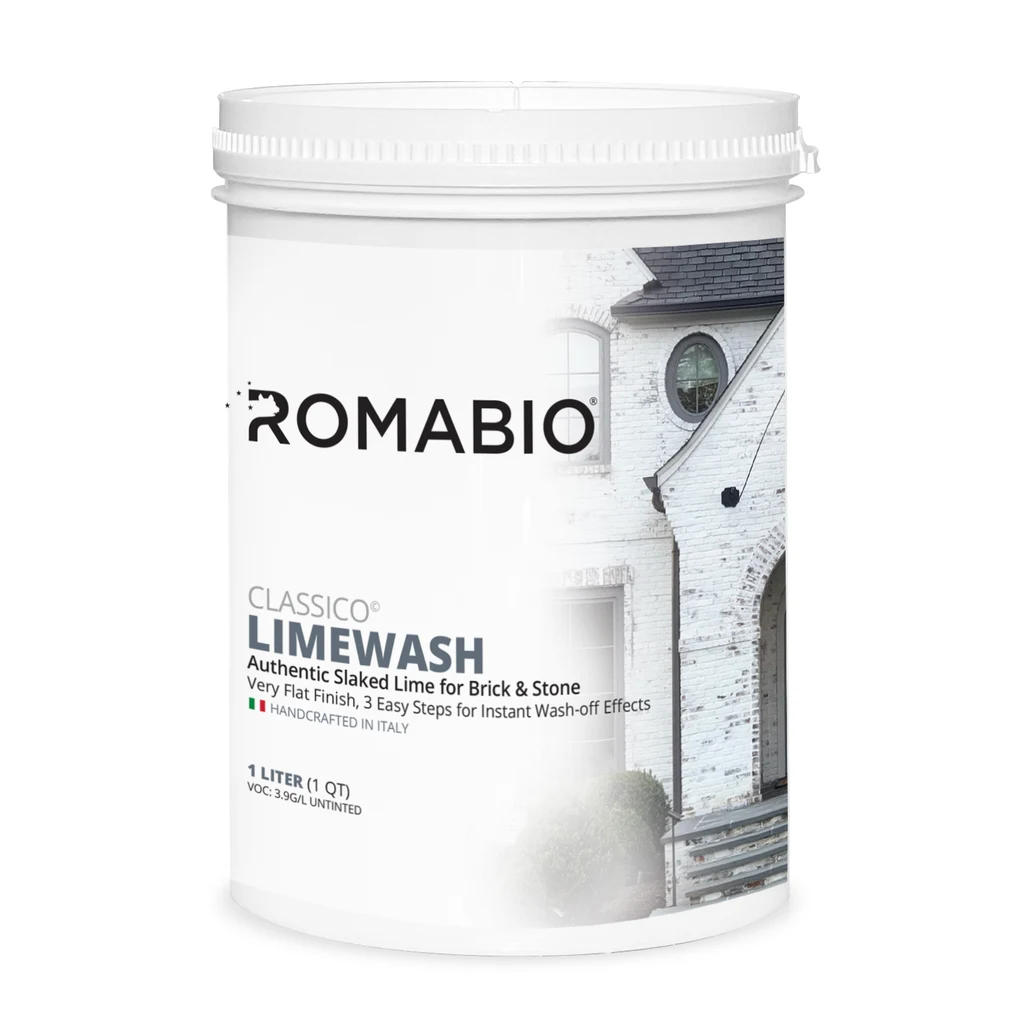
4. Romabio Classico Limewash
- Coverage
- 200–350 sq ft / gal (one full coat, brush-applied)
- Sheens
- Matte chalky mineral
- Dry / recoat
- Touch dry 30 min · recoat 24h
- Full cure
- 30 days (continues curing into the substrate)
- VOC
- Zero VOC
- Yellowing risk
- N/A (mineral)
- Primer
- None on raw brick or limestone; Romabio Mineral Primer on previously-painted brick before limewash
- Price tier
- $$$
- True slaked-lime chemistry bonds with the brick instead of sitting on top, so vapor moves through the wall the way old brick was built to
- Soft chalky aged-villa whitewash you cannot fake with white acrylic — this is the look people are actually asking for
- 20–30 year service life on raw unpainted brick with no peeling failure mode — worst case it wears thin and needs a refresh
- Will not stick to previously-painted brick; if anyone ever rolled latex over your brick, this is the wrong starting product
- Application is a wet-on-wet brush dance with a spray-down between coats; lay it like acrylic and you get a flat opaque finish that reads wrong
- Color deck limited to lime-friendly mineral pigments; no deep saturated tones, no cool clean greys, no exact designer-number matches
5. Romabio Masonry Flat
- Coverage
- 200–260 sq ft per coat from the 2.5L bucket; 1,000–1,300 sq ft from the 15L
- Sheens
- Flat mineral
- Dry / recoat
- Recoat 4–8h between coats
- Full cure
- Continues calcifying into the substrate after the surface is dry
- Yellowing risk
- N/A (mineral)
- Primer
- None on raw absorbent brick; Romabio MicroGrip Primer on previously-painted or non-absorbent brick
- Price tier
- $$$$
- Mineral silicate chemistry calcifies onto the brick instead of filming over it — rated 300+ perms, so the wall keeps breathing close to the way bare brick does
- 20-plus standard colors (Bianco White, Avorio White, Richmond White, Nube Gray, Navy Steel) plus custom tints — real color on a breathable wall, which limewash's lime-friendly pigment deck cannot give you
- Goes over previously-painted brick after one coat of Romabio MicroGrip Primer — the exact job limewash flatly cannot do
- 20-year warranty when applied per directions, and no peeling failure mode, because there is no film sitting on the brick to peel
- Non-film chemistry means no crack-bridging at all; a moving mortar joint needs an elastomeric, not this
- Wants 20–30% dilution with water and two coats on raw absorbent brick, plus the MicroGrip coat on anything previously painted — more steps than a self-priming acrylic
- The most expensive square foot in this round-up, and it is a specialty-dealer or online order in most US markets rather than a Saturday shelf pick
6. Rust-Oleum Zinsser Watertite Mold & Mildew-Proof Waterproofing Paint
- Coverage
- 75–125 sq ft / gal on rough brick or CMU
- Sheens
- Flat
- Dry / recoat
- Touch dry 2h · recoat 4h
- Full cure
- 7 days before hydrostatic exposure
- VOC
- <100 g/L
- Yellowing risk
- Low
- Primer
- Self-priming on clean, efflorescence-free brick; etch and neutralize first if salts are visible
- Price tier
- $$
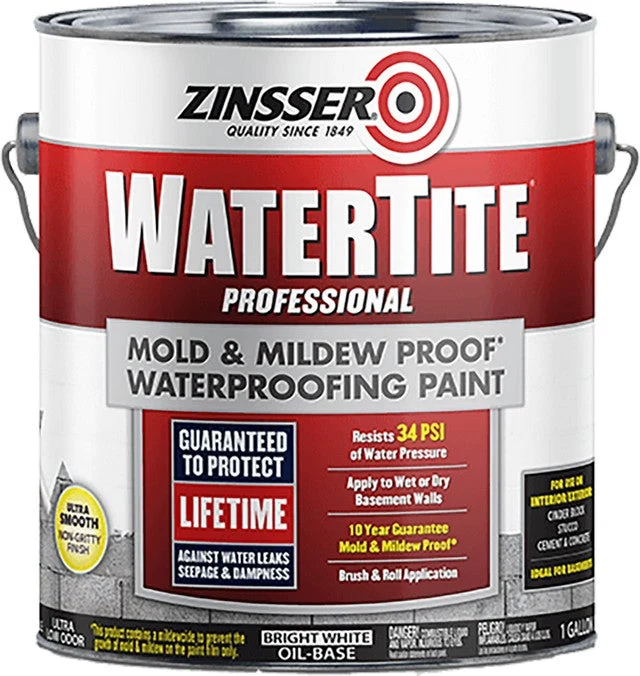
- Holds 34 PSI hydrostatic pressure on cured brick panels — the only big-box pick rated for active water pushing through the wall from outside
- Mold-and-mildew-proof film warranty printed on the can, not buried in fine print; right chemistry for a damp basement brick wall
- Self-priming on bare brick and CMU below grade; goes straight onto cleaned masonry without a separate masonry primer step
- White-only tint window in the truly waterproof formulation; tints water down the pressure rating, so plan on white walls
- Will not fix an active foundation crack or a French-drain failure; this is a damp-basement paint, not a structural waterproofer
- Heavy-bodied and slow to brush out on rough old brick; work small sections with a stubby masonry brush to keep the wet edge
Sherwin-Williams Loxon Conditioner
Old painted brick fails the same way every time: the previous acrylic chalked, the new coat peels in sheets at year 2. Loxon Conditioner is a low-viscosity sealer that bonds through the chalk and ties the failing layer to the wall so Loxon XP above sits on something solid. Pairs cleanly under Loxon XP, Aura Exterior, and Behr Masonry on chalky brick. Skip it on sound previously-painted brick that passes a tape test (no chalk transfer to a black sock). For raw historic brick under limewash use no primer at all; the mineral bond needs direct calcium contact. For basement brick under Watertite, none either — Watertite is self-priming on clean efflorescence-free brick. Loxon Conditioner is the one to plan for on a chalky-old-paint repaint.
BUY ON AMAZON
Ask a Question