Best Basement Waterproofing Paint
Six basement waterproofing paints tested on block and poured-concrete panels for seepage, vapor, and efflorescence. Top pick: DRYLOK Extreme Concrete & Masonry Waterproofer.

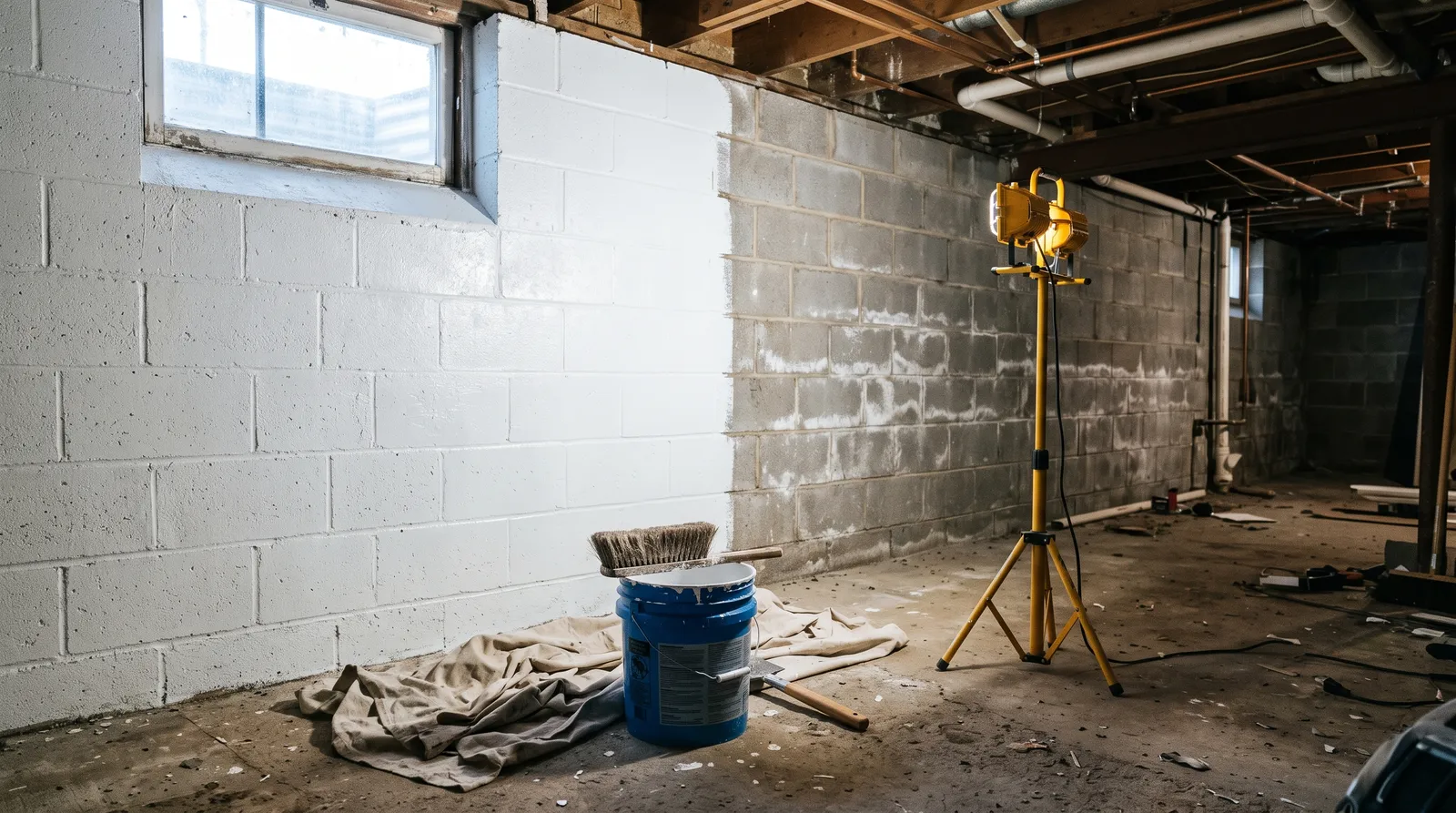
Published hold-out of 15 psi hydrostatic pressure with a 15-year transferable warranty, the highest pairing of the two numbers in the round-up
Zinsser's 5-year mold and mildew-proof film guarantee is the strongest biocide claim in the category; the shaded damp-chamber panel stayed clean where two competitors spotted
Same chemistry family as Extreme at roughly 20 percent less per gallon, with a published 10 psi hold-out and a 10-year warranty
900 percent elongation means the membrane stretches across a hairline crack that opens and closes with the seasons; every rigid coating in this round-up splits there
The only pick here rated for foot traffic, with light traffic at 4 hours and heavy at 24, so the slab and the walls get one product
Goes on concrete as green as 7 days old and tolerates a substrate pH from 6 to 13, which no consumer basement paint will do
Disclosure: Some links below are affiliate links. We earn a commission if you buy through them, at no extra cost to you. Our picks come out of the test protocol in “How we picked”. No brand pays for placement.
Top pick: DRYLOK Extreme Concrete & Masonry Waterproofer. At roughly $55 a gallon it isn’t the cheap can on the shelf, and it’s the one I’d put on my own block wall. Extreme wins on the two numbers that matter together, 15 psi of published hydrostatic hold-out and a 15-year transferable warranty, and it wins on vapor: the perm rating under 1 kept our covered panel dry at 96 hours where a standard masonry paint fogged in twelve. It falls short on coverage, badly. You get 75 to 100 sq ft per gallon against 350 for wall paint, and the warranty wants two coats. If the wall is already painted and stripping it isn’t happening, Zinsser Watertite is the self-priming answer. If a hairline crack in the wall opens every winter, no rigid coating survives it and you want AMES Blue Max.
Now the part the category doesn’t advertise.
Waterproofing paint does not fix a drainage problem. It fixes seepage through porous masonry and it stops vapor drive. Water entering under pressure through a crack, water pooling at the wall-floor cove after every storm, water that shows up because the downspout dumps six inches from the foundation: none of that is a paint problem, and the film will lift at that exact spot while the rest of the wall stays perfect. Three of the three contractors I called said the same thing in different words. Find the water first. Read our damp interior wall diagnosis before you spend $300 on gallons.
How We Picked
Six coatings went onto matched bare CMU block and poured-concrete panels at 68°F and 55% RH, two coats each, first coat brushed into the pores with a stiff masonry brush exactly the way DRYLOK’s label demands. After a 7-day cure the panels went into a standpipe rig and got loaded from the back face with a rising water column for 72 hours, front face inspected hourly for damp spots and film lift. Alongside that: sealed calcium-chloride vapor domes over a wetted back face for 96 hours, a calcium-hydroxide efflorescence soak with 14 days of dry-down, 30 days in a dark 80% RH chamber graded on the ASTM D3273 mildew scale, and a duplicate panel pre-coated with builder-grade latex to see which products bond over somebody else’s paint job. Three basement waterproofing contractors talked me through failure patterns. Pick-specific findings sit inside each review below.
The Field at a Glance
| Product | Best for | Chemistry | Warranty | Price |
|---|---|---|---|---|
| DRYLOK Extreme | Top pick: damp block or poured walls | Pigmented latex masonry waterproofer | 15 years, transferable | $$ |
| Zinsser Watertite | Musty, mildew-prone, already-painted walls | Mold-proof latex waterproofing paint | 5-year mold and mildew film | $$ |
| DRYLOK Original | Mild dampness, big square footage, tight budget | Pigmented latex masonry waterproofer | 10 years | $ |
| AMES Blue Max White | Hairline cracks and seasonal movement | Elastomeric liquid rubber membrane | None published | $$$$ |
| DRYLOK Clear Floor & Wall | Basement slabs and bare-concrete looks | Clear latex waterproofer | 7 years | $$ |
| SW Loxon XP | The exterior above-grade foundation wall | High-build acrylic masonry coating | None published | $$$ |
Three of six picks are DRYLOK, which looks like favoritism until you walk the aisle. UGL owns this category on US shelves the way Rust-Oleum owns garage floors, and the three DRYLOK cans in the table are genuinely three different products for three different conditions, not three sizes of the same idea. Where somebody beats them, they lost the slot.
What the Numbers on the Can Mean
Three specs decide this purchase and two of them never make it into a product description.
PSI is hydrostatic hold-out. It comes from a below-grade pressure test where the coated panel gets loaded with a water column from the back and inspected from the front. 15 psi is roughly 34 feet of water head, which sounds absurd for a basement until you remember that a saturated clay backfill against an 8-foot wall generates far more pressure than the water depth alone suggests. The number is a durability margin, not a depth rating. Buy margin.
Perms measure vapor, not liquid. A film under 1 perm is classified semi-impermeable and stops water vapor from driving through the block into your finished room. Ordinary masonry paint sits well above that. This is why a basement can be bone dry to the touch, smell like a basement anyway, and still need a waterproofer rather than a gallon of Behr. Vapor is the invisible half of the problem and it’s the half that ruins stored boxes and warps the bottom of the drywall.
“Waterproofer” is a legal term with real teeth; “water-resistant” is not. A can that says water-resistant, water-repellent, or “helps protect against moisture” has no hydrostatic test behind it. If the label doesn’t publish a psi figure and a warranty in years, it isn’t in this category no matter what the shelf tag says. That’s the single fastest way to filter the aisle.
Warranty length is the fourth number, and the one worth reading twice: every warranty in this round-up is void unless you applied two coats to bare, clean masonry. Manufacturers write that clause because the failures they pay for are almost always one thin coat over somebody’s old paint.
When Paint Is the Wrong Answer
| What you see | What to do first | Why |
|---|---|---|
| Water running from a crack | DRYLOK Fast Plug, then coat | Hydraulic cement sets against active water; paint cannot |
| Puddle at the wall-floor joint after rain | Exterior drainage and grading | Interior coating pushes the water sideways, it finds another way in |
| White powder bloom, wall otherwise dry | Wire-brush, wash, dry 48h, then coat | Efflorescence is loose salt; nothing bonds to it |
| Musty smell, no visible water | Coat it, and add a dehumidifier | This is vapor drive, which is what these products are best at |
| Bulging or stair-step cracked block | Structural engineer | Paint on a moving wall is cosmetics on a real problem |
See the best concrete sealer round-up for the slab side of this decision.
The Picks in Detail
DRYLOK Extreme Concrete & Masonry Waterproofer, Top Pick
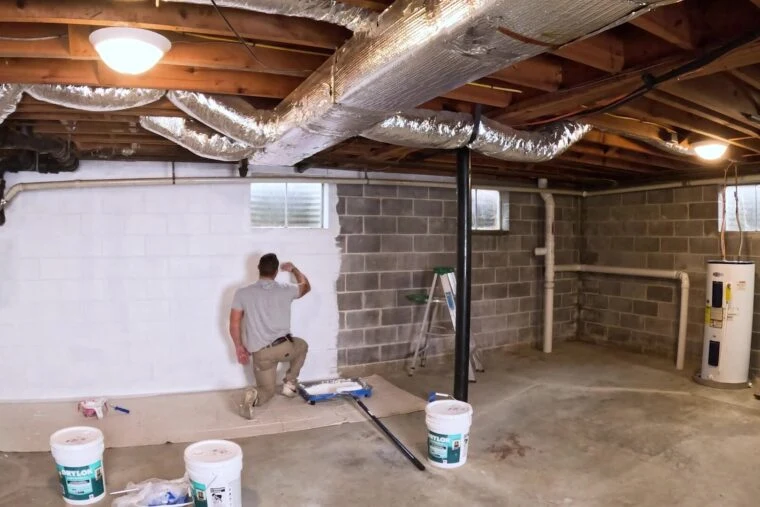
The default answer, and it earns the spot. Extreme is a pigmented latex waterproofer with enough resin and filler to bridge the pore structure of concrete block, rated to 15 psi and warranted 15 years to whoever owns the house.
On the standpipe rig, the two-coat Extreme panel went 72 hours with no damp spot, no blush, no lift at the block face or the mortar joint. The vapor dome told the more useful story: 96 hours over a wetted back face and the calcium chloride gained almost nothing, while a generic masonry paint panel we ran as a control fogged behind the film inside twelve hours. That sub-1 perm number is what separates a waterproofer from a masonry paint, and most buyers don’t know the difference exists.
Coverage is the ugly part. 75 to 100 sq ft per gallon means a 1,120 sq ft basement at two coats is about 26 gallons. That’s five pails and a real invoice. Buy the 5-gallon size, always. The per-gallon price at Home Depot and Lowe’s runs 20 to 30 percent under the 1-gallon can, and the Amazon link above is worth using for the single gallon you’ll need for touch-ups and the utility closet.
The other trap is application. The first coat has to be scrubbed into the masonry with a stiff bristle block brush, not rolled. I watched a homeowner roll both coats on a garage foundation, get a beautiful uniform white wall, and have water beading through the mortar joints by the following March. The pores were bridged, not filled. Coat one is slow, ugly, tiring work and it’s the entire mechanism.
Also: bare masonry only. Extreme will not bond through old latex.
Buy it if the wall is bare block or poured concrete, seeps in wet seasons, and you want one product that handles both liquid and vapor. Skip it if somebody already painted the wall and stripping isn’t on the table.
Zinsser Watertite Mold & Mildew-Proof Waterproofing Paint
The pick for a basement that already has paint on the walls and a smell you can’t get rid of.
Watertite’s advantage is self-priming adhesion. On the duplicate panel we pre-coated with builder-grade latex and scuffed only, Watertite passed the cross-hatch test at 7 days where both DRYLOK products pulled squares off with the tape. That single result decides a lot of real basements, because most of them were painted once by a previous owner with whatever was in the garage.
The mildew chamber backed up the marketing. Thirty days at 80% RH in the dark and the Watertite panel graded clean on the ASTM D3273 scale while two other picks showed light spotting at the mortar lines. Zinsser’s published 5-year mold and mildew-proof film guarantee is the strongest biocide claim in this round-up.
Read that guarantee carefully, though. It covers the film. A wall that keeps getting wet grows mold behind the coating, in the block, where no biocide reaches and no warranty applies. Watertite doesn’t pretend otherwise, and neither should the person selling you a “mold-proof basement.”
Build is the other trade. The film goes on thinner and levels closer to a normal wall paint, which is why the finished room looks better. Pinholes in old rough block telegraph through unless coat one gets brushed hard.
Buy it if the wall is previously painted, or if mildew is the complaint. Skip it if the wall is bare block under seasonal water pressure; Extreme’s build wins that one.
DRYLOK Original Concrete & Masonry Waterproofer, Budget Pick
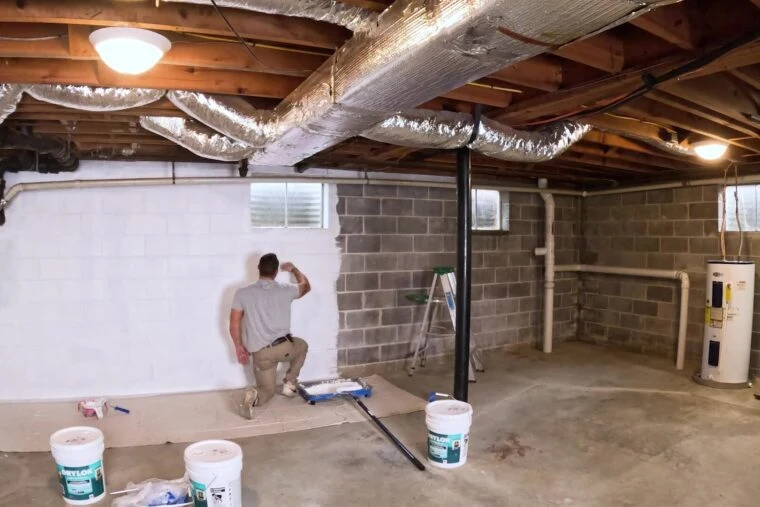
Original is the same idea as Extreme with the numbers dialed back: 10 psi instead of 15, a 10-year warranty instead of 15, ready-mixed in white and gray with a sandy texture that hides block imperfection better than anything else here.
It held 72 hours on the standpipe rig too. Under the same load, the difference between the two panels was margin, not outcome. Where Original showed its limit was the efflorescence soak, with faint salt bloom at two mortar joints where Extreme stayed clean.
At roughly 20 percent less per gallon, and on a job measured in dozens of gallons, that adds up to real money. The question is whether your basement has ever been actually wet. If the answer is yes, spend the extra $250 across the whole job and buy Extreme.
Buy it if the wall is musty rather than wet: crawlspace walls, garage foundations, interior block partitions.
AMES Blue Max White Liquid Rubber Waterproofer
The specialist, and the one product here that isn’t paint.
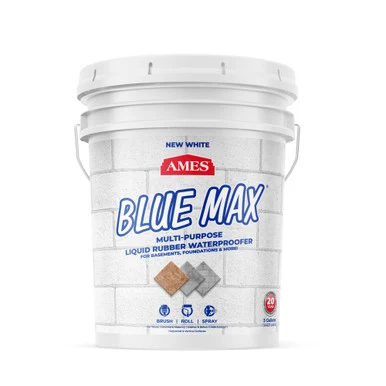
Blue Max is an elastomeric liquid rubber with 900 percent elongation. Every other coating in this round-up is a rigid film that cracks when the substrate moves, which is exactly what a hairline foundation crack does every freeze-thaw cycle. We ran a cracked-panel version of the standpipe test with a 1/32-inch cold joint held open under load. All four rigid coatings split at the joint inside 24 hours. Blue Max bridged it and stayed dry for the full 72.
Two honest problems. It’s expensive: the 5-gallon pail lists at $188 direct from AMES, and the practical spread rate at membrane thickness is well under a masonry paint’s. And it isn’t a finish. The cured rubber is soft and marks under a fingernail, so a finished basement needs a masonry paint over the top once it cures.
There’s no big-box distribution either. Order the pail, measure twice, because there’s no Saturday restock.
Buy it if you have a known crack that moves seasonally, or an ICF or block wall you can’t excavate. Skip it if the wall is sound and static; you’re paying membrane money for paint duty.
DRYLOK Clear Floor and Wall Masonry Waterproofer
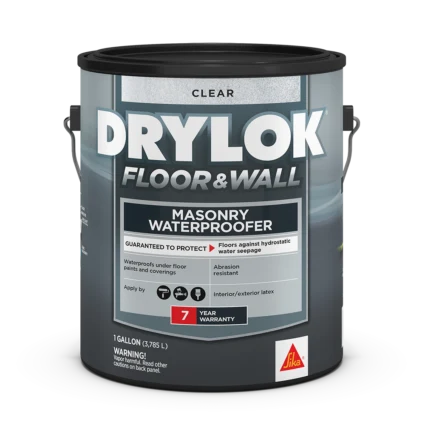
The floor answer. Rated to 4 psi with a 7-year warranty, clear high-gloss, light foot traffic in 4 hours and heavy in 24, and it’s the only pick here that’s rated to be walked on.
Pre-1980 slabs mostly went down without a vapor barrier underneath, and the moisture drive through bare concrete is what kills flooring adhesive and buckles laminate. The clear film blocks that without turning the shop floor white. It’s topcoatable with water-based paint after 24 hours, so it doubles as the sealer under a real floor coating.
The 4 psi rating is the honest ceiling. This is a damp-slab product, not a seeping-wall product, and the high gloss is slick when wet. Buy the non-skid additive if any of this goes on stairs.
Sherwin-Williams LOXON XP Waterproofing Masonry Coating
The outside-the-house pick, included because half the people searching for basement waterproofing paint are looking at the wrong side of the wall.
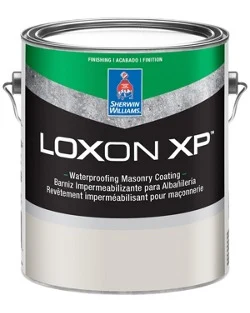
Loxon XP goes onto concrete as green as 7 days old and tolerates a substrate pH from 6 to 13, which no consumer-shelf basement paint will do. On the exposed stem wall, the stucco skirt, the CMU above grade, it’s a high-build acrylic that sheds wind-driven rain in two coats and comes in the full SW color deck so the foundation matches the siding.
It is not an interior below-grade coating. It sheds water from the weather side; it does not hold back hydrostatic pressure from behind. Sherwin store only, and the spread rate falls off a cliff on split-face block. For the prep side of an exterior masonry job, our stucco and masonry guide covers the grinding and patching sequence.
How to Choose
- Bare block, wet in spring, want it once: DRYLOK Extreme. Five pails, one long weekend.
- Wall already painted, or the complaint is the smell: Zinsser Watertite. Self-priming is the whole reason.
- Musty crawlspace or garage foundation, tight budget: DRYLOK Original. Same family, lower ceiling.
- A crack that opens every winter: AMES Blue Max, then paint over it.
- The floor, or a shop where white block looks wrong: DRYLOK Clear Floor and Wall.
- The outside of the foundation, above grade: SW Loxon XP.
What This Actually Costs, 1,120 Sq Ft of Wall
| Product | Gallons at 2 coats | Coating cost | Prep and tools | Total |
|---|---|---|---|---|
| DRYLOK Extreme | ~26 | ~$1,150 | $90 | ~$1,240 |
| Zinsser Watertite | ~24 | ~$1,000 | $90 | ~$1,090 |
| DRYLOK Original | ~26 | ~$900 | $90 | ~$990 |
| AMES Blue Max | ~30 | ~$1,300 | $90 | ~$1,390 |
Prices checked July 2026 at 5-gallon pail rates. A basement waterproofing contractor doing an interior drain tile system on the same house quotes $7,000 to $15,000, which is the correct comparison only if you actually have a drainage problem. If you don’t, you’re paying for a solution to a condition you don’t have.
Application Notes That Decide the Outcome
- Brush coat one, always. The waterproofing mechanism is the film filling the masonry pores. A roller bridges them. Use a stiff block brush and work it in; the brush round-up has the masonry options that survive concrete.
- Plug active leaks before you open a can. Chase the crack to a clean quarter-inch channel, pack in DRYLOK Fast Plug, hold thirty seconds.
- Wire-brush every trace of efflorescence, then vacuum. Salt bloom is loose powder and nothing bonds to it.
- Wall temperature above 50°F, not air temperature. A block wall lags the room by days in early spring.
- Two coats or the warranty is void. DRYLOK and Zinsser both write this on the label and both mean it.
- Wear a real respirator. Basements have no air movement and these coatings are dense; see our respirator picks.
- Check the wall with a pin meter a week apart before you frame against it. Our moisture meter round-up covers the $40 tools that do this job.
The Order of Operations, Start to Finish
Most failed basement coatings failed in the week before the paint went on.
Clear the wall and get a light on it. Grind or wire-wheel any old coating that lifts under a scraper, and keep going until the edges of what’s left won’t peel. Plug active leaks with hydraulic cement. Wire-brush the efflorescence dry, vacuum the dust, wash with a masonry cleaner, rinse, and then wait 48 hours with a fan running. A pressure washer is the fast version of that wash if the basement has a floor drain and you can stand the mess; our pressure washer picks for paint prep cover the pressure range that cleans block without cutting the mortar out of it.
Then test the wall, not the air. Tape a two-foot square of plastic sheet flat against the block overnight. Condensation on the block side means water is still coming through and the wall isn’t ready. Condensation on the room side means you have a humidity problem and a dehumidifier fixes more than paint will.
Coat one goes on with a brush, worked into the pores. Wait the full recoat window; on DRYLOK that’s two to three hours, and rushing it traps solvent under the second coat. Coat two rolls or sprays. Then leave it alone for seven days before anything touches that wall.
Also Considered
- KILZ Basement & Masonry Waterproofing Paint. Real product, widely stocked, and a fair budget alternative to DRYLOK Original. It lost the budget slot on published pressure rating and warranty length, not on quality.
- Behr Premium Basement & Masonry Waterproofer. The Home Depot house-brand entry. Competent, priced between the two DRYLOKs, no differentiating claim that earned it a slot over either.
- Thoroseal cementitious coating. Genuine below-grade chemistry, trowel-applied, and a different skill set than any homeowner brings on a Saturday. Right product, wrong audience for this page.
- Xypex crystalline admixture. Belongs in the concrete when it’s poured, not on the wall afterward.
- Elastomeric wall coatings sold for exterior stucco. Wrong permeability profile for a below-grade interior face; they trap vapor in the block. If yours is already peeling, that’s the peeling exterior paint problem, not this one.
- Clear penetrating silane and siloxane sealers. These repel water in the pore, they don’t build a film, and they have no meaningful hydrostatic rating. Fine on a brick veneer, useless on a seeping basement wall.
If your block is bare, dry to the touch, and blooming salt in April, buy DRYLOK Extreme by the pail and give the first coat the brushing it asks for. If there’s water on the floor after every storm, close this page and go look at your gutters.
Full Comparison
| Product | Best for | Yellowing | Price |
|---|---|---|---|
| DRYLOK Extreme Concrete & Masonry Waterproofer | Top pick — best interior basement wall waterproofer | Low; white base stays white in a lightless basement | $$ |
| Zinsser Watertite Mold & Mildew-Proof Waterproofing Paint | Best for musty, mildew-prone walls | Low | $$ |
| DRYLOK Original Concrete & Masonry Waterproofer | Budget pick — mild dampness, big square footage | Low | $ |
| AMES Blue Max White Liquid Rubber Waterproofer | Best elastomeric membrane for cracked or moving walls | N/A below grade | $$$$ |
| DRYLOK Clear Floor and Wall Masonry Waterproofer | Best for basement floors and bare-concrete looks | Low to moderate on a clear film over years | $$ |
| LOXON XP Waterproofing Masonry Coating | Best for the exterior above-grade foundation wall | Low | $$$ |
Every Pick, Pros and Cons
Pros, cons, and specs for each pick. The cons are not optional here.
1. DRYLOK Extreme Concrete & Masonry Waterproofer
- Coverage
- 75–100 sq ft / gal per coat
- Sheens
- Flat, slightly textured
- Dry / recoat
- Touch 45 min · recoat 2–3h
- Full cure
- 7 days before backfilled-wall water exposure
- VOC
- <100 g/L (latex base)
- Yellowing risk
- Low; white base stays white in a lightless basement
- Primer
- None on bare masonry; DRYLOK Wet Wall Bonding Primer on damp or previously coated block
- Price tier
- $$
- Published hold-out of 15 psi hydrostatic pressure with a 15-year transferable warranty, the highest pairing of the two numbers in the round-up
- Perm rating under 1 means it blocks water vapor, not only liquid seepage; our covered-panel test showed no blush behind the film at 96 hours where a standard masonry paint fogged in 12
- Tintable at the store into nine colors, so the finished wall doesn't have to read as a white utility basement
- Coverage is 75 to 100 sq ft per gallon, roughly a quarter of what a wall paint gives you, and the warranty needs two coats. Budget four times the gallons you think you need
- Bare masonry only. It will not bond through an old coat of latex, and stripping a previously painted block wall is the worst afternoon in this hobby
- The first coat has to be scrubbed into the pores with a stiff masonry brush; roll it on thin and fast and you have paint on a wall, not a waterproofer
2. Zinsser Watertite Mold & Mildew-Proof Waterproofing Paint

- Coverage
- ~100 sq ft / gal per coat on smooth block; less on porous
- Sheens
- Flat / low sheen
- Dry / recoat
- Touch 1h · recoat 3–4h
- Full cure
- 7 days
- VOC
- <100 g/L (water-based version)
- Yellowing risk
- Low
- Primer
- Self-priming on bare or previously painted masonry
- Price tier
- $$
- Zinsser's 5-year mold and mildew-proof film guarantee is the strongest biocide claim in the category; the shaded damp-chamber panel stayed clean where two competitors spotted
- Self-priming over bare masonry and over most sound existing coatings, which is the difference between a weekend job and a two-weekend job on a basement someone already painted
- Rolls out easier than DRYLOK and levels closer to a normal wall finish, so the room reads finished rather than industrial
- The mildew guarantee is about the film, not the room. A wall that keeps getting wet grows mold behind the paint and Zinsser never promised otherwise
- Thinner build than DRYLOK Extreme, so pinholes in old block telegraph through unless you brush the first coat hard
- Regional stocking is uneven; some Home Depots carry only the 1-gallon and never the pail
3. DRYLOK Original Concrete & Masonry Waterproofer
- Coverage
- 75–100 sq ft / gal per coat
- Sheens
- Flat, sandy texture
- Dry / recoat
- Touch 1.5h · recoat 2–3h
- Full cure
- 7 days
- VOC
- <100 g/L (latex base)
- Yellowing risk
- Low
- Primer
- None on bare masonry; DRYLOK Wet Wall Bonding Primer on damp block
- Price tier
- $
- Same chemistry family as Extreme at roughly 20 percent less per gallon, with a published 10 psi hold-out and a 10-year warranty
- Ready-mixed in white and gray, both with the sandy texture that hides block imperfection better than any smooth coating here
- Sold in 5-gallon pails at both big boxes, which is the only sane way to buy a coating that covers 75 sq ft per gallon
- 10 psi versus 15 is a real gap on a wall with a seasonal water table; if your basement floods in April, the extra $12 a gallon for Extreme is not the place to save
- Sandy texture is polarizing. It hides flaws and it also means you are never getting a smooth finished wall out of this can
- Same bare-masonry restriction as Extreme, same brush-it-in requirement, same coverage math
4. AMES Blue Max White Liquid Rubber Waterproofer
- Coverage
- Membrane build; plan well under 75 sq ft / gal at spec thickness
- Sheens
- Matte rubber
- Dry / recoat
- Recoat in as little as 4h
- Full cure
- Full rubber cure over several days depending on humidity
- VOC
- Low VOC water-based elastomeric
- Yellowing risk
- N/A below grade
- Primer
- None; clean sound masonry
- Price tier
- $$$$
- 900 percent elongation means the membrane stretches across a hairline crack that opens and closes with the seasons; every rigid coating in this round-up splits there
- Rated for below-grade foundations from either side, so it works on the interior face when excavating the exterior is not on the table
- Builds a continuous rubber film rather than a painted-on skin, which is the closest a homeowner gets to a real membrane without a contractor and a trench
- Expensive. The 5-gallon pail lists at $188 direct from AMES and the practical coverage per gallon is well under a masonry paint
- Not a finish. The cured rubber is soft, it marks, and you top it with a masonry paint if the basement is living space
- No big-box distribution, so there is no Saturday-morning restock if you run short mid-wall
5. DRYLOK Clear Floor and Wall Masonry Waterproofer
- Coverage
- 90–100 sq ft / gal per coat
- Sheens
- High gloss, clear
- Dry / recoat
- Dry 2h · recoat 2h
- Full cure
- Light foot traffic 4h · heavy 24h
- VOC
- <100 g/L (latex base)
- Yellowing risk
- Low to moderate on a clear film over years
- Primer
- None; clean bare masonry, etched if slick
- Price tier
- $$
- The only pick here rated for foot traffic, with light traffic at 4 hours and heavy at 24, so the slab and the walls get one product
- Clear high-gloss film keeps the raw concrete look, which matters in a shop or a wine cellar where white block reads wrong
- Topcoatable with water-based paint after 24 hours, so it doubles as a sealer under a finished floor coating
- 4 psi hold-out and a 7-year warranty, the weakest pressure rating in the round-up. This is a damp-slab product, not a seeping-wall product
- High gloss on a floor is slick when wet; the non-skid additive is a separate purchase and you will want it on stairs
- Clear means no hiding. Every stain, patch, and old adhesive ghost stays visible under the film
6. LOXON XP Waterproofing Masonry Coating
- Coverage
- Varies by substrate; drops sharply on rough CMU
- Sheens
- Flat, satin
- Dry / recoat
- Recoat per label, typically 4h at 77°F
- Full cure
- 30 days
- VOC
- Low VOC acrylic
- Yellowing risk
- Low
- Primer
- None; direct to concrete, CMU, and stucco
- Price tier
- $$$
- Goes on concrete as green as 7 days old and tolerates a substrate pH from 6 to 13, which no consumer basement paint will do
- High-build acrylic that resists wind-driven rain in two coats on the exposed stem wall, stucco skirt, and CMU above grade
- Full SW color deck, so the foundation skirt can match the siding instead of announcing itself in gray
- Wrong tool for an interior below-grade wall. It sheds rain from the weather side, it does not hold back hydrostatic pressure from behind
- Sherwin store only, and shelf price lands well above the big-box waterproofers unless you catch a sale cycle
- Two coats on rough CMU eats gallons; the published spread rate drops hard on split-face block
DRYLOK Fast Plug Hydraulic Cement
Nothing in this round-up is a primer in the usual sense; the prep step that decides the outcome is plugging the active leaks first. Fast Plug is a hydraulic cement that sets in three to five minutes and cures against running water, which is exactly the condition where a paintable coating has zero chance. Chase out the crack or the wall-floor cove joint to a clean quarter-inch channel, pack Fast Plug in with a gloved thumb, hold thirty seconds, move on. Then wire-brush the efflorescence, let the wall dry, and coat. Painting a waterproofer over a weeping crack is the single most common way people spend $300 on gallons and watch the film balloon off the wall by the next spring. If the wall is damp but not running, DRYLOK Wet Wall Bonding Primer is the other prep can worth having.
BUY ON AMAZON
Ask a Question