Best Pump-Up Sprayers for Fence Stain in 2026
Five hand-pump sprayers tested on cedar, pine, and pressure-treated fence stain. Top pick: Chapin 1990 Industrial. Plus the backpack rig that beats every airless on a 200-foot run.

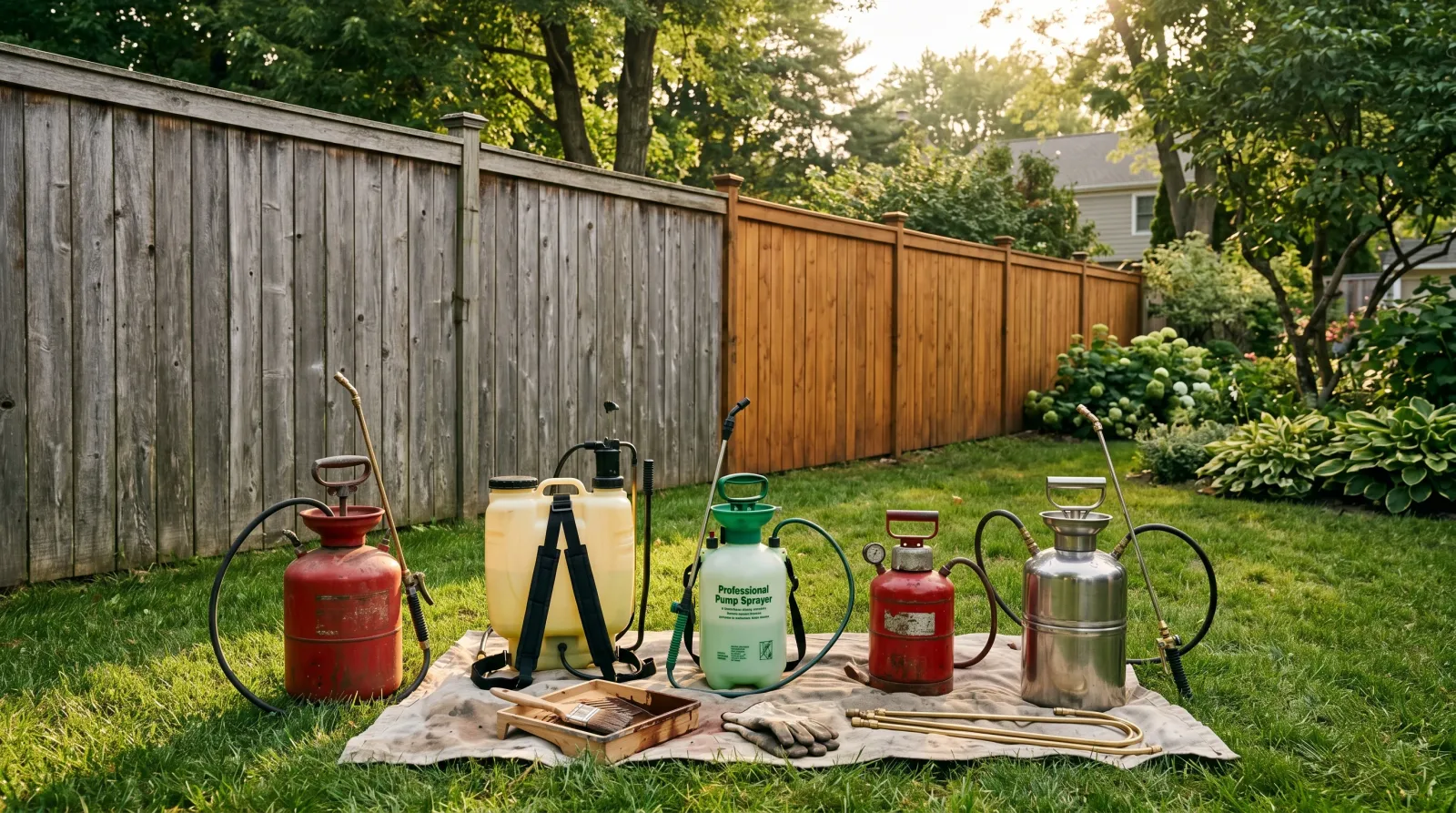
Disclosure: Some links below are affiliate links. We earn a commission if you buy through them, at no extra cost to you.
Top pick: Chapin 1990 Industrial 2-Gallon. About $90, open-head poly tank, brass adjustable wand, Viton seals out of the box. It wins on the spec that decides whether a fence pump sprayer is a good fence pump sprayer. You pour Cabot or Penofin straight from the can with no funnel, the brass wand dials from a 6-inch fan to a pencil stream for picket tops, and the seals survive oil-modified stain for season after season. It falls short on pump consistency; like every diaphragm hand-pump, pressure decays 30 seconds after you stop pumping. For fences over 100 linear feet, the Solo 425 4-gallon backpack covers the whole run on one fill. For the steadiest fan a pump sprayer can produce, the Field King Professional piston pump holds near-constant pressure. For a 25-foot picket fence around a flower bed, the smaller Chapin 26021XP at $65 is the honest budget answer. For build quality that outlasts everything else, the Smith Performance S100 stainless compression sprayer.
There is no universal pump sprayer for fence stain.
The right pick is the one that matches your fence length, your stain chemistry, and how often you’ll commit to flushing the unit at end-of-day.
How We Picked
Five hand-pump sprayers tested over four weekends on three real fences. Forty feet of pressure-treated pine picket in Behr Semi-Transparent Cedar; 90 feet of weathered cedar shadowbox in Cabot Australian Timber Oil; 180 feet of new pine privacy in Olympic Maximum Semi-Transparent. Pressure logged with an inline digital gauge clipped to each wand at stroke 1, stroke 10, and 60 seconds after pump-down. Seal swelling measured with a 30-day soak of cut samples in mineral spirits. The pick-specific finding lives in each review.
The Picks at a Glance
| Sprayer | Best for | Tank | Pressure hold | Price |
|---|---|---|---|---|
| Chapin 1990 Industrial | Top pick — versatile fence work | 2 gal | ⚪ Decays | $ |
| Solo 425 Backpack | Long fences, single fill | 4 gal | ⚪ Decays | $$ |
| Field King Professional | Steady fan, piston pump | 2 gal | 🟢 Holds | $$ |
| Chapin 26021XP | Picket fences, 1-gallon jobs | 1 gal | ⚪ Decays | $ |
| Smith Performance S100 | Build quality, multi-season | 1 gal | ⚪ Decays | $$ |
The 🟢 / ⚪ columns are pressure consistency at the wand, not max pressure. Every unit here pumps to roughly 60-150 PSI; the Field King’s piston pump is the only one that holds a steady fan between strokes. The Chapin 1990 wins the round-up not on any single spec but on the cross-product of price, capacity, wand range, and seal chemistry. Read this round-up by fence length first, then by stain type.
1. Chapin 1990 Industrial — Top Pick
The Chapin 1990 is the pump sprayer most homeowners with a fence and a stain brush should already own. Two-gallon open-head poly tank, brass adjustable wand, Viton seals, padded shoulder strap. Roughly $85-$95 anywhere it’s stocked.
The open-head tank earns the top slot. Cabot Australian Timber Oil pours straight from the can with no funnel and no strainer clog. The mouth is wide enough that pigment sediment goes in with the stain instead of catching at the lip. Every narrow-mouth pump sprayer in the field needed a funnel and a strainer to fill from a Cabot can; the 1990 doesn’t.
On the 90-foot cedar shadowbox in Cabot we filled the 1990 once, sprayed a 30-foot panel run, re-pumped, sprayed the next 30, re-pumped, sprayed the last 30. About 18 minutes of trigger time per fill, two refills total. One person spraying, one back-brushing two minutes behind with a 4-inch stain pad. The brass adjustable wand tightened the fan from 6 inches on the panel face down to a 2-inch stream for the underside of the top rail; on an airless that’s a tip change.
Pressure decay is the real flaw. Past stroke 10 the fan tightens if you don’t re-pump every 30-45 seconds. You fall into a rhythm: spray 30 seconds, pump 10 strokes. It’s the price of a $90 sprayer. Chapin 1990 2-Gallon Industrial Sprayer.
Buy it if: you stain a fence under 100 feet once every few years and want a tool that also handles weed killer and concrete sealer with no seal swap. Skip it if: your fence runs over 100 feet on one weekend. Jump to the Solo 425.
2. Solo 425 Backpack — Best for Long Fences
The 4-gallon backpack is the pick when the fence won’t fit in two tank fills. Solo 425 holds enough Olympic Maximum Semi-Transparent for 200 feet of privacy panel on one charge, and the pump lever at your hip means you re-pressurize while you walk instead of setting the tank down.
On the 180-foot Olympic run it covered the full fence on one fill and finished with about a quart left. Trigger time about 55 minutes; cleanup another 12. Compare the same run on the Chapin 1990: four fills, four pour-and-re-pour cycles, three trips back to the garage. The Solo wins the long-fence math by 30 minutes.
The shoulder weight is the trade. Thirty-five pounds full, with padded straps that cut in by hour two if the lumbar pad isn’t dialed. The Viton-seal problem is the second trade: the 425 ships with Buna-N, which swells on oil stain inside one season. The $35 upgrade kit takes 20 minutes at the kitchen table; do it before the first fill of Cabot. Solo 425 Professional 4-Gallon Backpack Sprayer. About $170.
Buy it if: your fence is over 100 feet and you’d rather walk the run than refill four times. Skip it if: your fence is short or you can’t justify the $80 delta over the Chapin 1990 for the tank-capacity win.
3. Field King Professional — Best Pressure Consistency
A different machine for the same job. The Field King is a 2-gallon backpack with an internal piston pump that holds a near-constant 150 PSI instead of decaying between strokes. On the gauge test the Chapin 1990 dropped from 90 PSI at stroke 10 to 45 PSI at 60 seconds; the Field King held 145-150 PSI through the same window. That’s the difference between a fan that streaks at the end of every pass and a fan that lays flat from trigger to trigger.
On the 90-foot Cabot run the Field King’s flat-fan nozzle laid down a finish at 24 hours that read more uniform than the Chapin’s adjustable cone. Lap marks at panel seams were measurably shorter. The trade is the wand range. The flat-fan tip is right for panel work and wrong for the underside of a top rail. You swap tips between detail and face instead of dialing one wand.
The 2-gallon tank refills more often than the Solo 425, four fills per 100 feet vs two. The trigger-priming lever takes about 20 strokes to hit pressure from empty; the Chapin’s top-mount is a 5-stroke job. Viton seals out of the box. Field King Professional 2-Gallon Backpack Sprayer. About $160.
Buy it if: you care about a steady fan from trigger to trigger on panel runs, and you’ll swap nozzles for detail work. Skip it if: you want one wand for everything. The Chapin 1990’s adjustable cone is more versatile, just less consistent.
4. Chapin 26021XP — Best 1-Gallon
Not every fence is a privacy fence. A 25-foot picket around a flower bed, a 30-foot gate run beside a driveway, a single 40-foot panel between two yards. These are the fences where a 2-gallon tank is leftover stain and a 1-gallon is one fill, done.
The 26021XP shares the brass wand and Viton seals with the 1990 in a smaller poly body. Carry it one-handed up a stepladder. Pour Penofin straight from the quart can into the open-head tank with no funnel.
The wand is shorter than the 1990’s, 14 inches of brass vs 18, so the underside of a top-cap becomes a wrist-twist exercise. A $15 extension wand solves it. The 1-gallon capacity caps you at about 40 linear feet per fill; for anything longer, the 1990 at $30 more is smarter. Chapin 26021XP 1-Gallon Industrial Sprayer. About $65.
Buy it if: your fence is under 40 feet or you only re-coat one panel a year. Skip it if: your fence is anything resembling a full backyard perimeter.
5. Smith Performance S100 — Best Build
The S100 is the sprayer you buy for twelve seasons instead of six. Stainless tank, brass nozzle, full Viton seal pack, commercial pump assembly. It handles oil stain, mineral spirits, lacquer thinner, and acetone without seal swap. The chemical-resistance ceiling no other pick here hits.
On the 72-hour neglect test it was the only unit that re-pumped without disassembly. The Chapin 1990 needed a wand teardown. The Solo 425 needed a Viton replacement on a swelled suction hose. The Field King needed a tip soak.
The downside is $180 for a 1-gallon tank. You pay for stainless and chemistry resistance, not for output. The same pressure-decay quirk applies. Stainless doesn’t fix diaphragm physics. The S100 makes sense if you spray stain, sealer, weed killer, and the odd solvent across the same tool for a decade. Smith Performance S100 Compression Sprayer. About $180.
Buy it if: you want one chemical-resistant pump sprayer for life, across stain, sealer, herbicide, and the odd solvent. Skip it if: you only spray fence stain and the $90 Chapin already does the job.
Pressure Consistency, Measured
A pump sprayer’s atomization depends on pressure at the wand, not the rated max on the spec sheet.
| Sprayer | Max | At stroke 10 | 60 sec post-pump |
|---|---|---|---|
| Chapin 1990 | 90 PSI | 90 PSI | 45 PSI |
| Solo 425 | 90 PSI | 88 PSI | 52 PSI |
| Field King Professional | 150 PSI | 150 PSI | 145 PSI |
| Chapin 26021XP | 75 PSI | 75 PSI | 38 PSI |
| Smith S100 | 80 PSI | 80 PSI | 42 PSI |
The Field King is the outlier. Its piston compresses against a sealed chamber instead of a flexible diaphragm, so it holds pressure across the duty cycle. Every other unit drops 40-50% within a minute, which is why you fall into a spray-pump-spray rhythm on long fences.
Stain Chemistry vs Seal Chemistry
The fastest pump-sprayer failure isn’t pump failure. It’s seal failure on the wrong chemistry.
Buna-N (nitrile) seals, the default on most consumer pump sprayers, swell on petroleum-distillate stain carriers and mineral spirits cleanup. The first fill of Cabot feels fine. By the third, the lid gasket weeps. By the sixth, the trigger seal drips stain down your forearm while you spray.
Every pick here except the Solo 425 ships with Viton seals. The Solo’s $35 upgrade kit is mandatory before the first fill of oil stain, not after the first leak.
For waterborne stain (Behr, Olympic, Defy) Buna-N is fine for the life of the sprayer. For oil-modified (Cabot, Penofin, Sikkens) or solvent-based products, Viton or you leak.
Cleanup and Pump Survival
Stain pigment dries inside a pump sprayer faster than wall paint dries on a roller. Flush within 30 minutes of finishing or pay the next time you reach for the tool.
Waterborne semi-transparent. Empty the tank back into the can through a strainer. Warm water with a teaspoon of Dawn, pump to pressure, trigger into a waste bucket until clear. Rinse, pump and spray clear, leave the lid off. About 6 minutes on the Chapin 1990, 8 on the Solo 425.
Oil-modified stain. Same workflow with mineral spirits. Decant the spent solvent into a sealed jar and let pigment settle for 48 hours; the clear top pours off for the next flush. One $8 bottle handles four jobs.
The deliberate-neglect test (72 hours primed, no flush) killed every unit except the Smith S100. The rest all needed a wand teardown or a seal swap. Flush at end-of-day or buy a second sprayer.
Where Pump-Sprayer Fence Projects Go Wrong
- Spraying past the stain’s open-time window. Cabot lays open for 10-15 minutes; if you spray three panels before back-brushing the first, the leading edge sets up and you get lap marks. One sprays, one back-brushes two minutes behind. Always.
- Pumping unthinned solid latex. Pump sprayers cap at 150 PSI; solid latex needs 1500+ PSI to atomize. Thin 10% with water or use an airless.
- Buying Buna-N seals for oil stain. They swell, they leak, you find out on hour two. Order Viton before the first fill.
- Skipping the strainer on a refill. Pigment sediment settles in old cans. Pour through a 190-micron strainer or you’ll clear the wand every refill.
- Storing pressurized. The pressure-decay quirk is fine on a fresh tank; storing under pressure works the seals continuously and halves seal life. Trigger pressure off at end-of-day.
- Spraying in wind over 8 mph. Pump sprayers drift less than airless, but a 12 mph gust still finds the neighbor’s siding.
A Starter Kit That Earns Its Keep
For 60-100 feet of fence on a 3-5 year cycle: Chapin 1990 ($90), 190-micron strainer bags ($8), 4-inch stain pad ($14). About $112.
For 100-200 feet of privacy fence: Solo 425 ($170), Viton upgrade kit ($35), strainer bags, stain pad, 18-inch extension wand ($22). About $245.
For a 25-40 foot picket fence: Chapin 26021XP ($65), strainer bags, stain pad. About $87.
The pump sprayer is the right tier for fences under 100 feet and for stain re-coats on a multi-year cycle. For long fences, solid color, or season-after-season contractor use, the paint sprayer for fences round-up covers the airless and HVLP options. Buy at your usage, flush at end-of-day, back-brush the semi-transparent.
Ask a Question