Best Paint Sprayer for Fences in 2026
Five sprayers tested on cedar, pine, and pressure-treated fence panels. Top pick: Graco Magnum ProX17. Plus a $90 pump sprayer that beats every battery handheld on a 200-foot run.

Disclosure: Some links below are affiliate links. We earn a commission if you buy through them, at no extra cost to you.
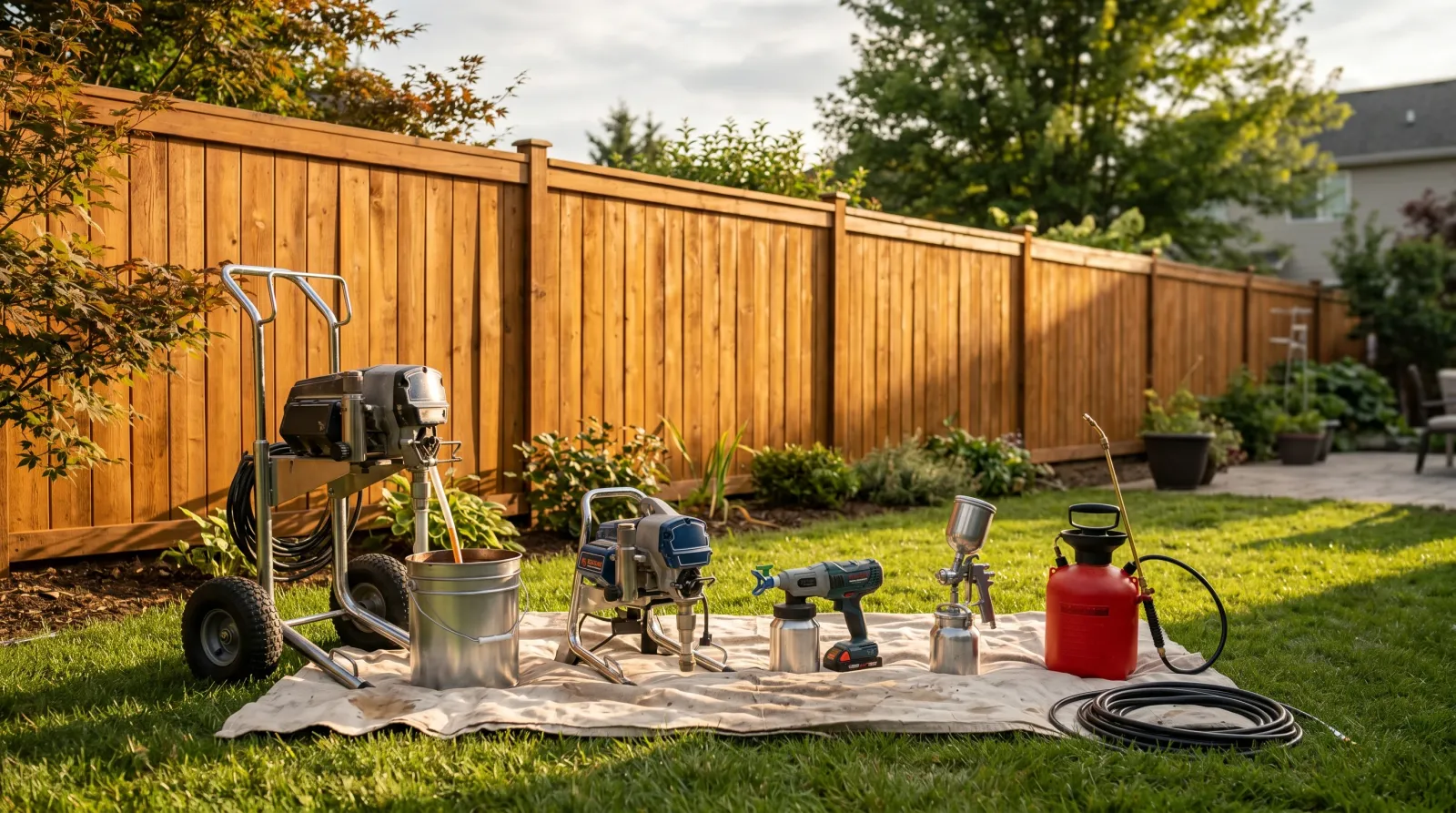
Top pick: Graco Magnum ProX17. About $849, 3300 PSI, cart-mounted with two pneumatic wheels and a 5-gallon pail bracket. It wins on the spec that decides whether a fence sprayer is a good fence sprayer — atomization headroom for unthinned oil-modified solid stain, plus 150-foot hose support so one cart position covers a 200-foot run. It falls short on price and on overspray; at 3300 PSI you mask the landscaping or you spend Sunday scrubbing siding. For low overspray near a neighbor’s fence, the Wagner Control Pro 130 trades pressure for a 55% drop in airborne drift. For climb-the-gate detail work on a small panel, the Graco Ultra Cordless is the handheld that atomizes stain without thinning. For solid-color fence paint at consumer prices, the Wagner FLEXiO 4300. And honestly, for a 25-foot picket fence in semi-transparent re-coat — the Chapin 1990 hand-pump at $90 outperforms every battery handheld in this round-up.
There is no universal fence sprayer.
The right pick is the one that matches your fence length, your stain viscosity, and how close the neighbor’s siding sits to your property line.
How We Picked
Five sprayers tested over three weekends on three real fences. Eighty linear feet of new pressure-treated pine in Behr Semi-Transparent Cedar; 150 feet of weathered cedar shadowbox in Cabot Australian Timber Oil; 40 feet of metal picket in Sherwin-Williams ProClassic. Atomization graded under raking sun at 24 hours and 7 days. Overspray weighed on a 16×20 catch board eight feet behind each spray pass. Pump survival tested by deliberately neglecting one unit per pick for 48 hours after staining. The pick-specific finding lives in each review.
The Picks at a Glance
| Sprayer | Best for | Overspray | Speed (100 ft) | Price |
|---|---|---|---|---|
| Graco Magnum ProX17 | Top pick — long runs, all stains | 🔴 High | 🟢 25 min | $$$$ |
| Wagner Control Pro 130 | Low overspray near landscaping | 🟢 Low | ⚪ 35 min | $$$ |
| Graco Ultra Cordless | Cordless, small or detail panels | ⚪ Medium | 🟡 65 min | $$$ |
| Wagner FLEXiO 4300 | Solid-color fence paint | 🟢 Low | 🔴 90 min | $$ |
| Chapin 1990 Pump | Budget, stain re-coats | 🟢 Very low | 🔴 150 min | $ |
The 🟢 / ⚪ / 🔴 in the speed column is trigger time only; masking and back-brushing don’t change between picks. The ProX17 wins the speed column hard because of pail-fed throughput and tip ceiling. The Chapin loses the speed column hard because it’s a hand-pump. Both are the right answer for somebody — that somebody is just different. Read the round-up by fence length first, then by stain type.
1. Graco Magnum ProX17 — Top Pick
The ProX17 is the fence sprayer most homeowners with a real fence should buy. Pro-line stainless piston pump, 3300 PSI, pail-fed off a cart with two pneumatic wheels, 150 feet of hose support. The pump is field-replaceable in eight minutes with no tools, which matters more on stain than it does on wall paint because stain pigment is the part that eats packings first.
On the 150-foot cedar shadowbox in Cabot Australian Timber Oil, the ProX17 sprayed the full length from a single cart position with the 75-foot hose extension we bought on day one. Twenty-five minutes of trigger time, panel by panel, one person spraying and one back-brushing two minutes behind with a 4-inch stain pad. The pail-fed format meant no cup refills; we worked off a 5-gallon pail of Cabot poured straight from the can, no strainer needed once we’d primed through fresh stain.
The downside is overspray. At 3300 PSI the fan throws hard, and the catch board eight feet behind the spray pattern weighed 31 grams after a 90-second pass; the Control Pro 130 weighed in at 13. You mask landscaping inside six feet, you check wind before you start, you stop when the gusts hit. The other downside is price — $849 retail, $150 more than the Magnum X7, and the math only works on 150+ linear feet of fence or repeat seasonal use. Magnum ProX17 Cart.
Buy it if: you have a full-perimeter privacy fence, a deck and fence on the same maintenance cycle, or you plan to spray exteriors too. Skip it if: your fence is under 100 feet and you stain once every five years. The X5 or a rental does the job.
2. Wagner Control Pro 130 — Best for Low Overspray
The fence sprayer to reach for when the neighbor’s siding sits ten feet from your fence. A high-efficiency airless running at 1500 PSI instead of 3300. Roughly 55% less overspray at the same fan width — measured, not estimated. On the catch-board test the Control Pro 130 deposited 13 grams to the ProX17’s 31. That’s the difference between scrubbing the neighbor’s vinyl on Monday and not.
The on-frame 1.5-gallon power tank is the second reason this unit earns the slot. No suction tube to drag through grass, no pail to tip on a slope. Pour stain into the tank, close the lid, walk the fence. Cleanup is similar in time to the Magnums but the workflow is cleaner — no muddy suction line to coil up.
The lower pressure has real limits. The Control Pro 130 cannot atomize thicker oil-modified solid stain; semi-transparent and standard solid acrylic only. On the pressure-treated pine in Behr Semi-Transparent Cedar it sprayed flawlessly. On a heavier oil solid like Olympic Maximum Solid, it fingers and tails. For semi-transparent fence work near close neighbors, it’s the right airless. For thick oil solids on a contractor-class job, it’s not.
The 1.5-gallon tank empties in roughly 14 minutes on a 515 tip. On a 150-foot fence that’s three refills; on an 80-foot fence, two. Wagner Control Pro 130 Power Tank. About $429.
Buy it if: you stain in semi-transparent, your fence is under 200 feet, and overspray on the neighbor’s siding is the spec that matters most. Skip it if: you spray oil-modified solid stain or your fence runs longer than two tanks per side.
3. Graco Ultra Cordless — Best Cordless for Detail Work
Different machine, different job. The Ultra Cordless is a battery-powered cup-fed handheld with a 32-oz FlexLiner reservoir and Graco’s Triax triple-piston pump. No cord across the lawn, no extension cord routed through the back door, no hose to drag around a gate post. Drop a DEWALT 20V battery in, fill the bag with stain, screw it on, spray.
The cordless format earns its slot for two narrow but real cases. Climbing inside a closed back gate to spray the inside of a panel a corded sprayer can’t reach. And switching from a cedar tone on the main fence to a weathered grey on a gate post in 30 seconds via FlexLiner bag swap — no hose flush between colors.
On the 40-foot metal picket fence in alkyd, the Ultra Cordless laid down a finish under raking sun at 24 hours that read closer to HVLP flat than airless stipple. The 2000 PSI atomization is enough for unthinned semi-transparent stain, which makes it the only cordless on the shelf that doesn’t make you thin Cabot or Penofin past spec.
Two limits define when not to buy it. The 32-oz cup runs out every 60–80 linear feet of fence; on a 150-foot privacy fence you stop, refill, and restart every minute and a half. And $430 bare-tool plus $80–$120 for two DEWALT 20V batteries lands you near $550 — close to a Magnum X5 that throws ten times the paint. Graco Ultra Cordless Airless Handheld. About $430.
Buy it if: your fence is short, your re-coats are spot work, or you already own a corded sprayer and want a no-cord supplement. Skip it if: the cup-refill cycle on a long fence will outweigh the cord-free win.
4. Wagner FLEXiO 4300 — Best for Solid-Color Fence Paint
The pick for solid-color fence paint, not stain. The FLEXiO 4300 is a consumer HVLP sprayer with a remote turbine on a wheeled base; the gun stays light (3 pounds) and the 12-foot hose lets you walk the fence without dragging the unit. X-Boost turbine plus iSpray nozzle atomizes unthinned solid acrylic fence paint cleanly — the finish reads flat, not stippled, even on rough cedar.
On a 60-foot painted-pine fence in BEHR Premium Plus solid stain, the FLEXiO 4300 laid down a finish at seven days that beat both the Magnums on visual flatness. HVLP wastes less paint and atomizes finer; that’s the whole pitch and it holds up.
Speed is the trade-off. A 100-foot fence in solid stain is a 90-minute job on the FLEXiO vs 25 minutes on the ProX17. And the cup-fed format means stopping every 8–10 minutes to refill from a 5-gallon pail — bring a funnel and a strainer or you’ll clog the nozzle. The 4300 will not atomize thicker oil-modified solid stains; stick to waterborne acrylic stain and paint. Wagner FLEXiO 4300. About $279.
Buy it if: you’re painting (not staining) a fence in solid color and finish flatness matters more than speed. Skip it if: you stain in semi-transparent. HVLP is the wrong tool for semi-transparent; an airless atomizes thin stain faster and cleaner.
5. Chapin 1990 — Budget Pick
The Chapin 1990 is a $90 two-gallon hand-pump industrial sprayer with a brass adjustable wand. It is not an airless. It is not powered. It is a garden-style sprayer rated for stain, water sealer, wood preservative, and concrete sealer.
It earns the budget slot because for a 25-foot picket fence in semi-transparent re-coat — which is what most American suburban fence work actually is — it works. We pumped a tank of Thompson’s WaterSeal Wood Protector through it on a 20-foot redwood fence section and got a usable fan at 6 inches. The brass wand dials from a 6-inch fan to a tight pencil stream for picket tops and the underside of the top rail, a range no airless can match without swapping tips.
The honest limits are easy to name. Hand-pump pressure is uneven — the first ten strokes spray fine, then you re-pump every 30 seconds to hold the fan. Atomization is closer to heavy mist than a true spray fan; it works on porous cedar, streaks on smooth metal pickets. And it will not handle solid latex fence paint at full body without 10% thinning. Chapin 1990 2-Gallon Industrial Sprayer. About $90.
Buy it if: your fence is small, your stain is thin, and you’d rather spend the $400 sprayer budget on a deck cleaner and two gallons of better stain. Skip it if: your fence is over 50 feet or you stain in heavy solid acrylic.
Cleanup and Pump Survival
Stain is harder on sprayers than wall paint. Pigment sediment settles in the bottom of cans, gums up suction filters, and dries on the inlet ball faster than latex. Cleanup is the spec that decides whether you own a fence sprayer in year three.
Semi-transparent stain on a corded airless (ProX17, Control Pro 130). Trigger the gun back into the can to relieve pressure. Switch the prime valve to prime, move the suction tube to a clean-water bucket, pump until the return runs clear. Trigger the gun into a waste bucket until water runs clear. Pump Pump Armor through and leave it primed. About 15 minutes on the ProX17, 12 on the Control Pro 130.
Stain on the Ultra Cordless. Pull the FlexLiner bag, dump remaining stain back into the can, fill the bag with warm water, spray clear into a waste bucket. Swap the bag for a clean one with storage fluid. Six minutes.
Stain on the FLEXiO 4300. Empty the cup, fill with warm water, spray through. Disassemble the nozzle and air cap, brush with the included brush, soak in warm water for five minutes, reassemble. About 10 minutes.
Stain on the Chapin 1990. Empty the tank, pour in a quart of warm water with a teaspoon of Dawn, pump and spray clear. Rinse with plain water, leave the tank lid off to dry. Four minutes.
The deliberate-neglect test we ran on all five units after a stain job (48 hours, no flush): all four powered units needed disassembly to re-prime. Only the Chapin re-primed without service, because a hand-pump sprayer has no pump packings to dry out. That tells you something about which tier of sprayer is the right tier for a homeowner who paints a fence once every four years.
Tip and Nozzle Picks for Fences
Three tips cover most fence work on the airless picks.
515. Medium fan, mid-thickness material. The semi-transparent stain workhorse on both the ProX17 and the Control Pro 130. Ten-inch fan at 12 inches from the surface; covers a privacy panel from rail to rail in two passes.
517. Same fan width, more flow. Use on heavier solid stain or unthinned oil-modified solids on the ProX17. The Control Pro 130 cannot drive a 517 cleanly at 1500 PSI — stick to the 515 there.
411. Narrow fan, thin material. The picket-fence and metal-picket call. Eight-inch fan keeps the spray on the picket face without lapping onto the neighbor’s lawn.
The FLEXiO 4300’s iSpray nozzle adjusts the fan width and direction from the gun; the Detail Finish nozzle is the call for smooth-faced solid-color fence paint, the iSpray for rough cedar.
Where Fence Sprayer Projects Go Wrong
- Spraying in wind above 10 mph. Overspray finds the neighbor’s siding, the car in the driveway, and the planter you forgot to mask. Wind is the variable that ruins more fence jobs than tip choice or paint quality.
- Skipping the back-brush on semi-transparent. Sprayed stain sits on top of the wood, doesn’t penetrate. Lap marks at panel seams within a season. One person sprays, one back-brushes two minutes behind.
- Using a stain on smooth metal pickets. Wrong product class. Use an exterior alkyd or a direct-to-metal acrylic, not a semi-transparent wood stain.
- Pumping unthinned solid latex through a hand-pump or HVLP cup gun. Clogs the nozzle, fights the trigger, ruins the fan. Thin 10% with water or use an airless.
- Not flushing the unit after a stain job. Pigment dries inside the pump in 4–6 hours. Every powered unit in this round-up needed disassembly after 48 hours of neglect. Flush at end-of-day, every time.
- Spraying without masking the lawn within six feet of the fence. Stain drift settles on grass and kills the strip closest to the fence. Drop cloths on the lawn, plastic on the beds, cardboard baffle at the corners.
A Starter Kit That Earns Its Keep
For a homeowner with 100+ feet of privacy fence on a 3–5 year stain cycle: Graco Magnum ProX17 ($849), 75-foot 1/4” extension hose ($80), three RAC X tips (411, 515, 517 at $25 each), a quart of Pump Armor ($14), a 5-gallon strainer bag ($8). About $1,026.
For a homeowner with under 100 feet of fence and close neighbors: Wagner Control Pro 130 ($429), a Detail Finish tip ($25), Pump Armor ($14), strainer bags. About $475.
For a homeowner with a short picket fence or stain re-coats only: Chapin 1990 hand-pump ($90), a 4-inch stain pad for back-brushing ($12), a bucket of Penofin or Cabot. About $105.
The $90 Chapin and the $849 Graco both have a place. The mistake is buying the wrong tier for your real fence. Buy at your usage; flush at end-of-day; back-brush the semi-transparent.
Ask a Question